

Based on the number of property sale contracts deposited at Land Registry offices across Cyprus, non-EU buyers made up 30.8% of all property sales in Cyprus during January.
Following last week’s report, the Department of Lands & Surveys has now released updated data breaking down property sales to EU and non-EU buyers. Amid growing ‘concern’ in foreign property purchases, the latest figures highlight both the number and percentage of sales across domestic, EU, and non-EU market segments.
However, the data has some limitations. The Department only began separating EU and non-EU buyers’ statistics in 2018. Before then, all foreign purchases were recorded together as “Overseas Sales Contracts,” combining both groups.
Additionally, UK citizens were reclassified as non-EU citizens from 31 January 2020 due to Brexit. As a result, sales to EU citizens appear lower – and sales to non-EU buyers higher – from that point onward.
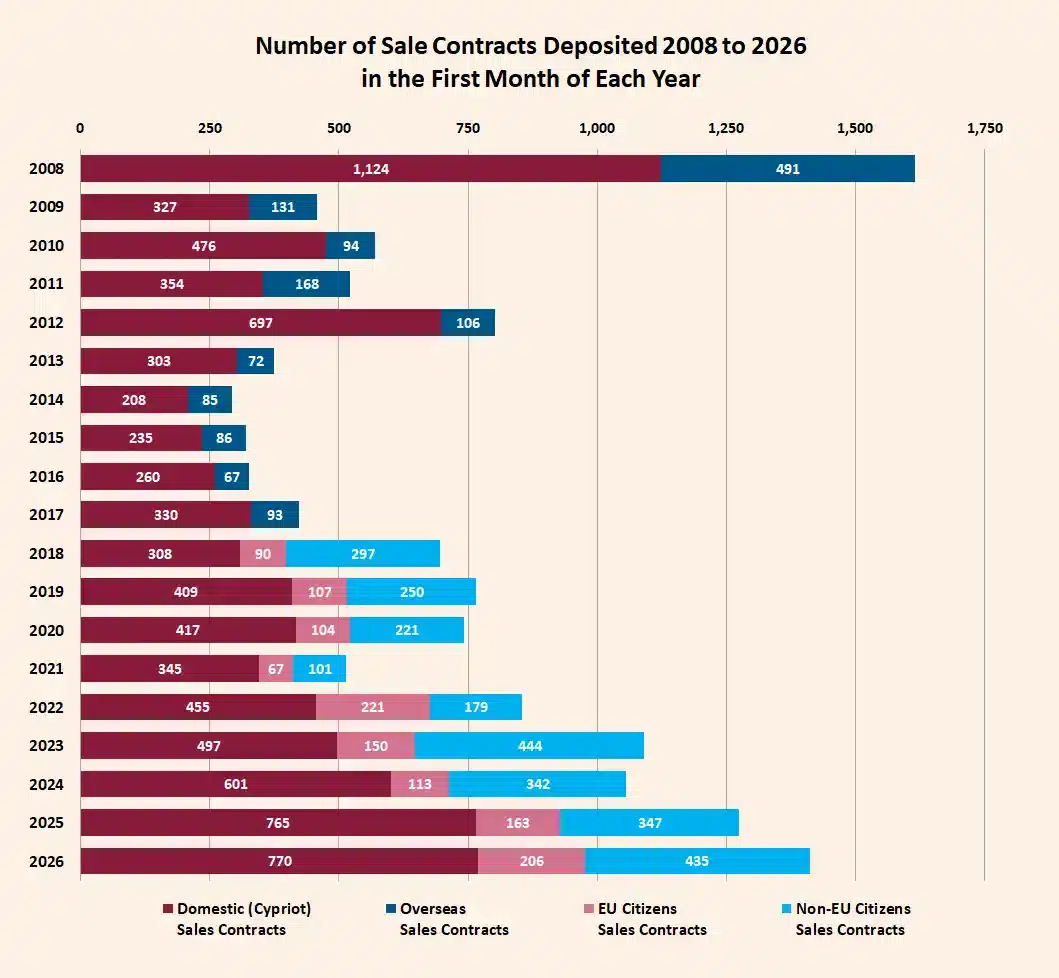
 Property sales – market segment analysis
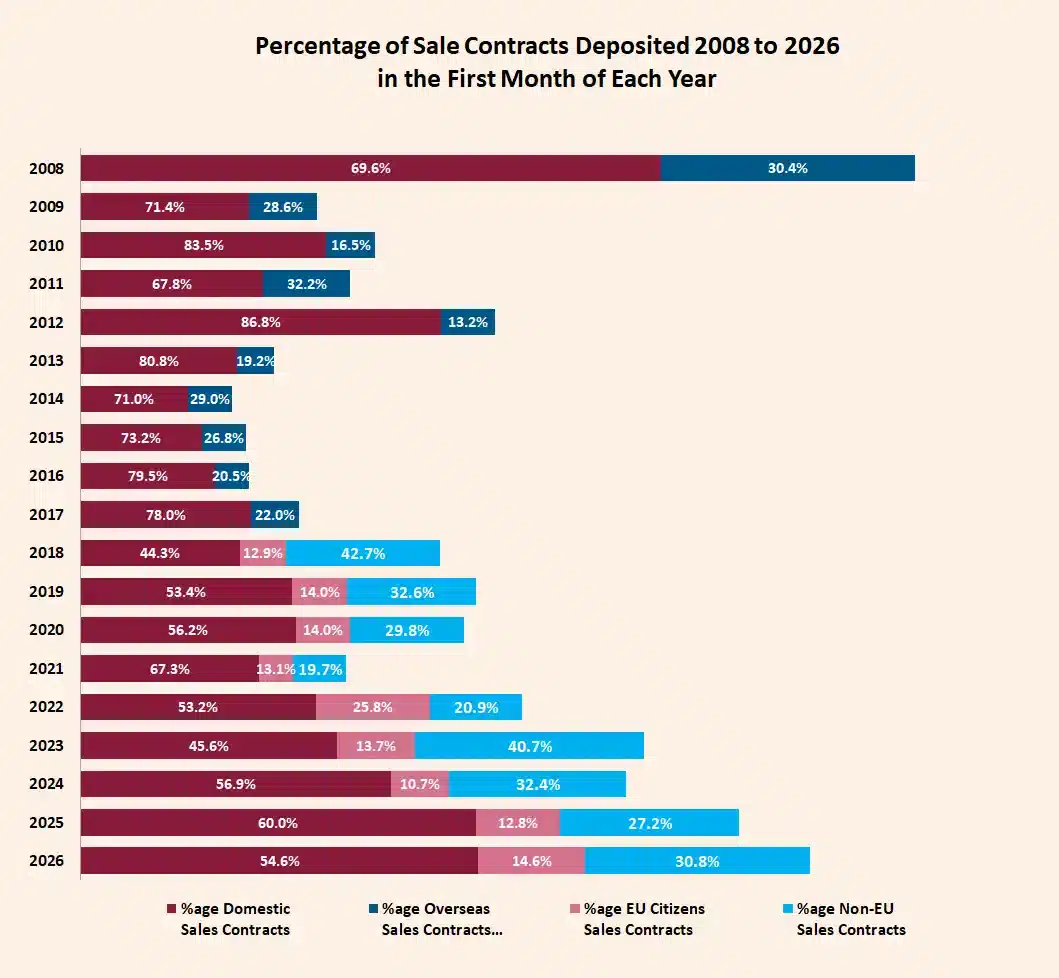
Marginal growth in domestic sales
Domestic buyers accounted for 54.6% of total property sales in January, with 770 contracts, compared with 765 in the same month last year — a 1% increase.
Sales fell in:
- Paphos: -13% (62 vs 71)
- Larnaca: -12% (130 vs 148)
Sales rose in:
- Famagusta: +78% (41 vs 23)
- Nicosia: +4% (249 vs 240)
- Limassol: +2% (288 vs 283)
Strong growth in property sales to EU citizens
EU buyers made up 14.6% of total sales, with 206 contracts, up 26% from 163 last January.
Sales changed as follows:
- Famagusta: -26% (14 vs 19)
- Limassol: -24% (34 vs 45)
- Nicosia: unchanged (17)
- Larnaca: +135% (40 vs 17)
- Paphos: +55% (101 vs 65)
The strong rises in Larnaca and Paphos outweighed the falls elsewhere.
Strong growth in property sales to non-EU buyers
Non-EU buyers accounted for 30.8% of total sales, with 435 contracts, an increase of 25% from 347 in January last year.
Sales by district:
- Famagusta: unchanged (14)
- Nicosia: +32% (25 vs 19)
- Paphos: +30% (155 vs 119)
- Larnaca: +26% (118 vs 95)
- Limassol: +22% (123 vs 101)
Market drivers
In Paphos, both EU and non-EU buyers bought more properties than Cypriot buyers, confirming it as a leading destination for overseas investors and holiday-home buyers. Larnaca has also seen strong demand from non-EU buyers.
