


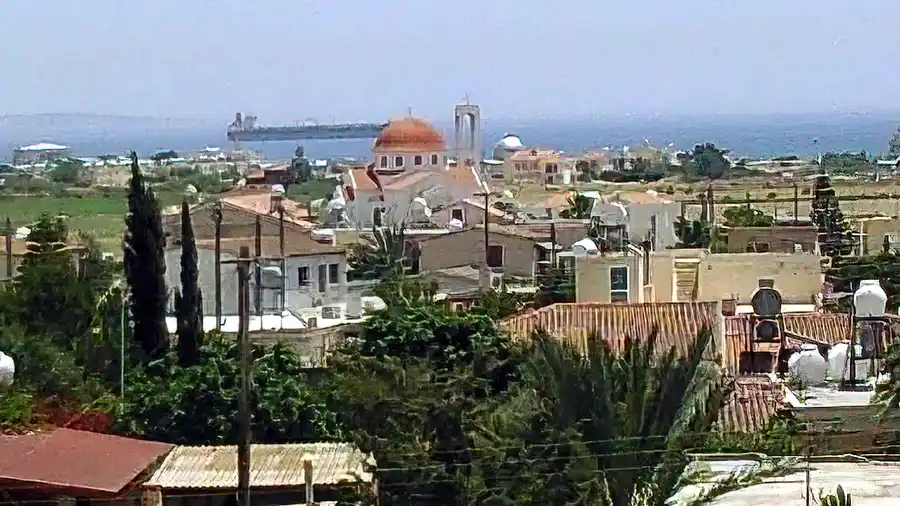
Just over two years ago, Livadia’s transformation appeared impressive. Today, it has become one of the most remarkable property stories in Cyprus.
When plans first emerged in March 2024 following the relocation of the area’s oil storage facilities, investment interest already exceeded €130 million, according to municipal figures. While strong demand was anticipated, few could have predicted the extraordinary pace of development now taking shape.
Today, projects worth hundreds of millions of euros are either under construction or progressing through the planning system. Crucially, these figures exclude the newly released three-kilometre beachfront, where future investment is expected to exceed €1 billion.
Construction activity accelerates across Livadia
The surge extends well beyond the reclaimed waterfront.
Across Livadia, now a municipal district of Larnaca, formerly undeveloped land is rapidly giving way to apartment schemes, mixed-use developments and residential complexes. Areas once characterised by reed beds are being transformed into modern neighbourhoods, while numerous additional plots have either entered construction or are awaiting planning approval.
The scale of activity represents one of the most significant periods of residential expansion Larnaca has witnessed in recent decades.
Horizon Towers set to introduce Livadia’s first high-rise skyline
Among the flagship projects is Horizon Towers, a landmark residential scheme proposed by developer SLK.
According to the Larnaca District Local Government Organisation, the €200 million development is approaching the licensing stage. The project will comprise six residential towers delivering 528 homes, marking Livadia’s first major high-rise community.
Elsewhere, several mixed-use schemes valued at tens of millions of euros are nearing completion close to the former refinery site.
International investors are playing a leading role in the area’s transformation. Israeli developers are behind many of the largest schemes, while Lebanese, Iranian and Ukrainian investors are also active. However, in terms of volume, the majority of smaller residential developments continue to be delivered by Cypriot property companies.
Planning approvals reflect surge in demand
Official figures highlight the pace of expansion.
During 2025, authorities issued 385 planning permits and 454 building permits within Livadia alone.
In the first half of 2026, a further 178 planning permits and 228 building permits were approved.
According to Angelos Hadjicharalambous, President of the Larnaca District Local Government Organisation, Livadia is currently experiencing the fastest rate of development anywhere in the district.
He said demand continues to rise, driven by a constant flow of planning applications, with most proposals focusing on apartment buildings rather than individual houses. He also confirmed that additional applications for high-rise developments have been submitted, emphasising that all projects comply with the area’s approved Local Area Plan.
Rapid growth brings growing concerns
Livadia’s population stood at 8,581 in the 2021 census.
If current construction levels continue, local officials believe the population could increase dramatically rather than simply doubling over the coming years. Horizon Towers alone could eventually accommodate several thousand residents.
The challenge is particularly striking given Livadia covers only nine square kilometres, compared with neighbouring Aradippou, which spans approximately 57 square kilometres.
Infrastructure struggles to keep pace
While investment continues to pour into the area, local authorities warn that essential infrastructure is failing to keep up.
Traffic congestion has become increasingly severe, while local schools have already reached capacity.
Deputy Mayor Marios Armenis has repeatedly called on central government to accelerate two key road projects considered critical to Livadia’s future growth.
The first is the long-delayed second phase of Alexandrou Panagouli Avenue. Despite the masterplan having been prepared as far back as 2009, construction is not expected to begin before 2028.
Armenis argues that the delay is forcing increasing volumes of traffic onto local residential roads that were never designed to accommodate such demand.
The route also serves three schools, including a secondary school, a high school and a nursery, with more than 1,000 pupils travelling through the area each day. He warned that significant road safety concerns remain unresolved and indicated that school parent associations are preparing to take action ahead of the next academic year unless improvements are made.
A second priority is Andreas Mouzakis Street, which local officials describe as unsafe due to the absence of pavements despite heavy pedestrian use. The road provides access to the Anorthosis stadium, nearby retail facilities and residential areas, while congestion during peak hours has become a major concern.
Public projects aim to preserve Livadia’s character
Alongside private investment, several public regeneration projects are reshaping Livadia’s traditional centre.
The first phase of the €3 million reconstruction of Makarios Avenue is scheduled for completion in early 2027, with a second phase expected approximately one year later.
Plans are also progressing to redevelop the village square surrounding the Basket Weaving Memory Museum.
Meanwhile, the first phase of a €4 million flood channel enhancement project has been completed, creating a pedestrian connection between Livadia and the Larnaca–Dhekelia coastal road.
Further improvements include landscaping works at the Agios Savvas roundabout and the refurbishment of 12 public parks, several of which now feature basketball and tennis courts.
Looking ahead, plans are being prepared for a new regional primary school, kindergarten and environmental park, with funding expected to be sought through European programmes.
Balancing growth with identity
Livadia’s transformation is reshaping not only Larnaca’s property market but also the wider residential landscape of Cyprus.
For local leaders, however, the challenge extends beyond accommodating record levels of investment. Maintaining the area’s identity while ensuring infrastructure keeps pace with population growth will ultimately determine whether one of Cyprus’ most ambitious development stories becomes a long-term success.
From billion-euro waterfront ambitions to hundreds of new homes already under way, Livadia is rapidly becoming one of the country’s defining real estate investment destinations.