


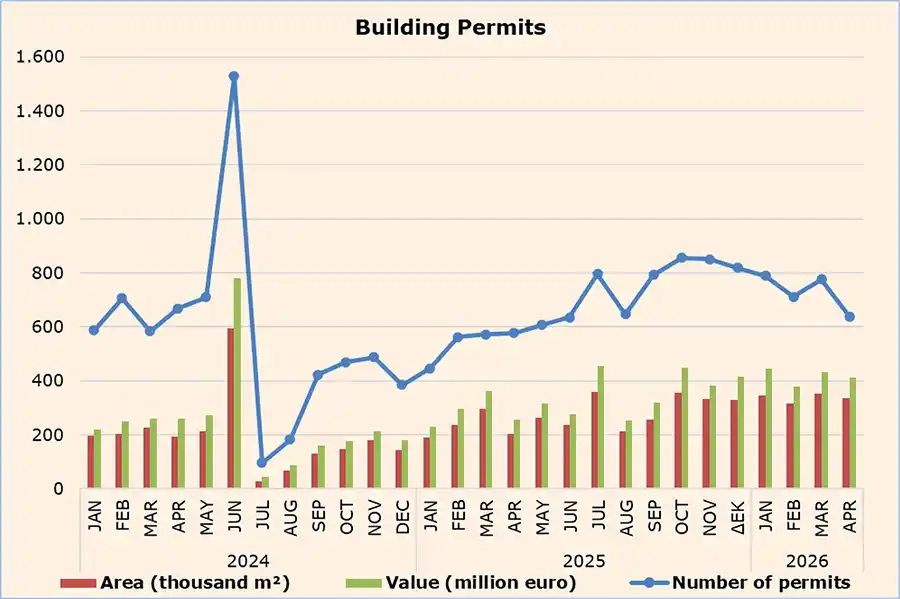
Cyprus building activity rose 45.5% in the first four months of 2026, with approved projects covering 1.35 million square metres. The increase was driven mainly by residential construction, while non-residential development declined.
Residential building floor area rose 66.9% to 1.23 million sqm, from 738,562 sqm a year earlier. Civil engineering projects also recorded strong growth, with approved floor area jumping 844.7% to 17,231 sqm.
By contrast, non-residential building area fell 46.4% to 100,562 sqm.
Larnaca leads growth
Larnaca district recorded the strongest increase. Approved project floor area reached 290,400 sqm, up 168.3% from 108,200 sqm in the first four months of 2025. It was also 223.8% above the 2019 level.
Paphos followed, with approved floor area rising 99.0% to 141,200 sqm. Nicosia recorded the largest total area at 489,400 sqm, up 63.8% year on year.
Limassol saw more modest growth of 2.6%, reaching 401,000 sqm. Famagusta was the only district to record a decline, with approved floor area falling 51.7% to 28,600 sqm.
Across Cyprus, approved project floor area was 93.3% higher than in the first four months of 2019.
Building permit value up 46.1%
The total value of building permits reached €1.671 billion, up 46.1% from €1.144 billion in the same period of 2025.
Residential permits accounted for much of the increase. Their value rose 66.6% to €1.429 billion.
The number of building permits also increased. Authorities issued 2,915 permits, up 35.1% year on year. Residential permits rose 33.6%, while land subdivision permits increased 72.0%.
In April alone, 639 permits were issued, covering 335,300 sqm and providing for 1,728 residential units.
New housing supply jumps 65%
The number of residential units covered by permits rose 65.0% to 7,131 in the first four months of 2026, from 4,321 a year earlier.
Apartment buildings recorded the strongest growth. The number of units rose 85.9% to 5,184, compared with 2,789 in 2025. Detached houses increased 23.3%, while semi-detached homes rose 14.2%.
