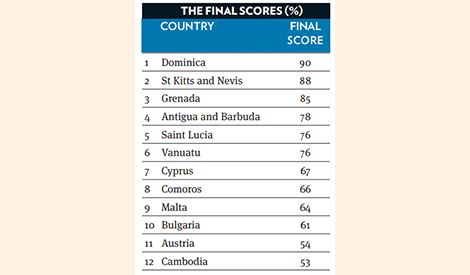
CYPRUS ranks 7th out of 12 countries studied in an analysis of citizenship-by-investment programmes by the Financial Times group’s Professional Wealth Management, ahead of Malta, Bulgaria and Austria, the other European Union member states on the list.
The research group ranked Dominica as the top jurisdiction in scope of the study, scoring an overall 90 per cent, with St Kitts and Nevis trailing with 88.
Third, with 85 per cent, was Grenada, with Antigua and Barbuda (78), Saint Lucia (76), and Vanuatu (76), following in the next three spots.
Cyprus scored 67 per cent overall, Comoros 66 and Malta 64 per cent.
Bulgaria, Austria and Cambodia ranked last, with 61, 54, and 53 per cent, respectively.
The rankings were devised as the aggregate of seven indicators: freedom of movement, standard of living, minimum investment outlay, mandatory travel or residence, ease of processing, citizenship timeline, and due diligence.
On freedom of movement, Cyprus scored 9 out of 10, with only Austria and Malta getting top marks.
“Benefits for acquiring citizenship in Cyprus includes freedom of movement and residence in any other European Union member state, although it does not occasion membership of the Schengen Area,” the report said of the island’s naturalisation by exception scheme.
“Citizens may avail themselves of visa-free travel to around 160 countries.
In terms of standard of living, the island scored 8, again with Austria and Malta scoring highest, 9.
Cyprus’ was second-to-last in minimum capital outlays – the capital that needs to be tied up for citizenship – with 2 out of 10, with only Austria scoring worse (1) and Comoros, Dominica and Saint Lucia getting a perfect 10.
“In its original form, [Cyprus’ scheme] required a €15m investment – an exorbitant price that discouraged applicant participation,” the researchers said.
“The current scheme was unveiled in 2014, and last amended in late 2016 by the nation’s Council of Ministers. All applicants for citizenship must purchase real estate valued at €500,000, and declare that real estate as their permanent residence. They then have a choice of three options in which they must invest €2m.”
In mandatory travel or residence, Cyprus scored a respectable 7, while the Caribbean nations – Dominica, Grenada, Saint Lucia and Saint Kitts and Nevis – scored 10.
“Applications for citizenship under the scheme are processed by the Ministry of Interior and are further subject to application and processing fees,” the report read.
“The applicant must be a resident permit holder at the time of application, otherwise an application for residency may be lodged at the same time as the application for naturalisation. The application process takes a minimum of three months and involves no language test or interview requirements.”
The island fared as well in ease of processing and citizenship timeline, scoring 7 and 8 respectively, but many of the Caribbean’s again edged past it.
It also scored rather poorly in due diligence – 6 out of 10 – where Dominica, Malta, and Saint Kitts and Nevis, got 10, and Grenada, Bulgaria, and Antigua and Barbuda, got 8.
Further reading
A guide to global citizenship (An in-depth report examining and evaluating citizenship by investment schemes. These fast-track routes to citizenship and second passports are offered by a variety of countries in the Caribbean, Europe and Asia.)
THE NUMBER of building permits authorised in Cyprus during May 2017 stood at 507 compared with the 440 authorised during the same period in May 2016; an increase of 15.2% according to official figures released by the Cyprus Statistical Service.
The total value of these permits rose by 7.0% to €108.6 million compared to May 2016, while their total area rose by 28.2% to 109.9 thousand square metres.
During May 2017, building permits were issued for:
Residential buildings – 347 permits
Non-residential buildings – 99 permits
Civil engineering projects – 18 permits
Division of plots of land – 34 permits
Road construction – 9 permits
During the first five months of 2017, 2,368 building permits have been issued compared to 2,156 in the same period last year.
The total value of these permits increased by 28.3% and the total area by 36.2%.
Building permits for new homes
The 347 residential building permits approved in May provided for the construction of 289 new homes comprising 266 detached houses and 81 multiple housing units (such as apartments, semis, townhouses and other residential complexes); an increase of 52.5% compared with May 2016 when permits were issued for the construction of 278 new homes.
Building Permits Issued for the Construction of
New Homes (Number of Dwellings)
Month
2016
(Dwellings)
2017
(Dwellings)
Increase/
Decrease
%age
Change
January
243
381
138
56.8%
February
312
383
71
22.8%
March
306
412
106
34.6%
April
201
289
88
43.8%
May
278
424
146
52.5%
Totals
1,340
1,889
549
41.0%
During the first five months of 2017, the number of new homes for which permits have been issued rose by 41.0%.
According to the Cyprus Statistical Service, building permits constitute a leading indicator of future activity in the construction sector.
THE BANK OF CYPRUS has been hit with an administrative fine of €170,000 by the Cyprus Consumer and Protection Service (CCPS) for using vague terms that allowed it to unilaterally amend interest rates and other charges.
In its 22 page ruling the service said the bank used vague contractual terms that allowed it to unilaterally amend interest rates and other charges burdening the consumer and providing vague and inadequate information regarding the terms and cost of prepaying a loan.
The Bank of Cyprus (BoC) also linked the loan agreement with an insurance agreement, making the loan dependent on the payment of an insurance premium using vague terms, the service said.
It also unilaterally changed the loan repayment period without affording the right to revert to the previous state of affairs.
The consumer service fined BoC €170,000 and ordered the bank to cease enforcing the practices in question and avoid repeating them in the future.
THE NUMBER of property sales in Cyprus during July rose 18 per cent compared to July 2016 according to official statistics published by the Department of Lands and Surveys earlier today.
This rise follows a 28% increase in June, a 59% increase in May and a fall of 2% in April.
During July a total of 739 contracts for the sale of residential and commercial properties and land (building plots and fields) were deposited at Land Registry offices across Cyprus, compared with the 625 deposited in July 2016.
Of those 739 contracts, 488 (66%) were deposited by Cypriot purchasers and 251 (34%) were deposited by overseas purchasers. (This is a sharp rise in the number of overseas purchasers that usually average in the region of 27%).
Although the number of sales contracts in Larnaca fell by 16% compared with July 2016, they rose in the remaining four districts.
Sales in Famagusta rose 119%, while sales in both Nicosia and Limassol rose 22%, while sales in Paphos rose 20%.
Total Property Sale Contracts – 2016/2017 Comparison
District
Year
Jan
Feb
Mar
Apr
May
Jun
Jul
Aug
Sep
Oct
Nov
Dec
Nicosia
2016
54
79
82
79
82
98
102
64
81
80
86
144
2017
72
73
79
80
118
162
124
Famagusta
2016
22
35
33
35
24
34
27
41
32
47
19
87
2017
21
19
40
29
38
46
59
Larnaca
2016
78
108
121
127
103
120
123
81
121
111
114
153
2017
102
100
113
69
119
96
103
Limassol
2016
92
179
197
166
145
222
220
129
195
270
249
432
2017
132
177
232
192
298
304
289
Paphos
2016
81
100
106
107
120
183
153
136
127
126
183
318
2017
96
87
162
136
183
235
184
Totals
2016
327
501
539
514
474
657
625
451
556
634
651
1,134
2017
423
456
626
506
756
843
739
During the first seven months of 2017, sales contracts have risen 20% compared to the same period last year.
(An unknown number of property sales contracts relate to ‘non-sale’ agreements such as loan restructurings, recoveries and debt-to-asset swaps agreed between the banks and defaulting borrowers. These contracts inflate the total figures above and the domestic sales figures below.)
Domestic property sales
Property sales to the domestic (Cypriot) in July rose 12% compared to July 2016 with sales rising in all districts with the exception of Larnaca, where sales fell 32%.
Famagusta lead the way with sales up 58% compared to July 2016, followed by Paphos (+26%), Paphos (+26%) and Limassol (+24%). Famagusta is popular with those living in Nicosia looking for a second home.
Domestic Property Sale Contracts – 2016/2017 Comparison
District
Year
Jan
Feb
Mar
Apr
May
Jun
Jul
Aug
Sep
Oct
Nov
Dec
Nicosia
2016
43
70
10
69
68
92
94
58
75
70
73
116
2017
63
69
71
62
103
150
109
Famagusta
2016
20
31
21
33
24
7
19
32
22
37
9
72
2017
20
17
24
23
27
31
30
Larnaca
2016
68
96
85
91
93
75
91
67
90
81
74
114
2017
77
80
85
49
76
70
62
Limassol
2016
68
158
145
122
126
162
156
101
142
202
196
307
2017
97
130
176
152
202
227
194
Paphos
2016
61
72
59
65
105
126
74
88
98
83
111
171
2017
73
47
82
93
88
157
93
Totals
2016
260
427
382
380
416
462
434
346
427
473
463
780
2017
330
343
438
379
496
636
488
During the first seven months of 2017, domestic have risen 13% compared to the same period last year reaching a total of 3,109.
Overseas property sales
Property sales to the overseas (non-Cypriot) market during July 2017 rose 31% compared to the same month last year with 251 contracts of sale deposited compared with 191 in July 2016.
Sales rose in all districts with Famagusta leading the way where they increased by 263%. Sales in Nicosia rose 88%, while those in Larnaca, Limassol and Paphos rose by 28%, 17% and 15% respectively.
Overseas Property Sale Contracts – 2016/2017 Comparison
District
Year
Jan
Feb
Mar
Apr
May
Jun
Jul
Aug
Sep
Oct
Nov
Dec
Nicosia
2016
11
9
10
10
14
6
8
6
6
10
13
28
2017
9
4
6
18
15
12
15
Famagusta
2016
2
4
12
2
0
27
8
9
10
10
10
15
2017
1
2
16
6
11
15
29
Larnaca
2016
10
12
36
36
10
45
32
14
31
30
40
39
2017
25
20
28
20
43
26
41
Limassol
2016
24
21
52
44
19
60
64
28
53
68
53
125
2017
35
47
56
40
96
77
75
Paphos
2016
20
28
47
42
15
57
79
48
29
43
72
147
2017
23
40
80
43
95
78
91
Totals
2016
67
74
157
134
58
195
191
105
129
161
188
354
2017
93
113
186
127
260
208
251
During the first seven months of 2017, property sales to the overseas market have risen 42% compared with the same period last year reaching a total of 1,240.
(During July a total of 87 properties were transferred to overseas buyers bringing the total number of transfers for the year to date to 543.)
LIMASSOL’S status as a lively cosmopolitan seaside business centre which is home to a large, mostly wealthy expat community is having a huge impact on rents and pricing locals out of the market.
Property experts say rents in Limassol far surpass those in any other city across Cyprus.
An unremarkable average two-bedroom flat can rent for between €800 to €900 and more per month if close to the beach. Further away from the coast, rents may be between €500 to €600, according to property valuer and consultant Antonis Loizou.
By contrast in Nicosia, the same kind of flat, even in areas with high student populations such as Engomi and Makedonitisa that push up rents might cost somewhere between €450 to €550, chairman of the Cyprus property valuers’ association, Kyriacos Talatinis, told the Sunday Mail.
The discrepancy is infuriating Limassolians desperate to rent.
“I think the heat here in Limassol has gotten to everyone’s brain. Please explain to me how the hell in Paphos and Larnaca you can find brand new apartments for €350 up to €500 for two bedrooms and in Limassol, one bedroom from €750 to €1,000,” one commentator wrote on a Facebook group advertising houses and flats for rent.
“Some people have families… how are they supposed to buy other things for the house and support their children. I don’t know if my voice will be heard but it’s about time someone spoke their mind.”
According to Talatinis, Limassol’s high proportion of Russians is a major factor in rental prices.
“Limassol has a special category comprised of Russian businesspersons that can afford to pay high rent,” he said.
Limassol is also unique, Loizou said, because it attracts plenty of foreigners for businesses. Although Paphos and Protaras are also popular rental spots, this is primarily in the summer months due to the tourist season, whereas the demand in Limassol is all-year round. This contributes to the cosmopolitan feel of the city that makes it so attractive to Russians who can afford more than the average locals.
Limassol has also been the recipient of many beneficial projects such as the marina and the upcoming casino while the old town has been given a huge facelift.
Although Limassol is a special case, the demand for rental properties in general has grown in recent years.
After the 2013 financial crisis “demand for rent increased because the capability of local buyers was limited due to difficulty obtaining loans for instance and thus they turned to renting,” Loizou told the Sunday Mail.
“As a result, there is less supply.”
The spike really began in 2015 and has continued through to 2017.
The changing structure of society is also part of the demand for rental properties. Although Cypriots began to turn to flats as housing loans became harder to obtain, another contributing factor is that young couples largely choose to move in together before taking any more permanent steps in their personal life.
“The ways of life we saw in the West decades ago are quickly becoming the norm in Cyprus,” Talatinis said.
Nowadays, couples will try out renting a flat together before opting to get married – if they even choose to at all – a model drastically different from the traditional scenario when two people would get married and buy or build a house, he added.
“All of these factors contribute to an increasing demand for apartments, which in turn push prices up.”
But Loizou suggests that this increased demand could in turn encourage young people to go back to buying property.
“If they have a salary of about €2,000 per month and their rent is €700 (plus expenses) they might prefer to get a loan and pay €1,000 per month but own the property.”
Another effect in Limassol will be that people on lower budgets will look to places further away from the beach where rent costs are lower, Talatinis said, or alternatively seek out older properties.
Limassol residents Eleana Gregoriou and her boyfriend, both in their 20s, have been searching for a place to rent for months now.
“We’re not in a terrible rush as we’re both comfortable living with our parents, but we really want to start a life together and it’s hard because the rent prices are really off-putting.”
Gregoriou works two jobs, as does her partner.
“We were really considering one that was €500 with two bedrooms near the central police station. I was near my job as well but it was such an old flat. I didn’t want the roof to collapse over our heads!”
A quick search online shows a growing resentment over rental costs in Limassol. A Facebook group posting an advert for a newly built two-bedroom flat in Zakaki and asking for €850 per month, quickly got responses along the lines of “what the f**k. We’re looking to rent, not buy.”
It has also seen the creation of groups exclusively advertising flats rented out for less than €500.
One commentator said they often observed an apartment being advertised for €500 for instance but then within a few days would be advertised for €730 “because too many people want it and they can make the price as they want.”
Swearing seems to be common underneath various advertorials, with one posted about two weeks ago asking for €1,000 per month for a two-bedroom house in Nikou Patichi soliciting a response of “are you f**king joking?
“€1000 for two bedrooms with furniture dated from the Middle Ages? And in Nikou Patichi? Wake up for f**k’s sake.”
Salaries often crop up in discussion. One commentator said that perhaps the wrong question was being asked. Instead of asking why rent prices were high, the question should be “why are the salaries in such a good city so low? They forgot to increase the salaries!”
Some tenants are still protected by the rent control law. In Limassol, properties for rent that fall under the responsibility of local municipalities or are in Platres, Kakopetria or Lefkara and were built before December 31, 1999 can fall under this law which aims to protect tenants that have already signed a contract with a landlord.
According to Talatinis, every two years, Cabinet sets a percentage by which owners have a right to increase the rents for an existing contract, valid for the following 24 months.
Since 2015, the increase has been set at zero, which means existing rental contracts, if renewed, cannot contain a price increase.
If the current tenant is not interested in renewing a contract, a landlord can then charge a new tenant whatever price they want to begin with.
Prior to 2011, the ceiling had been set at 14 per cent increase and reduced to 8 per cent between 2011 – 2013.
The law however applies only to Cypriot and EU nationals – meaning Russian residents are exempt from the protection the law offers.
Nevertheless, tenants who feel they have been wronged by their landlords can take the case to a rent control court, Loizou said.
“With the speed of courts in Cyprus, however, that’s another story.”
Editor’s comment
A friend of mine and his wife have around 15 properties in the Limassol area that they rent long term (at reasonable prices). He tells me that a further problem is that there are very few properties for rent in the Limassol area and that pushes up prices. He knows of one couple who have been looking since January to find something suitable to rent.
None of his tenants has moved in the last three years and one asked him for a five-year rental agreement – unheard of in the past.
A further problem is that developers are building very expensive high-rise apartment blocks in efforts to attract foreign investors (which have now brought in some €6 billion into the island’s economy). However there are very little new homes being built that ‘ordinary’ people can afford.
What the government needs to do is encourage the building of new homes for ‘ordinary’ people. One way it could do this would be to insist that for every 12, 15 or 20 ‘luxury’ houses and apartments being built is that developers build one affordable home for the local community to purchase with a caveat that prevents them from renting.
MOODY’S considers that in order for the Bank of Cyprus (BoC) to attain its ambitious target of halving the ratio of non-performing loans (NPL’s) to 20% by 2019 it will also have to include NPL sales in its toolkit.
In a report on the Bank of Cyprus the international credit rating agency notes that “Bank of Cyprus’ continued recovery after a bailout four years ago will depend on the bank’s ability to significantly clean-up its loan book from legacy bad loans.”
“Non-performing loans (NPLs) fell to 40% of the loan book in March 2017 (equal to €8 billion) from a peak of 53% in December 2014, driven by loan restructurings, debt for asset swaps and write-offs,” it notes.
According to Moody’s “management has set ambitious targets to halve the ratio to 20% by 2019,” adding that “we consider the target attainable only if the bank also includes NPL sales in its toolkit.”
The report points out that “progress on restructuring has led to large volumes of performing loans.”
Management, it adds, “expects another €1.6 billion loans approximately to be reclassified as performing by 2019.”
“Since 2014, BoC’s dedicated restructuring unit has handled close to €10 billion of non-performing and under-performing loans out of a total loan stock of €20 billion as of March 2017,” it reads. “Around 91% of corporate restructured loans have no arrears,” it continues.
At the same time Moody’s notes that “the strengthening economy will support improved loan performance,” adding that “Cyprus’ economy which has enjoyed a broad-based recovery, driven by a growing tourism sector, the recovery of the construction sector and rising consumer spending as unemployment declines.”
“We expect the economy to post solid GDP growth of 2.7% in 2017, supporting borrowers’ debt repayment capacity,” the credit agency says.
The bank, Moody’s notes, “has made regular use of debt for asset swaps. Debt for asset swaps give the bank control of assets put up as collateral, allowing it to set more realistic sale prices and to benefit from income generated by these assets.”
However, it points out that, “although assets are taken onboard at a 25%-30% discount to current prices, the bank is exposed to the risk of losses if it is unable to sell the assets at the on-boarded price.”
At the same time it comments on the bank’s write offs which amount to €1.6 billion of bad debt since 2014.
“Management expects around one third of its targeted NPL decline to be driven by write-offs,” it says, adding that “accounting write offs of bad loans do not constrain a bank from pursuing debt recovery. However we expect limited reversals of these write-offs in the future.”
It expresses the view that “the bank will need to sell NPL portfolios if it is to meet its 20% target.”
Assuming, it notes, “new lending of around €1.5 billion per year, write-offs close to €300 million per year and that all restructured loans currently in the pipeline become performing, we estimate that BoC’s ratio of non-performing loans to gross loans would decline to around 22% by 2019. Additional NPL sales would therefore be required for the bank to achieve its 20% target,” it says.
According to Moody’s “around 77% of restructured loans currently have no arrears. The figure excludes €420 million of loans which were restructured in the first quarter of 2017 and for which it is too early to judge their performance.”
Corporate loans, it points out, “perform best, with 91% of restructured loans now performing in line with the terms of their revised contract.”
On the contrary, “retail loans are the weakest performers with 65% of restructured loans not having arrears while SMEs perform slightly better with 67% of restructured loans not having arrears.”