Cyprus exits economic adjustment programme

Cyprus exits economic adjustment programme
Cyprus Finance Minister Harris Georgiades

EUROGROUP finance ministers have given their formal approval for Cyprus to exit its three-year Economic Adjustment Programme that expires officially on 31st March.

The ministers held a meeting in Brussels during which the Cyprus Finance Minister Harris Georgiades presented a report on Cyprus’ progress in implementing the reforms and complying with the requirements under its €10 billion programme that was concluded in March 2013.

The Eurogroup will continue supporting the Cyprus reform process in the context of post-programme surveillance and of the regular EU and euro-area specific monitoring frameworks.

Georgiades said that Cyprus is determined to continue with reforms contained in its Economic Adjustment Programme that are still pending, which include the privatisation of the Cyprus Telecommunications Authority (CYTA).

Cyprus drew €7.25 billion from the total assistance sum available of €10 billion and beat all projections of a sharp drop in its gross domestic product (GDP), achieving a growth of 1.4% last year after a four year recession. It also managed to keep its sovereign debt to about 106% of its GDP, 20 percentage points below projections.

Cyprus is the fourth member of the euro area to exit its bailout following Ireland, Spain and Portugal.

Speaking to reporters last Thursday Georgiades said: “The completion of the programme is not the end of the road, but it is a new beginning, which will see dedication, commitment and effort, in the direction of further reforming the economy of Cyprus, staying clear of the mistakes of the past.

“We had the chance to review the good progress achieved during the last three years, which saw the stabilization of the banking sector, the consolidation of public finances, the promotion of much-needed structural reform, the re-establishment of market access and, primarily, the return to positive growth rates.”

Further reading

Eurogroup statement on Cyprus – 7th March 2016

BoC sets up bad real estate asset unit

Bank of Cyprus Real Estate Management UnitBank of Cyprus has set up a Real Estate Management Unit (REMU) deploying another tool that would assist the island’s largest lender to facilitate loan restructuring and manage its big commercial real estate loan portfolio more efficiently.

The Unit aims to acquire real estate in a voluntary asset-to-debt swap of non performing delinquent borrowers which otherwise would follow the foreclosure process.

In an interview, Miltos Michaelas, Director of the newly-established Unit, told CNA that the aim of REMU is manifold; to reach settlements that would entail benefits both for clients and the bank, to manage real estate, while removing work load from the bank’s recovery units and would utilise new structures to dispose of the real estate.

As Cyprus nears exit from its three-year €10 billion bailout, the economy returned to a modest growth in 2015 following three years of recession.

“Our primary aim is to achieve the fastest exit possible from the real estate market without killing the market. The Unit has small and big ideas on how to achieve that but the exit policy goes hand in hand with the course of the economy,” Michaelas added.

REMU could come to a voluntary settlement with the borrower by acquiring the real estate pledged as collateral against a part of loan, provided the borrower will be in a position to repay the remaining loan.

Michaelas stated that as the arrears management unit progressed the bank has amassed considerable experience and built a database showing the outcome of each distressed case and therefore the Unit could step up the settlement process for cases, which otherwise would end up in foreclosure.

“Let’s be honest, the bank did not want to be a real estate owner but above all realising the economic environment and the Cypriot economy that could not cope with massive real estate disposals found this way out,” he added.

As the real estate management is not a core banking operation, the unit has acquired advisory services from a foreign agency specialising in real estate agency management, that would assist in the disposal of the acquired real estate.

Michaelas added the Unit began operating with a significant number of real estate under management obtained from older cases mainly in Cyprus but from other BoC operations abroad, noting that as restructuring deals progress the amount of real estate to be transferred to REMU would increase. He also added that the bank was also considering acquiring real estate from auctions should the opportunities are considered worthwhile.

“We have plans to set up structures that would allow us to liquidate the real estate we have,” he said, noting that the bank could bundle mainly large real estate in special purpose vehicles (SPVs), set up structures for attracting foreign investors, while the bank could engage in partnerships with investors.

“We will not close the door to any proposal that would benefit the bank,” he added.

As for the timeframe for real estate management, Michaelas pointed out the bank’s strategy was to manage the acquired real estate for periods exceeding three years which is currently the maximum allowed by the Central Bank of Cyprus.

“With a little good will and given the fact the reheating of the economy is our common goal, we believe that the Central Bank will assist us with some extension and not flood the market,” he said, adding however the bank does not intend to manage real estate for ten years.

“We aim to assist the economic recovery, to attract new investors and as the economy gathers pace we will reduce our exposure to a non-core banking sector,” he added.

Furthermore, Michaelas who worked in disposing the bank’s assets abroad, cautioned on moral hazard, saying the bank “will not do any favours and will not assist clients who have the capacity to repay their loans.” The solutions are focused on clients whose cases head towards foreclosure but a voluntary settlement could grant them a second chance, he went on to say.

Discussions for setting up a Real Estate Management Unit, Michaelas said began in September 2014 but then the tax regime was not helpful because the capital gains tax and transfer fees rendered voluntary settlements financially unattainable.

According to Michaelas, the turning point emerged after the government sliced transfer fees in half and eliminated capital gains tax in case of bank real estate acquisition.

“That enabled the bank to make deals with clients. The government saw the broader picture and the wider gains for the economy and took the right decision,” he concluded.

Source: Cyprus News Agency (CNA) Reporter Gregoris Savva

Green plan for Limni golf course

THE DEPARTMENT OF ENVIRONMENT is set to review a new environmental study for the area today (1st March), where a Shacolas Group company is planning the construction of two golf courses at the abandoned mine in Limni, near Polis Chrysochous.

The new plan has reportedly been improved to meet the strict criteria and guidelines set by the European Commission on the Natura 2000 network.

Earlier plans submitted in 2008 by the company failed to get permission by the department after the Commission had learned that tourist facilities in the area, next to Natura 2000, had led to the clearing of flora while lights and noise from the complex were a disturbance to the turtles nesting on the beach.

The multimillion golf course project at Limni Resort, according to a letter by the Commission, noted that trees had been cut and the coast cleared without permission and or proper environmental study for the Natura 2000 network.

But the new study, conducted by two civil and environmental engineers, brings new and updated information for the site, where Cyprus Limni Resorts and Golf Courses plans to turn a neglected and abandoned mine into a golf course oasis.

The project will include two 18-hole golf courses, two club houses, sports facilities, shops, parking, pedestrian and cycling lanes, residences, a small hotel with 160 rooms, and a number of single-storey private bungalows.

A central sewerage system for rainwater will be constructed according to the new plan, which will manage runoff in the area under development.

New systems will also be used to enable water reuse for the golf courses that need a lot of water.

The Department of Antiquities has also asked that the company halt immediately any construction in the event of an ancient find.

There are reports that debris has already been cleared from the area.

In April 2015 Cyprus was cautioned by the EU Commission to respect the Natura 2000 guidelines and asked for a conservation study to be commissioned on the effects of the project and surrounding areas – and sent an official letter to Nicosia instructing the government to cancel building permits for two golf courses.

This conservation study was bypassed by the state during the final days of the Christofias administration in order to speed up the process.

In 2010 more than 3,500 people signed a petition to stop the development of the Limni site for the golf course and villas complex.

Action against crocodile park threatened

Psematismenos crocodile park RESIDENTS of Psematismenos in Larnaca are threatening to close roads and other measures to prevent the creation of a crocodile park in their area.

The decision to take action was discussed at a meeting on Tuesday night and included residents from the wider region including Kofinou, Skarinou, Tochni, Choirokoitia, Ayios Theodoros until Asgata. A presentation was also made on the issues surrounding the creation of the park, which opponents say will have as many as 1,000 crocodiles.

Psematismenos community leader Christodoulos Papachristou said on Wednesday the residents haf decided to send a letter immediately to Interior Minister Socratis Hasikos demanding he issue instructions to stop the planned park for health reasons and the safety of residents. They fear that if the crocodiles ever escaped, it would pose serious dangers to the communities and the environment.

“The main reason for the refusal of local residents to allow the creation of a crocodile park is the health issue, which has been raised at the relevant parliamentary committees,” said Papachristou, referring to the possibility of an outbreak of Nile virus “an infectious disease that thrives in populations of crocodiles and can be transmitted to humans with deadly results,” he said. “Also crocodiles would be a foreign element introduced to the ecosystem of Cyprus.”

Papachristou said the farm would only be 50 metres from the residential area of ??Psematismenos “and within another 100 metres there are also homes in the communities of Tochni and Skarinou”.

Also against the park were the Larnaca Municipality, and the Union of Communities of Larnaca, and Vasilikos, he told the Cyprus News Agency (CNA).

Papachristou said the only ones who seemed to be in favour were officials at the agriculture and environment ministry, which has said that if all safety requirements were met, the park could go ahead.

He said not all of the 16 conditions could be met, among them the amount of water that would be needed to take care of so many crocodiles.

“We will give a reasonable time to Mr Hasikos to reply to the letter that we will send today and then we will take more drastic measures such as closing roads, and we will look into legal measures,” said Papachristou.

Green Party leader Giorgos Perdikis charged earlier this month that political pressure was put on the environment department to allow the operation of the theme park despite the widespread opposition.

Perdikis said at a House environment committee meeting that none of the 10 advisors from various government departments and other organisations were positive towards the project, yet the minister put pressure on the environment authority to issue the permit. The park now only needs the go-ahead from the town-planning department.

Costas Constantinou, the co-owner of the group of companies planning to build the farm, told MPs during the same meeting that the park would have 170 to 200 of the reptiles.

He said the company would comply with the strict conditions set by the environment department for the theme park that is expected to cost €8m. It would plant thousands of native trees and bushes and would adhere to strict safety rules, he said.

The crocodiles will be brought from a farm in Israel and each one will carry a radio frequency identification tag (RFID) for identification and tracking purposes.

Property price falls slowing

THE TWENTY-fifth edition of the RICS Cyprus Property Price Index issued yesterday reports that the average prices of residential houses and apartments in Cyprus fell by 0.1% and 0.5% respectively over the fourth quarter of 2015.

Across Cyprus, changes in residential property prices over the quarter were mixed:

Limassol saw the largest fall in apartment prices (-1.4%) followed by Famagusta/Paralimni (-1.4%) and Nicosia (-0.8%), while apartment prices in Larnaca rose 0.8% and remained unchanged in Paphos.

House prices in Nicosia fell 0.8%, while prices in Paphos rose 0.6%. House prices in Limassol, Larnaca and Paralimni/Famagusta were unchanged.

Compared to the fourth quarter of 2014, the average price of a residential apartment has fallen by 1.6%, while the average price of a 3-bed semi has fallen by 0.3%.

Rental values

Across Cyprus, on a quarterly basis rental values increased by 0.5% for apartments, 1.1% for houses and 0.2% for offices, while rental values for retail units and warehouses fell by 0.2% and 1% respectively.

On an annual basis rental values for apartments and houses rose by 0.3% and 0.8% respectively.

Gross yields

At the end of the fourth quarter of 2015 average gross yields stood at 3.9% for apartments, 2% for houses, 5.2% for retail, 4.3% for warehouses, and 4.5% for offices.

The parallel reduction in capital values and rents is keeping investment yields relatively stable and at low levels (compared to yields overseas). This suggests that there is still room for some re-pricing of capital values to take place, especially for properties in secondary locations.

Cyprus_property_price_index_RICS

Prepared by RICS Cyprus in conjunction with the Cyprus Association of Quantity Surveyors (SEEOKK) and the Cyprus Valuers Association (SEEAK), the quarterly RICS index monitors property prices and rents in all districts using a methodology developed by Reading University in the UK.

Residential property prices

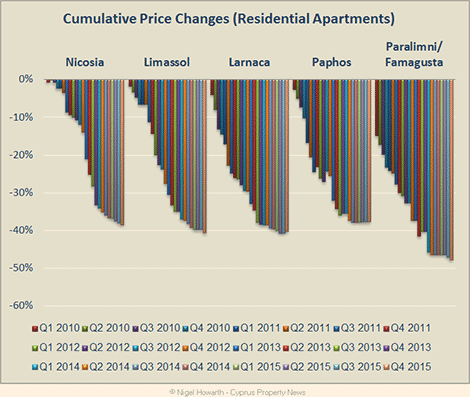
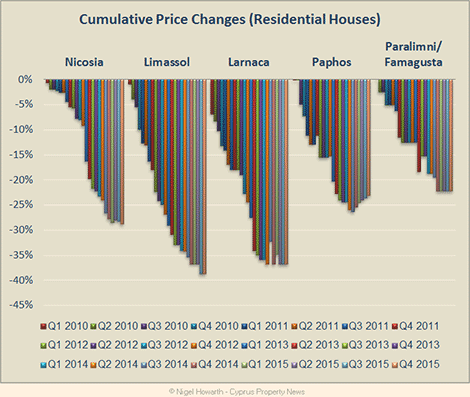
Since the first RICS Cyprus Property Price Index was published for the first quarter of 2010 residential house prices have fallen by an average of 30.1%, while those of apartments have fallen 40.9%.

The charts below plot the price changes in each of the districts since the Index was first published.

Cyprus_Apartment_Prices

Cyprus_House_Prices

(Note that the RICS Cyprus Property Price Index does not include prices of holiday homes and all properties used to construct the Index have clean Title Deeds.)

RICS (Cyprus) plans to expand its coverage to include apartments and houses in tourist areas.

Immigration permits for non-EU nationals (revised)

THE Ministry of Interior or the Republic of Cyprus issued an Announcement on February 22, 2016 revising the terms by which Immigration Permits (Permanent Residence) will be issued to third country nationals.

1. Legal Framework:

1.1. In pursuance of the provisions of Regulation 6(2) of the Aliens and Immigration Regulations, the Minister of Interior, having notified the Council of Ministers, has decided to issue an Immigration Permit to third country applicants, in cases where the following conditions are satisfied:

2. Investment / Financial Criteria:

2.1 The applicant should submit a confirmation letter from a financial institution in Cyprus that he/she has deposited a minimum capital of €30.000 into an account, which will be pledged for a period of at least three years. It must be proved that the said amount has been transferred to Cyprus from abroad.

2.2 The applicant should prove that he/she has at his/her disposal a secure annual income of at least €30.000. This annual income should increase by €5.000 for every dependent person of his/her family (spouse and children) and by €8.000 for every dependent parent or parent-in-law. This income should derive from abroad, and may include salaries from employment, pensions, dividends from shares, fixed deposits, rents a.s.o. For the calculation of the total amount of the annual income, the spouse’s income may be also taken into consideration.

2.3 The applicant should submit, together with the application, title deeds or a sale contract in his/her name and/or his/her spouse, which has been officially filed at the Department of Lands and Surveys, of a real estate, of total market value of at least €300.000 (V.A.T. is not included therein) and official payment receipts of at least €200.000 (excluding V.A.T.), irrespective of the delivery date of the real estate. It should be stressed that the full payment of the real estate value shall be settled in an account in a financial institution in Cyprus.

The abovementioned amounts must be proven to have been transferred to Cyprus from abroad.

It is noted that the real estate purchase may be accepted even when made in the name of a legal person, provided that the applicant and/or his/her spouse are the sole shareholders or the ultimate beneficial owners of it, and that this legal person is legally established in the Republic or other member state of the European Union or European Economic Area.

2.4 For the purpose of implementing this policy, the applicant may purchase up to two housing units (apartments or houses), which can be independent, but be purchased from the same development company, or one housing unit and a shop of a surface of up to 100 sq.m., or a housing unit and an office of a surface of up to 250 sq.m., provided that the total market value satisfies the conditions in paragraph 2.3. In the case of a couple, these restrictions apply for the couple and not for each of the persons involved.

The said purchase must be in relation to a property (and the combinations described above) sold for the first time by a development company. In the case of acquiring two dwellings, both must be sold by the same development company. As from 7/05/2013, for the purpose of this policy, applications in relation to the re-sale of dwellings will not be accepted. It should be stressed that sale contracts in relation to a re-sale of dwellings that have been officially filed at the Lands and Surveys Department prior to 07/05/2013 (the date of filing the sale contracts is to be confirmed by the Department of Lands and Surveys), shall be accepted for the purpose of implementing this policy.

It is noted that the alienation of the purchased property without an immediate replacement with another property, as it is described in par.2.3, of the same or/and higher value and in accordance with the conditions of this procedure, (i.e. sold for the first time by a development company), will result to the cancellation of the Immigration Permit pursuant to the provisions of Regulation 6(2) of the Aliens and Immigration Regulations.

3. Dependent Persons:

3.1 The Immigration Permit issued to an applicant covers his/her spouse and children under the age of 18. Two separate Immigration Permits may be granted to each spouse, if desired, provided that a separate application is submitted and the relevant fee is paid, without being required for the other spouse to satisfy the criterion of the purchase of a property, the secure annual income and the deposit in a financial institution in Cyprus. Children under the age of 18 may be included as dependent persons in both Immigration Permits with the payment of the relevant fee.

In the event of the death of an Immigration Permit holder, the spouse is granted an Immigration Permit pursuant to the provisions of Regulation 6(2) of the Aliens and Immigration Regulations with the submission of an application and the payment of the relevant fee, without being required for the other spouse to satisfy the above criteria.

3.2 Unmarried children aged between 18 and 25, who prove that they are students in an institution of tertiary education abroad with at least six months of remaining study period from the date of the submission of the application and, furthermore, that they are financially dependent on the applicant, may submit a separate application to obtain an Immigration Permit with the payment of the relevant fee. In such a case, the father or mother and/or both parents together must present an additional annual income of €5.000 for every such dependent child. It is noted that every such dependent child, shall submit with his/her application, all the documentation defined in the relevant list.

The said permit is still valid even if the holders have exceeded the age of 25 years old and even if they do not remain unmarried and/or students and/or financially dependent on their parents. It is noted that their future spouses or underage children cannot be included as dependent persons on this permit.

If children wish to study in an institution of tertiary education in the Republic, they have to submit through the institution an application for acquisition of a temporary residence permit in the Republic as students, according to the provisions of the relevant legislation (EU Directive). After the completion of their studies in the Republic, these children regardless of their age, will be able to submit their own application to obtain an Immigration Permit, as it is described above, with the condition that their parents present only an additional annual income of €5.000 for every such child.

3.3 An Immigration Permit may also be granted to the parents and parents-in-law of the applicant/holder of an Immigration Permit with the submission of an application and the payment of the relevant fee, with the condition that the applicant/holder of an Immigration Permit presents only an additional annual income of €8.000 for every such dependent parent. It is noted that every such dependent parent, shall submit with his/her application, all the documentation defined in the relevant list.

3.4 Applicants who were granted an Immigration Permit without satisfying themselves the conditions of the acquisition of real estate in the Republic, the secured annual income and the deposit in a financial institution, are not allowed to include in their permit their spouses, children and parents.

4. Investment of a Higher Value for the Inclusion of Children who are not financially dependent:

4.1 An Immigration Permit may also be granted to children of the applicant over the age of 18, who are not financially dependent on the applicant, provided that the market value of the acquired real estate attributed to each such child is at least €300.000 (excluding V.A.T.), as described in para. 2.3 hereinabove, (e.g. in the event the applicant has a child that is 30 years old and wishes to obtain an Immigration Permit, the applicant must purchase real estate valued at €600.000, if the applicant has two (2) adult children, financially independent, he/she must purchase real estate valued at €900.000 etc). In such an event a payment confirmation for the 66% of the market value of the real estate must be submitted with the application (e.g. €400.000 for real estate of a market value of €600.000). It is noted that the purchase of the real estate must be made solely in the name of one or/and both parents, or solely on the child or on both parents and the child.

Provided that in such an event each child shall submit the necessary documentation with his/her application (e.g. secured annual income of €30.000, a deposit in a financial institution in Cyprus amounting to €30.000, which is bound for 3 years).

5. Qualitative Criteria:

5.1 The applicant and his/her spouse must submit a confirmation of a clean criminal record from their country of residence or from Cyprus, in case they are residents of the Republic, and generally they should not be considered as a threat in any way to the public order or public security in Cyprus.

5.2 The applicant and his/her spouse shall confirm that they do not intend to undertake any sort of employment in Cyprus.

It is noted that the applicant and/or his/her spouse may be a shareholder(s) in a Company registered in Cyprus, and the income from the dividends of such a company in Cyprus are not deemed to be an impediment for the purpose of obtaining an Immigration Permit.

5.3 The holder of an Immigration Permit according to the provisions of Regulation 6(2) of the Aliens and Immigration Regulations is obliged to acquire residence in Cyprus within one (1) year from the date of the issuance of Immigration Permit Certificate. At the same time, the holder of such a permit, as well as his/her dependent persons who are included in his/her permit are obliged not to be absent from the Republic for more than two (2) years. Otherwise, the Immigration Permit is automatically cancelled pursuant to the provisions of Regulation 6(3), or/and may be cancelled pursuant to the provisions of Regulation 6(4).

5.4 All the necessary documentation that is attached to the application for an Immigration Permit, including the translation of the same into the Greek or English language, must be duly certified.

6. Procedure for the Submission and Examination of an Application:

6.1 Applications accompanied with the required documents must be submitted directly to the Civil Registry and Migration Department (CRMD), personally or through an authorised representative (relevant telephone numbers are 22-403921 and 22-403943). A fee of €500 is payable with the submission of the application.

6.2 Applications that are submitted through authorised representatives must be accompanied by an authorisation letter from the applicant stating the particulars, full address and contact number of the representative.

6.3 The application shall be processed by the CRMD and be submitted to the Minister of Interior, through the Permanent Secretary of the Ministry of Interior. An interview with the applicant shall take place only when deemed necessary by the Permanent Secretary of the Ministry of Interior.

6.4 The Ministry of Interior shall notify the applicant or his/her authorised representative and the CRMD as to the decision of the Minister of Interior.

7. Time schedule for issuing an Immigration Permit:

It should be stressed that, provided the criteria of this policy are satisfied and there are no reasons with regard to either the criminal record of the applicant or to public order and public security issues, the application shall be examined by the Minister of Interior in a positive manner and an Immigration Permit shall be issued.

It is estimated that the procedure described in this policy statement for the examination of the application shall not exceed two (2) months from the date of the submission of a complete application.

8. Application Forms:

The following forms are available electronically:

Application form (MIP1)

Checklist of the documents submitted with the application

Checklist of the documents submitted with the application for adult children

Checklist of the documents submitted with the application for applicant’s parents

Affidavit or Official Statement as to the annual income of the applicant, with other supporting evidence

Official declaration as to the confirmation of non-employment of the applicant and his spouse in Cyprus.

9. Further information:

Authorized Officer: Ms Panagiota Nathanael – CRMD Administrative Officer

E-mail: [email protected]

Phone: 22 804517

Fax: 228 04491

Website of Ministry of Interior: www.moi.gov.cy