Ayia Napa marina construction starting soon

Ayia Napa Marina – Source G. Caramondanis Investments Ltd

CONSTRUCTION works for the new Ayia Napa marina are expected to start in the beginning of April, Mayor Yiannis Karousos announced on Monday.

“The process for the construction of the marina is progressing according to existing schedules. Expressions of interest from companies was a great success after more than 30 companies showed interest,” the mayor stated, adding that 12 companies would be bidding in the end.

February 15 is the due date for submission of the tenders which will be evaluated, Karousos said.

“According to our calculations they will be expected to sign the relevant contracts in late March and in early April the work which is anticipated not only by Ayia Napa but indeed the whole of Cyprus will begin,” he added.

He said the companies would include bids from Cyprus and abroad.

The project also includes villas, apartments, restaurants, bars, shops, cafés and boutiques, as well as a square for holding events. The marina will be able to berth 600 vessels with a length of up to 60 metres and support work on minor repairs and servicing, he said.

During the construction of the marina, which is expected to last about three years, 800 jobs will be created with the majority of employees consisting of people of the region, while 350 people will be needed for the marina’s operation.

The vast complex is going to be built in the area between the Ayia Thekla chapel and Makronisos beach.

Memorandum of Understanding January 2016

yprus Memorandum of Understanding January 2016CYPRUS and its troika of international lenders have agreed an updated 41 page Memorandum of Understanding (MoU) following the eighth review of the island’s economic adjustment programme.

A summary of the key points relating to property are as follows:

Legal framework for private debt restructuring

1.12. All legal, administrative or other hurdles currently constraining the seizure and sale of loan collateral will be removed so that the assets pledged as collateral can be recovered within a reasonable period deemed to be a maximum time-span of 1.5 years from the initiation of the relevant proceedings. In the case of primary residences, this time-span could be extended to 2.5 years. The authorities commit not to introduce any further impediments to the seizure of assets pledged as collateral.

1.13. By end-November, the authorities will present to programme partners revised draft legislation for all future title deeds transfers that:

  • ensure that property buyers who have paid the purchase price in full, will have their title deeds transferred without delay after title deed issuance,
  • put obligations on all parties involved to ensure that the procedures releasing encumbrances and transferring the title can operate without delay, legal uncertainty and as automatically as possible, and
  • provide safeguards against abuse, inter-alia by introducing a mandatory escrow account system that will ensure that all payments related to a property transaction are processed in a safe manner, at low operational cost and without delay.

By end-December, the legislative proposals regarding all non-legacy title deeds transfers will be adopted by the Council of Ministers. By end-January, these will be adopted by the House of Representatives.

The authorities will assess the need for further legislative measures necessary to incentivise the swift transfer of title deeds, including minimum standards for property sales contracts by end-November.

Immovable property tax reform

3.8. The Cypriot authorities will reform the immovable property tax with the objective to improve the fairness of the tax burden and to increase the efficiency of the tax administration.

  • By Q1-2016, the House of Representatives will adopt the legislation on the reformed recurrent immovable property tax with effect for the 2016 collection, based on the most updated General Valuation for all immovable properties. The new immovable property tax should be based on the recommendations of the study on the consolidation of property taxes, should ensure a broad tax base and should be fiscally neutral, taking also into account the reduction of the transfer fee,
  • the House of Representatives will adopt by Q1-2016, legislation specifying the frequency of the mandatory update of the cadastral values to three years maximum from 2018 onwards,
  • continue the assessment of the relevance of the parameters used in the Computer Assisted Mass Appraisal (CAMA) model for the General Valuation, on a quarterly basis.

Housing market and immovable property regulation

5.2. Action is required to ensure property market clearing, efficient seizure of collateral, and swift transfer of property rights. A particular risk arises from legal disputes, which may be due to incomplete documentation of ownership and property rights and the slow pace of judicial procedures. Resolving the backlog in issuing title deeds requires legislative action. In addition, streamlining of building and planning procedures, also in the context of local government reform, will minimise the risk of building up new backlogs in the future.

The Cypriot authorities will:

  • aim at reducing the title deed issuance backlog of immovable property units from development projects pending3 for more than six months to less than 3,500 units by Q4-2015. To that end, the Cypriot authorities will continue to provide to programme partners analytical data on the stock of backlogs of permits, deeds, certificates, and mortgages associated with the underlying properties and continue publishing the quarterly progress reviews. From January 2016 onwards, at least 3,000 titles will be issued per month to reduce the backlog on remaining projects,
  • ensure that based on the recommendations by the working group on title deeds, the following actions will be taken on removing bottlenecks to title deed issuance, and thus

the Cypriot authorities will present to programme partners draft legislation on enforcement and remedy periods regarding non-certified completed buildings, as well as unauthorized works by mid-December 2015. Where parliamentary ratification is required, the corresponding legislation will be adopted by the House of Representatives by mid-February 2016,

the Cypriot authorities will present to programme partners draft legislation to enforce the timely issuance of building compliance certificates by the relevant authorities by mid-December 2015. The legislation will be adopted by the House of Representatives by mid-February 2016,

the House of Representatives will adopt by mid-February 2016 amendments to the Streets and Building Permits law that ensure the timely issuance of certificates of completion by the supervising engineers, also with view to expand self-certification,

the Minister of Interior will issue ministerial decree by mid-December 2015 that defines an exhaustive list of what constitutes unauthorized works, with retroactive effect covering also all past pending cases, ensuring that the rest of deviations will not prevent the certification process,

  • moreover, the authorities will present a progress report by Q1-2016, on the further comprehensive streamlining of building, planning and title deed procedures from 2016.

Further reading

Memorandum of Understanding on Specific Economic Policy Conditionality (Full text – January 2016)

Cyprus plummets 18 places in property chart

Cyprus plummets 18 places in property chartAFTER jumping twelve places to number 10 in November’s ‘Top of the Props’ chart published by property portal TheMoveChannel.com, Cyprus plummeted eighteen places to number 28 in the December edition of the chart.

According to the portal, the USA remained the most popular country in the world for the third month in a row accounting for a 13.21 per cent of total enquiries.

France moved up four places to take second position, while Brazil moved up two places to secure third place, knocking Portugal into fourth.

Thailand jumped seven places to number five, while Germany rocketed eighteen places from 24 to number six.

Spain dropped five places to number seven and Canada retained its position at number eight.

Commenting on the performance of Cyprus TheMoveChannel.com Director Dan Johnson noted that “overall enquiries [for Cyprus] in real terms climbed 36 per cent in Q4 2015 compared to Q3 2015.”

The full breakdown of the December 2015 edition of the ‘Top of the Props’ chart follows:

Rank Country Share (%age) Change
1 USA 13.21 No change
2 France 6.9 Up 4
3 Brazil 4.39 Up 2
4 Portugal 4.27 Down 1
5 Thailand 4.08 Up 7
6 Germany 3.38 Up 18
7 Spain 3.12 Down 5
8 Canada 2.98 No change
9 Turkey 2.9 Down 5
10 UAE 2.09 Down 1
11 Italy 1.95 Down 4
12 India 1.59 Up 7
13 Philippines 1.22 Up 9
14 Bulgaria 1.2 Up 2
15 Cape Verde 1.08 Down 1
16 Australia 0.95 Down 1
17 Ireland 0.83 Up 17
18 Romania 0.65 Up 2
19 Morocco 0.64 Up 9
20 Greece 0.59 Down 3
21 Egypt 0.48 Up 2
22 Croatia 0.48 Down 1
23 South Africa 0.47 Up 12
24 Barbados 0.47 Up 1
25 Austria 0.44 Up 7
26 Fiji 0.44 Up 3
27 Argentina 0.39 No change
28 Cyprus 0.33 Down 18
29 Poland 0.28 Up 2
30 Dominican Republic 0.23 Up 6
31 Saint Martin 0.2 No change
32 Bahamas 0.19 Down 21
33 Belize 0.19 Down 15
34 Hungary 0.16 Down 1
35 Panama 0.16 Up 4
36 Vanuatu 0.14 No change
37 Cayman Islands 0.12 Up 3
38 Cambodia 0.12 No change
39 Czech Republic 0.11 Up 7
40 Pakistan 0.09 Up 7

Big landowners not paid tax bill

Big landownersTHE GOVERNMENT says it managed to collect €86 million from tax payers who took advantage of the early discount filing period in 2015, but revenue fell short of the goal as big landowners have yet to pay.

While the state had set a target to collect €100 million in Immovable Property Tax (IPT), it appears the majority of those who have not paid yet, over 33,000 people according to daily Phileleftheros, own land or property over half a million based on 1980 prices which translates to over €5 million today.

Senior tax officer Klelia Papadopoulou said the pool of immovable property owners totals 273,052 and the data running through December 29 show that 239,413 owners paid a total of €85.8 million.

The total money saved by taxpayers who filed early, which was through December 1 with a 20% discount, amounts to €20.3 million, said Papadopoulou.

The official also told Phileleftheros that the majority of taxpayers made electronic payments amounting to €77.3 and the rest of the money was received at cash registers.

Those who paid in-person prior to the discount being voted into law are still eligible to receive the 20% discount, according to Papadopoulou, and the department will send out tax refunds by post.

The late period for filing taxes does not include any discount, on the contrary there is a 10% administrative fee assessed to the total money owed.

In the meantime, the House is still reviewing a bill that would bring tax returns under a single index of 1/thousandth based on prices in 2013. Eliminating local and municipal taxes is also being discussed following a commitment between the state and the troika of international lenders.

Papadopoulou criticised the story in Phileleftheros on Friday, when she spoke on state radio CyBC3 saying the paper was exaggerating.

The senior official maintained that the Tax Department is satisfied with the tax revenue for 2015.

For the 2014 tax year, the state had met its €100 million goal last year by collecting €104 million out of the total €135 million.

Copyright © 2014 Phileleftheros Public Company Ltd

Chinese buyers scammed

THE CHAIRMAN of the Cyprus Real Estate Agents’ Association, said that non-licenced property mediators helped sell properties in Cyprus at excessive prices to foreign buyers, threatening the recovery of the property market.

“There are some crafty, unlawful real estate agents who take advantage of foreign buyers,” Marinos Kynegirou said in a telephone interview on Friday. “They inflate prices of some properties worth only €200,000, to €300,000 to take advantage of the increased interest for real property in Cyprus”.

The association’s chairman said that “several dozen” mainly Chinese property buyers already fell victim to people who act as real estate agents while in reality they are not registered at the Real Estate Registration Council, which tests the suitability of candidate real estate agents in written exams.

Kynegirou added that while some of the alleged victims filed complaints, because of the size of China’s population, estimated at almost 1.4 billion, the cases reported did not “dramatically” affect demand for property in Cyprus.

Chinese property buyers, together with Russians and citizens of Arab countries are one of the main categories of foreign property buyers in Cyprus, he said. While the vast majority of foreign buyers focus on residential property, there is a small number who bought hotels, he added.

The reputation of Cyprus’ property market suffered in recent years because of laws which made impossible for buyers to get a title deed for properties they paid for if the developer who sold it was insolvent. The Cypriot parliament passed a law in September to address this issue.

In 2015, the number of properties bought by non-Cypriots rose 46 per cent to 646 compared to 2014, which is 13 per cent of last year’s total property transactions, according to the latest official figures. Demand for Cypriot property by third-country nationals increased as a result of incentives offered to buyers, which include tax breaks and a speedy issue of a residence permit for buys worth over €300,000. Third-country nationals can also apply for a Cypriot passport after investing more than €2.5m.

Kynegirou added that the property market would stabilise further in 2016 after prices, which are currently “attractive,” showed the first tentative signs of stabilisation. “This year will be better than 2015,” he said, adding that the turbulence at the Chinese financial markets and the drop in revenue from the sale of oil in Arab countries and Russia would not affect demand for Cyprus.

“China and Russia have so many millions in population and it only takes a small fraction of their population to cause an increase in property sales,” he said. “Crises in these countries do not play any role when we are talking about several dozen transactions (in Cyprus)”.

The chairman of the real estate agents’ association said that while construction activity picked up in the second half of 2015, there was still considerable property stock available for sale.

According to the latest Central Bank of Cyprus figures, the value of non-performing loans extended for construction and real estate purposes stood in September at €5.1bn and €2.4bn, accounting for 78 per cent and 55 per cent of the respective categories. More than one in four non-performing loans in the Cypriot banking system is related to construction and real estate.

Editor’s comment

Please see a related story Developers warned over Chinese market

Better year for property sales

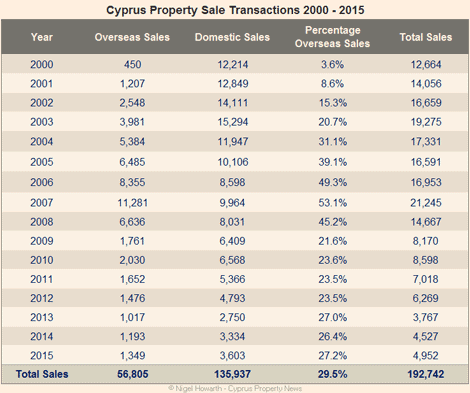
Better year for Cyprus property salesPROPERTY sale transactions in 2015 recorded only their second year-on-year increase since 2010, growing by 9 per cent to reach 4,952 compared with 4,527 in 2014, according to official statistics published earlier today by the Department of Lands and Surveys,

This follows a 20 per cent increase in 2014 compared to 2013.

Of those 4,952 sale transactions (which include residential properties, commercial properties and land) 3,603 (73%) were made on behalf of Cypriot purchasers while the remaining 1,349 (27%) were on behalf of overseas buyers.

Sale transactions in Larnaca rose by 35 percent, while those in Limassol rose by 11 percent. Transactions in Paphos and Nicosia rose marginally by 0.2 per cent and 0.1 per cent respectively, while transactions in Famagusta fell by 2 per cent. (As noted by Resolute Asset Management in its annual report, Cyprus Economy & Real Estate Market, Famagusta is heavily reliant on local demand for holiday homes.)

property_sales_2000_2015_final
Frenzied buying, mainly by UK nationals looking for a holiday home in the sun, together with nefarious business practices and reckless lending by the banks pushed up prices creating a bubble, which eventually burst in at the end of 2007. Cypriots found themselves priced out of the market as land prices rose faster than their salaries; property sales to the Cypriot market reached their zenith in 2003.

property_sales_graph

The exposure of Cypriot banks to overleveraged property companies together with a number of other ‘idiosyncrasies’ reported by PIMCO in its independent due diligence report of the island’s banking system, resulted in the collapse of the economy, the effects of which are still being felt today.

Whether Cyprus has learnt from its mistakes of the past only time will tell. But it appears that after two consecutive years of rising sales, the island’s property market has finally started on the long road to recovery.