Price falls at very low levels

Slowdown in house price fallsDURING the third quarter of 2015, the Cyprus Central Bank’s (CBC) general housing price index, which includes houses and apartments, fell by 0.3%, compared with falls of 0.4% and 1.0% during the previous two quarters, indicating that prices may be stabilising.

Over the quarter house prices fell by 0.7%, while apartment prices rose 0.8%. (An increase in apartment prices was last recorded in the fourth quarter of 2009.)

On an annual basis the general housing price index fell 3.7% compared with an annual fall of 5% over the previous quarter, with house prices and apartment prices falling by 3.9% and 2.8% respectively, compared with annual falls of 4.6% and 6.2% in the second quarter.

The CBC reports that “The recovery of the economy, improving financial conditions, reduced lending rates and progress in structural changes to improve the framework for issuing title deeds are developments that are expected to have a positive impact on demand for real estate and on house prices.”

However, the report omits to mention of the possible impact of foreclosures on the property market.

Quarterly winners and losers

Famagusta saw the largest quarter fall in the general housing price index (-1.6%) followed by Nicosia (-1.3%) and Limassol (-0.1%). In contrast the price index in Larnaca and Paphos rose by 1.2% and 0.2% respectively.

Over the quarter house prices fell by 5.6% in Limassol and 0.6% in Famagusta; house prices in Limassol, Larnaca and Paphos fell by 5.1%, 2% and 2.3% respectively.

Over the quarter apartment prices fell 1.5% in Famagusta and 0.6% in Nicosia, while apartment prices in Limassol, Larnaca and Paphos rose 2.1%, 0.3% and 1.5%, respectively.

Further reading

Residential Property Price Index 2015Q3 (Greek)

Corruption in the Land Registry

corruptionFURTHER details are coming to light of the 2014 report by the Cyprus Auditor General, Odysseas Michaelides, which was handed to President Nicos Anastasiades on Monday. The report has created a storm through the bleak picture it has painted of corruption in the Land Registry and poor collection of taxes.

The research into occupational groups revealed tax evasion among the medical and legal professions, with many not even being registered for tax purposes.

One example was a doctor in Nicosia who reported total income of €358,533 for the period 2006-2009. Yet during the same period the taxpayer spent €652,059 (or €757,059 based on Land Registry records) for the purchase and renovation of real estate.

Another example was a lawyer in Larnaca who filed no tax returns for the years 2007 to 2010. The taxation services did not take prompt legal action against him, yet according to other records the taxpayer purchased property worth €800,000.

Under-taxation

The tax department was also found to have under-charged in a number of cases. For example, government revenue was lost owing to the way in which a company that owned of 12 plots in Ayia Napa was taxed.

The value of the 11 properties assessed in 2002 on the basis of values in 1980 amounted to €4,102,345 (€4.1m). However, for the years 2002-2012, the Department imposed taxes on real property at a value of only €546,325, resulting in estimated loss of about €168,000 to the government.

Another company registered its name as the owner of a field in Paralimni that turned out to be a building. The value was estimated in 2011 and at 1980 prices at €1,623,171. The Tax Department imposed property tax only for the years 2012-14, and appears not to have imposed taxes for the years 2002-11. This resulted in a €51,000 tax loss for the government.

A registered owner of three properties in Kaimakli valued at €407,875 was not taxed at all in 2013-14, while for the years 2008-12 it was taxed at a discounted value of €371,738.

There were also cases in which there was a big increase in valuation for tax purposes from 201 – the year in which new tax rates came into force and new valuations were made.

A company that owned a hotel complex and tourist apartments in Protaras was taxed in 2013 on the basis of a valuation of €3,622,235, whereas the previous year the company was taxed on the basis of a valuation of €387,243.

Another company was taxed in 2013 on property valued at €1,710,000 at whereas in 2012 it had been valued at €189,655.

The Auditor General a found that 30 legal entities engaged in land development owed €14.7m in interest and charges as of February 2015. Of this total, €11.1m (75.6%) concerned due taxes for the years 2013 and 2014.

Total overdue taxes reached increased by €11.38 million to €733.37m in 2014, from €721.99m in the previous year. Overdue interest on tax payable amounted to €421.30m, bringing the total arrears to €1,154.67m (€1.2 billion).

Around 40%, or €461.78m of the arrears are considered “uncollectable”.


More new homes in Cyprus

THE NUMBER of building permits authorised in Cyprus during September 2015 stood at 407, the same as the number authorised during the same period last year, according to the latest figures from the Cyprus Statistical Service.

Compared with September 2014, the total area of these permits fell 1.0% to 69,398 square metres from 70,103, while their value rose 0.1% to €78.5 million from €77.9 million.

During September, building permits were issued for:

  • Residential buildings – 228 permits
  • Non-residential buildings – 92 permits
  • Civil engineering projects – 14 permits
  • Division of plots of land – 28 permits
  • Road construction – 5 permits

During the period January – September 2015 the number of building permits authorised for both residential and non-residential projects has fallen by 0.6% to 3,693 compared with the 3,714 authorised in the same period last year. However, their value has risen by 20.6% to €764.1 million and their area has increased by 14.8% to 658,427 square metres.

New homes construction

The 228 residential building permits approved in September provided for the construction of 314 new homes comprising 127 single dwellings and 187 multiple dwelling units (such as apartments, semis, townhouses and other residential complexes).

This is an increase of 1.9% compared with September 2014 when building permits were issued for the construction of 308 new homes.

Cyprus new homes construction

During the period January – September 2015, the number of dwelling units for which building permits have been issued has risen 15.1% compared with the same period last year.

According to the Cyprus Statistical Service, building permits constitute a leading indicator of future activity in the construction sector.

Cyprus property sales recovering

Cyprus Property Sales - November 2015THE TOTAL number of Cyprus property sales during November rose 21% compared with the same period last year according to official figures issued this morning by the Department of Lands & Surveys.

During November a total of 446 contracts for the sale of commercial and residential properties and land (building plots and fields) were deposited at Land Registry offices across Cyprus, compared with the 370 deposited in November 2014.

Of those 446 contracts, 69% (308) were deposited by domestic (Cypriot) purchasers, while 31% (138) were deposited by overseas (non-Cypriot) purchasers.

With the exception of Nicosia, where sales fell 18%, they rose in all other districts.

Property sales in Famagusta rose 65%, while sales in Larnaca rose 35%. Sales in Limassol and Paphos rose by 33% and 14% respectively.

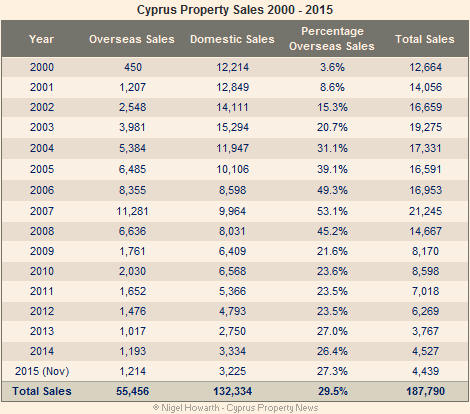
Property sales during the first eleven months of 2015 are up 9% compared with the same period last year with the number of properties sold reaching 4,439 compared to 4,074 in 2014. The number of sales in Nicosia and Famagusta remain unchanged, while sales in Larnaca, Limassol and Paphos have risen 32%, 8% and 3% respectively.

However, non-performing real estate loans remain a serious challenge to the market. According to KPMG’s Property Lending Barometer 2015, Cyprus has the highest number of impaired real estate loans of all the European countries. Almost 70% of its real estate loans are non-compliant (59% serious and 11% minor impairment).

Domestic sales

The number of properties purchased by Cypriots in November rose 11% compared to November 2014, with sales reaching 308 compared with 227 during the same period last year.

Although sales in the mainly business and commercial districts of Nicosia and Limassol fell by 24% and 2% respectively, they rose by 300% in Famagusta, 47% in Larnaca and 8% in Paphos.

Sales rose in all districts with Paphos leading the way with sales up 105%. Sales in Nicosia rose 58% and those in Limassol rose 23%, while property sales in Famagusta and Larnaca rose by 9% and 7% respectively.

domestic sales

Domestic sales during the first eleven months of 2015 are up 8% compared with the same period last year with sales reaching 3,225 compared to last year’s figure of 2,977.

Overseas sales

Property sales to the overseas (non-Cypriot) market rose 48% in November compared to the same period last year with 138 properties sold compared with the 93 sold in November 2014.

While sales in Famagusta fell by 36%, they rose in all the other districts with Limassol leading the way where sales increased by 189% compared with November 2014. Sales in Nicosia rose by 43%, while sales in Paphos and Larnaca rose by 31% and 11% respectively.

overseas sales

During the first eleven months of 2015, property sales to non-Cypriots have risen 11% compared to the same period last year, with the number of sales rising to 1,214 from last year’s figure of 1,096.

Cyprus property sales 2000 to 2015

Three banks ready to ease Swiss franc loan burden

Swiss-Franc-500THREE banks have devised voluntary schemes for distressed borrowers who took out loans in Swiss francs, which include loan write-offs from 10 to 40 per cent, the central bank told the House finance committee on Tuesday.

According to the Central Bank’s acting Oversight Director Yiangos Demetriou, six in ten Swiss franc borrowers receive their income in sterling, and are thus essentially unaffected by change in exchange rates between the euro and the franc.

However, following a series of meetings between the central bank and three banks, there has been progress on certain schemes that banks are ready to offer. These, he noted, will be available to borrowers who can document their inability to repay their loans.

According to Demetriou, one bank has agreed to write off 10 per cent of the original loan if the borrower agrees to switching the loan currency to euros or pounds sterling, at interest of six-month Euribor plus a margin to be agreed, and extend the repayment period to 30 years, or until the borrower reaches 70 years of age.

The currency switch will be done for free, and the borrower will enjoy an optional one-year grace period, during which only interest will be payable. No early-repayment penalty fee will be imposed.

A second bank will offer discounts on the loan from 20 to 40 per cent, in case of a currency switch or full repayment, and the bank will waive all expenses. The offer will be made to all borrowers, irrespective of the type of loan made. The interest rate will be similar to the one agreed originally, with a lower margin.

A third lender, which holds very few loans in Swiss franc, told the central bank that it is prepared to offer a discount of up to 25 per cent on loans that are switched to euros or pounds sterling.

The level of the discount will depend on the value of any collateral offered, as well as the borrower’s behaviour – i.e. cooperation, or lack thereof – and ability to make repayments.

According to this scheme, the existing loan will be split into two separate loans, one for repayment and the other – interest-free – to be fully discounted over five years, provided the borrower can demonstrate that repayment is not possible.

The value of the second loan will diminish by 20 per cent each year, until it is written off completely in year five.

Swiss francs loan landmark decision

Swiss frannc loan agreement

THE COMMERCE ministry’s Competition and Consumer Protection Service has found Alpha Bank in Cyprus culpable of dealing unfairly with two of its clients.

The two persons, both permanent UK residents, took out a loan from Alpha Bank for the purpose of re-financing a previous loan for the purchase of an apartment.

The loan was issued in Swiss francs, but the plaintiffs claim that the conversion to another currency was made unbeknownst to them, based on a power of attorney they had concluded with a Cypriot lawyer.

They moreover claimed that they were not informed of the exchange-rate risks of the loan, nor of the other terms of the loan agreement.

The subsequent strengthening of the Swiss franc led to “a significant increase in the un-matured principal balance,” as a result of which the loan became non-performing.

Specifically, on March 3, 2009 the bank issued the two plaintiffs, plus another person, a housing loan in Swiss francs for CHF 217,000. This was to replace a previous loan of €124,500 taken out for the purchase of an apartment.

The loan agreement in Swiss francs was signed by the plaintiffs’ lawyer, to whom they had ceded power of attorney.

During the commerce ministry’s investigation of the complaint, the bank conceded it did not provide the plaintiffs pre-contractual information that the loan currency would be converted into Swiss francs. The bank’s position was that this was responsibility of the borrowers’ legal representatives.

In its decision, the Competition and Consumer Protection Service found the loan agreement to be in breach of the law on unfair terms in consumer contracts and also in breach of the principle of transparency.

However, the service did not slap Alpha Bank with a fine, nor did it make it explicit that the lender was legally liable.

DISY MP Zacharias Zachariou, who chairs the House Commerce Committee, said the decision was a tool that could be used by the plaintiff in a court.

Zachariou spoke of a “landmark decision” that would have ramifications for all banks engaging in unfair practices.

He said the complaint in question pertains to lack of transparency in a contract, conversion into Swiss francs without informing the borrower, and whether a bank has the right to cancel a contract without notifying the borrower.

In addition, the complaint and the decision raised another question. When a borrower lodges a complaint against the bank, the case is referable only to Cypriot courts. But when a bank has a complaint, it can take legal action against the customer in any court in any country.

Zachariou said parliament “was right all along about the unfair terms of contract against borrowers, and my statement today is intended to make borrowers aware of a decision that relates to a specific bank, all of whose contracts are like that.”

According to the MP, the case in question would end up in court.

“With these kinds of contracts, borrowers are at the mercy of the banks’ appetites,” he said.

Swiss francs loan ruling

CCPS Decision 56/2015 Alpha Bank Cyprus Ltd (Greek)