Loan sale bill passed by whisker

Loan sale bill passed by Cyprus parliamentPARLIAMENT on Thursday gave the nod to a bill governing the sale of loans by banks to third parties – passage of which was a precondition for the release of the last aid tranche to Cyprus.

The item passed by 26 to 25 votes thanks to the ‘ayes’ from ruling DISY and opposition DIKO. Voting against were AKEL, EDEK, the Greens, EVROKO and independent Famagusta MP Zacharias Koulias.

Under the new law, loans may be sold only to investment or hedge funds licensed and registered in the Republic, and thus subject to all local laws and the jurisdiction of Cyprus courts.

In addition, the Central Bank may at its discretion forbid the transfer of debt to third parties, for reasons of national security – a clause inserted to allay fears that Turkish concerns may gain a claim on Cypriot assets.

The new law affords debtors the right to bid to buy back their loan at a discount, after it has been deemed non-performing by the lender, but before it can be sold to third parties like investment funds.

But a debtor’s bid shall not be binding on the bank, according to a last-minute amendment.

Individual borrowers will be notified of the bank’s intent to sell their loan – this also applied previously – and given 45 days to make the bank an offer to pay back their loan.

Following notification, a borrower may make an offer only once.

In a professed bid to protect debtors, DIKO had earlier toyed with the idea that a bank should be forbidden from transferring a loan to a third party at a price lower than that quoted by the borrower.

In addition, such a proposal might have been seen as state interference with contracts between two parties – the debtor and the lender – in the private market.

Cyprus’ international lenders, known as the troika, opposed the loan buyback scheme, arguing it would lead to moral hazard, encouraging even those who can afford to repay their loan to let it go unserviced so they can then buy it back at a discount.

DIKO – which held the swing vote in the House – had warned they would vote against the bill as a whole unless debtors were given a say on the sale of their loans.

Re-jigging the wording of the amendment – where a bank is now not bound to accept the debtor’s offer to pay back a loan – allowed DIKO to maintain the pretence that some protection is still afforded to borrowers.

It remains to be seen if the final version is to the troika’s satisfaction.

The island’s international creditors had made it clear what without the bill Cyprus would not be eligible for the next – and most likely last – bailout tranche.

Having passed his party’s amendments, DIKO leader Nicholas Papadopoulos offered a pragmatic analysis:

“We in Cyprus are champions when it comes to non-performing loans. We are here today because we want to exit the economic adjustment programme in May 2016, not May 2026.”

The bill stipulates that the sale of loans to third parties is governed by existing foreclosure-related legislation, which affords debtors several ways to challenge repossession proceedings.

It’s understood that on selling loan packages, banks will be able to bundle good loans along with the bad – as a means of making their package more attractive to investment funds.

Some object that borrowers who are consistent with their payments will thus fall prey to speculators.

But one MP, speaking on condition of anonymity, told the Cyprus Mail this should not be a concern because the same terms of the initial loan agreement will apply once a loan is transferred.

“So if you’re already servicing your loan, what does it matter if you’re dealing with a Cypriot bank or a foreign fund?” he said.

For the troika, the primary driver is slashing the high-level of non-performing loans – accounting for about half of all debt – thereby boosting banks’ liquidity and allowing them to recycle some of the freed-up cash back into the economy in the form of consumer loans.

At least that’s the theory.

But as the same MP conceded: “We’ve gone through the motions. Now we’ll see how it plays out in the real world. Will foreign investment funds now come in and scoop up all the bad loans, as many claim?

“With so many bad loans out there, and with the housing market in a slump… let’s just see.”

The bill also provides for the potential – this being the operative word – establishment of a national asset management agency (NAMA). But that is more likely than not a damp squib, as the text of the bill states that the creation of a NAMA, which requires a great deal of capital, must not be to the detriment of public finances – raising the question as to how well it would be funded.

Swiss franc loan time bomb

Cyprus: Swiss franc time bombALTHOUGH the “The Limitations Law (66(1) 2012)” came into force in the Republic of Cyprus on 1st July 2012, MPs voted in 2013 and again in 2014 to extend its transition period – and this transition period will now expire in less than two months on 31st December 2015.

The Limitations Law imposes time limits on which a party must bring a claim or give notice of a claim to the other party. Once the limitation period has expired, a party is prohibited from starting a claim against another party.

The 2012 law provides for different limitation periods depending of the nature of the actionable right. For example:

Actionable Right
Limitation Period
Breach of contract Six years
Damages for nuisance, negligence or breach of Statutory Duties Six years
Defamation or malicious falsehood One year
Tort Actions Three years
Action for remuneration of self-employed persons (e.g. lawyers, doctors, architects, etc.) Three years
Bills of exchange, Bonds in customary forms, cheques, promissory notes Six years

Among those who have benefited from earlier extensions to the law are those who bought property in Cyprus with loans denominated in a foreign currency (most notably Swiss Francs). As the vast majority of these loans were arranged before the end of 2009, time is running out for them to decide whether to bring a claim against the bank for mis-selling.

Unless the Cyprus government decides to a further extension, borrowers will have to bring a claim against the lending bank by 31st December 2015.

Recent developments

On September 21st, Members of the Cyprus Parliament asked the Central Bank of Cyprus to investigate the cost to local banks of converting Swiss Franc mortgages Euro at their original exchange rates. The Central Bank was given two weeks to communicate with the banks and provide its opinion. Parliament warned that legislation regarding the case would follow even without an answer from the Central Bank.

Subsequently, at the end of October, ratings agency Moody’s warned that the forced conversion of Swiss Franc loans would cost the banks at least €250 million and would make the restructuring of non-performing loans more challenging.

We await further developments.

Cyprus property sales up 23 per cent

THE NUMBER of properties sold in Cyprus during October 2015 increased according to the latest official statistics issued by the island’s Department of Lands and Surveys.

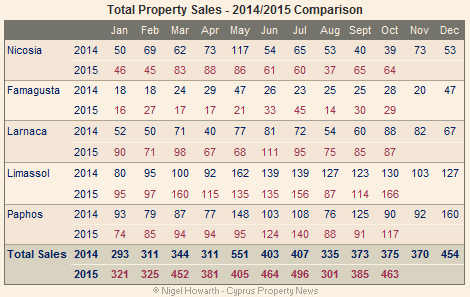
During October a total of 463 contracts for the sale of commercial and residential properties and land (building plots and fields) were deposited at Land Registry offices across Cyprus, compared with the 375 deposited in October 2014; an increase of 23 per cent.

Of those 463 contracts, 76% (352) were deposited by domestic (Cypriot) purchasers, while 24% (111) were deposited by overseas (non-Cypriot) purchasers.

With the exception of Larnaca, where sales fell by 1%, sales rose in all the other districts. Sales in Nicosia (the island’s capital) rose 64%, while sales in Paphos went up 30%. Sales in Limassol and Famagusta rose by 28% and 4% respectively.

Cyprus total property sales October 2015

Sales during the first ten months of 2015 are up 8% compared with the same period last year with the number of properties sold reaching 3,993 compared to 3,703 in 2014.

It appears that Cypriots in particular are returning to the market following the introduction of legislation reducing Property Transfer Fees and issuing Title Deeds to ‘trapped buyers’ (the hidden mortgage law) – and the introduction of a building amnesty allowing building coefficients to be increased by 20 per cent or 60 square metres without penalty.

Domestic sales

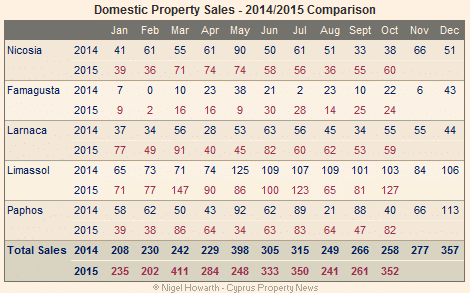
Property sales to the domestic (Cypriot) market in October rose 36% compared to October 2014, with sales reaching 352 compared with 258 in October last year.

Sales rose in all districts with Paphos leading the way with sales up 105%. Sales in Nicosia rose 58% and those in Limassol rose 23%, while property sales in Famagusta and Larnaca rose by 9% and 7% respectively.

Cyprus domestic property sales October 2015

Domestic sales during the first ten months of 2015 are up 8% compared with the first ten months of last year with sales reaching 2,917 compared to last year’s figure of 2,700.

Overseas sales

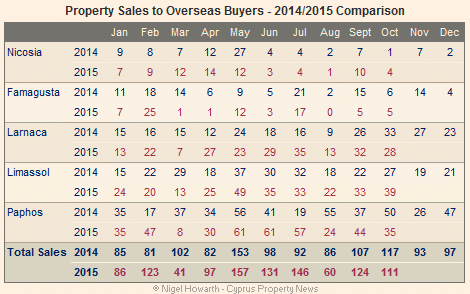
In contrast with domestic sales, property sales to the overseas (non-Cypriot) market fell 5% in October compared with October 2014 with 111 properties being sold compared with the 117 sold during October 2014.

It appears that Cyprus has some way to go before it can regain the confidence and trust of foreign investors.

Athough sales in the mainly business districts of Nicosia and Limassol rose by 300% and 44% respectively, they fell in the mainly tourist districts of Paphos (-30%), Famagusta (-17%) and Larnaca (-15%).

Cyprus overseas property sales October 2015

During the first ten months of 2015, property sales to the overseas market have risen 7% compared with the first ten months of 2014, increasing to reach 1,076 from last year’s total of 1,003.

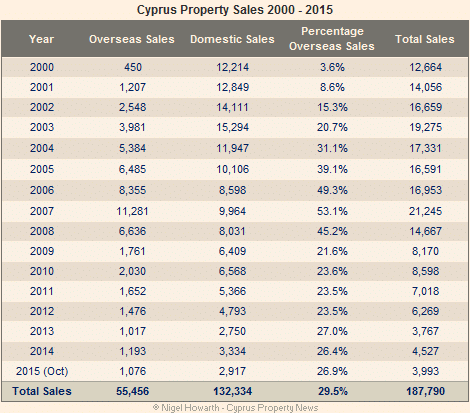
Cyprus property sales analysis 2000-2015

Troika starts eighth evaluation

cyprus-troikaREPRESENTATIVES from the troika of Cyprus’ international lender are to start their eighth evaluation of the island’s economic adjustment programme today and are expected to remain on the island until 13th November.

Prior to the arrival of the troika delegation a senior official from the European Commission told the Cyprus News Agency that the pace of reforms had slowed down significantly.

Speaking to StockWatch Finance Minister Harris Georgiades stressed that “I do not expect even the process of the last assessment and the Memorandum will be completed, without the adoption by the legislature of the bill on the sale of loans.”

The bill should have been approved by the end of last September. It is anticipated that the Financial and Budgetary Affairs Committee will give the bill the green light on Monday and schedule a date for its discussion and approval at a plenary session of the house.

Legislation on the sale of loans is seen as vital to reducing non-performing loans (NPLs) by enabling loans to be sold to third parties in compliance with the EU’s four basic freedoms. However, there is a fear in Cyprus that this would result in the sale of defaulting mortgages and large swathes of property would fall into foreign hands, which would have political implications.

Other critical issues under review include the bills concerning the reform of the public sector, loan securitisation, the resolution of the ex Laiki Bank, the implementation of the National Health Scheme (delayed until 2017), the privatisation of the Cyprus Telecommunication Authority (CYTA) and the separation of the Electricity Authority’s (EAC) activities.

On property issues, the implementation of the new Immovable Property Tax (IPT) using revised property values has been deferred until 2016 as a result of delays in its discussion by parliament. The European Commission has noted that “This points to high risks for the implementation of the IPT reform.”

Furthermore legislation specifying the frequency of mandatory updates of cadastral property values, which should have been adopted by mid-October 2015, has yet to be implemented.

Other outstanding property-related issues include:

  • legal or contractual standards for property sales contracts and connected loan and mortgage arrangements (which should have been in place by last October).
  • a mandatory escrow account system to ensure that all payments related to a property transaction are processed in a safe manner to provide safeguards against abuse (end of last September).

It looks as if the troika delegation is going to be kept very busy!

Cyprus property buyers debate

A PARLIAMENTARY debate at Westminster Hall heard from Andrew Gwynne MP that he had been contacted by a number of people in his constituency about the mis-selling of Swiss Franc mortgages by Alpha Bank in Cyprus and poor advice received from solicitors purporting to be acting on their behalf.

Andrew Glynne focussed on a case involving one of his constituents, who he referred to as “Mr TC”.

In 2007 Mr TC and his brother-in-law wanted to purchase a retirement property in Cyprus through a UK company called ROPUK and after meeting with the company’s representatives they decided to go ahead with the purchase. Having paid a deposit of £25,000 they understood that when the property was completed they would visit Cyprus to inspect the property and then sign a mortgage agreement.

They were advised by ROPUK’s representative that a Swiss Franc mortgage would be best, but they did not sign up to any agreement, except to give a Cypriot lawyer Power of Attorney in any transactions that they agreed to.

In 2010, when the property was due for completion, Mr TC visited Cyprus to monitor the progress of the build; he found that it wasn’t even half finished – and it’s still the same today in 2015.

Mr TC believes that the Power of Attorney was not executed in accordance with the common or Cypriot law, therefore rendering it illegal – and anything signed using the Power of Attorney invalid.

Mr TC and his brother-in-law first heard of Alpha Bank when the bank started to pursue them for payment. They did not personally sign any mortgage agreement; it was signed by a third party without their knowledge or consent and they had never even seen the mortgage agreement with the Alpha Bank despite repeated requests.

They believe that the Alpha Bank, in effect, released all of the money from their fraudulently obtained mortgage agreement to fund something that is simply not there.

They now owe the bank some £257,000 plus interest against the quoted purchase price of £150,000 less their deposit. The Alpha Bank issued them with a writ.

By the time the Alpha Bank’s case against them received its second hearing in London in September 2014, Mr TC and his brother-in-law had appointed Cubism Law to represent them. Their case was led by Duncan McNair, who they understood to be an expert in this field. They paid the firm £2,000 up front to represent them. A barrister attended court but they were simply told that a European Enforcement Order had been ratified and that a charge had been placed on their properties in the UK.

They then had to defend the European Enforcement Order in Cyprus, appointing a law firm recommended to them by Cubism Law, which they paid. The Enforcement Order was overturned with reservation when the case in Cyprus was eventually heard in February this year.

However, despite informing Cubism Law on 28th October 2014 and again on 10th November 2014 not to incur any further costs, these specific requests were ignored and the costs continued to mount.

Mr TC feels incredibly let down by the representation he received and believes that a lot of the costs incurred were avoidable and totally unnecessary. He has complained through the firm’s complaints procedures and received what he and his brother-in-law consider to be a derisory offer of redress and they have referred the matter to the Law Society and the Ombudsman, as has Andrew Gwynne MP.

The following 20 minute video is a recording of the Parliamentary debate at Westminster Hall.

[youtube=https://www.youtube.com/watch?v=jo5hq82Bxck&w=470&rel=0]

Further reading

Extract from House of Commons Hansard 27 October 2015

Cyprus property prices stabilising

THE TWENTY-fourth edition of the RICS Cyprus Property Price Index issued earlier today reports that the average price of apartments in Cyprus fell by 0.4% and the average price of houses fell by 0.5% over the third quarter of 2015.

Famagusta saw the largest fall in residential apartment prices (-1.2%) over the quarter followed by Nicosia (-0.9%), while prices in Limassol, Larnaca and Paphos were unchanged.

Although residential house prices in Paphos rose 0.6% over the quarter, they fell 3.2% in Limassol and by 0.3% in Nicosia, while remaining steady in Famagusta and Larnaca.

Compared to the third quarter of 2014, the average price of a residential apartment has fallen by 1.9%, while the average price of a 3-bed semi has fallen by 1.3%. Retail property has fallen by 4.0%, while the prices of offices and warehouses have fallen by 2.7% and 1.8% respectively.

Rental values

Across Cyprus, on a quarterly basis rental values increased by 0.3% for apartments, 1.5% for houses and 2.6% for office. A decrease of 1.1% for retail units was noted and 0.1% for warehouses.

Compared to the third quarter of 2014, rents dropped by 1.5% for flats, 0.5% for houses, 4% for retail, 2.5% for warehouses, and 0.2% for offices.

The majority of asset classes and geographies continue to be affected, with areas that had dropped the most early on in the property cycle now nearing or at the trough, e.g. Paphos and Famagusta are showing some signs of price stability.

Paphos is the only district with positive returns in all asset classes when compared to the third quarter of 2014.

Gross yields

At the end of the third quarter of 2015 average gross yields stood at 3.9% for apartments, 2% for houses, 5.2% for retail, 4.3% for warehouses, and 4.5% for offices.

The parallel reduction in capital values and rents is keeping investment yields relatively stable and at low levels (compared to yields overseas). This suggests that there is still room for some re-pricing of capital values to take place, especially for properties in secondary locations.

Cyprus_property_price_index_RICS

Prepared by RICS Cyprus in conjunction with the Cyprus Association of Quantity Surveyors (SEEOKK) and the Cyprus Valuers Association (SEEAK), the quarterly RICS index monitors property prices and rents in all districts using a methodology developed by Reading University in the UK.

Residential property prices

Since the first RICS Cyprus Property Price Index was published for the first quarter of 2010 residential house prices have fallen by an average of 30.1%, while those of apartments have fallen 40.6%.

Cyprus_Apartment_Prices

Cyprus_House_Prices

(Note that the RICS Price Index does not include prices of holiday homes and all properties used to construct the index have clean Title Deeds.)