Title Deeds & the financial crisis

Title Deed Gordian KnotTHE BRITISH parliament raised the issue with the Cypriot authorities’ inability to protect the property rights of UK citizens who had invested in Cyprus properties back in 2007. To their astonishment, these buyers found out that they would get no Title Deed even though they bought the property through a law office (something that in their country implies that you automatically get a Title Deed).

In 2007 Cyprus, no-one involved in the rapidly developing and already large property sector (banks, developers, chartered surveyors, land registry, town planning and municipal authorities, lawyers, accountants, politicians etc.) was alarmed, despite the developing dangers for an economy trying to sell properties. In my opinion, ultimate responsibility for failing to tackle this problem must lie with the government agencies that have the primary responsibility of protecting property rights.

One basic principle for an economy to function well is the protection of a citizen’s property rights. In this case, the property right is protected with the issue of a Title Deed. My fundamental position is that no immovable property should change hands without a Title Deed. With this tough measure in place (which would have forced authorities to ditch bureaucratic procedures because of the large economic cost from failing to do so), subsequent systemic problems would have been largely avoided.

First, in the absence of Title Deeds, reselling a property is difficult, therefore increasing the possibility for an unrestrained increase of immovable property prices. When reselling becomes very difficult, the property market is not allowed to function properly. Not only do prices rise too fast in the good times but in the bad times dangers rise disproportionately due to property illiquidity in a leveraged economy. Second, in the absence of a central credit register, it is more likely for credit from the banking sector to increase very fast in the good times without the central bank having the necessary tools to control credit expansion. Third, the state loses substantial revenue from transfer fees and subsequent property taxes.

The solution to this Gordian Knot is simple, and a state respecting its citizens would not have waited for the imposition of a solution by the Troika. No property transaction without a Title Deed should be legal and there should be a central credit registry. The financial crisis would have been much more manageable were these simple instructions from the Troika put in place back in 2007.

Inability to quickly apply similar changes to the “business as usual” model will bring the next economic crisis to Cyprus sooner than many people think.

About the author

Alexandros Michaelides is a Professor of Finance at Imperial College Business School London.

Chinese interest increasing

Chinese-dragon-470THE CHINESE Residential Purchasing Intent Index for Mediterranean countries for the second quarter of 2015 by juwai.com reports that Chinese interest in Cyprus has increased significantly over the previous quarter and over the year.

According to the report Chinese interest in Cyprus starts from a particularly low base, given the island’s small size and the difficulties that investors face there – due to the banking crisis, the title deeds scandal and allegations of overpricing.

With that caveat, the Purchasing Intent Index for Cyprus has increased furthest in relative terms of all the countries discussed in the report. It is up 102 percent over the prior quarter and 351 per cent over one year earlier.

The average price of Chinese property hunters in Cyprus was $815,166 (€718,178) in the second quarter of 2015, down three percent from the prior quarter’s average price of $837,687. That’s down one percent from the value of $826,998 (€728,475) a year earlier.

The two top destinations for Chinese buyers in Cyprus are Paphos and Limassol. Paphos in 2011 was the first Cypriot location to see large-scale Chinese purchasing.

About the Index

The Juwai.com Purchasing Intent Index seeks to measure the change in Chinese buyer interest for a given location. It does this by tracking their online property hunting activity on Juwai.com, such as property searches, property detail page viewings, email inquiries, clicks to view agent phone numbers and more. Destinations with more activity rank higher, while those with less rank lower. The data is not based specifically on transaction activity, but on the property hunt activity that precedes and leads to transactions.

Further reading

Juwai.com Purchasing Intent Index: Mediterranean Countries – Q2 2015

Central Bank blasted on FX loans

central bank of CyprusTHE BORROWERS Association slammed the Central Bank of Cyprus (CBC) on Tuesday accusing it of not properly regulating banks when they were giving out loans in foreign currency.

“Where was the Central Bank when monetary policy reports mentioned an increase in loans taken out in Swiss francs? When amongst other things they could see that borrowers were overlooking the risks of the exchange. Did the finance ministry know this? If yes, and since they did nothing they too committed crimes.”

The issue concerns 3,000 borrowers that took out loans in foreign currency – mainly Swiss francs but they saw their debt increase 35 to 40 per cent after the exchange rate worked against them.

Of the 3,000 borrowers found to have received credit in foreign currency, approximately 40 per cent – €600 million in 1,200 accounts – were Cyprus residents, the Central Bank said on Monday.

According to the Central Bank’s stats report on the issue, 98 per cent of foreign-currency loans were made by the Bank of Cyprus, Hellenic Bank, and Alpha Bank.

The same report estimated that, if the loans were to return to the original exchange rate, the Bank of Cyprus stands to bear losses of €147 million, Hellenic Bank €11 million, and Alpha Bank (only from housing loans) €10 million.

Total losses across the Cypriot banking system could reach €250 million, the report found.

During a House finance committee on Monday, the CBC said the problem could not be addressed through legislation after deputies said they would seek to legislate solutions for borrowers, pegging the exchange rate to the point it was on the date the loan agreement was signed thus burdening the losses on the lender.

The association said the CBC was proving, yet again, that it wasn’t working for the benefit of national economy and maintaining financial stability but rather was facing the issue with the borrowers “superficially”.

“It would be good if the CBC became seriously concerned with the major responsibilities it has on the state of Cyprus’ economy.”

Moreover, the association accused the CBC of never taking the necessary steps to ensure that a circular they sent out to banks on October 11, 2006 outlining the risks to borrowers in taking out loans in foreign currency was actually adhered to.

Also disagreeing with the finance minister Harris Georgiades on restructuring loans they said “we insist that restructures are easy and can be done correctly in a way to benefit both sides, as long as there is good will from the banks.”

The association also sought to wonder if banks need three years to learn how to restructure loans and to what extent it would be fair if borrowers were burdened with the cost of the delay, appealing to both the CBC and the state to find a solution for the troubled borrowers, bond holders, and depositors that had a haircut.

Banks to take hit on Swiss Franc loans?

Swiss-National-BankDESPITE objections from the Cyprus Central Bank, the majority of members of the House Finance Committee want legislation to resolve problems created with three thousand accounts, mainly belonging to non-Cypriots, due to the revaluation of the Swiss Franc (CHF).

The issue was discussed yet again in front of the Committee with the Central Bank’s representative, Elena Gregoriades, who warned that such legislation could potentially disrupt the banking system.

The majority of foreign currency loans were granted by the Bank of Cyprus and the Alpha Bank.

According to Mrs Gregoriades, if these loans were converted to Euros at a previous exchange rate, the Bank of Cyprus would have to take on losses of €147 million, the Hellenic Bank €11 million and the Alpha Bank €10 million. (But the Alpha Bank has only calculated its loss on loans granted for primary residences.)

She said that based on data from the Central Bank, the total Swiss Franc loans granted for the purchase of housing amounted to €1.05 billion and affected 3,000 accounts, 40% of which are held by Cyprus residents.

Mrs Gregoriades added that someone who borrowed in Swiss Francs between 2008 and 2010 had suffered a loss of between 30% and 40% at the current exchange rate.

Member of the Committee considered the Central Bank report to be unsatisfactory and were dissatisfied with their explanations – particularly as it failed to propose any solutions to the problem.

Property sales up 3 per cent

Following a drop in sales of 10 percent in August, the number of properties sold in Cyprus during September rose 3 per cent compared with the same month last year according to official statistics published by the Department of Lands and Surveys.

During September a total of 385 contracts for the sale of commercial and residential properties and land (building plots and fields) were deposited at Land Registry offices across Cyprus, compared with the 373 contracts deposited in September 2014.

Of those 385 contracts, 68% (261) were deposited by domestic (Cypriot) purchasers, while 32% (124) were deposited by overseas (non-Cypriot) purchasers.

Although the number of sales increased in Nicosia (up 63%), Larnaca (up 42%) and Famagusta (up 20%), sales were down 27% and 7% in Paphos and Limassol respectively.

Cyprus total property sales September 2015

Sales during the first nine months of 2015 are up 6% compared with the same period last year with the number of properties sold reaching 3,530 compared to 3,328.

Speaking to StockWatch, Pavlos Loizou MRICS VRS of Resolute Asset Management said that the property market has stabilised at a very low level of trading volume; this is expected to increase slowly as the island’s economy recovers. However the high volume of sales seen in 2007 are not expected to return.

Domestic sales

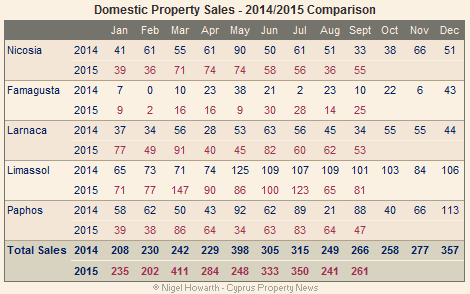
Property sales to the domestic (Cypriot) market in September fell 2% compared to September 2014, falling to 261 from 266 last year.

While sales in Famagusta, Nicosia and Larnaca were up 150%, 67% and 56% respectively, sales fell by 47% in Paphos and 20% in Limassol.

Cyprus domestic property sales September 2015

Domestic sales during the first nine months of 2015 are up 5% compared with the first nine months of last year with sales reaching 2,565 compared to last year’s figure of 2,442.

Overseas sales

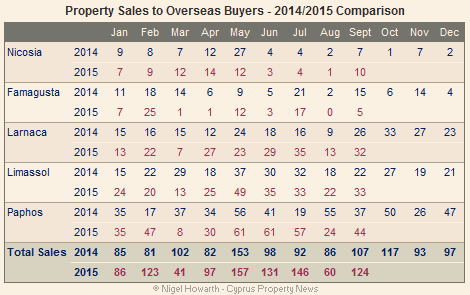
Property sales to the overseas (non-Cypriot) market during September rose 16% to reach 124 compared with the 107 sold during September 2014.

With the exception of Famagusta, where sales fell 67%, sales in Limassol rose 50%, sales in Nicosia rose 43%, while sales in Larnaca and Paphos rose 23% and 19% respectively.

Cyprus overseas property sales September 2015

During the nine months of 2015, property sales to the overseas market have risen 9% compared with the first nine months of 2014, increasing to reach 965 from last year’s total of 886.

Cyprus property sales 2000-2015

Cyprus property prices rising

price-index-methodIN SHARP contrast with the Cyprus Central Bank’s Residential Property Price Index for Q2 2015 and the RICS (Cyprus) Property Price Index for the same period (both of which reported price falls), Eurostat reports that home prices in Cyprus rose during the second quarter of 2015.

According to Eurostat, house prices in Cyprus rose 7.4 per cent over the second quarter of 2015 after falling 2.8 per cent during the first quarter of the year – and rose 2.4 per cent compared with the second quarter of 2014.

These Eurostat figures are at odds with the Cyprus Central Bank, which reported house prices and apartment prices falling by 0.8 per cent and 1.5 percent respectively over the second quarter – and by 4.6 percent and 6.2 percent respectively compared with the second quarter of 2014.

The RICS (Cyprus) Property Price Index for the second quarter of 2015 reported quarterly falls of 0.3 per cent in house prices and 0.4 percent in houses.

According to Eurostat, the highest quarterly increases in house prices were recorded in Cyprus (+7.4%), Austria (+6.4%), Denmark and Spain (+4.1% each), while the highest falls were observed in Romania (-1.1%), Malta (-0.3%) and Italy (-0.1%).

In the same reports, Eurostat reports that the highest annual increases in house prices in the second quarter of 2015 were recorded in Sweden (+13.0%), Hungary (+11.9%), Ireland (+10.7%) and Estonia (+10.5%), and the highest falls were observed in Latvia (-4.4%), Italy (-3.0%) and France (-2.2%).

It is known that Eurostat, the Cyprus Central Bank and RICS (Cyprus) employ different methodologies to calculate their indexes, but it is difficult to understand the wide variation.

Speaking to the Cyprus Mail, property valuator Pericles Markaris said that the difference in the findings may be related to a difference in the methodology and inclusion of transactions of homes “at prime locations” involving non-Cypriots. However, as non-Cyprus accounted for just 30.8 percent of sales in the second quarter it is hard to understand how such a small percentage could result in such a dramatic variation in the figures.

Further reading

Eurostat newsrelease 174/2015 – 8 October 2015