THE NUMBER of building permits issued in March 2015 stood at 460 compared with the 448 issued in March 2014; an increase of 2.7 per cent, according to the latest figures from the Cyprus Statistical Service.
Compared with March 2014, the total area of these permits increased by 21.1% to 71,301 square metres from 58,870, while their value increased 14.5% to €70.0 million from €61.2 million.
During March, building permits were issued for:
Residential buildings – 319 permits
Non-residential buildings – 73 permits
Civil engineering projects – 24 permits
Division of plots of land – 37 permits
Road construction – 7 permits
During the first quarter of 2015 the number of building permits authorised for both residential and non-residential projects increased by 1% to reach 1,265 compared with the 1,253 authorised in the same period last year, while their value rose by 4.8% to €254.4 million.
Speaking to the Cyprus Mail property valuator Periclis Markaris said that while the increase in building permits reflects decisions taken six to twelve months ago, it is also indicative of the improvement in the overall economic sentiment. “In 2013 almost no decisions were taken but things in 2014 improved,” he said.
He also attributed the increase in the building permits to the decrease in construction costs resulting from the drop in energy prices as well as lower mortgage rates offered by banks in combination with new housing loan schemes.
He added that another reason leading to the increase in building permits is related to incentives offered by the government to construction companies two years ago in the form of an additional 20 per cent density factor for grand scale projects; an attempt to help kick-start the economy through construction.
As a result additional building permits were issued which did not translate into additional construction activity, he said.
New home construction
The 319 residential building permits approved in March provided for the construction of 297 new dwellings comprising 165 single dwellings and 132 multiple dwelling units (such as apartments, semis, townhouses and other residential complexes).
This is an increase of 53.9% compared with March 2014 when building permits were issued for the construction of 193 new dwellings.
According to the Cyprus Statistical Service, building permits constitute a leading indicator of future activity in the construction sector.
EARLIER today, the Cabinet approved a scheme aimed at protecting the primary residence or business premises of crisis-stricken debtors against repossession by the banks.
The scheme, which will be managed by the state-owned Cyprus Land Development Corporation (CLDC), will subsidise the interest on mortgages in default by up to 4% for a period of up to four years.
Small debtors wishing to take advantage of the scheme must own a residence or business premises worth no more than €250,000. The debtor must have exhausted all other avenues available, including applying for a restructuring of their debt and the process of mediation by the financial services commissioner and the insolvency authority.
Interior Minister Socrates Hasikos said that the scheme offers adequate protection for vulnerable groups against property repossession. He said that the scheme will be applied for two years initially, with a possible extension for a further two years.
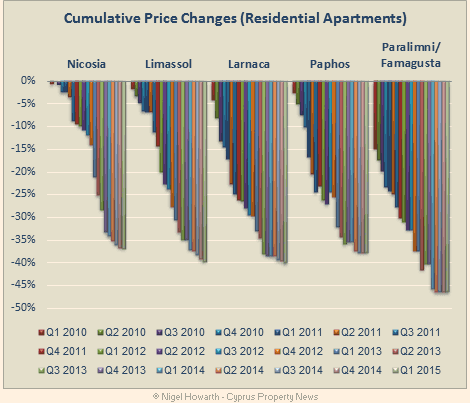
The largest quarterly fall for apartments was reported in Limassol (-1.0%), while the largest rise in house prices was reported in Larnaca (3.0%).
Although house prices in Nicosia continued to fall they remained steady in Limassol and Famagusta – and those in Larnaca and Paphos rose slightly and while apartment prices in Nicosia, Limassol and Larnaca continued to fall, they remained steady in Paphos and Famagusta.
Values of retail premises fell by an average of 1.7%, value of offices fell 0.1% and the value of warehouses rose 1.3% over the quarter.
Compared to the first quarter of 2014, the average price of a residential apartment has fallen 3.2% and the average price of a 3-bed semi has fallen 3.0%. Retail property has fallen by 8.1%, offices by 4.8% and warehouses by 3.2%.
Commenting on the latest figures, Charalambos Petrides MRICS, said “The positive thing seen in the first quarter of 2015 compared to 2014 and 2013, is the 20 per cent increase in marketability on an annual basis,” adding that “It seems that property transactions have recovered and the drop in prices is restoring market activity.”
Mr Petrides expects that property prices will continue to fall during the year but at a slower pace than 2014 due to pending developments in the financial sector related to non-performing loans, foreclosures and stricter loan standards in the banking system.
Rental values
Rental values recorded a quarterly drop of 0.3% for apartments, 1.9% for offices, 0.4% for retail units and 0.1% for warehouses. On a more positive note, the rental value of houses rose 1.2%. 0.2% for houses.
Compared to the first quarter of 2014, rents have dropped 4.0% for apartments, 1.2% for houses, 8.1% for retail premises, 3.5% for offices and 5.9% for warehouses.
Gross yields
At the end of first quarter of 2015 average gross yields stood at 3.8% for apartments, 2.0% for houses, 5.3% for retail, 4.3% for warehouses, and 4.4% for offices.
The parallel reduction in capital values and rents is keeping investment yields relatively stable and at low levels (compared to yields overseas). This suggests that there is still room for some re-pricing of capital values to take place, especially for properties in secondary locations.
Characteristics of the properties used to compile the index and the methodology employed was developed by the University of Reading, UK. The document may be viewed by clicking here.
Overall property price falls
Since the first RICS Cyprus Property Price Index was published for the first quarter of 2010 residential house values have fallen by an average of 30%, while those of apartments have fallen 40%.
(Note that the RICS Price Index does not include prices of holiday homes and all properties used to construct the index have clean Title Deeds.)
THE ‘Citizenship by Investment’ programme, which enables high-net-worth third country nationals to apply for Cypriot citizenship has boosted the Cyprus economy by €2 billion.
The announcement was made by interior minister Socrates Hasikos during his examination of his ministry’s audit services report for 2013.
However, the Minister avoided giving any further details on the issue due to privacy issues and invited MPs who wished more information to visit the Interior Ministry’s offices.
The Minister said that “The Republic of Cyprus is under pressure to stop this policy, so we need to keep a low profile.”
We understand that the pressure to stop the policy is coming from Europe.
Answering a question raised in the European Parliament regarding easy access to European citizenship for individuals from non-EU countries, Ms Jourová on behalf of the Commission replied:
“As regards national schemes for naturalisation of investors (investor citizenship schemes), the Commission recalls that it is for each Member State to lay down the conditions for the acquisition and loss of its nationality. As confirmed in settled case-law of the Court of Justice of the EU, when exercising their competence in the area of nationality, Member States must have due regard to Union law.
“The Commission has stressed that it expects Member States to use their prerogatives to award citizenship in a spirit of sincere cooperation with the other Member States and the EU. Account should be taken of the norms and obligations by which they are bound under international law and the criteria upon which they traditionally build their nationality laws. These criteria require in particular the existence of a genuine link between the applicant for naturalisation and the country or its people. Investor citizenship schemes providing for the possibility to obtain naturalisation in return for investment alone do not meet the minimum requirement of a genuine link to the country.
“The Commission is analysing investor citizenship schemes in all Member States concerned. At this stage, it appears that there is only one Member State granting naturalisation in return for investment alone, namely Cyprus.
“The Commission is currently pursuing a dialogue with the Cypriot authorities on this issue.”
I APPLAUD your decision to introduce legislation to address the problem of thousands of trapped home buyers who are unable to get the deeds to the property they purchased due to their developer’s outstanding mortgage debt(s).
But to be effective the legislation must include the release of a deed that is encumbered by other debts and memos, including taxes owed to the state and local authorities.
The legislation must also ensure that trapped home buyers are not, under any circumstances, required to contribute towards paying a vendor’s debt(s) and tax liabilities – and that the fees payable to effect the transfer of the property are no more than the fees payable had the property been unencumbered.
Furthermore, once the property is registered in the name of its purchaser that purchaser must be free to mortgage the property, sell it, gift it, leave it to their heir(s) or dispose of it in any way they wish within the law – and subsequent owners must also be free to dispose of the property without incurring any costs over and above those that would normally be payable.
Any proposed legislation that fails to embrace the conditions above would be disingenuous and unacceptable.
The present system unfairly penalises home buyers who are unable to obtain title to the property they purchased through no fault of their own. This must change.
As you openly admitted in July last year, the state – government and parliament – has failed miserably over the Title Deeds issue. Not only has this miserable failure contributed to the decline property sales, it has also resulted in tarnishing Cyprus’ reputation in the international community and reducing the inflow of revenue to state coffers.
Title Deed issuance
The most effective solution to the many problems associated with Title Deeds is to ensure that unencumbered title is available for transfer on delivery of a property to its purchaser(s). This solution would both:
(a) help to restore the island’s tarnished reputation and
(b) help the recovery of the island’s beleaguered property industry.
Other countries deliver unencumbered deeds on the delivery of a property, why not Cyprus?
There are numerous ‘idiosyncrasies’ in the present system. Perhaps the most obvious is that property ownership is dependent on whether a built property conforms to the permissions and permits issued for its construction; but only in some cases:
If a purchaser buys a property off-plan, a deed for that property will not be issued until that property has been completed and inspected by the Planning Authority and issued with a ‘Certificate of Final Approval’.
However a purchaser can buy a plot of land, pay the Property Transfer Fees and secure its title. That purchaser can then build a house on that land (having first secured the required permissions and permits) safe in the knowledge that they own the land and the house, regardless of whether the house has been issued with a ‘Certificate of Final Approval’.
Why is a purchaser who buys a property off-plan treated differently to another purchaser who builds a house on land they own? That’s discrimination.
Article 10 of the Streets and Buildings Regulations Law, Cap. 96, provides that no person shall occupy, use or permit any other person to occupy or use any building, unless and until a ‘Certificate of Approval’ has been issued in respect thereof by the appropriate authority. This law is almost universally ignored and, as far as I am aware, it is rarely (if ever) enforced.
What is the point of having a law that is never enforced? It might just as well be scrapped and replaced with something more appropriate.
A second idiosyncrasy is the fact that many home buyers are unable to obtain the deed to the property they purchased because their developer has failed to build roads, pavements and other infrastructure. Why should this be the case?
Providing the property developer has fulfilled his contractual obligations to the purchaser, there can be no reason for not issuing its deed. An inspection of the property prior to its delivery may be desirable to advise the purchaser of possible health & safety and other issues enabling the purchaser to make an informed decision whether to accept delivery of the property. Responsibility and costs associated with completing roads, pavements and other parts of the development would remain with the developer.
Site inspections are another issue. Does it really need the Planning Authority, the Land Registry and the local authority to each carry out separate property inspections? Why not establish a single independent inspection authority (perhaps a government agency) to take responsibility for all site and property inspections. The Planning Authorities, Land Registry and local authority could carry out ‘sample inspections’ (say 1 in 20) to ensure that authority inspections are being correctly executed.
Anyone who has dealt with the authorities in Cyprus will appreciate the paperwork and mind-numbing bureaucratic processes involved. As many as 10 different permits from various local & central Government authorities may be required before a property can be legally built, owned and occupied. This number needs to be rationalised.
Cyprus agreed a target with the troika to ensure that the title deed issuance backlog dropped to less than 2,000 cases of immovable property units with title deed issuance pending for more than one year by Q4-2014, but there has been no public release on the reduction actually achieved. I know from the correspondence I understand that good progress was made, but can you advise how many cases remained outstanding at the end of 2014?
Over many years successive governments have made minor adjustments to the various processes involved in planning and the issuance of Title Deeds. These have all failed to reduce the time it takes to issue Title Deeds. Indeed it would appear that some of these adjustments have further complicated the system resulting in even longer delays. The ‘Town Planning Amnesty’ is a case in point.
Speaking in 2011 former Interior Minister Neoclis Sylikiotis said: “The approval by parliament of four of the five bills will solve the Gordian knot for the thousands of title deeds that have been pending for years now.” But once again, no official statistics on the number of deeds issued as a result of the amnesty have been released. Can you please advise?
What is needed now is a total review of the planning and Title Deed issuance processes and procedures by those with no interest in maintaining the status quo.
This review would be followed by redesigning and then re-engineering the processes involved to meet best business practices with the over-riding objective of ensuring that unencumbered title is available for transfer on delivery of a property to its purchaser.
In spite of the progress made to date there are still many thousands of properties waiting to be issued with their Title Deed as a result of unacceptably long delays in planning departments and Land Registry offices. In Paphos, for example, there are a number of cases where home buyers have been waiting for deeds since 1979.
Three homes in another area of Pissouri that have now been demolished due to land slippage
HOMEOWNERS in Limnes in Pissouri are appealing to the government to step in as dozens of houses are facing serious structural damage due to land slippage.
Damage includes cracks in interior and exterior walls, swimming pools, roads, pavements, footpaths, retaining walls, drains, water pipes and other infrastructure works.
The damage is ongoing and almost daily, according to homeowner Antony Walker, who has written to the minister of the interior to request that the government step in to help.
Walker, 69, a retired chartered quantity surveyor and expert witness, said that the damage is due to land slippage, resulting from a decade-long failure of successive authorities to provide adequate infrastructure to manage ground water, and allowing development to go ahead in the area.
He stressed it isn’t caused by poor building and construction standards.
Walker and his wife moved to Cyprus 14 years ago but have owned their five bedroom house for the last 25 years.
He told the Sunday Mail that he believes upwards of 50 homes, both Cypriot and British owned, may be affected in some way.
“The situation is seriously affecting our daily lives. We feel very anxious, as almost daily we hear sounds similar to a pistol shot and then find another crack,” he said. “Each time we are concerned as to how serious the next one will be. We can’t plan anything because we do not know how extensive the damage will be or what demands may be made on our savings.”
Lazros Lazarou, the community leader of Pissouri said that the problem in the area is huge and that the council is doing everything possible to help.
“We have spoken to the district office in Limassol many times and met with the Interior Minister Socratis Hasikos in March, he promised to do something.”
Lazarou said government experts have visited the area a number of times and carried out studies. He said despite numerous requests to the Limassol district office for information, details have not been forthcoming, so the council has organised a meeting with the minister of the interior and other officials, scheduled to take place in Pissouri on May 27.
“We hope they will inform us on what has been done and enable us to inform residents. People are suffering and they need to know what’s being done about it. We fully support the homeowners. To live in fear of losing your home is terrible,” he said.
Walker first noticed damage at his home about two years ago and according to experts appointed by an insurance company, other houses close by had already been affected.
“The side of the hill on which our part of the village is built has started to slip, exerting enormous force on houses below – effectively pushing our house down the hill and causing land to drop.”
The couple’s swimming pool has cracked from top to bottom and cracks regularly appear on floors and both external and internal walls. Doors and window are being distorted and some are becoming impossible to open or close, he said. External paving and boundary walls are also cracking.
Walker has already forked out more than 60,000 euros on intermediate repairs to try to slow down the progress of the damage, which he says is unstoppable and irreparable by an individual home owner.
He said that in order for the couple to remain living in their home, they also have to carry out a continuous programme of cosmetic repairs, filling in cracks as they appear.
The Walkers’ house was designed for them and constructed by a local builder in 1990. It was extended in 1997 and is not part of a development. He says that the builder is not to blame. The couple have title deeds for the land and the house.
“I am confident that the house was constructed according to law and in line with building requirements,” he said.
Walker said that a report by both civil engineers and the geological department put the problem down to uncontrolled ground water.
“The authorities have permitted large scale development here, but have failed to carry out infrastructure works either to manage the ground water, or to stabilise the hillside.”
He said that a similar problem affected another area in the village, which destroyed three houses. Civil engineering works there cost around six million euros to stabilise the hillside.
John Lamb and wife Linda moved to Cyprus from the UK 27 years ago and live close to Walker. Their bespoke home was completed in 1988 and an extension was added in 1998. They also have title deeds for their six-bedroom property, which was built by the same builder as the Walkers’ and the 85-year-old said no blame lies with him, as the property meets all building requirements.
“Our quality of life is being affected and the slippage may continue to the extent of making the property uninhabitable,” he said.
Lamb said that he first noticed separation cracks between the extension and original house about two years ago. Cracks appeared in the main building about three months ago. These run mainly across the centre of the building from wall to wall.
“They are now about 1 to 2 inches wide floor to ceiling and include the ceiling. Cracks are now in all rooms upstairs and downstairs excluding one of the rooms at the front and a toilet,” he said.
Lamb said that a recent report received from his insurers following two visits, the last of which was a month ago, found that the problems are being caused by slippage and settlement of subsoil.
“The authorities are to blame for this situation and action needs to be taken immediately to prevent further slippage, as well as repairs to existing damage.”
Walker said that his greatest concern is that the drainage pipes under his house, along with central heating pipes in the house will break, windows will shatter and that his house will soon become uninhabitable.
“I would like the authorities to carry out all the necessary work and pay for my house to be restored to its previous condition, or to be compensated to the full insured value of our house and land, so that my wife and I may rehouse ourselves in Cyprus.”
He added that fifty or so houses may need to be demolished and the land left fallow.
Lazarou said that the village urgently needs the government’s support, as the damage runs into millions.
“And they have to do this soon, if we go into another winter period some people may lose their homes,” he said.


 THE NUMBER of building permits issued in March 2015 stood at 460 compared with the 448 issued in March 2014; an increase of 2.7 per cent, according to the latest figures from the Cyprus Statistical Service.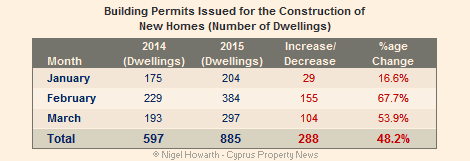



 THE ‘Citizenship by Investment’ programme, which enables high-net-worth third country nationals to apply for Cypriot citizenship has boosted the Cyprus economy by €2 billion.