Pledge to protect paid-up buyers

Pledge to protect paid-up buyersINTERIOR minister Socratis Hasikos yesterday urged MPs to give the government a three-month window to submit legislation comprehensively regulating the matter of homes paid for by owners but facing the prospect of repossession because of developer mortgages.

Last month parliament passed a bill, indefinitely banning repossession of houses whose owners have no title deeds, even though they may have paid for them in full, because the building developers had already taken out loans on those properties which they cannot repay.

Developers’ land and buildings are counted as assets that need to be offset against their debt to banks, which gives lenders a claim on people’s properties that had been mortgaged by developers.

Tens of thousands have been left without title deeds as a result.

A clause in the main foreclosures law exempts this category of properties from repossession until April 30. According to the provision, such properties will be exempted provided the buyers paid at least 80 per cent of the sale price or have fully complied with their contractual obligations towards the seller.

But in March MPs amended the duration of the exemption, making it indefinite.

The President then refused to sign the bill into law and sent it back to parliament, arguing that it was unconstitutional and created a general and permanent shield, not for vulnerable groups, but a number of sellers and land developers.

Hasikos proposed to MPs that, rather than an indefinite exemption, legislators should instead extend the initially envisaged deadline of April 30 to June 30. By that time, he said, the government will bring to parliament a comprehensive law dealing with this class of home owners without title deeds.

The government’s top priority, he added, was to protect all those people who paid up fully for their homes, or up to 80 per cent but are unable to get the title deed.

Under the terms of its bailout, Cyprus has set up a task force “on registered, but untitled, land sales contracts” that must prepare a study by the end of May.

A lasting ban on repossessing any properties would breach the terms of the island’s bailout deal, which mandates that Cyprus enact effective foreclosures legislation allowing banks to gradually recover bad loans.

This has given opposition parties ammunition to accuse the government of siding with banking interests rather than with distressed borrowers.

It is perhaps why Hasikos told MPs that Cyprus’ international creditors – known as the troika – have “pleasantly surprised” the government.

According to the minister, the troika are not seeking mass foreclosures on properties, and are working on various scenarios to avert this phenomenon.

The ministry has already drafted legislation on this class of properties; the item is currently being vetted by the Attorney-general’s office.

Under it, the director of the department of lands and surveys will review title deeds in limbo on a case-by-case basis.

Hasikos went on to explain how the new system would work. Where an apartment bloc has 10 flats, of which nine have been sold and paid for, the bloc as a whole is still held in mortgage due to the developer’s debt, and title deeds cannot be issued to any of the buyers.

By way of example, if the developer’s outstanding loan is €100,000 and the value of the flat that has not been fully paid for covers the developer’s mortgage, then the other nine flats will be released from the encumbrance and title deeds issued to their buyers.

On Friday, April 17 the House plenum is to convene extraordinarily to vote on the President’s referral of the MPs’ bill.

Should the House reject the President’s referral, the matter will be settled by the Supreme Court.

Also on the same date, the House plans to finally put to the vote the insolvency framework, which is inextricably linked to the foreclosures issue.

The parties have tabled a raft of amendments to the framework – a set of five government bills regulating personal and corporate bankruptcy.

During Monday’s joint session of the House finance and interior committees, AKEL said it disagreed with the philosophy of the bills because they provide no real safety net for vulnerable borrowers.

In particular, AKEL wants to strike a clause stipulating that banks cannot be left in a worse financial position once a property is repossessed.

For his part, DIKO chairman and MP Nicolas Papadopoulos said they would vote down the framework unless their own amendments are adopted.

The centrist party is proposing debt cancellation for debts up to €25,000 where the borrower is unable to repay – has a monthly income of up to €200 – and has property worth up to €1,000.

DIKO further proposes that a bank may not take legal action against guarantors unless it has first exhausted all means against principal debtors.

They also want primary residences shielded from repossession, where properties are worth up to €300,000 (currently the bill stipulates up to €250,000) and where a person’s total debts are under €350,000.

Socialist party EDEK meanwhile propose that during a debt restructuring process, a court may order banks to write off compound interest, with lenders instead allowed to charge a maximum 2 per cent interest on loan payments in arrears.

They insist also that a guarantor should be let off the hook when the principal debtor declares bankruptcy.

Property sales improve but…

THE NUMBER of properties sold in Cyprus in March increased 31 per cent compared with March 2014 with sales improving in all districts with the exception of Famagusta.

In March a total of 452 contracts for the sale of commercial and residential properties and plots of land were deposited at Land Registry offices across Cyprus; an increase of 31% on the 344 contracts deposited during the same period last year.

Of those 450 contracts 91% (411) were deposited on behalf of domestic buyers, while 9% (41) were deposited in favour of overseas buyers.

Although sales fell 29% in Famagusta, they increased in all the other districts.

Sales in Limassol increased 60% to reach 160 compared to the 100 sold in March 2014. Sales in Larnaca went up 38%, while those in Nicosia and Paphos increased by 34% and 8% respectively.

Cyprus property sales - March 2015

Overall sales during the first quarter of 2015 are up 16% compared with the first quarter of last year with sales reaching 1098 compared to 948 last year.

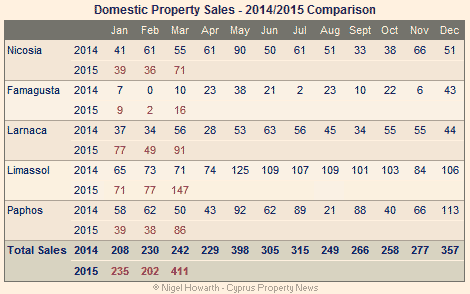
Domestic sales

Domestic sales in March increased by 70% compared with the same month last year, rising to 411 from 242.

Sales increased in all districts lead by Limassol, where the number of properties sold increased 107% to reach 147 compared to the 71 sold in March last year. Sales in Paphos increased 72%, sales in Larnaca rose 63%, while sales in Famagusta and Nicosia rose 60% and 29% respectively.

Cyprus: Domestic property sales March 2015

During the first quarter of 2015, domestic sales are up 25% compared to the first quarter of 2014 increasing to reach 848 compared to 680 last year.

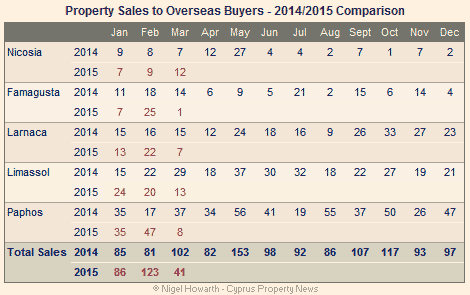
Overseas sales

With reports of Lebanese buyers being duped, the devaluation of the rouble and reports of Chinese buyers being ripped-off appearing in the Greek-language media, it isn’t surprising that overseas sales bombed in March with sales falling 60% compared to March last year

With the exception of Nicosia, where sales improved 71%, sales fell in all the other districts.

Sales in Famagusta fell 93% with just one property sold compared to the 14 sold in March 2014. Sales in Paphos were down 78%, while sales in Limassol and Larnaca fell 55% and 53% respectively.

Cyprus: Overseas property sales March 2015

During the first quarter of 2015, sales to the overseas market have dropped 7% compared to the first quarter of 2014 having fallen to 250 from 268.

President abandons home buyers

anastsiades betrays home buyersPRESIDENT Nicos Anastasiades has rejected a bill banning banks from repossessing homes that owners have paid for but have no title deeds because of developer mortgages, judging it to be in violation of the island’s bailout agreement.

In a letter to parliament on Friday, Anastasides said the bill, passed on March 19, was being sent back to the legislature because it created a general and permanent shield, not for vulnerable groups, but a number of sellers and land developers.

This, according to the president, was a departure from the provision to suspend repossessions of certain properties until April 30, 2015.

According to the terms of its bailout, Cyprus must enact effective foreclosures legislation.

According to the provision, such properties will be exempted provided the buyers paid at least 80 per cent of the sale price or have fully complied with their contractual obligations towards the seller.

In the letter, Anastasiades said the issue of trapped buyers was being handled by the ministries of finance and the interior in cooperation with the Central Bank.

Parliament removed the date – April 30 — that was included in the main foreclosures law, indefinitely banning repossession of houses whose owners have no title deeds, even though they may have paid for them in full, because the building developers had already taken out loans on those properties which they cannot repay.

In the same article, parliament added that apart from the buyer, the mortgagee must also inform “the debtor” about the provisions of the article so that the “buyer or/and (also added by MPs)” the debtor submits the necessary proof of payment.

Developers’ land and buildings are counted as assets that need to be offset against their debt to banks, which gives lenders a claim on people’s properties that had been mortgaged by developers.

Under the terms of its bailout, Cyprus has set up a task force “on registered, but untitled, land sales contracts” that must prepare a study by the end of May.

This should have been done by October last year.

Included in their tasks would be a financial impact assessment regarding title transfers and lifting encumbrances.

Parliament can now accept Anastasiades’ referral or reject it and let the matter be settled by the Supreme Court.

Capital controls to end on Monday

Cyprus to lift capital controlsPRESIDENT Nicos Anastasiades said on Friday all capital controls imposed on the island in 2013 to stem a cash flight will be lifted on Monday.

“As from next Monday, the last restrictions on capital movement concerning transactions and capital transfer abroad will be lifted,” Anastasiades said during a news conference.

“The lifting of the remaining restrictions signals the final restoration of confidence in our banking system” he added.

“From today the positive prospect for raising investments in full trust and confidence conditions is reinforced. The ability of banks to raise capital and to finance safely the economy is boosted, with a positive impact on the support of citizens, businesses and development” he concluded.

Cyprus introduced the controls in April 2013 to prevent outflows after a chaotic bailout forced the closure of one bank, and a second bank seized deposits to recapitalise.

It was the first time controls were imposed in the history of the eurozone.

It has since lifted all domestic controls but despite being eased significantly, some restrictions remain on international transactions.

Asked about the timing of the easing while Greece was in crisis over its own bailout programme, Anastasiades said: “We want to hope that there will be no further deepening of the crisis with Greece.”

Cypriot banks, he said, had fully severed their links with the Greek banking system following the 2013 crisis.

Since the crisis struck in 2013 deposits shrank to €46.5 billion at the end of February compared with €65.5 billion in the same month of 2013.

In its decision to revise the outlook for Cyprus to positive on 27th March, Standard & Poor’s said “Although domestic capital controls were completely eliminated in May 2014, we see uncertainty regarding the impact of elimination of the remaining controls on international transactions on the stability of private-sector deposits.”

New home construction increases

THE NUMBER of building permits issued in January 2014 stood at 404 compared with the 396 issued in January last year; an increase of 2 per cent, according to figures released yesterday by the Cyprus Statistical Service.

Compared with January 2014, the total area of these permits increased by 23% to 83,398 square metres from 65,564, while their value fell 4% to €75.5 million from €78.6 million.

During January, building permits were issued for:

  • Residential buildings – 270 permits
    •  
  • Non-residential buildings – 83 permits
    •  
  • Civil engineering projects – 13 permits
    •  
  • Division of plots of land – 32 permits
    •  
  • Road construction – 6 permits

New home construction

The 270 residential building permits approved in January provided for the construction of 204 new homes comprising 143 single houses and 61 multiple housing units (such as apartments, semis, townhouses and other residential complexes).

This is an increase of 17% compared with January 2014 when building permits were issued for the construction of 175 new homes.

Cyprus new home construction January 2015 vs 2014

According to the Cyprus Statistical Service, building permits constitute a leading indicator of future activity in the construction sector.

Insolvency framework delayed again

Insolvency framework delayTHE implementation of the five bills comprising the insolvency framework, which is vital for the next tranche of Cyprus’ bailout loan, has been delayed again.

Parliamentary Finance Committee President Nicholas Papadopoulos said that the bills will not be brought before the House plenum on 2nd April as originally planned, but after Easter; probably 16th April and definitely before a crucial Eurogroup meeting.

Today MPs concluded debating the fifth and final bill and next Monday the parties will submit their proposed amendments.

Ruling DISY leader Averof Neophytou asked Cyprus’ European partners for their understanding, noting the need to protect vulnerable groups. “We think that these matters are urgent and despite delaying, when we vote on them they must be legally correct and serve the aim of protecting borrowers,” he said.

AKEL general secretary Andros Kyprianou stressed that his party will only support the framework on the condition that vulnerable groups are protected.

Socialist EDEK MP Nicos Nicolaides said that the goal is to safeguard loan guarantors.

EVROKO chairman Demetris Syllouris, who holds the potential crucial vote for the approval of the framework, said that his condition for voting in favour of the bill is the adoption of his proposal, which provides a safety-net for loan guarantors. The proposal exempts loan guarantors if a property sells for less than 80% of its market value and, if a property sells for more than 80%, the guarantors will pay the balance without becoming insolvent.