Has Spain caught the Cyprus tax disease?

Has Spain caught the Cyprus tax diseasePEOPLE who bought homes in Spain at bargain prices are being hit with shock tax bills because the authorities believe they got too good a deal according to a report in the Daily Mail Online.

In Cyprus, Britain and Spain, those buying property are required to pay a tax on the property based on its market value at its date of purchase.

  • In Cyprus this tax is known as Property Transfer Fees.
  • In Britain it’s known as Stamp Duty Land Tax (SDLT).
  • In Spain it is called Impuesto de Transmisiones Patrimoniales (ITP).

In all cases the tax is calculated on a percentage of the assessed market value of the property at its date of purchase.

If you search through our archive you will find reports of the Land Registry assessing market values at 58 per cent, 37 per cent, 36 per cent, etc. more than the purchasers actually paid for the property, resulting in them having to pay significantly higher Property Transfer Fees than they anticipated.

Although it is possible to appeal the Land Registry’s valuation by applying to the Supreme Court supporting your claim with a report from a private valuer, the secretive nature of the Land Registry in Cyprus means that it will not provide the appellant with a written report supporting its own valuation.

It seems that the Spanish authorities have caught the Cyprus tax disease as the cash-strapped Spanish government is combing through tens of thousands of house sales that have taken place since property prices plummeted following the country’s deep recession over the past four years.

The authorities are comparing the declared sales price to what they believe the real value is. If the house’s sale price does not match with the official valuation of the property, the owner is asked to pay the difference in duty.

Annual property sales up 20 per cent

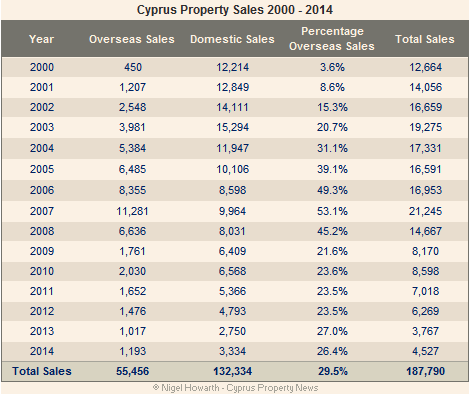
ACCORDING to official statistics published by the Department of Lands and Surveys, property sales in 2014 recorded their first year-on-year increase since 2010, growing by 20 percent to reach 4,527 compared with 3,767 in 2013.

Of those 4,527 properties 3,334 were purchased by Cypriots while the remaining 1,193 were purchased by overseas buyers.

Cyprus property sales comparison 2013-2014

In an interview with StockWatch Solomon Kourouklides, the Vice Chairman of the Cyprus Real Estate Agents Association (CREAA) said “since banks are pushing people in terms of their loan obligations, property sales started in order to make arrangements. As for the developers, interest in property sales is now directed mainly to China”.

Speculating on 2015, Mr. Kourouklides believes that the increase in sales will continue at the level of 2014 due to pressures from the banks.

Cyprus property sales stats 2000-2014

Property sales in Cyprus during 2013 were at their lowest since record began in 2000 and although property sales improved in 2014, they are still down by more than 64% on the numbers sold fourteen years ago and more than 78% down on the peak year of 2007.

Cyprus property sales chart 2000-2014

Overseas property sales falter

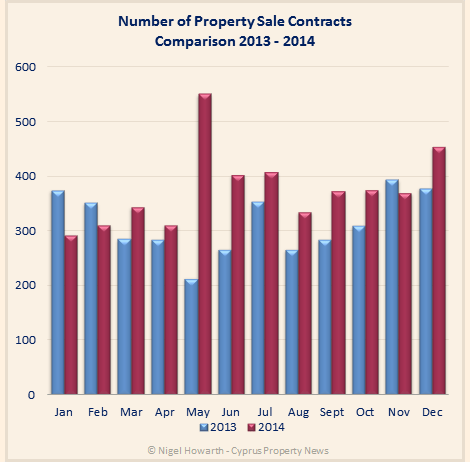
DURING December 2014, a total of 454 contracts to purchase immovable property were deposited at Land Registry offices across Cyprus; a 20 per cent increase compared with December 2013 when 379 contracts were deposited according to official statistics.

Of those 454 contracts, 97 (21%) were deposited in favour of overseas buyers, while the remaining 357 (79%) were deposited in favour of domestic buyers.

However, this increase was totally attributable to domestic sales which rose by more than a third compared to December 2013, while sales to the overseas market faltered and fell by 14 per cent.

Overall sales in 2014 stood at 4,527; an increase of 20% compared with 2013.

Domestic sales

Sales to the domestic market rose sharply, increasing 34 per cent compared to December 2013.

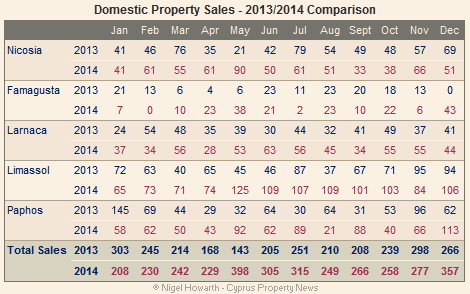
Although sales in the capital Nicosia fell (-26%), they improved in all other districts. Paphos headed the field with an 82% increase in sales, followed by Limassol (+13%) and Larnaca (+7%) and in Famagusta, where no sales were achieved in December 2013, 43 properties were sold.

Cyprus domestic property sales December 2014

Property sales to the domestic market in 2014 stood at 3,334; an increase of 20% compared to 2013 when 2,750 were sold.

Overseas sales

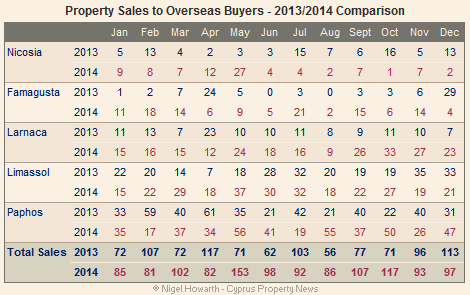
Sales to the overseas market fell 14% compared to December 2013. Although sales improved in Larnaca (+229%) and Paphos (+51%) they fell in Famagusta (-86%), Nicosia (-85%) and Limassol (-36%).

Cyprus overseas property sales December 2014

Property sales to the overseas market in 2014 stood at 1,193; an increase of 17% compared to 2013 when 1,017 were sold.

Cyprus-style bail-in EU Directive

Cyprus-style bail-in EU DirectiveDIRECTIVE 2014/59/EU that establishes a Cyprus-style bail-in framework for the recovery and resolution of credit institutions and investment firms in all EU member states entered into force on 1 January 2015.

According to the European Commission, the new rules harmonise and improve the tools for dealing with bank crises across the EU. They will also ensure shareholders and creditors of the banks pay their share of the costs through a “bail-in” mechanism.

The Bank Recovery and Resolution Directive (BRRD) was adopted in Spring 2014 to provide authorities with comprehensive and effective arrangements to deal with failing banks at national level, as well as cooperation arrangements to tackle cross-border banking failures.

Banks are required to prepare recovery plans to overcome financial distress.

The Directive grants authorities a set of powers to intervene in the operations of banks to avoid them failing. If they do face failure, authorities are equipped with comprehensive powers and tools to restructure them, allocating losses to shareholders and creditors following a clearly defined hierarchy. They have the powers to implement plans to resolve failed banks in a way that preserves their most critical functions and avoids taxpayers having to bail them out.

EU Commissioner for Financial Stability, Financial Services and Capital Markets Union, Jonathan Hill, said: “The Bank Recovery and Resolution Directive equips public authorities for the first time across Europe with a broad range of powers and tools to deal with failing banks, while preserving financial stability. From now on, it will be the bank’s shareholders and their creditors who will bear the related costs and losses of a failure rather than the taxpayer.”

National resolution funds are also being established. In the case of euro area Member States, these funds will be replaced by the Single Resolution Fund as of 2016.

The Cyprus ‘bail-in’ was part of an attempt to find €13.5 billion to bolster the island’s economy and forced savers to pay for the recapitalisation of the Bank of Cyprus.

Troika expected in Cyprus 27 Jan

A TROIKA delegation is set to return to Cyprus within weeks, after international lenders suspended Cyprus’ bailout review in September, pending the passing of foreclosure legislation.

“Technocrats from the Troika will be in Cyprus from January 27 and heads of mission will arrive on February 1 – at the end of the suspension of the foreclosure legislation,” a source within the Finance Ministry told The Cyprus Weekly.

Implementation of the foreclosure legislation means the International Monetary Fund (IMF) can finally release the €86 million, withheld from the Cyprus bailout programme. It will also renew government attempts to return to international market that were twice delayed during controversy over foreclosure legislation.

The complications began on September 6, 2014, when opposition parties added six amendments to the legislation for the protection of creditors – despite the fact that international lenders had made it clear that the amendments were unacceptable. President Anastasiades referred all six changes to the Supreme Court, receiving favourable rulings for four, with parliament accepting to overrule a fifth. The Troika agreed to turn a blind eye on the remaining amendment.

Three days later, Cyprus received €350 million from the European Stabilising Mechanism (ESM) on the condition that there would be no more delays with the foreclosure legislation.

“The government should have returned the [ESM] money,” said Professor Theodoros Panayiotou, who teaches business ethics and is a director of the Cyprus International Institute of Management.

Opposition parties maintained that the government’s failure to simultaneously introduce the insolvency and foreclosure legislation would have left creditors unprotected from the banks and suspended the legislation until the end of January, giving the government time to present the whole package of insolvency legislation to the parliament.

The government rejected the argument that creditors were left unprotected.

Finance Minister Harris Georgiades slammed the suspension of the legislation, describing it as an “unnecessary and unjustified act”.

In an effort to reach an acceptable solution for all, President Anastasiades yesterday met Interior Minister Socratis Hasikos and Georgiades. Anastasiades has already expressed his determination to ensure parliament approves the foreclosure law before January 30.

At the January 12 party leaders meeting Anastasiades will attempt to secure majority support in parliament to back the bailout programme, by offering parties the chance to re-join his administration. DIKO and AKEL have already publicly turned down his proposal.

The unloved nature of foreclosed assets

The unloved nature of foreclosed assetsTO MAKE a frappe you need water, coffee, a shaker, ice cubes, a tall glass and a straw. The total cost of these items is about €0.30, and its retail price about €2.00 – €3.00. If you leave the frappe sitting in the sun for an hour, then the ice cubes will melt, the foam will go down and the coffee will taste bitter. Its retail price now will be almost nil.

A building is much like a frappe. Its value, if the developer has done his job right, is more than the aggregate cost of its components. Leaving market forces aside, if the building is left unattended or is undermanaged, then it will progressively deteriorate, both physically and economically. The lack of maintenance will create increasingly higher repair and operational costs, which combined with limited contact with tenants, both current or prospective, will result in a built-up in grievances and to lease terminations.

A ‘Minsky Moment’ is a sudden collapse of asset values, where such moments occur because long periods of prosperity and increasing value of investments lead to increasing speculation using borrowed money. High debt levels and a decrease in demand, leads to cash flow problems for investors. The cash generated by their assets is no longer sufficient to sustain the debt they took on to acquire them, with losses on such assets prompting lenders to call in their loans. As investors and banks look to exit their respective positions, no counterparty can be found to bid at the high asking prices previously quoted. This progressively leads to a precipitous collapse in market-clearing asset prices, a sharp drop in market liquidity and a severe demand for cash. Exiting at this point can only be done if one is willing to incur the maximum level of losses.

At the end of Cyprus’ ‘Minsky Moment’ banks will end up being the owners or economic owners of a sway of assets ranging from individual plots of land to sizeable commercial assets. Commercial assets with an operational component, such as hotels, malls, multi-tenanted buildings, etc., pose particular challenges as they require hands-on asset management or else their value will deteriorate further. Assets also have various holding costs running in the background, e.g. maintenance, insurance, property taxes, as well as physical deterioration due to natural wear and tear and vandalism. For operational assets the need to act is even more pronounced as any significant or prolonged disturbance in the operation/business side, is likely to have a heightened impact on the asset’s value, for example if tour operators fear that a leisure property may close down they could terminate their contracts or divert tourists elsewhere.

In order to add value and improve liquidity, the asset manager needs to employ an “Owner Mentality” in order to tackle the gamut of issues that relate to each asset. This requires first-hand knowledge of the real estate itself, a principle often forgotten in more “transaction-based” environments. Banks need to employ this “Owner Mentality” in order to appreciate the range of factors that affect their real estate assets and maximize value by resolving problems and taking value-add steps before putting assets on the market. This will help them reduce their losses, maximize liquidity, and structure their disposal strategy in a more capital efficient manner.

Pavlos Loizou
Partner (Greece & Cyprus)
Resolute Asset Management