Repossessions bill delayed to clear troika funds

Reposessions bill delayed to clear troika fundsTHE MAJORITY of parliamentary parties decided on Monday to press ahead with two bills suspending the entry into force of repossessions-related legislation – but crucially omitted to fix a date for their move.

DIKO MP and House finance committee chairman Nicolas Papadopoulos confirmed the two items would be forwarded to the House plenary for a vote.

But the parties will hold back until after the finance minister has ‘informed’ them as to when the so-called insolvency framework is to be presented to them, he said.

Papadopoulos has written to the finance minister requesting that information.

“Pending the minister’s explanations, the House finance committee will then decide on the date of forwarding the bills to the plenum,” the DIKO leader told reporters.

Two parties, AKEL and EDEK, have submitted bills, the first to suspend implementation of the foreclosures law until July next year, the second to suspend it until the beginning of the year.

It’s understood that a possible suspension of foreclosures legislation in the first half of this month would have complicated the release of the next bailout tranche from international creditors.

Omitting to set a date for a vote on the two contentious bills likely means that no such vote will take place prior to the disbursement of the next aid tranche – due by December 15. At around that time parliament will instead be busy reviewing and voting on the 2015 budget.

In effect, the parties’ decision on Monday seems to have given the administration a free pass by de-linking the aid tranche to the timeline of the so-called insolvency legislation package.

Whereas come the New Year opposition parties may yet move to delay enforcement of the foreclosures law – thus maintaining a semblance of consistency in the eyes of the public – it would be immaterial as far as the bailout tranche goes.

Opposition parties want to suspend the foreclosures law, arguing that as it stands borrowers are left without a safety net. That safety net is the insolvency framework – comprising six bills – the effort being to protect people unable to keep up with mortgage payments because of the downturn and not those who deliberately failed to do so.

The parties’ insistence appears counter-intuitive, given that repossessions of primary residences will not be enforced before the beginning of 2015 when the insolvency framework comes into force.

Papadopoulos however stuck to his mantra that, as long as insolvency legislation is absent, the system is gamed in the banks’ favour, leaving delinquent borrowers at the mercy of lenders.

“They [banks] are already threatening borrowers with mass foreclosures, wanting to pre-empt the enactment of the insolvency framework,” he said.

Last month Finance Minister Harris Georgiades warned MPs to avoid disrupting the island’s bailout programme by passing legislation that was incompatible with the terms.

Back in October eurozone finance ministers endorsed in principle the disbursement of the next aid tranche, finding that Nicosia has amended laws on foreclosures and forced sales of mortgaged property in line with a deal with its international creditors.

But the Eurogroup also added that the payout would be recommended “so long as this situation remained unchanged.”

Battle for consumer protection to Westminster

AIPP takes battle for consumer protection to Westminster
The Houses of Parliament (photo by Adrian Pingstone)

THE ASSOCIATION of International Property Professionals (AIPP) took its battle to establish standards for the industry – and more safety for consumers – to Westminster last week. The occasion also saw a new free legal advice service to buyers.

Tuesday (18th) saw the launch of a White Paper entitled AIPP guidelines for the sale of overseas land and property to buyers from the United Kingdom, free to download here, at a reception at the Palace of Westminster where the Board of the AIPP were there to meet MPs interested in the subject and to press the case.

Although the turnout of MPs was sparse, due to a vote in the Commons, several members of the Houses of Lords and Commons did turn up to hear AIPP Managing Director Peter Robinson explain the need for government to take an interest. “AIPP is taking the initiative to review the overseas property industry with the aim to identify areas that can be improved to enable a more transparent, safer and professional cross-border transaction and make appropriate conclusions and recommendations,” he said. “We seek additional partners, agencies and commercial businesses to work with us in delivering this.”

After explaining the particular problems facing the overseas buyer, who as a cash-rich, potentially older buyer working in an unfamiliar culture and legal jurisdiction is particularly tempting to professional fraudsters, Mr Robinson outlined the path to better regulation: “To galvanise and guide this process at a governmental and supranational level, we would like to encourage the formation of a new All Party Parliamentary Group (APPG) on foreign property matters.” For this to happen, some 20 MPs must sign up, so members of the AIPP are being urged to contact their own Member of Parliament to explain the need. Mr Robinson also announced the publication of a new 50 page Buying Safely Abroad guide, available free of charge via the AIPP website, and another exciting launch, the AIPP Legal Working Group, set up by members to offer British buyers up to five hours worth of legal work:

  • 1 hour’s free consultation on the legal issues in their country of choice
  • A review of up to 50 pages of documentation

In the past year membership of the AIPP has risen to well over 300 corporate members, from 26 countries. Peter Robinson told OPP that he hopes to get the Parliamentary Group running by the end of January: “We need to move quite quickly.”

Also present at the meeting were Jesulado Ros Tonda, Secretary General of Provia, the Spanish Property Developers Association, Paul Gardner Bougaard of the Resort Developers Association, and Denise Boyes and Mike Stead from the Foreign and Commonwealth Office, who were the architects of the Know Before You Go campaign to advise Britons buying and moving abroad; Gerry Fitzjohn the Vice Chairman of the Property Ombudsman and Michael Reeve the CEO of AFPOP, the Portuguese residents’ association.

– OPP Magazine

Financial dispute mediation

THE AGENCY for out-of-court financial settlements said it will start receiving applications on Friday to appoint mediators in disputes between financial institutions and consumers who cannot service their loans in an attempt to facilitate their restructuring.

Financial ombudsman Pavlos Ioannou said that the agency’s mediation will apply in cases of credit facilities of up to €350,000 at the start of the loan agreement for the purchase of a primary residence, provided that none of the parties has resorted to legal procedures or the lender has not initiated the foreclosure procedure and the mortgaged homes are not in receivership.

The mortgage property should have been a primary residence of the owner or lessee for a minimum of six months.

Ioannou warned of high expectations. “Unfortunately due to the huge systemic problems that the financial sector of Cyprus is facing, our compatriots may have excessive expectations,” he said and added that “the result on many occasions are distortions in their strategic decisions in dealing with their mediation problems. We don’t have a magic wand to solve problems”.

Cases brought for arbitration to the agency will take up to a month before they area settled, Ioannou said, while in some cases it will be at the discretion of his office to grant an additional month for the parties to reach an out-of-court settlement.

Mediators will receive a fee of no more than €500, of which 20% per cent will be paid by the consumer, while 80% will be charged to the bank.

Pressure on House to act on foreclosures

Pressure on House to act on foreclosuresKEY ASPECTS of the new repossessions legislation are for the time being unenforceable, the attorney-general has said.

In a letter dated November 19 addressed to the finance ministry and later forwarded to parliament, AG Costas Clerides noted that certain provisions of the law – enacted in September – cannot be implemented unless the relevant accompanying regulations are first passed by the House.

Such provisions include the method of selecting auctioneers for properties undergoing foreclosure as well as the process governing the issuing of foreclosure notices.

Speaking in parliament last week, Finance Minister Harris Georgiades likewise told MPs that the foreclosures law could not be imminently enforced.

In doing so, the minister was apparently seeking to dissuade opposition lawmakers from tabling bills aiming to delay the entry into force of the contentious foreclosures legislation.

Two parties have tabled fresh legislative proposals to suspend enforcement of the foreclosures law, pending the enactment of the bankruptcy-related legislation. The insolvency framework, they argue, is necessary as a safety net for homeowners who have fallen on hard times and are unable to keep up with mortgage payments.

AKEL’s bill aims to suspend implementation of the repossessions law until end of June 2015; the other legislative proposal, tabled by EDEK and co-sponsored by DIKO and the Greens, would postpone the law until the beginning of the year – even though the foreclosures law itself does not come into effect until January 1.

The parties appear determined to press ahead with these bills in spite of the finance minister’s warning that any move impacting the repossessions law would jeopardise the disbursement of financial assistance from international lenders that is due by December 15.

Tuesday’s session at the House finance committee is crucial, as the two bills are set to be discussed and the parties expected to give their final positions.

Reports said that AKEL and EDEK intend to push the two items to the plenum for a vote this Thursday.

Earlier this month eurozone finance ministers endorsed in principle the disbursement of the next aid tranche, finding that Nicosia has amended laws on foreclosures and forced sales of mortgaged property in line with a deal with its international creditors.

But the Eurogroup also added that the payout would be recommended “so long as this situation remained unchanged”.

Also on Tuesday, the House finance committee will take a first look at a bill aimed at increasing the government’s direct control over state-owned enterprises, such as semi-governmental organisations. The bill – expected to be hotly debated – would give the government a fast-track method of sacking board members or the entire board of such entities for dereliction of duty or on other grounds.

Title deed event ‘sold out’

ACCORDING to Nigel Howarth, a Limassol based property advisor, who offers independent information and advice for Cyprus homebuyers and property investors, the lecture will focus on the efforts being made by the authorities to accelerate the issuance of title deeds and complications that have arisen as a result of the island’s economic crisis.

He said that along with disgruntled purchasers, the president of the Cyprus real estate agents’ association, Solomon Kourouklides, would be attending.

The lecture will be given by Andreas Symeou – a former senior officer with the Department of Lands and Surveys and is entitled, ‘The Title Deeds Problem: Efforts for accelerating their issuing and complications because of the economic crisis.’

The lecture will be followed by an open discussion on the issues faced by many in obtaining the deeds pertaining to property they purchased in Cyprus and how these may best be addressed.

Attendees will be asked to complete confidential questionnaires on their particular problems so that proposals to resolve them can be put to the authorities.

The questionnaire will cover a number of points including, what type of property was bought, the year the contract of sale was signed, if it’s a new or re-sale property, is there a title deed for the property and is it a clear title, as well as the reasons for it not being transferred into the purchasers name.

Howarth said that there were many outstanding issues and added that he believes ‘hidden mortgages’ are the key issue that the government must address.

“A number of property development companies have already gone into liquidation as a result of the economic meltdown and collapse of the property market. Liquidators, acting on behalf of the banks, have ‘requested’ those who have purchased property from those developers to pay a ‘contribution’ towards repaying the developer’s debt,” he said.

He added that one of island’s banks was being particularly aggressive and had approached purchasers directly demanding money in exchange for a waiver (release) from any claim that the bank has on the property.

Howarth said he believes this practice is ‘legalised extortion’.

“These people have already paid for their homes in full and the problem is totally due to the banks’ mismanagement; why should these people be expected to pay for the banks’ incompetence in running their businesses?

“While opposition parties play political games in parliament by delaying the implementation of the long-awaited foreclosures law, the banks are trying to grab every penny they can get from these vulnerable people.”

The lecture and discussion will take place on December 4 at the Technopolis 20 Cultural Centre in Paphos.

Increasing transparency in the Cyprus property market

Increasing transparency in the Cyprus property marketTHE MAIN obstacle to investing in the Cyprus property market is the limited transparency of the property market, which is coupled by the lack of clarity regarding processes and procedures.

The lack of reliable market data, combined with the on-going economic turbulence and the complications caused by the lack of title deeds on individual properties, continue to significantly hamper inward overseas investment as they heighten uncertainty regarding specific actions, projects, or assets.

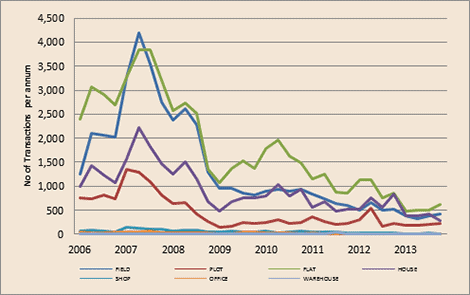
Three years in the making, Cyprus Economic Intelligence (CEI) is a centralised databank that collects, analyses, and displays information on the Cyprus property market. CEI has cleaned and filtered all transactions recorded by the Cyprus Land Registry from 2006 onwards – more than 145,000 transactions – and provides aggregate data up to the municipality or community level. Users are able to break down transaction volume by property type or price band, comparing different geographies or sub-sectors of the island over time.

Breaking down transaction volume by property type and by price band, shows that out of 144,784 properties were sold in Cyprus from 2006 up to Q2 2014 57,480 (circa 40%) were apartments. This is hardly surprising, given the type of developments that were constructed during 2004-2008 or the nature of housing in urban areas, especially in Nicosia and Limassol.

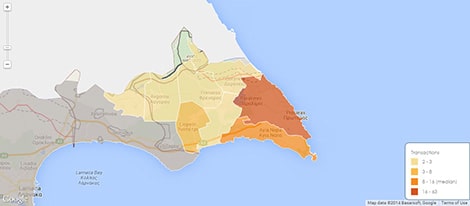
Out of the apartments transacted, 6,527 (circa 11%) were in Famagusta district, with a median price of €114,476. The transaction volume shows that the majority of apartment units transacted were mainly in the other districts, with apartments in Famagusta having a relatively lower price. The latter is understandable, given the density of the district, with most high-density real estate being located near Paralimni rather than closer to the beach.

In terms of the liquidity profile of these apartments it is important to note that during Q2 2014 31 units transacted, having a price of between €100,000-€150,000. This indicates both the rate of sale of a new development, and the liquidity profile of assets given current demand dynamics in terms of transaction volume (rate of sale) and price (demand varies by price band).

Transaction Volume of Apartments in Famagusta District (2014 Q1 & Q2)
Source: Cyprus Economic Intelligence www.cei.com.cy
Transaction Volume by Property Type (2006-2014) Source: Cyprus Economic Intelligence www.cei.com.cy
Transaction Volume by Property Type (2006-2014)
Source: Cyprus Economic Intelligence www.cei.com.cy