Insolvency bills delay

Troika officials are unhappy with delays in the insolvency billsA REPEAT of the foreclosures’ debacle may be on the cards with the so-called insolvency framework, which according to the bailout agreement must be enacted by year’s end.

With the clock ticking, a visiting team of troika technocrats on Thursday discussed the new bankruptcy legislation with an inter-parliamentary team of ‘experts’ as well as with Central Bank and finance ministry officials.

Sources close to the talks said the discussion revolved around “an initial exploration and exchange of views” on bankruptcy-related legislation currently being fleshed out and which is tightly linked to soon-to-be-enforced repossessions proceedings.

During the meeting, party officials claimed that the Central Bank is not furnishing data on the impact of new bankruptcy laws on lenders, which made it impossible at this point to assess how much protection should be extended to mortgagors who have fallen on hard times.

As it stands, the bill governing personal insolvency contains only one eligibility condition, namely, that a borrower has lost 25 per cent of his or her income over the past two years. As yet there’s no mention of the outstanding debt amount or the value of the primary (mortgaged) residence to be exempted from repossession.

According to reports, the troika technocrats insisted that following any debt restructuring a bank cannot find itself in a worse financial position than it would in the event of a forced property sale. Party officials in turn countered that the auctioning off of properties en masse will inevitably drive down mortgage values.

The insolvency framework currently consists of six bills, four of which concern corporate bankruptcy and the others relating to personal insolvency. The bills concern examinership, administration, liquidation, the introduction of insolvency practitioners, and two items relating to personal bankruptcy, such as personal repayment schemes and debt relief schemes.

Under the examinership bill, an examiner would be appointed to restructure the debt of corporations. The examiner will first determine whether a company is viable and then work with the directors in finding ways to keep the company a going concern so that it can gradually repay its loans.

Once a company is placed in examinership, no liquidation measures may be taken against it for a period of 120 days.

The bill governing administration deals with issues such as when floating charges on loans are transformed into fixed charges.

According to sources, the IMF technocrats are of the opinion that the provisions of the two bills contain a great deal of overlap, and propose that the examinership item prevail as it adequately covers both bills.

A proposal has also been floated for merging the two bills.

Per the terms of the bailout agreement, Cyprus must enact new insolvency laws by the end of the year. However achieving that time-objective is now looking increasingly unlikely.

So far, only three or four of the draft bills have been prepared. Once all the drafts are ready, they will need to be translated from English into Greek, and then forwarded to the Attorney-general’s office for legal vetting, which could take anywhere from one to two weeks. Next, the bills are sent to parliament for what is expected to be a long deliberation process, as parties are bound to introduce a host of amendments before the bills get to the plenum for a vote.

The chances of the bills reaching parliamentary committee by early December are slim to none. And in mid-December the plenum will be busy voting on the 2015 budget.

Meanwhile, the next meeting of eurozone finance ministers – known as the Eurogroup – is scheduled for December 2 or 3, where they are expected among others to give the nod to the disbursement of the next tranche of aid to Cyprus.

But AKEL and even EDEK could throw a spanner in the works should they table a legislative proposal to postpone enforcement of the foreclosures law, passage of which – without any strings attached – was a precondition for the release of the next tranche.

In a bid to protect mortgagors’ primary homes from repossession, the two parties insist the foreclosures legislation cannot be enforced unless a safety net for debtors – the insolvency framework – is in place.

Given that few sessions of the plenum remain until the end of the year, AKEL and EDEK may make their move soon, and certainly before the insolvency framework is ready.

Once again, a lot will depend on the stance of DIKO, since AKEL and EDEK will not proceed unless they have the former’s backing.

If a bill blocking enforcement of the foreclosures law is passed before the Eurogroup next meets, Cyprus’ international creditors may again withhold release of the pending aid tranche.

“Let’s hope we avoid a Round 2 of the foreclosures saga,” a source from the ruling DISY party said.

Construction sector in the doldrums

THE NUMBER of building permits authorised in August 2014 stood at 298 compared with the 351 authorised in August last year; a fall of 15%, according to figures released by the Cyprus Statistical Service.

Compared to August 2013, the total area of these permits fell by 13% to 47,060 square metres from 53,809, while their value fell 13% to €48.5 million from €55.9 million.

During August, building permits were issued for:

  • Residential buildings – 206 permits
  • Non-residential buildings – 61 permits
  • Civil engineering projects – 11 permits
  • Division of plots of land – 15 permits
  • Road construction – 5 permits

New home construction

The 206 residential building permits authorised in August provided for the construction of 227 dwelling units comprising 136 single houses and 91 multiple housing units (such as apartments, semis, townhouses and other residential complexes).

This is a drop of 2% compared with August 2013 when building permits were issued for the construction of 232 new homes.

Cyprus construction sector in the doldrums

Year to date performance

During the first eight months of 2014, a total of 3,307 building permits were authorised; a fall of 7% compared to the 3,571 permits authorised during the same period last year. The total value of these permits has fallen by 30%, while their total area has fallen 29%.

According to the Cyprus Statistical Service, building permits constitute a leading indicator of future activity in the construction sector.

Title Deed problems lecture Paphos

A FREE lecture on the problems faced by many in obtaining their Title Deeds will be the focus of a seminar to be held in the studio of the Technopolis 20 Cultural Centre in Paphos on Thursday 4th December, starting at 17:15hrs.

Entitled “The Title Deeds Problem: Efforts for accelerating their issuing and complications because of the economic crisis”, the lecture will last for about 45 minutes and will be followed by an open discussion on the problems faced by attendees in securing their Title Deeds.

The principal speaker will be Andreas Symeou, a former Senior Officer at the Department of Lands and Surveys. Andreas served forty years with the Department and holds a degree in law (LL.B, University of London) and an M.Sc degree in Urban Land Appraisal (University of Reading). He is also a member of RICS (Royal Institute of Chartered Surveyors and ETEK (Cyprus Scientific and Technical Chamber).

During the lecture a confidential questionnaire will be distributed to those attending to gather more information about the problems they face getting their Title Deeds. (Alternatively you may download the questionnaire and return it to the address shown.)

The purpose of the questionnaire is to get a clearer picture of the current situation so that concrete proposals can be put to the Authorities to resolve the problems.

Those wishing to attend the lecture and discussion should complete and send the form below. Seats are limited so book yours now to avoid disappointment.

Update 18 November

The lecture is now fully booked, no more reservations are being accepted – but please download the questionnaire and return it to the address shown.

Technopolis 20

Technopolis 20 is situated at 18 Nicolaos Nicolaides Ave (the road leading from the Paphos District Court traffic lights towards the General Hospital). Before, during and after the lecture, those attending may purchase coffee, tea, wine etc. and home-made snacks at their coffee shop.

Mass repossessions unlikely

Mass repossessions unlikelySINCE the Cyprus Supreme Court rejected four bills designed to mitigate the impact of the foreclosures bill as unconstitutional, rumours of mass repossessions have been spreading like wildfire.

These rumours allegedly emanate from opposition political parties who seem intent on spreading fear, uncertainty and doubt amongst those who can no longer afford their home loan repayments in efforts to gain support/votes.

But looking at the situation logically the banks have little, if anything to gain, from seizing people’s homes and mass repossessions are unlikely for a number of reasons:

  • Banks need capital (not property) and they are much more likely to restructure the loans of those unable to maintain their loan repayments rather than repossess their homes.
  • Anyone with property in Cyprus will know that homes need constant maintenance to preserve their value. If banks repossess homes en masse, the cost of maintaining them in a marketable condition will be significant and deplete the bank’s capital reserves until a buyer is eventually found – and the banks will also be liable for Immovable Property Tax and other related taxes on those properties.
  • Mass repossessions will flood the market that already has a serious stock overhang. This will drive property prices down even further, erode collateral values, and place more borrowers in negative equity. This, in turn, will put the banks in a position where they will need further injections of capital to stay afloat.

No-one seems to have considered who is going to buy these repossessed homes. Today, the property market is a shadow of its former self and it is going to take many, many years for the banks to sell ‘mass repossessions’.

But that is not say that the banks will not repossess properties, but in my opinion the banks will focus their attentions the ‘low hanging fruit’ first. This will include property development companies with non-performing loans that have completed/part completed but unsold developments – and I suspect there are large investors waiting for these assets to be seized and sold at a discount by the banks.

The change in the law also will help the banks put pressure on ‘strategic defaulters’ – i.e. those who can afford to repay their debts but are refusing to do so due to inadequacies in the law that enable them to delay their property being repossessed – sometimes for decades.

Of course I may be wrong – but if the banks do go ahead with mass repossessions it will probably lead to civil unrest and the annihilation of the island’s property sector.

Cyprus bailout tranche approved

Cyprus bailout tranche approved

EUROZONE finance ministers on Thursday approved handing out the next tranche of bailout loans for Cyprus after the country met the last two conditions for the payout, a Cypriot official said.

To get the 350-million-euro tranche from the European Stability Mechanism, the euro zone bailout fund, Nicosia had to amend laws on foreclosures and forced sales of mortgaged property in line with a deal with its international lenders.

A document prepared for the ministers’ meeting in Brussels said: “The program partners find that Cyprus has complied with the conditions for a positive conclusion of the fifth review.” It added that the payout would be recommended so long as this situation remained unchanged.

“Today the eurogroup reaffirmed the significant progress made on reforms for the economic recovery of the Cypriot economy,” Cypriot Finance Minister Harris Georgiades said.

“The process of releasing 350 million (in aid) which our economy needs has started,” he said.

The EU and the IMF reached a deal in March 2013 to extend 10 billion euros in aid to Cyprus, staving off bankruptcy from exposure of its banks to indebted Greece, and fiscal slippage.

A new tranche of aid, Cyprus has received about half of its bailout amount, had been delayed amid disagreement from local lawmakers on provisions of a foreclosures law demanded by lenders to make rising non-performing loans of banks more manageable.

Cyprus’ Supreme Court last week declared unconstitutional legislative amendments which essentially weakened the foreclosures process and which lenders had objected to.

Reuters

Property prices up to 9.6 per cent down

ACROSS Cyprus, residential property prices for both houses and apartments fell by 1.6% and 1.0% respectively during the third quarter of 2014, with the biggest drop being in Nicosia (3.4% for houses) and Limassol (1.5% for apartments).

Values of retail properties fell by an average of 2.0% and those of offices by 1.4%, while those of warehouses remained stable, according to the twentieth publication of the quarterly RICS Cyprus Property Price Index.

Compared to the third quarter of 2013, the average price of a residential apartment has fallen by 6.3% and the average price of a 3-bed semi has fallen by 4.4%. Retail property has fallen in value by 9.6%, offices by 6.3% and warehouses 4.2%.

RICS Cyprus reported that due to the prevailing economic conditions and the turbulence in the Cyprus banking system, there was a lack of transactions during the quarter. Local buyers in particular were the most discerning as the increase in unemployment and the prospects of the local economy maintained the lack of interest. Furthermore, those interested were unable to access bank-finance or their deposits.

The recession in the Cyprus property market is causing major problems for the banks and borrowers, many of whom are now in negative equity.

Overall property price falls

Since the first RICS Cyprus Property Price Index was published for the first quarter of 2010 residential house values have fallen by an average of 29%, while those of apartments have fallen 39%.

(Note that the RICS Price Index does not include prices of holiday homes.)

Rental values

Rental values recorded a quarterly drop of 1.2% for apartments, 0.9% for houses, 3.2% for retail units, 0.4% for warehouses, and 0.9% for offices.

Compared to the third quarter of 2013, rents dropped by 4.7% for apartments, 4.1% for houses, 11.2% for retail, 9.2% for warehouses and 4.6% for offices.

Gross yields

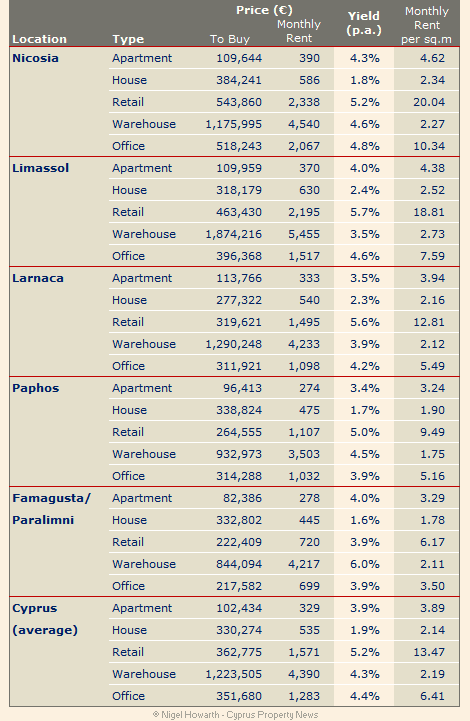
At the end of third quarter of 2014 average gross yields stood at 3.9% for apartments, 1.9% for houses, 5.2% for retail, 4.3% for warehouses, and 4.4% for offices.

The parallel reduction in capital values and rents is keeping investment yields relatively stable and at very low levels (compared to yields overseas). This suggests that there is still room for re-pricing of capital values to take place.

RICS Cyprus Property Price Index Q3-2014

Contributing professional bodies

Profile of RICS

RICS – the Royal Institution of Chartered Surveyors – is the largest organisation for professionals in property, land, construction and environmental assets, worldwide. The organisation was created in 1868 and now has over 140,000 members in 146 countries. RICS Europe is based in Brussels and represents 17 national associations, with over 8,150 members in Continental Europe. Visit www.joinricsineurope.eu and www.rics.org for more information.

Profile of ?EEOKK

The Cyprus Association of Quantity Surveyors and Construction Economists (??????) is the association that represents Chartered Quantity Surveyors and Quantity Surveyors whose main area of work is in Cyprus and they permanently live in Cyprus. Visit www.seeokk.org for more information.

Index parameters and methodology

Methodology

The methodology underpinning the RICS Cyprus Property Price Index was developed by the University of Reading, UK. The report may be viewed by clicking here.

Coverage and Variables Monitored

The RICS Cyprus Property Price Index monitors the urban centres of Nicosia, Limassol, Larnaca, Paphos and Paralimni-Famagusta. The Index only tracks prices in Republic of Cyprus’ government controlled area and not in the occupied North.

In each of these centres, the index monitors the Market Value and Market Rent, as defined in the RICS Red Book, across the four main property sectors – office (CBD), retail (high street), industrial (warehouse) and residential (houses and apartments).

Recognising that there are sub-districts within these urban areas which operate and behave in a varying manner, a number of these is monitored in order to derive the composite index for each category per urban area.

The information provided in this publication is based on the average price and rent of the sub-districts monitored per urban centre per sector. The complete list of these sub-districts can be found in the University of Reading’s report which may be viewed by clicking here.

Nature of Notional Buildings

The RICS Cyprus Property Price Index monitors hypothetical or notional buildings, each having specific characteristics. Details of these hypothetical properties are provided in the University of Reading’s report.

The provided price per sqm is based on the Gross External Area of the property (as defined in the RICS’ Code of Measurement Practice 6th Edition), which includes the living area and covered verandas but excludes common areas.