SPEAKING after a meeting with President Nicos Anastasiades on Monday morning, chairman of the bank association Giorgos Georgiou said they will convene in the afternoon to decide on certain issues relating to the bill that will be positive for bank customers.
“Commercial banks have no intention to foreclose on the homes of vulnerable groups. There should not be such a concern,” Georgiou told reporters.
Anastasiades saw the chairmen and CEOs of commercial banks and co-operatives in the presence of the ministers of finance and interior.
Georgiou was echoed by Bank of Cyprus chairman Christis Hassapis who described the bill as an exceptionally useful and effective legal framework.
“All countries in the world must have effective legislation. There are many borrowers who strategically do not pay,” he said. “The legislation will force them to come and pay.”
Current legislation makes it next to impossible for banks to repossess mortgaged properties.
Procedures are way too slow often taking over 10 years. The proposed legislation speeds up the process mainly by removing the land registry from the picture and allowing private auctions.
This has raised concerns among opposition parties who warned they will reject the bill if it was not improved.
Hassapis said his bank’s priority would be to restructure all viable loans.
“Rest assured that Bank of Cyprus will only move to foreclose only after exhausting all means at its disposal,” he told reporters.
He said it was logical that lenders would go after large borrowers first before moving onto smaller ones.
“BoC’s intention is to look at large borrowers first. Small borrowers have nothing to fear,” he added. “We will start with the millionaires and work our way down.”
The bank has already announced various schemes for small borrowers and more were expected on Monday or Tuesday, Hassapis said.
BoC has a scheme for unemployed individuals that allows them to pay five euros per month for three years.
Businesses who saw their turnover reduced by over 25 per cent can also apply for help.
AN ACCOUNTS clerk at one of Cyprus’ largest and most respected construction companies (yes, they exist) spent her annual summer holiday ascertaining which of the company’s (sold) properties – whose ‘occupants’ await title deeds – would be sent their Immovable Property Tax (IPT) bills directly by the relevant authority.
Unfortunately for the company, forty per cent of their housing stock remains unsold.
IPT bills amounting to fifty thousand euros will fall to the company, which now seeks to negotiate ‘better terms’ with the minister of the interior to reduce the load – as will hoteliers, large manufacturers and farmers.
‘A deal’ was struck between bankrupt developers and Interior Minister Socratis Hasikos to stop outright theft of both the state and ‘untitled occupants’, who were previously invoiced IPT plus ‘outrageous’ commission by those same developers, many of which are not paying their bills.
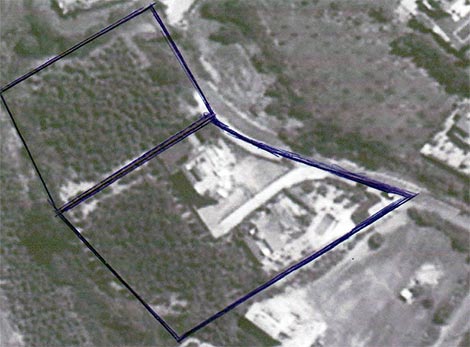
A resident of Peyia printed out the cadastral plan which should have shown a total of 48 plots with houses, but only 16 houses of the 48 are shown on the plan.
If registration tax is paid on the purchase of a plot, it costs almost nothing to register the house on that plot. But by not registering the house you avoid paying refuse collection and higher local and national IPT charges.
In other words, blatant tax evasion! Pictured is a Peyia site plan (sheet 45/Plan 17W1/Block 3). The outlined smaller parcel is a field of 3971 m². Its 2013 valuation of 337,500 euros works out at 85 euros m².
The larger parcel is 5368 m² with two very large houses and pool. Its 2013 valuation is 456,300 euros, which also works out at 85 euros m². Yet, it seems that no account has been taken of the two large houses and pool, which are clearly visible on the DLS website.
The new 2013 valuations will be seen as yet higher indirect taxation in 2015 for ‘high density build’ concrete palaces even though Hasikos claimed that IPT bills would be reduced after the DLS had discovered a further 300,000 unregistered properties/land, all clearly visible on Google Earth.
Hasikos also said that the number of ‘untitled’ would be reduced from 100,000 to around 2000 by the end of this year. You bet it will!
And what about those 300,000 Googled.
Will they be backdated to pay 2013 as well as 2014 IPT or will the minister make the same offer as did some genius from the ministry of transport for non-payers of road fund licences?
IPT bills this September are based on 1980 valuations and charged at the same amount as last year; a 15 per cent discount (10 per cent in 2013) deductible if paid before the end of October.
IPT on 2013 valuations will become payable in 2015. If it is below 200,000 euros, you should have nothing to pay ‘promises’ Hasikos – anything above will be charged at one euro per thousand.
The new IPT was initially announced as a one off by Hasikos. But he is blessed with what the Chinese call ‘sweet lips’ – unaccountable gift of the gab just like the rest of them.
The disgruntled will have a year to dispute 2013 valuations at their own cost. But when you consider that the DLS took barely six months to arrive at 2013 valuations yet all of ten years to produce 1980 valuations, thousands of disputes between the DLS and surveyors employed by ‘les disputants’ are unavoidable.
Ten or more names on high density land title deeds will reduce IPT bills considerably (allowance of 12,500 euros per head) and this is the ‘artful’ way forward. But beware! You will never sell the property unless all ten named agree. No easy task in Cyprus.
The construction company’s accounts clerk likened the DLS to a malignant cancer (chaotic). Fearful of an operation to remove the cancer (reorganise) and thereafter undergo radiotherapy (public outcry), the DLS forewent the operation (prevaricated) in the hope that the cancer would not spread.
But when the troika arrived last year, the DLS complained of a noticeable loss of appetite (income) and body weight (files) combined with perpetual fatigue (laziness) caused by a troika demand to reduce considerably title deed backlog.
Most other government departments – health, education, Inland Revenue, defence, etc. – will be obliged by the MOU to undergo drastic reorganisation to improve the manner in which they conduct their affairs.
Crying ‘foul play’, as the administration will, means drastic measures to reduce costs/debt and increase taxation are inevitable. Let’s take NPLs for example.
Stage one: The House of Reps is presented with a troika NPL repossession bill. All political parties pompously reject it.
Stage two: The Minfin is threatened by the troika with non-payment of the next tranche if the bill is not passed. Political parties rumble discontent but still reject the bill.
Stage three: The House is threatened by the Central Bank with the demise of our banks if the bill is not passed. There is yet more senseless mumbling by politicians and union bosses, but a silent majority ‘crosses the floor’.
Stage four: The economy is threatened with total collapse if the bill is not passed followed by exit from the eurozone and hyperinflation. And to top that lot, Archbishop Chrysostomos requests so called bankrupt developers as well as doctors, lawyers et al, to return illicitly hidden funds from abroad.
The shock horror bill on repossessions of NPLs will be passed intact with a ‘vague’ proviso that the government will ‘protect’ vulnerable groups from the hangman (the troika), who is just waiting in the wings for the indebted to climb the scaffold steps.
The vast majority of NPLs are owed by developers, and to a lesser extent SMEs, employees of banks, the administration and SGOs, who all received preferential terms from banks to build huge concrete palaces in high density areas, ergo insurmountable debt and costlier 2015 IPT.
IN 2008, after failing to get its presidential candidate into round two of the Presidential elections, DIKO has done the unthinkable and backed Demetris Christofias a die-hard communist of limited ability to become the President of the Republic of Cyprus. Christofias’ five year reign has given Cyprus two explosions.
The first, a physical explosion, at Mari where thirteen people lost their lives and the main power station of the country at Vassilikos has been partially destroyed.
The second was at the very foundations of the country’s economy which came about from the worst economic management of public sector finances and a near total lack of regulation and control of the banking system.
The banking crisis was blamed on Christofias and his lack of ability and unwillingness to take advice, although in truth, the banking bubble was brewing for some years even before Christofias came to power. As Bloomberg Businessweek wrote in a report on 21 March 2013, the problem was that “Cyprus’ two biggest banks couldn’t manage the flood of deposits [and] Cypriot regulators fell short as well”.
Nevertheless, in polls conducted shortly before the end of his presidential term, Christofias was voted as the worst president to have held office since the foundation of the Republic. Moreover, when Cyprus finally asked for a financial bailout in June 2012, President Christofias was guilty of stalling the negotiations as he was unwilling to accept measures such as privatization, thereby accentuating the economic problem and leaving a real mess to his successor to clean up.
Soon after being installed in power, taking over from the Christofias’ Government, the newly elected Anastasiades Government, found itself in dire straits regarding the state of the economy and the painful options that were laid out before it in the iniquitous Eurogroup of March 2013.
The new president, in his beloved method of “charm them and win them over” has tried his utmost to persuade our European partners and the World Bank representatives that no bail-in was necessary and that if we had to do something, we should be content to “tax” all the deposit holders (including those accounts with balances of under €100,000 which as the head of the State he was obliged to be the guarantor and protector of) with an across the board bail-in of 9.9%. A curious number indeed, by the way. It is as if some bigger force has mandated that a bail-in of higher than 10% would not be acceptable.
It was a taste of things to come for a Government and President that makes up policy by public relations. The problem with such President of course is that he soon becomes vulnerable to organised interests who happen to have or can somehow secure access to the Presidential Palace.
Unfortunately, an over-confident president with a dominant and overwhelming personality but one who, as it seems, is also superficial and conniving in his approach, is liable to drive the country into new and bigger dangers and risks. And this, I am afraid, is what may be happening right now.
The latest piece of presidential political mastery may have come about in the role the President may have played in the recent takeover of our systemic banks by hedge funds. For about six months, when I was a member of the Interim Board of the Bank of Cyprus, we rebuffed hundreds of hedge funds who were trying every which way to enter through the back door and take over at greatly discounted prices the loan portfolio of the bank. We slammed the door because we very well knew that the bank (and the country) could not sustain such losses. We also had a fairly good idea of how hedge funds operate. They basically suck the blood out of governments and financial institutions in distress making themselves a quick huge profit and move on. This is the last thing the after bail-in Cyprus needed.
A financial expert has characteristically recently commented, “We need hedge funds taking over our banks like we need the Ebola virus in Cyprus”. Of course, when one is at the edge of the cliff and about to fall down to a certain death he is perhaps willing and is wise to accept a parachute that is full of holes. At least this way, he stands a chance to survive, be it at the cost of sustaining very serious injuries. The question we should be asking, however, is why we have allowed ourselves to come to this point? Why indeed a whole year has passed without taking any reconstructive measures both at the Government and Bank level? The proposal to create a Development Bank to take the lead in the restructuring of major projects in the economy for example was quickly thrown in the recycle bin.
Typically, the current debacle has unfolded following reports of private meetings at the Presidential Palace with Mr Hourican and some “prospective investors”. Seemingly, as if the stage was set, soon enough we witnessed the parameters of the passing of control of ownership of the Bank to hedge funds rather clearly spelled out and mandated by the Central Bank and strongly supported by the Minister of Finance. The end result is that the hedge funds are now triumphantly, and as saviours, entering the Bank of Cyprus through the front door, but very suspiciously, via and courtesy of the Presidential Palace.
Our president, and in truth, most of our politicians who are now criticizing the new and totally necessary law for a legal framework that allows for a quick resolution in liquidating mortgaged assets that secure non-performing loans have once again failed to understand how hedge funds operate and what is really at risk.
As Mr Hourican and the new boss at Bank of Cyprus Wilbur Ross were so quick to point out in articles in the local press, almost as if they were already prepared for it, it is not their intention to engage in an immediate selling off of mortgages. I believe them. In fact, the real threat is from selling the loan portfolio of the bank which will subsequently be packaged and sold to investors. Indeed, if it was possible for investment banks to do this in the United States with packages of sub-prime loans, how easier would that be with well collateralised loans that are likely to appreciate in value in the next three to five years? Moreover, this is not likely to take place until after the bank passes the stress tests and becomes a member of the new European Central Bank network of banks. This way, it will be possible to sustain the losses the bank will inevitably incur from selling off their loan portfolio at hugely discounted prices as ECB and the Government of Cyprus will have to pick up the bill of recapitalising the bank once again. Soon, after the selling off of the loans I expect the Hedge Funds will also sell off their shares in the bank and move on to “save” other distressed countries and financial institutions in the world.
The auctioning of the acquired mortgages will happen gradually in order to cover the interest due to bond holders with a major sell off happening perhaps in 3-5 years when, as they expect, the property prices in Cyprus will recover and will thus generate a huge profit for them.
What is really at stake is that this wealth transfer will go outside Cyprus. Even in the case where the Bank takes over the properties or of creating an Asset Management Company in Cyprus, value would be preserved and remain to a large extent within the country. This is the major risk our politicians must be aware of and should be thinking of ways to contain.
In my opinion, instead of asking for many changes to the new bill which are not even feasible let alone desirable, such as to compel the bank to settle the whole loan when it auctions a mortgaged property, our political leaders should try to understand what is likely to happen and think of ways to guard against or at the very least mitigate its impact on the people of Cyprus. For example, a simple condition in the new law to be drafted making it illegal to sell off loan assets outside the Cyprus Banking system (a very reasonable condition based on the lender-borrower contract) will go a long way towards achieving this objective.
The bottom line is that a president who cannot judge the character and true intentions of people around him or assess the real situation of the country, and I may add, one that is evidently more concerned with his image rather than substance, is the worst that could have followed the “egocentric and incompetent” style of the previous president. The country cannot survive consecutively two such presidents. In fact, I don’t think any country can.
About the author
Savvakis C. Savvides is an economist, specialising in economic development and project financing. He is a former senior manager at the Cyprus Development Bank and has been a regular visiting lecturer at Harvard University and more recently at Queen’s University, Canada. Visit the author’s page.
THE TROIKA of international lenders is increasing the pressure on delinquent borrowers through the updated MoU issued following the conclusion of fifth review of the Cyprus €10 billion bailout.
The lenders’ suggestions come as non-performing loans (NPLs – loans in arrears over 90 days) in the Cyprus banking sector reached €27.5 billion in May.
The Troika, comprising the European Commission, the European Central Bank and the International Monetary Fund (IMF) believe that the way forward with regard to the containment of the rising NPLs is debt restructuring through the bank’s internal restructuring units under the guidance of the Cyprus Central Bank (CBC).
However Cyprus lenders (notably the IMF) believe that the extent of the rise in NPLs is partly due to strategic defaults and delinquent borrowers, who refuse to service their loans despite having the ability to do so.
According to the fifth update of the MoU, the CBC will issue revisions of the Arrears Management Directive and of the Code of Conduct on Arrears Management by end-November which will assist only households and small and medium-sized enterprises.
“The revised Code of Conduct will target only households and Small and Medium-Sized enterprises,” says the MoU.
The amendments will include specific procedural steps and precise deadlines attached to them, facilitating swift procedures within an appropriate time limit with clear start and end date to the restructuring procedure.
The CBC will also incorporate in the Code of Conduct and definition for a unified measure of viability based on a reasonable standard of living as defined in the insolvency framework.
Furthermore, “to ensure that the banks are held accountable for offering sustainable restructuring solutions,” the CBC will issue specific guidance to banks on operational and financial indicators, such as the ratios of proposed, concluded and successful restructurings as well as on tools to determine the capital cost of restructuring solutions by the end of October.
The MoU stipulates that legal amendments to the law on financial ombudsman will be adopted in order to clarify that the responsibility for assessing compliance with the Arrears Management Directives is not transferred to the mediators but remains with the CBC.
However the updated MoU features elements that will increase pressure on delinquent borrowers.
The Cypriot authorities are called on to allow lenders to obtain adequate updated information on the financial situation of delinquent borrowers under sufficient safeguards via court order if necessary.
For this reason, the authorities will engage an independent legal consultant to provide a report by end-October to identify the needed legal amendments. The authorities will develop a time-bound action plan by end-November and start its implementation by December.
Furthermore, the authorities with the assistance of an independent legal consultant will prepare a study by end-October and a time-bound action plan by end-November for removing impediments for lenders to file for, and obtain, an attachment of financial assets and earnings of delinquent borrowers as well as to realise such attachment to satisfy their claims under sufficient safeguards. According to the MoU, the implementation of this action plan will start by December.
Market for distressed assets
Based on the MoU, “in order to encourage a market for distressed assets and to facilitate the issuance of securities by securitisation vehicles, the authorities will allow and facilitate lenders to transfer existing individual loans together with all collateral and securities to third parties at minimal transaction costs without having to obtain the consent of the borrower.”
“Any information obligation of the creditor should not be an impediment for the transfer and or securitisation of loans,” the MoU adds.
With this objective in mind the MoU notes that the Cypriot authorities will establish a task force, consisting of relevant stakeholders from the public and private sectors, which will finalise an assessment of existing impediments and of required legislative amendments by end-November. The assessment will include a review of the regulatory framework for non-bank third parties.
The identified impediments will be removed and legislative amendments made by the end of January 2015.
ONE of the key issues facing many who bought property in Cyprus is their inability to obtain Title Deeds as corrupt developers have previously mortgaged the land on which that property was built – a fact that was ‘hidden’ from purchasers when they agreed to buy.
As any prior claims, including mortgages, take precedence over sales contracts deposited after all earlier claims lodged at the Land Registry, those who purchase property are unable to obtain its Title Deed until those prior claims have been settled.
Although a new law was introduced in 2011 that provided ‘new’ purchasers with a degree of protection against this deceitful practice, it relies totally on the honesty and integrity of lawyers and vendors to advise their clients accordingly – or an intimate knowledge of the Cyprus immovable property laws, which are very different to many other countries, including the UK.
There are possibly thousands of deed-less homes built on land that developers have used as collateral to obtain mortgages, which will be at risk of being seized if the mortgage becomes non-performing or if the company fails and is liquidated. This situation will be exacerbated when the Cyprus parliament finally passes a law on foreclosures as it will accelerate the seizure and sale of mortgaged property if that mortgage is non-performing.
A number of development companies are currently being liquidated and liquidators have ‘requested’ that purchasers without deeds contribute to repaying the developer’s debts or face the consequences even though they have paid for the property in full.
Many of those facing these ‘requests’ are pensioners who used the proceeds of their home sales in the UK to fund the purchase of a retirement home in Cyprus. They simply have no money to pay. But we must not forget that there are probably many more Cypriots in the same situation.
There have been some positive (if limited) developments to rectify this corrupt practice. Paragraph 1.31 of the fifth revision of Memorandum of Understanding MoU, which the Cyprus government has agreed with the Troika of international lenders states:
“The Task Force on registered, but untitled, land sales contracts will, by end September, finalise a study assessing the magnitude of registered, but untitled, land sales contracts and underlying mortgages, in close cooperation with the working group reviewing the issuance of title deeds under the MoU provision 5.3.
Based on this assessment and the recommendations developed so far, the Task Force will coordinate the work of the authorities involved and develop, by end-October, an action plan addressing at least,
(1) the removal of administrative hurdles for the transfer of title,
(2) the provision of tools to encourage the release of encumbrances on properties to facilitate title transfer, and
(3) the development of contractual standards for land sales contracts and connected loan and mortgage arrangements.”
Although this may be seen as a small step to secure the rights of those who have been duped into buying property built on mortgaged land, it is a move in the right direction. If the government meets its agreed target to prepare an action plan to deal with this issue by the end of October, we should know how this very worrying problem is to be resolved when the next review by the Troika takes place.
The Task Force comprises representatives of the Central Bank, the Ministry of Finance, the Law Office and the Land Registry.
THE INLAND Revenue Department has announced that it will start sending out Immovable Property Tax notices to property owners at the end of August to pay their annual property tax imposed as part of the bailout memorandum.
A spokesman from the Inland Revenue said that owners who pay by the end of October will receive a 15% discount on the amount due; those who pay after the end of October will pay the full amount, but a 10% surcharge and interest will be imposed on those who delay paying until after 30 November.
The spokesman added that a provision in the law stating that the occupant of unregistered property is liable to pay the tax is causing a major headache for Inland Revenue staff. This is due to the fact that the law also states that the property developer is still liable to pay the tax if he is responsible for failing to provide the purchaser with the property’s Title Deed, which has to be proved by the buyer.


 SPEAKING after a meeting with President Nicos Anastasiades on Monday morning, chairman of the bank association Giorgos Georgiou said they will convene in the afternoon to decide on certain issues relating to the bill that will be positive for bank customers.
 Savvakis C. Savvides is an economist, specialising in economic development and project financing. He is a former senior manager at the Cyprus Development Bank and has been a regular visiting lecturer at Harvard University and more recently at Queen’s University, Canada.

 THE INLAND Revenue Department has announced that it will start sending out Immovable Property Tax notices to property owners at the end of August to pay their annual property tax imposed as part of the bailout memorandum.