Repossession agreement leaked

ALTHOUGH the Cyprus government remains tight-lipped about details of the agreement reached with the troika easing the procedures for property foreclosures, some details have been leaked to the media.

According to information we have received, which we cannot confirm at this time, the key provisions of the law required to make repossessions more effective and less time-consuming include:

  • An assessment of the value of the property in question will be made by the bank and its owner(s). If there is a discrepancy between the two valuations a further valuation will be made by an independent third-party appraiser.
  • The property will be auctioned with a starting price of 80% of the its value as assessed by the above valuation procedure. The price will remain confidential and its publication will constitute a criminal offence.
  • The selling price of the property will remain valid for a period of three months, after which it will be reduced to 50% of its valuation.
  • If the property has not been sold within a year, its value will be re-assessed, but at no time will its selling price be dropped below 50% of its valuation.

The repossessions bill and a second bill on the subject of insolvency are designed to address the issue of non-performing loans, which are currently hovering around 50% of all outstanding loans.

European Commission officials have warned that the repossessions law has to be approved by Parliament before any new aid is distributed.

Cyprus Immovable Property Tax 2014

Immovable Property TaxALTHOUGH I have been highly critical of the amendments to Cyprus’ Immovable Property Tax (IPT) law for 2014, I have to admit that it does contain some good points.

However the law, in my opinion, will require the hiring of additional staff to deal with the many disputes, delays, complaints that are bound to arise leading to increased costs of collecting the tax.

This bureaucratic nightmare and additional cost could be easily avoided if the Land Registry were to have the Title Deeds to a property available for transfer on the delivery of a property to its purchaser. But their capacity to do this so far is a triumph of ambition over ability.

As readers will be aware, the Cyprus government originally proposed that IPT would be based on updated property values, rather than 1980 values. However, Parliament rejected the proposal as it shifted the burden of taxation onto the owners of medium value properties to the benefit of large owners such as property developers, who would pay less.

Eventually a last minute deal (a cross between a horse and a camel) was reached. Fifty three of the fifty four MPs voted that IPT would continue to be based on a property’s 1980 value.

The good points

It’s a face-saving change for Interior Minister Socratis Hasikos who told CyBC that “people will be asked to pay less than last year and the reason is very simple, many more properties have been included”, when referring to the original proposal as many people would have paid more tax.

People will pay less tax

  • A rebate of 15 per cent will be available to those who pay their IPT by 31st October 2014.
  • Home buyers who have yet to receive their Title Deeds will no longer have to pay their developer the IPT they have paid on their behalf (as usually stated in their Contract of Sale). This means that they will pay IPT at a much lower rate than the 1.9 percent paid by their developer – and they will also avoid the ‘enthusiastic charges’ imposed on them by the more nefarious developers.
  • Property developers are required to provide the authorities details of properties they have sold and which have yet to be transferred to their purchasers:

(a) The distinctive features of the sold unit building,

(b) the name and address of the purchaser or transferee or beneficiary of the construction unit,

(c) the date of sale or assignment document

(d) the date of completion of the building,

(e) the date of delivery of possession of the building unit sold to the purchaser or transferee,

(f) the percentage of the total area of the building and the land attributable to the unsold.

This will enable the Land Registry to assess the 1980 value of the property in question and the Inland Revenue can then issue an IPT notice to the purchaser.

The law contains provisions that removes a developer’s obligation to report details of properties they’ve sold if the company is in liquidation or if the delay in issuing Title Deeds is the fault of the owner (the developer) although who is going to decide the developer is at fault and how they’re going to reach that decision is not specified and will potentially be the subject of many claims and counter-claims.

Immovable Property Tax rates

The tax rates remain unchanged from last year:

Assessed 1980 Property Value
Tax Rate
Tax
Cumulative Tax
€1 to €12,500 nil €0 €0
€12,501 to ?€40,000 0.6% €240 €240
€40,001 to €?120,000 0.8% €640 €880
€?120,001 to €?170,000 0.9% €450 €1,330
€170,001 to €?300,000 1.1% €1,430 €2,760
€?300,001 to €?500,000 1.3% €2,600 €5,360
€500,001 to €?800,000 1.5% €4,500 €9,860
€800,001 to €?3,000,000 1.7% €37,400 €47,260
More than ?€3,000,000 1.9%

Those owning property(ies) whose total 1980 value exceeds €12,500 will pay tax on their total 1980 value.

Recommendations

Unfortunately, we cannot choose the laws we wish to obey, and although I consider this law totally illogical, irrational and unfair, all should comply or be prepared to face the consequences.

For those without Title Deeds:

  • Ensure your developer has your current address and contact details so that the Inland Revenue will send your IPT notice to the correct address.
  • Do not pay 2014 Immovable Property Tax to your developer. Your developer is obliged to advise the authorities details of the property you purchased so that the Inland Revenue may send you an IPT notice directly – and I’m sure that no-one wants to pay IPT twice!
  • If you believe the 1980 value of your property as assessed by the Land Registry is too high, you may challenge their valuation.
  • If you believe that your IPT has been incorrectly calculated by the Inland Revenue, you may challenge their calculation.

Further reading

Cyprus Immovable Property Tax Law Amendments (2014) – note the first 8 pages contain the Greek text, the remaining 3 an approximate English translation.


Aristodimou favours full investigation

Theodoros Aristodimou of Aristo Developers
Theodoros Aristodimou – Photo credit: paphosnet

AN EXTRAORDINARY session of the Paphos Municipal Council, convened to discuss a controversial land demarcation permit issued to Aristo Developers, decided to uphold the decision pending completion of a police investigation on the matter, the CyBC reported on Friday.

The session was attended by Aristo boss, Theodoros Aristodimou, who reportedly unleashed a verbal attack on council members and those who “tried to tarnish the name of his company.”

Aristodimou, who also served a stint as chairman of the Bank of Cyprus, denied allegations of fraudulently altering plot dimensions and switching plans in the case file in order to enlarge the demarcation area.

Speaking at the Paphos Municipal House after the session, Aristodimou said he favours the full investigation of the matter by both the police and the Attorney-general’s office.

“The truth must shine, and efforts by some to emotionally murder me, my family and the employees at my company shall fail,” he said.

Aristodimou called on all council members that approved the demarcation to commit to personally bearing the cost of any damages payable to his company by the municipality in case he is acquitted, and pledged to pay double the fine if Aristo is found guilty.

He claimed the council members based their decision on erroneous data, appealing to the police for a full investigation.

During the session, the room was packed with Aristo employees and concerned citizens.

Earlier in the week, daily Politis had reported that Aristodimou, his wife Sotiroulla, and former municipal engineer Savvas Savva, were named as suspects in a police report submitted to the state legal services.

The case was reported to police on July 1 and concerned an application filed by Aristo Developers, Aristodimou’s company, for a permit to demarcate 177 plots in the Skali area.

The application was approved, but according to the complaint filed to police, it later emerged that new plans were added in the file and the previous ones had been annulled.

With the new plans, the company basically took back some 5,000 square metres, which had been previously earmarked as green spaces in accordance with the rules and regulations.

The value of the land was estimated at €2.0 million, Politis said.

The company denied the accusations, saying the municipality got the calculations wrong. It claimed that the municipality had asked for new plans to be submitted and the discrepancy came about because the land area was bigger than what was recorded on the title deeds.

The changes in the demarcation of green areas were made at the behest of the water department to protect a stream.

Cyprus making relatively good progress

INTERNATIONAL lenders concluded a fifth review of Cyprus’s economy on Friday, saying the island was making “relatively good progress” after a bailout last year but that key challenges lay ahead.

Representatives of the lenders, the troika – comprising the European Commission, the International Monetary Fund and the European Central Bank – said the island’s fiscal performance was on track and that the banking sector had started to stabilise.

But it said non-performing loans exceeding 50 per cent of banks’ domestic bank loan books needed to be addressed.

Lenders and representatives of the Cyprus government agreed on key provisions of a more effective foreclosures law to replace the time-consuming current process, under which it could take a bank up to 20 years to reclaim what it has lent.

“The key challenge is getting a handle on the non-performing loan issue,” a senior EU Commission source said.

“Right now, NPLs are exceeding 50 per cent of domestic banking loan books. It’s crystal clear this is an issue which needs to be addressed.”

The law will require ratification by parliament and will exclude primary residences from foreclosure until a new and more effective insolvency law takes effect from January 1.

Commission officials said that was a “prior action”, which means it must be approved by parliament before new aid is disbursed.

Complimentary tickets to NEC property exhibition

Laura Hamilton, Jasmine Harman, Jonnie Irwin and Amanda Lamb

A PLACE IN THE SUN LIVE is the UK’s largest and best attended overseas property exhibition next taking place at NEC Birmingham 3rd – 5th October 2014.

The official exhibition of the hit television series, A Place in the Sun Live attracts thousands of serious overseas property hunters every spring and autumn. There are hundreds of exhibitors showcasing properties from popular countries such as France, Spain, Italy, Portugal, Turkey and Florida providing the perfect opportunity for visitors to meet agents, developers and service providers face-to-face.

There’s a packed programme of free-to-attend seminars in The A Place in the Sun Hub with advice and insight from Jasmine Harman, Jonnie Irwin, Amanda Lamb and Laura Hamilton, gained from many house-hunting episodes around the world with the A Place in the Sun TV crew. And with A Place in the Sun Editor Liz Rowlinson hosting panel sessions with industry insiders and expert Q&As, there’s everything from the fun of the hunt to the serious business of buying overseas property the right way.

For more in-depth information on particular destinations, there are dedicated feature areas and seminar theatres for the most popular countries with the French Property Village, Italian Property Pavilion, Portuguese Property Pavilion and Florida Property Pavilion. Focussed, dynamic and ever-popular, these areas deliver a full day’s worth of information for the house buyer who knows where they plan to buy.

Complimentary tickets

The organisers are offering complementary tickets, which are usually £10 each – and you can get yours by clicking on your complimentary ticket to A Place in the Sun Live and following the instructions.

Further reading

How to Buy Overseas Property Safely’ – a 49 page consumer guide from the Association of Independent Property Professionals (AIPP).

How to Buy Property in Cyprus‘ – advice from the UK Foreign & Commonwealth Office.

Domestic and overseas property sales increase

Earlier today, the Department of Lands and Surveys published a breakdown of property sales which show that, during June, sales to the domestic market and the overseas market both improved compared to the same period last year.

During June a total of 403 contracts for the sale of commercial and residential properties and plots of land were deposited at Land Registry offices across Cyprus; an increase of 157 per cent on the 267 contracts deposited during the same period last year.

Of those 403 contracts, 305 (76%) were deposited on behalf of domestic buyers, while 98 (27%) were deposited in favour of overseas buyers.

Domestic property sales

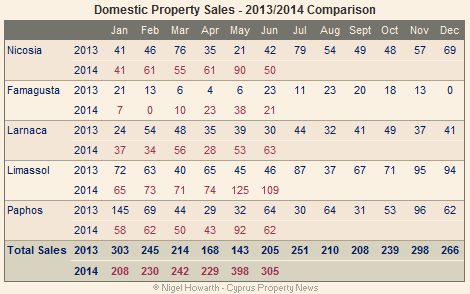
With the exception of Famagusta and Paphos, where sales fell 9 per cent and 3 per cent respectively compared to last year, sales increased in all other districts.

Sales in Limassol increased 137 per cent, while those in Larnaca and Nicosia rose by 110 per cent and 19 per cent respectively.

Cyprus domestic property salesDuring the first half of 2014 a total of 1,612 domestic sales have been achieved, an increase of 334 (26%) on the 1,278 sold during the first six months of 2013.

Overseas property sales

Property sales to the overseas market in June increased compared to June 2013, although not achieving the strong gains experienced during May.

Paphos performed best, with the number of properties sold in the district more than the total numbers sold in Larnaca, Famagusta and Nicosia. Larnaca saw sales improve by 80 per cent and Limassol saw sales improve by 7 per cent – and although sales also increased in Famagusta and Nicosia, the numbers sold in June were still in single-digits.

Cyprus overseas property salesDuring the first six months of 2014 a total of 601 overseas sales have been achieved, up 20% on the 501 achieved during the first half of 2013.

Will Cyprus bounce back?

Property sales to the domestic market may be slowly returning following the ‘haircut’ on bank deposits last year although it seems unlikely that they will reach 4,793 achieved in 2012. Sales to the overseas market are also improving and annual sales in 2014 could better the 1,476 sold in 2012 if the momentum continues.

property sales  2000-2014