Immovable Property Tax reductions

property valuesA BILL exempting property valued up to €200,000 from immovable property tax (IPT) was approved by the Cabinet yesterday.

Speaking to the press after the session, deputy government spokesman Viktoras Papadopoulos said that for all other properties, valued in excess of €200,000, the tax levy would be reduced to 0.1 per cent.

Current legislation calculated property tax using 1980 valuations, levying a tiered tax from 6 to 19 per cent, depending on value brackets. Revised property values to reflect 2013 prices have now been established, meaning the government can afford to adjust tax brackets accordingly.

“Previous legislation exempted 40 per cent of property owners, whereas this year 54 per cent will be exempted,” Papadopoulos said.

“Following the updating of the total tax base and the valuation of all properties with 2013 prices, the government can drastically reduce tax coefficients and increase tax-exemption brackets without impacting revenue targets relative to 2013,” he added.

“For this reason, the Council of Ministers approved a bill proposing the exemption of property valued up to €200,000 from property tax. For all other properties, valued in excess of €200,000, the tax coefficient applicable is reduced to 0.1 per cent.”

Papadopoulos added that “in the same spirit, the Council of Ministers approved a bill amending the Municipalities Law, so that municipalities can afford to adjust the tax coefficient on municipal fees for immovable property from 0.15 per cent to 0.022 per cent, in order to fall in line with the Land Registry’s 2013 prices.”

Asked to explain how the tax base had been broadened, he said updating values and prices and recording all properties that had not been registered – and thus were not taxed – will now be subject to taxation.

“Therefore, the tax base can now be broadened, and the tax-exempt base can also be broadened – from 40 per cent to 54 per cent,” he said.

Immovable Property Tax

€12 billion non-performing loans restructured

non-performing loansRESTRUCTURED loans in the Cypriot banking system reached €12 billion in April 2014, corresponding to 27% of total loans in Cyprus, according to figures released by the Association of Cyprus Banks (ACB).

According to an article co-written by Michael Kammas, the ACB’s Director General and senior official Michalis Kronides, total loans in April 2014 amounted to €44 billion of which 48% are considered as non-performing.

The article focuses on loans to corporations of the construction sector and loans to mortgage loans to households.

Loans to the housing sector is the biggest loan category totalling €7.2 billion of which €5 billion are considered as non-performing loans (NPLs), which includes restructured loans which continue to be regarded as NPL, due to a directive issued by the CBC on NPLs, that classifies a restructured loan in the NPL category for at least 6 months.

According to the ACB, restructured loans in the construction sector reached €3 billion representing 43% of the sector’s loan portfolio.

Restructured loans to households for house purchase have registered a much slower pace. From total loans of €5.8 billion of which €2 billion are classified as NPLs, restructured loans reached €1.5 billion representing 26% of total loans granted for house purchases.

Excluded from the international capital markets, Cyprus in March 2013 received a €10 billion bailout from the EU/IMF to cover its financing needs and to avert the collapse of its banking sector, severely hit by the haircut of the Greek sovereign debt and soaring bad loans due to an economic contraction that began in the second half of 2011. However the bailout included an unprecedented conversion of deposits to capital, also known as haircut, to recapitalise the island’s largest lender, Bank of Cyprus, which absorbed part of Cyprus’ second largest bank, Laiki. Cyprus’ lenders, stress that debt restructuring is a major element of the Cypriot programme.

“The above figures show that a significant number of loans have already been restructured despite the fact that a part (of restructured loans) continues to be classified as non-performing due to the CBC’s new directive. Therefore what is needed is patience and a further strengthening of the cooperation between the bank and the borrower and the containment of strategic defaults,” the article notes.

In response to politicians who criticise the banks for insufficient restructuring efforts, the ACB notes that “despite the adverse financial and other conditions the banks have responded to the challenge and proceeded with restructuring of problem loans where the borrower is viable and cooperative.”

Furthermore, Kammas and Kronides highlight the issue concerning the quick pace with which Cyprus has implemented a restructuring directive, compared to other bailed-out countries.

Ireland has implemented a restructuring code two and a half years following its entry to an adjustment programme, whereas Greece implemented a similar code four years after Athens and its lenders signed the country’s bailout. On its part Cyprus implemented the directive of restructuring loans in arrears five months after its entry in the adjustment programme.

– Cyprus News Agency

Cyprus ‘failed miserably’ on Title Deeds

Cyprus Title Deed protestTHE STATE – government and parliament – has failed miserably over the Title Deeds issue, Interior Minister Socratis Hasikos said yesterday, as Cyprus scrambled to clear a backlog of more than 23,000 applications before the end of the year.

Speaking before the House Watchdog Committee, Hasikos said proof that the state had failed miserably were the thousands of pending applications that must be cleared by the end of the year under pressure from the island’s international lenders.

“There was no need for a third party, the lenders, to force us,” the minister said.

Clearing the Title Deeds backlog is part of the island’s bailout terms. Cyprus must cut down the number to around 2,000 by the end of the year.

Hasikos pledged that his ministry would do everything in its power to sort out the matter, stressing that a radical review of the procedures was necessary.

He warned that failure to do so could put the economy at risk since there was a possibility of the lenders withholding the next tranche of assistance.

But “we cannot intervene in private organisations like banks,” he said. “However, since it is for the common benefit, especially for the economy, we feel that they will also be serious and responsible and co-operate in issuing a title.”

Watchdog committee chairman said there were 23,417 pending Title Deed applications at the end of 2013 and an additional 4,500 by May this year.

Deputy Giorgos Georgiou said sorting out the problem would mean a windfall for the state. In the past two and a half years, the state has collected around €156 million from transfer fees.

“This alone arms us with more will to provide solutions, provide proposals to stamp out a bad phenomenon, which has been stifling the state’s revenue collection ability,” Georgiou said.

EDEK MP Phidias Sarikas highlighted the bad publicity Cyprus received in recent years because of the matter.

“There are thousands of foreign buyers and compatriots who have been inconvenienced for years while trying to acquire an ownership title,” he said.

He added that it was very bad for Cyprus when foreign buyers and potential investors were trapped in lengthy procedures.

Cheap as chips or curry and chips?

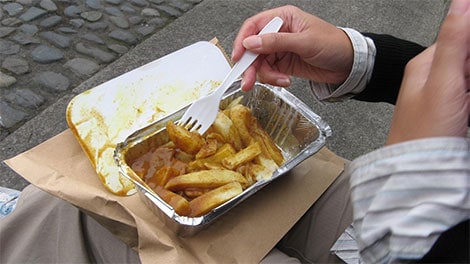
curry chipsIF YOU’RE not British or Irish, I am not sure whether you would have had the chance to ‘experience’ curry and chips. Curry and chips is not some Indian delight, nor is it meant to be gourmet. This is the sort of thing you might eat while you’re stumbling home after a (long) night at the pub.

Over the past six months Cyprus has begun attracting considerable positive comments and interest from both international bodies and overseas investors.

One year after the bail-in and following four positive assessments by the Troika, the Cyprus government recently issued a €750m bond, which matures in June 2019, priced at a yield of 4.85%. Although this is currently the highest yield of any sovereign-issued five-year maturity in the Eurozone, it is a ridiculously low yield by any measure. According to the Financial Times, fund managers accounted for about half of subscriptions, with 22% coming from banks and private banks and 27% from hedge funds, according to bankers working on the deal.

On the back of this issuance, Bank of Cyprus’ board is debating what amount of money to raise by issuing more shares (a minimum of €500m to a maximum €1bn is muted). This is the same bank that did the bail-in last year. The issue here is that the same people, who had their deposits converted into shares, now have to make a decision as to how much they are going to get diluted. Lovely.

Recent commercial real estate transactions have been at initial yields in the 6.0% to 6.7% range, whilst hotel transactions have been at higher multiples than one would expect for a country that is going through a recession; let alone the country where the bail-in experiment was first carried out in. A recent transaction to a Russian company of a sizeable development site in Larnaca and a smaller transaction of a commercial site in Limassol to Lebanese investors are signs that we are now past the stage of investors looking at Cyprus and progressively more towards them taking positions.

On the back of this vigour there are continuous government announcements and news-stories about Middle Eastern, European, and even US investors looking at various projects on the island. These include multi billion euro developments of tourism and leisure projects, infrastructure investments around natural gas, casino resorts, Chinese buying residency status or naturalisation, privatisations of state-owned companies, and the development of skyscrapers. At this rate, this shouldn’t be called a crisis but an investment bonanza.

My view is that Cyprus is the curry and chips after a long night at the pub. Cyprus is lucky to have entered the crisis last and at a point where the US and Western European economies have stabilised from the post 2008 turbulence. The UK economy is growing at its fastest rate in five years and money is sloshing around trying to find any form of income return. The stock market is riding high, bond yields are record low, and asset prices around the world are booming again – London house prices surged 18.7pc in the 12 months to April.

Three years ago Cyprus would have been in the same position as Ireland and Greece, whilst now it’s looking good compared to where everyone else is. The banks’ recapitalisation, the bond issuances, and the privatisations to follow are a fund manager’s have; where else are they going to put their money and what will people say if they don’t jump on-board the ‘European recovery train’ that is sweeping across the West-end (but not European economies).

As often recorded, the main bane of Cyprus banks are their real estate loan books especially those to developers. Two issues:

(1) Banks are refusing to allow developers to transfer title deeds to property buyers because the developer still owes them money (Note: the developer, not the buyer). They do that in order to squeeze more money from the buyers, by effectively holding them ransom by threatening them that they will bankrupt the developer if they don’t contribute to pay his debt. By taking this action banks aggravate property buyers, who are also their clients for mortgage loans, who often walk away from the property leaving the bank with another non-performing loan (and litigation costs).

(2) Many of the loans are against sizeable development sites, including proposed golf courses, marinas, mixed-use developments, etc. Banks provided loans against the collateral value of the asset without ensuring that this money was used to develop that specific asset. Thus, a developer raised money against a proposed golf development but invested it in other projects. In order for these sizeable developments to move ahead so that banks have a chance of monetising them at an agreeable price (as they stand any investor would not pay more than 20-25% of book value), they need to support the developer’s to execute them, provide them with additional funding, and provide mortgages to end buyers. Can banks think in such a commercial manner? Unlikely.

Asset price inflation is likely to continue across Europe, with Cyprus benefiting from it. It’s not hard to be bullish about Cyprus, although the fundamentals don’t really stack-up. Cypriots are unlikely to see any real benefit, as the economy is now leaner and companies are able to support any increase in activity with their existing stuff.

It will be quite a long time until unemployment is reduced and prices rise, which in turn will fuel consumption and the progressive repayment of household debt.

Pavlos Loizou MRICS VRS
Managing Partner
Leaf Research

IMF approves €84 million loan tranche

IMF-buildingTHE Executive Board of the International Monetary Fund (IMF) has completed the fourth review of Cyprus’s performance under an economic program supported by a three-year, approximately €1 billion extended arrangement under the Extended Fund Facility (EFF).
The completion of this review enables the disbursement of about €84 million, which would bring total disbursements under the arrangement to about €420.2 million. The Executive Board also approved the modification of end-June fiscal performance criteria.

In addition to the IMF’s extended arrangement, approved on May 15, 2013 (see Press Release No. 13/175), Cyprus’ economic program is supported by financial assistance from the European Stability Mechanism (ESM) amounting to €9 billion. The program is intended to stabilize the country’s financial system, achieve fiscal sustainability, and support the recovery of economic activity to preserve the welfare of the population.

Following the Executive Board’s discussion, Ms. Christine Lagarde, IMF Managing Director and Chair, said:

“The Cypriot authorities are to be commended for their achievements during the first year of their economic program. They recapitalized and restructured the financial sector, removed domestic payment restrictions, implemented an ambitious fiscal consolidation, and initiated important structural reforms. As a result, macroeconomic and fiscal outturns have been better than expected, and Cyprus recently re-accessed international capital markets. Looking ahead, challenges and risks remain, and full and timely policy implementation will be critical to the program’s continued success.

“Building on the progress made in strengthening the financial sector, efforts should focus on addressing the high level of non-performing loans, which is hindering the provision of credit and the resumption of growth. Swift implementation of the new debt-restructuring legal framework is essential to provide adequate incentives to voluntary loan workouts. The authorities also need to intensify supervisory monitoring of banks’ loan restructuring efforts, further strengthen overall supervision and regulation, and fully implement the anti-money laundering framework.

“The full elimination of domestic payment restrictions has helped to support activity and strengthened confidence. Further progress with restructuring and normalizing banks’ liquidity and funding will be needed to allow the removal of external capital controls while safeguarding financial stability. Adequate provision of liquidity by the Eurosystem remains essential.

“The authorities’ ambitious fiscal consolidation and prudent budget execution have helped reduce the fiscal deficit. Given lingering macroeconomic uncertainty, the authorities should continue to implement the budget cautiously. Further well-paced fiscal adjustment is needed in the medium term to ensure debt sustainability. Fiscal efforts should be complemented by structural reforms to protect vulnerable groups, modernize the revenue administration, strengthen debt and fiscal risk management, and privatize state-owned assets,” Ms. Lagarde said.

Dramatic fall in Cyprus property prices

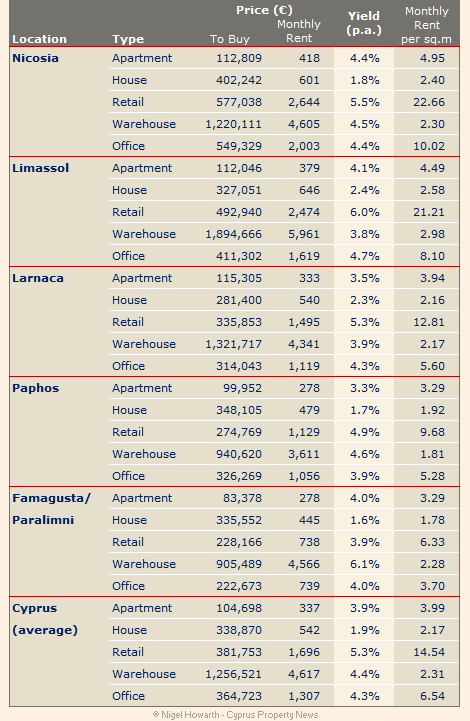
The RICS Cyprus Property Price Index, which reports quarterly on real estate values and rents in the major urban areas of the island, reveals that property prices on the island continued to fall over the first quarter of 2014.

Across Cyprus, prices of residential houses and apartments fell by 1.4% and 2.6% respectively during the first quarter of 2014.

Famagusta saw the biggest drop with house prices falling by 4.0% and apartment prices falling 9.3%. Across the island the values of shops fell by an average of 1.7%, while those of offices and warehouses fell by 1.4% and 0.9% respectively.

Annualised property price changes

Compared to the first quarter of 2013, the average price of a residential apartment has dropped by 10.7%, while the average price for a house has fallen 7.8%

Commercial property prices have fallen even more dramatically, with the price of retail units falling 14.8%, while the price of offices and warehouses have fallen by 10.4% and 11.4% respectively.

Gross rental yield

Gross rental yields recorded a quarterly drop of 1.4% for apartments, 1.6% for houses, 1.3% for shops, 3.1% for warehouses, and 1.2% offices.

Compared to the first quarter of 2013, rental yields have fallen 11.3% for apartments, 12.6% for houses, 23.3% shops, 15.3% for offices and 14.0% for warehouses.

RICS Cyprus Property Prices Index

Commenting on the figures MRICS Chartered Surveyor Charalambos Petrides said “it seems property sales in 2013 hit rock bottom but it’s clear that in 2014 real estate sales will move upwards.”

But he said property values are expected to continue on a downward spiral for the first six months with the exception of real estate in prime locations.

Outline of properties used to calculate the index

Apartments: Residential, two bedroom, 85sqm, Medium quality.

Houses: Residential, three bedroom with garden, Semi-detached, 250sqm, Medium quality.

Retail: High-street retail, 100sqm ground floor area with 50sqm mezzanine.

Warehouse: Light industrial area, 2,000sqm, which includes 200sqm office space.

Office: Grade A, City centre location, 200sqm

(All property types used to calculate the index are: freehold, have all licences and permits in place, have their Title Deeds, are subject to VAT and are in a good state of repair).

Monitoring Process

The estimation of price levels is carried out by accredited RICS property professionals who are active in the relevant markets.

Methodology

The methodology underpinning the RICS Cyprus Property Price Index was developed by the University of Reading UK and may be viewed by clicking here.
