Downward trend in building permits continues

THE NUMBER of building permits issued in August stood at 351 compared with the 447 issued in August 2012; a fall of 22%, according to figures released earlier this week by the Cyprus Statistical Service.

Compared with August 2012, the total area of these permits fell 45% to 53,809 square metres from 97,744, while their value fell 56% to €55,933 million from €125,734 million.

During August, building permits were issued for:

  • Residential buildings – 250 permits
  • Non-residential buildings – 54 permits
  • Civil engineering projects – 20 permits
  • Division of plots of land – 20 permits
  • Road construction – 7 permits

During the first eight months of 2013 a total of 3,220 building permits were authorised; a drop of 25% compared with the 4,284 permits issued during the same period last year. Their total value has fallen by 20% and their total area by 28%.

New home construction

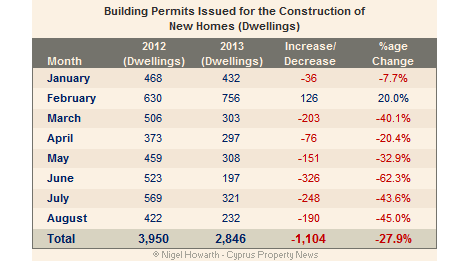
The 250 residential building permits approved in August provided for the construction of 232 new homes comprising 124 single houses and 108 multiple housing units (such as apartments and other residential complexes).

This is a fall of 45% compared with August 2012 when building permits were issued for the construction of 422 new homes.

During the first eight months of 2013, the number of new homes for which permits were authorised has fallen by 28% compared with the same period last year.

Cyprus building permits new homes August 2013

According to the Cyprus Statistical Service, building permits constitute a leading indicator of future activity in the construction sector.

IMF specialists to scrutinize Cyprus solvency laws

AN International Monetary Fund (IMF) team of experts is in Cyprus to scrutinise the island’s solvency law, reports said yesterday.

The Cyprus News Agency said the experts arrived here on Monday and would be meeting all stakeholders during week-long contacts, in a bid to examine the solvency law and make recommendations for amendments.

The team’s visit comes in the wake of the second review of Nicosia’s economic adjustment programme by international lenders.

Amid the continued economic slump, a key concern in the fragile banking sector is the rise of the non-performing loans, estimated at 30 per cent of total loans by March 2013.

Recent data released by the Central Bank estimated that overall NPLs stand at around €15.5bn.

Troika officials during their second review indicated they are not in favour of mass-scale seizures of primary residences.

The Bank of Cyprus has warned it will go after those who can pay their mortgage but use the economic crisis as an excuse not to do so.

At the same time the troika believes that legal obstacles to the seizure of property pledged as collateral should be limited to encourage viable borrowers to pay their loans and avert “strategic defaults.”

The updated Memorandum of Understanding (MoU) notes that “strong efforts should be made to maximise bank recovery rates for non-performing loans, while minimising the incentives for strategic defaults by borrowers.”

It moreover stipulates removing administrative hurdles currently constraining the seizure and sale of loan collateral so that property pledged as collateral can be seized within a maximum of 2.5 years, the MOU states.

“The necessary legislative changes are to be submitted to parliament by end of February 2014 and implemented by end-2014, macroeconomic conditions permitting. The authorities commit not to introduce any further impediments to the seizure of assets pledged as collateral.”

IMF team to scrutinuse Cyprus solvency law

Loan rate cuts are a step in the right direction – BUT

DOES the interest rate deduction announced by the banks concern all loans? What are the associated implications?

The simple answer is NO! It concerns specific loan categories and products which can be found on the Banks’ websites. Customers are urged to speak to their banks and check whether their loans are eligible/ subject to this interest rate reduction. If they are not eligible to this reduction, then we insist that they should speak with their bankers and insist that their interest rates should be also reduced (they will have a hard time doing so).

This move towards the reduction of 0.25-1.0% in the lending interest rates of Alpha Bank, Hellenic and Bank of Cyprus is “good step” towards the right direction but it is not ‘good enough’. We would say it looks more like a decent marketing communications campaign rather than something that it will indeed make a difference in the borrowers’ repayment ability.

Today, the high interest rates that our households and businesses are paying form the ‘Achilles Heel’ of the Cyprus economy. All local banks need to further reduce interest rates in order for the loans to become more affordable and be aligned with the EU equivalent. However, as in any ‘free and open’ market, we need to avoid making legislative changes to accommodate the reduction of interest rates as their will be negative consequences associated with such a change.

Even today, when banks ‘restructure’ a customer’s loan, such ‘restructuring’ is usually accompanied an increase in the interest rate. This is known as ‘re-pricing’, which often involves an additional rate of between 1.0 per cent and 3.0 per cent, depending on the level and basis of the existing rate on the loan. This policy by all banks has to END! It’s unethical and most importantly it does not help neither the economy (households and individuals) nor the banks (artificially inflating profitability). This is the time to make radical changes. The announcements made by banks to the effect that interest rates will be reduced by 0.25% to 1.0%, are not sufficient in order to assist over-indebted households and businesses to breathe.

This reduction will have minimal (if no effect to borrowers) that are unable to repay their instalments. The interest rates for housing and business loans are the highest in EU. Despite the significant reduction of deposit interest rates by more than 3%, a reduction on lending interest rates in the region of 1% is not enough to make the difference. Also, banks should enforce this across most of their lending products and not specifically to the loans that are ‘over-priced’ (i.e. have higher interest rates). Borrowers are urged to continually monitor the interest rates and speak to their bankers for their eligibility regarding this interest rate reduction as stated above.

If we do not take immediate action today, the non-performing loans will continue to increase resulting in higher provisions on the banks behalf with catastrophic consequences for the whole banking sector and our economy.

If the bankers and the Central bank cannot resolve this issue immediately, then we are in need of the immediate intervention by the Government to resolve this issue, as well as quicker and effective legislative reforms which will have side-effects and additional consequences for our image as International Financial Centre.

Dr. George Mountis
Regional Managing Partner
Banking | Wealth & Trust | Asset Management advisory
P.P. (The Parthenon Partners) & Co
Tel: + 357 – 99 49 41 42
Email: [email protected]
Web: www.theparthenonpartners.com

Property sales crash 44 per cent

PROPERTY sales in Cyprus this year have crashed 44 per cent compared with last year with the recession, record levels of unemployment and the unresolved Title Deed problems all taking their toll.

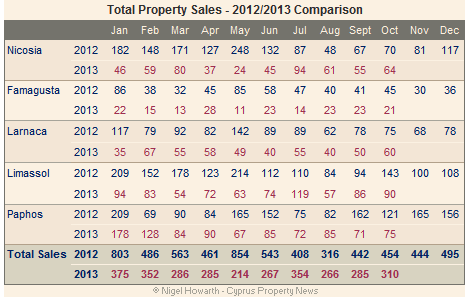
Figures published earlier today by the Department of Lands and Surveys reveal the extent of the problem. The number of contracts for the sale of property deposited at Land Registry offices across the island in October stood at 310 compared with the 454 deposited in October 2012; a fall of 32% from last year’s low levels.

Of those 310 contracts 77% (239) were deposited on behalf of domestic buyers, while 23% (71) were deposited in favour of overseas buyers.

Domestic demand fell by 23% and overseas demand slumped 30% compared with October last year.

Sales fell in all districts. Famagusta was the hardest hit with sales dropping by 53%. Sales in Paphos fell by 38% and those in Limassol by 37%, while sales in Larnaca and Nicosia fell by 20% and 9% respectively.

Cyprus property sales (total) October 2013

During the first ten months of 2013, total sales are down 44% compared to the same period last year having fallen to 2,994 from 5,330.

Domestic sales

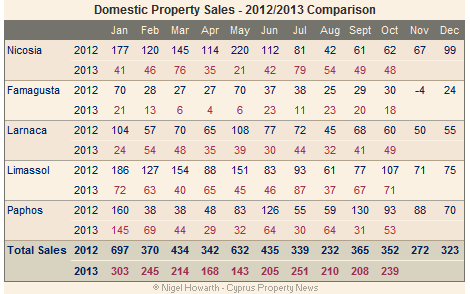
Domestic sales during October were down 32% compared with October last year, having fallen to 239 from 352; sales were down in all districts.

Paphos was the hardest hit with sales dropping 43%. Sales in Famagusta fell by 40%, those in Limassol by 34%, while sales in Nicosia and Larnaca fell by 23% and 18% respectively.

Domestic property sales October 2013

During the first ten months of 2013, domestic sales have slumped 48% compared to the same period last year falling to 2,186 from 4,198.

Amid the island’s deep recession and slowing economy, more than 76,000 are now out of work, with nearly 44% of those aged 25 or less. To cope with the soaring number of redundancy applications, the Labour Ministry is reported to have hired 45 jobless university graduates who have undergone special training.

Overseas sales

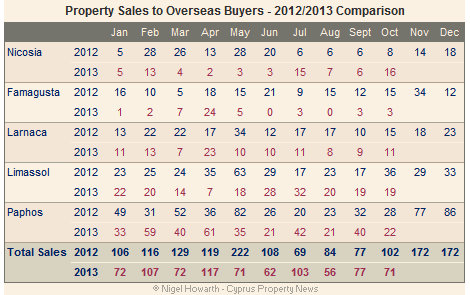
Sales to the overseas market fell 30% in October compared with October last year, having fallen to 71 from 102. Although sales in the capital (Nicosia) doubled, sales fell in all other districts.

Famagusta was hardest hit with sales falling 80% compared with October last year, while sales in Limassol fell 47%. Sales were also down in Larnaca and Paphos, falling by 27% and 21% respectively.

Overseas property sales October 2013

During the first ten months of 2013, property sales to the overseas market have slumped 30% compared to the same period last year falling to 808 from 1,132.

Naïve optimism?

The Final Report and Recommendations by the Independent Commission on the Future of the Cyprus Banking Sector, which was released on 31st October, contains the following statement:

“We believe that Cyprus” small size could make recovery more achievable than in larger countries going through a similar process. For example, the unsold inventory of vacation houses is about 50,000. Provided prices are lowered sufficiently after repossession by the banks, an inventory of this relatively small size could be cleared quickly through sales to foreigners.”

In light of the fact that during the peak year of 2007 a total of 11,281 properties were sold to foreigners and that since 2009 the average number of properties sold each year to foreigners is approximately 1,600 – it seems somewhat naïve to say that the unsold inventory of 50,000 vacation homes could be cleared “quickly”.

Even with a massive reduction in prices, which would further depress property prices and their value as collateral, it is unlikely that these vacation homes will sell “quickly” unless they have their all-important Title Deed.

Revised Memorandum of Understanding (Updated)

3
Photo: Cyprus News Agency

CYPRUS and its international lenders have agreed in principle on an updated Memorandum of Understanding (MOU), following the second review of the Republic’s €10 billion financial assistance programme.

Finance Minister Harris Georgiades and the Troika heads (European Commission, European Central Bank and the IMF) will meet again tomorrow to clarify the last remaining issues that would close the updated MoU.

Finance Ministry sources told CNA that the thorniest issue during the second review that began on October 29 was the drafting of a plan for privatizations. Cyprus and the Troika agree that this plan should be made available in December, although the MoU stipulated that this plan should be ready by the end of November.

Furthermore, the Troika conceded to an extension to the drafting of a plan for the implementation of the National Health Scheme until January 2014. Cyprus requested the extension to make sure that the implementation of the NHS would not burden vulnerable groups.

Today`s meeting also covered the pending issues with regard to the banking sector.

Excluded from the international markets, Cyprus applied for financial assistance to cover its fiscal needs and to rescue its two largest bank hit severely by deteriorating assets amid the financial crisis and by the Greek sovereign debt haircut. The Cypriot authorities and the Troika (EC, ECB and the IMF) agreed last March on a €10 billion bailout, featuring haircut of uninsured deposits. So far Cyprus has received €4.7 billion.

Source:  Cyprus News Agency

Update 11th November

The Revised Memorandum of Understanding dated 6th November 2013 may be downloaded by clicking here.

Controversial rent bill ditched by parliament

PARLIAMENT yesterday accepted President Anastasiades decision that legislation aimed at regulating rents in the free market was unconstitutional and in conflict with EU, eliciting sour grapes from the bill’s authors, opposition party AKEL.

The law’s withdrawal means rent contracts will continue to be agreed between tenants and landlords, as normal.

The bill, originally passed by parliament in early October, aimed to lower residential and commercial rents for a period of one year. It was intended to apply to all contracts (rents and leases) concluded prior to October 2012.

But President Nicos Anastasiades, invoking his right under the Constitution, had then refused to sign off on the law and returned it to parliament.

The President said the law violated ‘liberty of contract’ as this is enshrined in the Constitution.

Article 26 of the Constitution states: “Every person has the right to enter freely into any contract subject to such conditions, limitations or restrictions as are laid down by the general principles of the law of contract. A law shall provide for the prevention of exploitation by persons who are commanding economic power.”

Anastasiades had argued moreover that the so-called ‘Law of Necessity’ could not be invoked to sidestep that article of the Constitution. The Law of Necessity, he said, was justified only in exceptional circumstances, such as when public order or national security are at risk. He also cited Supreme Court case law, which he said did not justify applying the law of necessity in this case since market forces had been regulating rents anyway, driving them down.

In a second vote yesterday to decide whether parliament should insist on passing the law or else accept the President’s referral and withdraw it, the majority of MPs opted for the latter.

The rent bill had been drafted by AKEL, who wanted to ease pressure on tenants amid the credit squeeze, despite warnings that the market should be left to its own devices.

At the House plenum yesterday, AKEL MP Yiannos Lamaris, accused the ruling party and the government of double standards.

Over the last few months, he argued, the administration and parliament have together churned out a raft of laws that do violate free market rules – cancelling collective agreements, seizing people’s deposits and imposing capital controls.

“It seems that it’s fine for the troika to invoke the law of necessity, but not for us to do the same,” he complained.

Lamaris also pointed to an apparent contradiction in government policy. He noted that back in April the cabinet decided to freeze controlled rents for the next two years in light of the deteriorating economic situation in Cyprus.

Rental market

The rental market in Cyprus can be divided into two broad categories: all buildings, (with the exception of hotels, petrol stations, etc) controlled by the Rent Control Law (1983), and the free market.

The Rent Control Law applies to tenancies of residential or business premises which lie within what the law defines as ‘Controlled Areas’. For a tenant to be deemed a ‘statutory tenant’:

(1) the property must fall within the defined areas (mainly cities).

(2) the building must have been constructed prior to 31 December 2000.

(3) the tenant must have had a lease which has expired and they have remained in occupation.

(4) the tenant must be an EU citizen or a company controlled by EU citizens.

(with amendments)