Bills to protect homeowners from eviction discussed

PARLIAMENT’S legal affairs committee yesterday discussed two bills aimed at protecting home owners and smaller businesses from repossessions as laid out in the terms of the Memorandum of Understanding (MoU) Cyprus has signed with its lenders as part of a €10 billion bailout.

The bills, submitted by EDEK, aim to stop banks from seizing primary residences as collateral for non-performing loans of up to €300,000, as well as protecting property belonging small to medium sized enterprises (SMEs), as long as the business is considered viable on “objective criteria,” EDEK MP Nicos Nicolaides said.

Another bill aims to protect loans’ guarantors or debtors from bankruptcy, under certain conditions.

“We cannot bear it to think that the MoU terms will result in families getting evicted from their homes. We cannot conceive of it to see homeless people in Cyprus,” Nicolaides said.

“We will start seeing SMEs shut down because they cannot afford to pay their loans because of the financial crisis, for which they are not responsible,” he added.

Nicolaides said that the content of the bills was still under discussion and was bound to change so they could stand up to legal scrutiny. But he said the question was whether the state had the backbone to stand against “destructive” MoU terms.

As part of the MoU, authorities are expected to expedite and streamline procedures for non-performing loans. This is in part to protect banks’ capital buffers but also to minimise “the incentives for strategic defaults by borrowers,” such as property developers who would default on debts while an overheating market pushed up the value of their property. This enabled banks to sell the collateral property that was worth much more by the time procedures were completed. Banks would regain their funds, while developers would get the remainder at no extra trouble.

Instead, the MoU states that banks must classify loans as non-performing if payments are in arrears for more than 90 days, and seize assets up to one and a half years “from the initiation of legal or administrative proceedings”. In the case of primary residences the time-span may be extended to two and a half years. All this needs to be implemented by the end of 2014, and voted by parliament by mid-2014.

Bills to protect homeowners from eviction discussed

New home construction down 40 per cent

THE NUMBER of building permits issued in March 2013 stood at 428 compared with the 808 issued in March 2012; a fall of 47%, according to figures released by the Cyprus Statistical Service earlier today.

Compared with March 2012, the total area of these permits fell to 87,251 square metres from 148,715 (-41%), while their value decreased to €82.428 million from €148.275 million (-44%).

During February, building permits were issued for:

  • Residential buildings – 306 permits
  • Non-residential buildings – 64 permits
  • Civil engineering projects – 28 permits
  • Division of plots of land – 29 permits
  • Road construction – 1 permits

During the first quarter of 2013 a total of 1,397 building permits have been authorised; a decrease of 30% compared with the 1,996 issued during the first quarter of 2012. Their total value has decreased by 5% and their total area has decreased by 13%.

New home construction

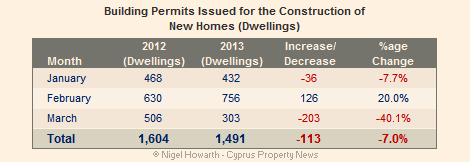
The 306 residential building permits approved in March provided for the construction of 306 new homes comprising 234 single houses and 72 multiple housing units (such as apartments and other residential complexes).

This is a fall of 40% compared with March 2012 when building permits were issued for the construction of 506 new homes.

During the first quarter of 2013, the number of new homes for which permits were authorised has fallen by 7% compared with the same period in 2012.

Cyprus new home construction March 2013

According to the Cyprus Statistical Service, building permits constitute a leading indicator of future activity in the construction sector.

Home buyers may pay IPT before getting Title Deeds

DIKO MP Angelos Votsis has prepared a bill which would force property buyers to pay property tax before even getting their hands on the Title Deeds, sparing developers millions of euros as part of the new immovable property tax (IPT) regime.

Votsis tabled the bill for discussion in the House Finance Committee on Monday, kicking off discussion on the proposal, which he hopes will conclude before September, when the new IPT legal framework is expected to kick in.

The latest rules on IPT were passed by parliament over a month ago as part of the government’s commitments to the troika, stipulated in the memorandum of understanding signed to secure a €10 billion bailout.

The government said at the time that the IPT bill was a provisional one which would be replaced in the summer, once the authorities have time to prepare a replacement.

In the meantime, the current ‘provisional’ legal framework on IPT provides for the collection of around €136 million in taxes.

Under the new law, all registered owners of property will be liable to pay a minimum of €75 a year for property valued up to €12,500 by the Land Registry based on a 1980 assessment.

The new tax bands range from 0.60 per cent (for property valued up to €12,500) to 1.90 per cent (for property valued at over €3m based on 1980 prices), providing a significant increase to the previous IPT regime.

Many developers, holding on to large swathes of property for whatever reason, are concerned that the new tax will dry up any liquidity they may still have.

The draft bill tabled by Votsis basically proposes that people who bought property will be obliged by law to pay the necessary taxes once they are in possession and have use of the property, even if they do not have the Title Deed issued in their name.

This effectively will force property buyers to pay the tax on properties that they may never see the Title Deed for, if for example the developer is guilty of irregularities or illegalities on the complex or even mortgaged property that they have already sold to buyers.

The acting head of the Land Registry Cleanthis Cleanthous was quoted in yesterday’s Politis saying the proposal would likely act as a disincentive to developers to do what needs to be done to get the large number of Title Deeds pending in Cyprus issued.

The Inland Revenue Department said the proposal would create more bureaucracy, making it very difficult for the department to distinguish which property buyers who submitted a Deed of sale to the land registry were actually in possession of and using the property in question.

For his part, Votsis told the Cyprus Mail yesterday that the IPT regime was already failing to act as an incentive to developers to sort out the Title Deeds fiasco, even though the new regime has yet to be implemented.

While acknowledging that very often it was the developers causing delays in issuing the Title Deeds of homes already paid for, he said: “Yes, but this (new IPT regime) is not the way to make the developer cooperate.

“We need to come up with better ways to put pressure on developers, as this won’t work,” he said.

The MP argued that if a person buys property from a developer today, until ownership is transferred, the developer has to pay the IPT.

Since the property is part of a larger sum, the developer pays much more in IPT than the single buyer of one unit would, as he’s put in a higher tax band.

However, when the Title Deed is ready to be issued, the developer forces the buyer to pay the higher tax before handing over the Deed. The buyer then has the right to apply to the tax authorities to get a rebate.

So, argued Votsis, it would make more sense to avoid all the bureaucracy and delays and higher tax bands by making the buyer, who is in possession of the property, and who has submitted a Deed of sale to the land registry responsible for paying the IPT.

“Now that the IPT is much higher, it will create a problem of liquidity for developers,” said Votsis, adding that buyers would be burdened with long procedures to secure the difference from the two tax bands from the tax authorities.

Home buyers may pay IPT before getting Title Deeds

Property sales plumb new depths in May

LATEST figures from the Department of Lands and Surveys show that a total of 214 contracts of sale were deposited at Land Registry offices across Cyprus in May 2013 compared with the 854 deposited in May last year; an annual decline of 75% and, once again, the lowest monthly figure on record.

Of those 214 contracts, 67% (143) were deposited on behalf of domestic buyers, while 33% (71) were deposited in favour of overseas buyers.

Property sales fell in all districts. Nicosia was hardest hit with sales falling to 24 compared with 248 in May last year (-90%). Sales in Famagusta fell to 11 from 85 (-87%), while sales in Limassol fell to 63 from 214 (-71%). Sales in Larnaca fell to 49 from 142 (-66%) and those in Paphos fell to 67 from 165 (-59%).

During the first five months of 2013 a total of 1,512 properties have been sold, down 52% on the 3,166 sold during the corresponding period last year.

Speaking to StockWatch property valuer Polys Kourousides attributed the decline in sales on the Eurogroup decision to restructure the banks and the haircut on uninsured bank deposits.

“There are no Cypriot buyers due to lack of liquidity and the inability of banks to grant loans. External demand is also negative due to Cyprus’ defamation abroad after Eurogroup. Foreigners are waiting to see how the situation develops before making any investment”, he said.

Domestic sales

Domestic sales in May were down 57% compared with May last year, with sales falling in all districts.

Sales in both Nicosia and Famagusta fell 91% and sales in Limassol were down 71%, while those in Larnaca and Paphos fell 64% and 61% respectively.

Cyprus domestic property sales - May 2013

During the first five months of 2013 a total of 1,073 properties were sold to  domestic buyers compared with the 2,475 sold during the first five months of 2012; a fall of 57%.

Overseas sales

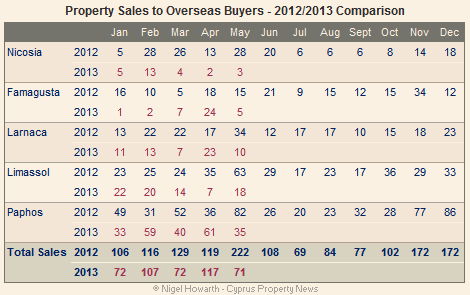
Despite the interest being shown by foreign investors, mainly Chinese and Russian, sales to overseas buyers fell in all districts, down 68% compared with May 2012.

Overseas sales fell 89% in Nicosia, 71% in Limassol and Larnaca, 67% in Famagusta and 57% in Paphos.

Cyprus overseas property sales - May 2013

During the first five months of 2013 a total of 439 properties were bought by overseas buyers compared with the 692 bought during the first five months of 2012; a fall of 37%.

The sniffing has started

SINCE the start of the year the country has had a change in government, has experienced the closing down of its second largest bank and the loss of all Cypriot-banks’ Greek operations, and a large part of its population has lost at least part of their savings that was held in its two largest financial institutions.

The knock-on effect has been a further increase in unemployment (now at 15.6%) and a series of pay-cuts in the private sector (from 10 to 30%), with various pay reductions and structural changes being planned for the public sector.

The “funny” part has been the reaction of the local population. There have been no demonstrations and no mass strikes. None. There is no notable moaning from the trade unions, as they seem (for now at least) to appreciate that they cannot be demanding in light of what has happened. They are in “damage limitation” rather than a “we won’t take this” mode. Most of the people, especially those in the private sector who have been “living the crisis” for more than two-three years now, are taking things in their stride.

The reaction of the politicians has been sub-par. Politicians are supposed to be leaders; elected representatives of the masses who are there to guide them. In contrast to the masses, the political parties seem interested only in squabbling amongst themselves and laying blame on one another for what happened. The relationship between government and the masses is based on trust; the masses put their trust in government for it to set the rules and regulate how they go about their daily lives. In the case of Cyprus, this trust has been lost. And it is this trust that needs to be rebuilt.

Let’s look at the due diligence report on the banking system of Cyprus prepared by PIMCO. The report cost the Cypriot tax payer in excess of €11m which was the original budgeted amount; at 103 pages, this equates to circa €100,000 per page (including the cover page). Nobody seems to have read it. The report makes some excellent comments as to the weaknesses of the local banking system, namely the way loans were granted and how these were reported by the banks. However, the only thing that politicians seem to care is whether or not the PIMCO report is based on false assumptions or methodology, rather than trying to learn from what it says so that they can implement a stricter, more transparent framework going forward. It’s the same “push-it-under-the-carpet” way of dealing with things that got Cyprus into trouble in the first place.

Despite the squabbling at the political level, or perhaps because of it, local property entrepreneurs have been quick to respond to the crisis by restructuring their businesses, aggressive marketing and price reductions, and targeting new markets (a Russian friend recently told me that she doesn’t feel “special” any more because all the signs are now in Chinese).

Various investors from overseas have already started arriving to the island, looking at opportunities in anything from large-scale real estate projects, operating hotels, acquiring non-performing loans, etc. They have seen this scenario play-out elsewhere and they know that in two/three years the economy will start growing again, provided that the country streamlines its public sector, strengthens its supervisory bodies, and restructures its banking industry.

When the economy does begin to grow, this time around the boom will not go to the Cypriots. The overseas investors will have bought a large chunk of the most profitable trophy assets and are likely to be selling them on to other foreigners at higher prices as locals will continue to be priced-out of the market due to low salaries and a lack of credit availability. The locals have seen this scenario play out before; only the last time round they were the ones gaining from the upside, as they were offloading their assets at inflated prices to foreigners.

Cypriots will now be left to benefit from providing services to these new foreign end buyers, and, in time, are likely to realise that had they spent more time scrutinising their government and dealing with their problems rather than pushing them under the carpet, Cyprus would be a much better place to live.

About the author

Pavlos Loizou MRICS is the Managing Partner at Leaf Research

Leaf Research is a real estate consulting firm, providing high quality real estate market research, strategic consultancy, valuation, and financial modelling.

Golf course at Secret Valley to open soon

View over hole 9 of the Secret Valley golf course

DESPITE the recent turmoil and bank crisis in Cyprus, construction of the new 18 hole golf course and academy at Secret Valley continues into the final stages of growing in and will be ready to be handed over within few weeks.

The future of the golf course and further development of the project have been guaranteed as Dolphin Capital Investors Limited subsidiaries Aristo Developers Ltd and Venus Rock Estates Ltd negotiated with a Hong-Kong based international conglomerate and real estate investment, China Glory National Investment, for the sale of shares and assets in the Venus Rock project, comprising all the plots and land, all permits and licenses granted, all related machinery and stock, and all the contracts and other agreements relating to the Project’s development.

The project, which will include two golf courses, the 5 Star Nikki Beach Hotel, two community sports centres, a commercial and leisure component as well as luxury private homes will be one of Europe’s largest luxury beach-front residential developments. Set in a stunning valley setting next to neighbouring Aphrodite Hills, the golf courses can be reached within 20 minutes from Paphos.

While the first new Secret Valley 18 holes at Venus Rock Resort are in their final construction phase, the set of plans for the second 18 hole course are finalised and ready for tender. These two new courses and golf facilities will replace the existing Secret Valley golf course, expanding further down the valley towards the beach as well as up the valley around the water dam with spectacular views down over the golf courses towards the Mediterranean Sea. The courses are designed by Golf & Land Design’s Hans-Georg Erhardt and Snorri Vilhjalmsson with signature from Tony Jacklin, a four times Ryder Cup captain and winner of the British Open and US open.

The existing Secret Valley Clubhouse will serve the first new course while a new and larger clubhouse will add luxury to the second course. And to add more golfing excitement, a floodlight 3-hole loop for evening play will be conveniently located at the lower end of the golf courses where the beach development links with the golf course.

The first course is scheduled for soft opening later this summer with a grand opening expected in September. The golf course documents and plans for the second golf course are prepared for tendering with the aim of starting construction in spring this year.

© GOLF & LAND DESIGN 2013