Immigration permits for non-EU nationals

THE Ministry of Interior or the Republic of Cyprus issued an Announcement on May 7, 2013 that Immigration Permits (Permanent Residence) will be issued to third country nationals under the following terms:

1. Investment/Financial Criteria:

(a) The applicant shall submit a statement from a Cyprus financial institution showing that an amount of at least €30,000 has been deposited in a reserve account, for a period of at least three years. This amount must show that it was transferred from abroad.

(b) The applicant and spouse are able to demonstrate that they have at their disposal a secured annual income of at least €30,000 increased by €5,000 for each dependent (including the spouse). This income may come from wages, work, pensions, share dividends, fixed deposits, rents etc. from abroad.

(c) The applicant shall submit with the application a title deed or purchase contract in its and/or its spouse name, filed at the Department of Lands and Surveys, for a residential or other building, of a market value of at least €300,000 (excluding VAT) and official proof of payment of at least €200,000 (excluding VAT), regardless of the delivery date of the house. Provided that the remaining value of the house will be paid from foreign funds into an account at a financial institution in Cyprus.

In case of a couple, this condition will apply for both of them, in the sense that the couple will not be allowed to acquire more than two units totally.

The above amounts should be shown to originate from abroad.

Note that the house purchase will be accepted even when made in the name of the Company and not in the name of the applicant, provided that the Company is registered in the name of the applicant and/or the name of applicant and his spouse and he/they are the sole shareholders.

Provided that if the shareholder is another legal person, it should be demonstrated that the sole shareholder of such legal person is the applicant and/or applicant and spouse.

(d) For purposes of this policy, the applicant may buy up to two housing units (apartments or houses), or a housing unit and a store with an area of 100 sq.m., or a housing unit and an office with an area of 250 sq.m., given that the total market value meets the provisions of paragraph (c) above.

The said sale must be for unit(s) sold by a development company to a buyer for the first time. From 07.05.2013, for the purposes of this policy, applications concerning resales of homes will not be accepted.

Note that purchase agreement documents for home resales deposited in the Land Registry before 7.5.2013 (date of deposit of purchase agreement will be confirmed by the Lands and Surveys Department) will be accepted for purposes of this policy.

Provided that the houses/apartments can be independent of each other, but both must be sold by the same company.

(e) Immigration permits are issued to the applicant with dependents the spouse and children under the age of 18. Unmarried dependent children aged 18 to 25 years, may submit their own separated application for acquisition of immigration permit only if they are proven students and the father and/or mother present additional annual income of €5,000 for each dependent child. Note that each such dependent child shall submit with the application all required documents specified in the list (see section 6 hereinafter).

Provided that such authorization will be valid until the age of 25 years. If the interested person wishes to obtain a new immigration permit, it must apply under the existing criteria as an independent person.

(f) Immigration permit may be issued to the applicant’s children over 18 years of age not financially dependent on the applicant, provided that for each of these children there is attributable market value of the acquired property of at least €300,000 (excluding VAT) as described in paragraph (c) above (i.e. if the applicant has a financially independent child aged 30 and wishes to obtain an immigration permit, he should buy a house total market value of €600,000, if he has two adult children, financially independent, must buy home value of €900,000 etc.).

In such cases, a certificate of payment of at least 66% of the market value of the home must be submitted along with the application (i.e. an amount of €400,000 for a home of a residential market value of €600,000) and each child will submit with its application all required documents (i.e. secured annual income of €30,000, deposit in a financial institution in Cyprus of an amount of €30,000 which will remain blocked for three years).

2. Quality Criteria:

(a) The applicant and spouse must submit a certificate of clear criminal record from the country of resident and generally must not constitute in any way a threat to public order or public safety.

(b) The applicant and spouse will attest that they will not be employed in any direct or indirect way in Cyprus.

Note that the applicant and/or spouse may be shareholder(s) in a company registered in Cyprus and the income from the dividends of such company is not considered as an obstacle to obtain the immigration permit.

(c) The applicant and the member of its family included in the immigration permit must be visiting Cyprus at least once every two years.

(d) All required supporting documents, which are attached to the application for immigration permit as well as their translation in Greek or English must be duly certified.

3. Procedure for Submission and Examination of Application

(a) Applications must be submitted directly to the Civil Registry and Migration Department (CRMD) personally or through a representative (relevant phones 22403921 and 22403943) with a non-refundable fee of €500.

(b) Applications submitted in Cyprus, either personally or through a representative, will be submitted in a common dossier. (Each document of the application will be punctured and attached in the dossier and numbered in blue ink from the first to the last page, this being the responsibility of the person submitting the application).

The dossier will include also a registration form for all documents submitted with the application and for any other supplementary documents by or on behalf of the applicant.

(c) The application shall be speedily processed by the CRMD and submitted to the Minister of Interior. For the purpose of this type of immigration permit, an interview with the applicant will take place only in certain cases considered necessary by the Director General of the Ministry of Interior.

(d) The Ministry of Interior will inform the applicant or his representative and the CRMD on the decision of the Minister of Interior.

(e) The holder of an immigration permit should be visiting Cyprus at least once every two years and comply with all the provisions of relevant legislation.

4. Transitional Provisions:

After the publication of this Announcement, any citizen of third country who applied for an immigration permit Category F may, if it wishes, submit to CRMD additional information to demonstrate conformity that the criteria in paragraphs 1-3 of the Announcement are fulfilled, through a new application form so that the review of the application is performed in accordance with the provisions of Regulation 6(2) of the Aliens and Immigration Regulations and based on the above criteria and relative procedure.

5. Time schedule for the issue of immigration permit

If the criteria of this Announcement are met and unless there are reasons relating to either the criminal records of applicant, either on grounds of policy or public security, the application will be considered by the Minister of Interior in a positive way and the immigration permit will be issued.

It is estimated that by applying the procedure described in this Announcement, the examination period of the application from the date of its submission, will not exceed 2 months.

6. Application Forms

Available online the following forms:

  • Application form (M.67).
  • List (check list) of documents submitted with the application (in Greek and English).
  • List (check list) of documents submitted with the application (in Greek and English) for adult children in accordance with paragraph 1(e).
  • Affidavit for the annual income of the applicant, together with other evidence (in Greek and English).
  • Declaration confirming non-employment of applicant in Cyprus (in Greek and English).

7. More info:

Authorized Officer: Ms Panagiota Nathanael – Administrative Officer CRMD
Elena Pieri – Administrative Officer CRMD
E-mail: [email protected]
[email protected]
Phone: 22804496 / 22804495
Fax: 22804491
Web page Ministry of Interior: www.moi.gov.cy
MINISTRY OF INTERIOR May 7th, 2013

Special Note

Re-sales are still allowed under the Law but applications are accepted and processed by the Immigration Office under the normal 6 month process rather than the accelerated 2 month process above.

Combatting construction sector decline

COSTAS Roushias, the President of the Federation of Associations of Building Contractors Cyprus (OSEOK), has painted an alarming picture of the state of the island’s construction sector.

Speaking to delegates at the Federation’s the 18th annual general meeting in Nicosia over the weekend, Mr Roushias reported that the sector has been contracting over the past four years with its value shrinking 39 per cent to just €1.9 billion in 2012 from €3.05 billion in 2008.

Unemployment in the sector has increased significantly with the monthly average of unemployed workers rising from 902 in 2008 to 6,177 in 2012; an increase of 585%.

He pointed out that Cyprus’ economic crisis has had a negative effect on the turnover of construction companies. It has resulted in lower activity, reduced investments in construction, low liquidity and difficulties in securing financing – and in some cases this has led to delays in making payments and freezing payments for projects that have already been completed.

The Federation has submitted a number of proposals to Government and political parties, which are aimed at supporting the sector and creating conditions for its recovery. Temporary measures include abolishing Property Transfer Fees where no VAT is payable, reducing VAT to 5% for all sector-related transactions and reducing Capital Gains Tax.

Other proposals include measures to combat late payments on public works projects, implementing large public sector projects and making an immediate start on creating the necessary energy infrastructure.

Property highlights all that is wrong

DURING Cyprus’ property sale ‘boom years’, most estate agents/developers employed at least one Russian/English speaker part-time. Now they employ a Mandarin/English speaker, who is likely to be a Chinese lady married to a Cypriot.

Mainland Chinese do not speak English, and those who say they do are limited to several tens of words enunciated incomprehensibly. In fact, it would be nigh impossible for any to negotiate the purchase of a house and live in Cyprus without the assistance of an interpreter.

Selling 2/3 bedroom flats/houses at a minimum of €300,000 in exchange for long term residence permits sounds ‘crisis’ expensive to me. An additional requirement is that €50,000 per person be left on deposit in a Cypriot bank for at least three years, thus a Chinese household comprising a couple with two children would be ‘coerced’ into investing half a million euros in Cyprus before immigration issues four long term residence permits, which purportedly facilitate easier access to EU member states.

If rumours circulated by estate agents/developers of 1,700 sales so far are to be believed, Paphos should be crawling with Chinese by now, but my Paphian friends report seeing hardly any in local supermarkets or sunbathing on the beaches. Last month, a Paphos estate agent confirmed that Chinese sales virtually dried up as soon as the troika imposed the haircut and the government introduced currency restrictions.

Unlike Russian permanent residents and second home owners, who mostly live within a three hour flight of Cyprus, a Chinese family would arrive here exhausted at more than twice the cost of their Russian counterparts; I know, I’ve done both the Moscow and Beijing run. The huge disparity in journey times and costs make me wonder whether the 1,700 sales actually refer to 1,700 different purchasers or several Chinese billionaires buying up new-build apartment blocks and entire housing estates.

Last month, a small and seriously bankrupt developer’s property was repossessed by his bank and auctioned off at almost a third of its pre-crisis market value. Four houses valued at a total of €840,000 went ‘hush-hush’ under the hammer to a single Russian purchaser for €280,000; he is reported to have said that he will sit on his investment until market conditions improve?

If strictly non-resident and simply using Cyprus as a means to ‘leak monies’ hors la Chine, the Chinese are hardly likely to be present, or even represented at hush-hush house repossession auctions. And worse still is that if banking restrictions persist, they will be obliged to look elsewhere to free-up profits from their ‘in China’ enterprises.

So, while established Russian residents, numbered in their thousands, pick up the bargains, the Chinese, pay through the nose for the opportunity to do so, when only six months ago the media reported the so called Chinese influx as ‘an invasion’. Yes, elephants do fly in Cyprus as well as donkeys! But no longer do the Chinese.

This is bad news for our construction industry and banks, who now find themselves left with critical over-supply of property, currency restrictions and an ever decreasing number of willingly duped buyers.

For years, our administration and banks have cleverly created a captive audience, holding householders to ransom by refusing to issue title deeds. Oh yes, there is method in this title deed madness! In fact, if all developers’ debts to banks were taken into account, most of the island’s property is owned, on paper, by bankrupt banks.

Sickeningly, we are now paying (via troika haircuts/theft and increased taxation) to restructure our banks, only for them to become the island’s landlords, who are subject to the will of the barons in Brussels; a situation redolent of those times when our Church collected taxes for the Ottomans.

After just 53 years of ‘freedom’, we have again become members of that familiar servile feudal class formerly under imperial rule. Bravo! This is what happens when you grow too big for your boots and can’t afford a new pair.

I recently visited an estate of 4 x 4 bedroom ‘luxury’ houses with pools – summer lets at €200 a day, minimum stay two weeks – situated a stone’s throw from the beach. The developer, who spotted me nosing around, invited me to view the one he, his wife and two children were occupying during this past Easter school break.

Spotlessly white concrete, glass trolley sized manicured and characterless, situated next door to a tavern oozing the stench of burnt cooking oil denied even a mild interest. I told him that he’d never sell ’em never mind let ’em with that fish fryer next door! He pretended not to smell the smell and will walk the walk to the gallows of bankruptcy like those many deluded developers before him.

Last week, the co-operative bank told a year-long unemployed engineer, who could no longer finance his house loan of €140,000, that he would become a tenant in his own house and pay rent. In other words, the bank has seized landlord status ownership. The ‘new tenant’, married with three daughters, can see no worthwhile reason to remain in this ‘burnt-out’ island and is emigrating from Cyprus to Australia.

But Cyprus is still burning while those responsible for igniting the fire keep fiddling. The ‘barons’ gave us just enough rope by which to hang ourselves and are now watching our every move; deviousness is dead. After years of misrule, our administration will be driven to raise standards or be ‘flogged’ for inventing yet more ‘ingenious’ ways around having to do so.

It takes a lifetime to build a good reputation and a few moments of indiscretion to destroy it. How long will it take our present administration to rid itself of its badly soiled name; a few years or another lifetime? I’m betting on never unless we remove those responsible for bringing the nation to its knees, one that will now be compelled to accept a lose/lose solution for us to the Cyprob. Bravo!

February building permits dip 24 per cent

THE NUMBER of building permits issued in February 2013 stood at 483 compared with the 633 issued in February 2012; a fall of 23.7%, according to figures released by the Cyprus Statistical Service.

However, compared with February 2012, the total area of these permits increased to 164,902 square metres from 141,435 (+16.6%), while their value increased to €196.75 million from €135.76 million (+44.9%).

During February, building permits were issued for:

  • Residential buildings – 349 permits
  • Non-residential buildings – 67 permits
  • Civil engineering projects – 27 permits
  • Division of plots of land – 36 permits
  • Road construction – 4 permits

During January and February a total of 969 building permits have been authorised; a decrease of 18.4% compared with the 1,188 issued during the same period in 2012. However, their total value has increased by 2.4% and the total area has increased by 16.9%.

New home construction

The 349 residential building permits approved in February provided for the construction of 756 new homes comprising 250 single houses and 506 multiple housing units (such as apartments and other residential complexes).

This is an increase of 20% compared with February 2012 when building permits were issued for the construction of 630 new homes.

During the first two months of 2013, the number of new homes for which permits were authorised has increased by 8.2% compared with the same period in 2012.

cyprus-home-building

According to the Cyprus Statistical Service, building permits constitute a leading indicator of future activity in the construction sector.

Valuing real estate in a mispriced market

real estate valuer
THE CHALLENGES faced by valuers are universal across asset classes and geographies, with the possible exemption of “deep” investment markets where there is considerable transaction activity, e.g. London, Paris, etc. Unfortunately, the biggest problem valuers face is a lack of “market signals” (comparable sales) which would allow them to undertake more accurate valuations.

Let us consider a simple way of valuing income producing property (and shares for that matter). The dividend discount model (DDM) is a method of valuing an asset based on the theory that an asset is worth the discounted sum of all of its future dividend/rent payments. In other words, it is used to value assets based on the net present value of the future dividends/rent. The equation most widely used is called the Gordon growth model. Because the model simplistically assumes a constant growth rate, it is generally only used for assets with stable income streams (e.g. commercial properties on long leases) with low to moderate growth rates.

Gordon’s growth model states that Y (the yield, i.e. rent divided by price) is equal to Rf (the risk free rate of return from an investment), plus Rp (the risk premium needed to undertake an investment alternative investment that will be “riskier”), minus G (the growth rate in the income from the dividends), i.e. Y=Rf+Rp-G.

Yields are just prices, or rather a multiplier to get the price of an asset (Rent/Yield=Price).  If the income from a given property is 100 and the yield is 5% then its price is 2,000. If the yield rises to 6% then its price is 1,666. So the issue is really why prices fluctuated so much over the past five years.  Basically prices dropped a lot in a period of market turmoil and then recovered.  Why?  Well, the economy was crashing, prices of most assets were falling.  Why should real estate be different?

The appropriate Rf rate is causing a lot of head scratching at the moment.  It should be noted that until recently Rf was mainly given to be the interest rate on five or ten-year government bonds, as these were deemed to be the safest possible investment. Clearly this is no longer the case, which in turn is part of the problem. Lots of hedge funds think that yields of UK/US (and some European) government bonds are far too low (i.e. overpriced) and are claiming that there is a government conspiracy to keep them low.  They have basically bet against them staying so low and are losing money.  Commentators like Paul Krugman state that current bond rates are pretty consistent with what economic theory (IS-LM) would predict in the current macro-economic climate – it’s Japan in the 1990s all over again.  Smarter people than me know a lot more than I do about this.

The real estate risk premium (the Rp) must have gone up over the past five years.  Assuming that in 2007 real estate had bubble components, then, as the bubble burst, a more rational real estate risk premium would emerge (i.e. the risk premium was too low in 2006-07).  But also the real estate risk premium may go up (compared to what it SHOULD have been in 2006-07) as tenant default is more likely, voids (as leases end etc.) may be longer.

However, there is a basic simple issue here – if government bond yields fall, then yields of assets that have bond-like components should also fall.  Calling it artificial is basically saying that the bond market is mispriced – it may be and it may not be.  I don’t know.  Financial assets are prone to mispricing.  If the prices of real estate assets are theoretically based on the prices of assets that are prone to mispricing, then we, valuers, will also misprice.

The other thing that is missing is also ‘G’ – expected income growth has also fallen dramatically. It is also a component of yield, but no one knows what growth to expect in a market as uncertain as now.

So where have I got to… Bonds (yields) can be mispriced. Textbook derivations of property yields include bond yields as a component (it is implicit that they are correct). No-one ever told us what to do when there was possible bond mispricing – i.e. it is based on the assumption that bond prices are efficient.  But why should they be?  Nothing else traded in financial markets is.

The main thing that people are struggling with because of the Rf rate, is estimating a target rate of return.  The underlying foundation (bond yields) is not perceived as reliable – so the answer to everything is basically to “find a plausible way to make the yield add up to 6% or 7%”.

There you have it. Valuers can’t value and now you know why.

Pavlos Loizou
Managing Partner | Real Estate Advisory
Leaf Research
www.leafresearch.com

Home sales hit a record monthly low

LATEST figures from the Department of Lands and Surveys show that a total of 285 contracts of sale were deposited at Land Registry offices across Cyprus in April 2013 compared with the 461 deposited in April last year; an annual decline of 38% and the lowest monthly figure on record.

Of those 285 contracts, 59% (168) were deposited on behalf of domestic buyers, while 41% (117) were deposited in favour of overseas buyers.

With the exception of Paphos, where overall sales increased by 7% compared with last year, sales fell in all districts: Nicosia -71%, Limassol -42%, Famagusta -38% and Larnaca -29%.

During the first four months of 2013 a total of 1,298 properties have been sold, down 44% compared with the 2,313 sold during the corresponding period last year.

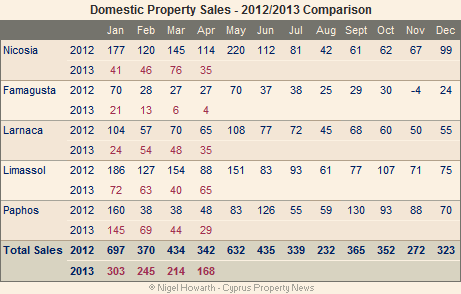
Domestic sales

Domestic sales in April were down 51% compared with the same month last year, falling in all districts from a total of 461 in 2012 to 285 in 2013.

Sales in Famagusta fell by 85% and sales in Nicosia were down 85%. Sales in Larnaca declined 46%, while those in Paphos and Limassol fell by 40% and 26% respectively.

cyprus property sales - domestic market

In efforts to encourage sales in response to the financial crisis ten construction companies, in conjunction with an estate agent, are offering houses and apartments at reduced prices. Typically new two-bedroom apartments in Strovolos (Nicosia) that normally retail at around €130,000 are now priced at €105,000.

Overseas sales

Although overall sales to the overseas market in April declined 2% compared to April 2012, sales in the districts of Paphos, Larnaca and Famagusta increased. These may be due to purchases by those seeking residency permits or citizenship though various government schemes and perhaps those seeking distressed sales at bargain prices.

In contrast, however, overseas sales in Nicosia and Limassol have fallen dramatically, dropping by 85% and 80% respectively.

cyprus property sales - overseas market

During the first four months of 2013 property sales to overseas buyers have fallen 22% compared with the same period last year.