PIMCO’s property price assumptions rejected

THE CYPRUS Association of Valuers and Property Consultants has rejected assumptions made by PIMCO that property prices will fall a further 30% – 40% this year.

PIMCO applied these assumptions to help determine the recapitalisation needs of the banks as part of its due diligence review of the island’s banking sector; in its baseline scenario property prices will fall 30%, while in its worst case scenario they will fall 40%.

In a statement, the Association said that “Projections on property values are rather difficult to make, based on the current uncertainty in the global and local financial market.”

“Changes in property values between 2009 and 2012 vary considerably, depending on the district, region and even specific property, unlike a general approach used by PIMCO in its forecasts for the next three years” the statement said, and gave some evidence of changes in value of properties over the past three years:

Nicosia

  • House and apartment values have fallen by up to 20%, while building plots have seen a 15% drop in value
  • Commercial properties in the city have fallen by 10%.
  • Property values in the suburbs – Dhali, Tseri, Deftera – have fallen by up to 30%.

Limassol

  • Limassol property values were more or less in line with those in Nicosia while the values of large residential and commercial projects on the beachfront were slightly down.

Paphos

  • The values of houses and land in tourist areas fell by up to 30 per cent, while apartment values have fallen by 40 per cent.
  • Commercial property values have fallen by an estimated 25:; those in tourist areas have fallen 30%.
  • In rural areas, property values have fallen 40%.

Famagusta

  • The situation with properties in Famagusta is similar to those in Paphos, with the values of houses and building land falling up to 30% and those of apartments falling by 40%.
  • Commercial property values have fallen 25%.

Larnaca

  • Property values in the urban area of Larnaca have fallen by 25%, while the value of houses and apartments in tourist areas such as Dhekelia and Pervolia have fallen 35%.

The statement noted that “the Cypriot real estate sector is going through a recession which is reflected on the real estate sales which has been in decline since 2009,” adding that the decline will intensify.

Property market will be hit by new Russian law

THE Cyprus property market is about to be dealt another blow, this time by the Russian government.

Late last year the State Duma (Russia’s Lower House) approved the first reading of a bill banning state officials and civil servants from owning property abroad.

This bill amends an existing law “On Countering Corruption” and it was passed by 437 MPs with no one voting against and just one abstention.

According to the draft law, the ban will apply to civil servants, MPs, those serving in the military, employees of the Interior Ministry, Federal Penal Service, Federal Drug Control Service, Investigation Committee, prosecutors’ offices and customs.

It will also apply to the spouses and underage children of the groups listed above – and the officials cannot own real estate, bank accounts or securities abroad.

Furthermore, civil servants who already own foreign property will have to get rid of it by June 1, 2013. If an official inherits foreign assets they must be sold or passed to another person within one year after the property rights come into force.

In addition, those leaving state posts will be banned from acquiring foreign assets for a period of three years after they leave office.

The draft bill imposes fines ranging from 5 to 10 million roubles (€125,000 to €250,000) or a prison term of up to five years for violations.

Although the bill still has some flaws, it has received the full support of President Putin who spoke about such measures in an address he made to the Federal Assembly late last year.

In his Duma speech MP Vyacheslav Lysakov of the majority United Russia party called the bill “new morals for the national elite” and emphasized that it had “a great virtue component” in it.

The bill is expected to pass its second and third readings unopposed.

Cyprus is a popular holiday destination for Russians and the 2011 official population census showed that around 9,000 of them are now resident on the island.

Bailiffs fail to seize ministers’ cars

ACTING on court writs, bailiffs went to the Ministry of Finance earlier today to confiscate the Minister’s car for unpaid compensation to owners of land that was expropriated by the state some years ago.

The value of the land is said to be worth €15 million.

The bailiffs also tried to confiscate the car of the Minister of Commerce who went to the finance ministry for a meeting. However, they were prevented from seizing the vehicle by the Minister’s driver who parked the car in the ministry’s underground car park and closed the doors.

Commerce Minister Neoclis Sylikiotis said that the attempt to seize his official car was unacceptable; other government ministers complained that the incident had been orchestrated for electoral reasons.

[youtube=http://www.youtube.com/watch?v=065rh_-0bKA&w=470&rel=0]

This was the second time that court bailiffs have acted on court writs ordering the confiscation of government property for unpaid debts. Several weeks ago bailiffs confiscated government owned cars and other property in Paphos, but their effort to sell them at an auction was stopped by the Attorney General at the last minute.

Double-digit falls forecast for property prices

A REPORT published by Leaf Research, a real estate advisory firm, states that property prices will continue to fall over the course of this year and next, with the fall in residential real estate and land prices reaching double digits.

Based on similar parameters employed by PIMCO for its due diligence exercise, Leaf Research concludes that, in the extreme scenario, the fall in property prices will approach 25% by 2015 from their present level.

Based on Leaf Research’s extreme scenario, over the next two years:

  • The price of residential plots is predicted to fall by 30% – 35%, while the price of commercial plots will fall 18% – 22%.
  • The price of apartments situated in central and other urban areas are anticipated to fall 15%, while those in secondary and tourist areas by 15% and 10% respectively.
  • Depending on their category, the price of offices will fall between 13% and 25% (larger falls for Grade B/C space).
  • The price of shops will also fall, as local’s spending power is eroded by higher unemployment, an increase in taxation and a decrease in average salaries due to pay cuts and pay freezes. Those in the commercial centres will fall by 26%, those in other urban areas by 22%, while the value of shops in tourist areas will fall by 8%.

Leaf Research expects that property prices will reach their lowest point in 2015/2016, when they will have fallen from their 2008 values by:

  • Residential property: 40% – 50%
  • Commercial real estate: 45% – 55%
  • Land: 60% – 70%

(These percentage falls are quite similar to those in Ireland and Spain).

Leaf Research believes that at their present values, properties are overpriced and beyond the purchasing power of the domestic market.

The local market currently accounts for around 80% of transaction volume; with household debt being one of the highest in the Eurozone having increased by 91% since 2006 (housing loans have increased by 201% over the same period). This high level of indebtedness combined with a high and rising unemployment rate may lead to a situation of a prolonged recession as local households are trapped in negative equity as the economy continues to contract.

As a result of their non-performing loans, banks may have to sell-off the collateral (real estate) underpinning those loans. This will put further downward pressure on property prices especially as the situation with the creation of the asset management company (AMC) which will take over the loans becomes clearer.

On a more positive note, the Company anticipates that the top end of the market will continue to improve as the recovery in the global economy continues.

Further reading

Cyprus Economy and the Property Market (2013-2014) – in Greek

One third fewer homes in 2012

THE NUMBER of building permits issued in December 2012 stood at 471 compared with the 560 issued in December 2011; a fall of 15.9%, according to the latest figures released by the Cyprus Statistical Service.

Compared with December 2011, the total area of these permits fell to 90,437 square metres from 213,916 square metres (-57.7%), while their value fell to €124.9 million from €189.3 million (-34.0%).

During December, building permits were issued for:

  • Residential buildings – 334 permits
  • Non-residential buildings – 56 permits
  • Civil engineering projects – 36 permits
  • Division of plots of land – 41 permits
  • Road construction – 4 permits

Over the whole of 2012, 7,172 building permits were issued; a decrease of 4.4% compared with the 7,506 issued in 2011. Their total value fell by 21.0% and the total area by 33.4%.

New home construction

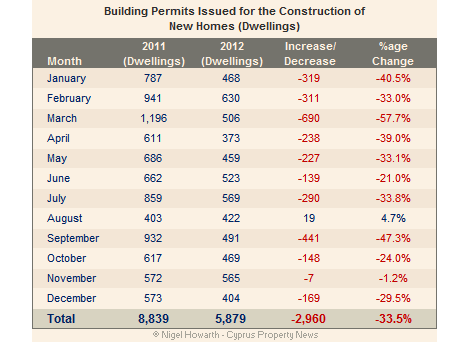
The 334 residential building permits approved in December provided for the construction of 404 new homes comprising 179 single houses and 225 multiple housing units (such as apartments and other residential complexes).

This is a fall of 29.5% compared with December 2011 when building permits were issued for the construction of 573 new homes.

During 2012, the number of new homes for which permits were issued dropped 33.5% compared with 2011.

cyprus_new_home_permits

According to the Cyprus Statistical Service, building permits constitute a leading indicator of future activity in the construction sector.

Risk of Cyprus default “material and rising”

Cyprus risks defaulting on its sovereign debt
©2013 Denis Lopatin; ©2013 , Splendum

CRIPPLED by its exposure to Greece, Cyprus needs €17 billion from the euro zone to recapitalise its banks and to finance the government over the next three years.

S&P’s comments come as the island gears up for a runoff presidential election on Sunday pitting a conservative in favour of a swift bailout deal against a Communist-backed candidate who supports a bailout but with fewer harsh austerity measures.

“We see at least a one-in-three chance that we could lower the Cyprus sovereign ratings again in 2013, for example if official financial assistance from the (European bailout fund) ESM and/or IMF is not forthcoming, leaving the Cypriot authorities few choices apart from to restructure its financial obligations,” S&P’s head of EMEA sovereign ratings Moritz Kraemer said in a report.

“We could also lower the ratings if we believe the (Cypriot) authorities are not able to fulfil the conditions that would be attached to an official assistance programme.”

S&P currently rates Cyprus at CCC+, well into non-investment grade “junk” bond territory, with a negative outlook.

Cyprus asked for international aid eight months ago after its banks suffered huge losses on exposure to a restructuring of Greek sovereign debt and due to difficulties in accessing international capital markets shut to it because of fiscal slippage since mid-2011.

Reuters (London)