Acting on unsound legal advice can cost you thousands

UNDER the provisions of the new “Sale of Immovable Property (Specific Performance) N81(I)/2011”, which came into force in Cyprus on July 29 last year, “vesting”/”assignment” contracts were introduced.

This new type of contract enabled a buyer to sell a property that they had contracted to purchase before its Title Deed had been issued without any involvement, cooperation or knowledge of the developer.

At a stroke, the new law removed the opportunity for nefarious property developers to demand extortionate sums of money from those wishing to sell their property before its Title Deed had been issued.

Or so we thought!

A recent case came to light in which a person who wished to sell his property was given the following advice by his lawyer:

Cancellation fee is charged by the developer to enable the signing of a new contract with the new purchaser. We have asked the developer to provide us with their statement of account and also cancellation fees. This is usually approximate to the amount that you would have paid as lands registry fees (Property Transfer Fees). Capital gains tax is zero. Other dues and expenses relate to the utilities and stamp duty on the legalisation of the cancellation agreement, and the agent’s commission fees.

In relation to the issue that you raise about vesting contracts, this is to inform you that since the adoption of the new law, the Deeds of Assignment (Vesting/assignment contracts) are now recognised as a valid exercise of a right to sell by way of assignment. What this article does not inform you is that you remain tight up to the property up and until separate title deeds are issued and you will be liable and responsible to pay lands registry fees at a future time when the separate title deeds are issued. Your purchaser will also have to pay lands registry fees.

The advantage of proceeding through the cancellation agreement and the developer is that you no longer have any connection with the property, the property is sold on and therefore it is an issue then between the developer and the new purchaser as to when separate title deeds will be issued. Additionally you will not be called to pay lands registry fees.

Regrettably, this person accepted this advice and proceeded with the cancellation agreement; this decision cost him many thousands of Euros.

The facts

I asked one of the lawyers on the list provided by the British High Commission in Nicosia for their opinion on the matter. The head of the Land Registry confirmed that:

  • the transfer will be made directly in the name of the assignees.
  • Property Transfer Fees only get paid once by the assignees i.e. when the actual transfer is made.

In a nutshell, the advice given to proceed with a cancellation agreement was wrong and the background information provided was rubbish.

You might well ask why the lawyer chose to give his client the wrong advice and in whose pocket the thousands of Euros it cost the buyer to sell the property ended up. I will leave this to our readers to speculate!

If you wish to sell

AS THIS CASE clearly demonstrates, the advice given by some lawyers in Cyprus is unsound; it cannot be relied upon or trusted.

Wrong advice cost this person many thousands of Euros in cancellation fees that could have easily been avoided, and I suspect that other clients of this lawyer may also have been given the wrong advice – and quite possibly other lawyers are giving wrong advice.

If you are considering selling your property and wish to avoid being taken to the cleaners, please use one of the lawyers on the list provided by the British High Commission in Nicosia.
Property sales in Cyprus tumble after a promising start

AFTER an encouraging start to the year, when the number of properties sold in Cyprus increased for the first time in nineteen months, sales tumbled in February.

It appears that the earlier surge in sales may be attributed to people waiting to deposit their contracts of sale until after the recent tax reductions had been introduced.

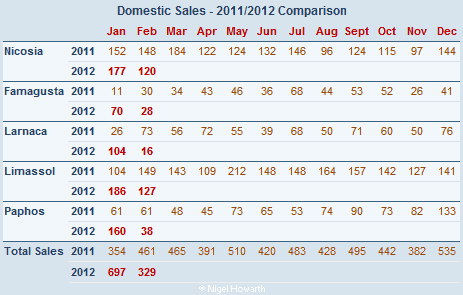
According to the monthly statistics published by the Department of Lands and Surveys, a total of 445 contracts for the sale of property were deposited at Land Registries across the Island in February compared with the 602 deposited during February 2011; a fall of 26.1%.

Of those 445 contracts, 329 (82%) were in favour of Cypriot buyers and 116 (18%) were in favour of overseas buyers.

Domestic sales

With the number of registered unemployed having reached a record level of 37,874 in February, a lack of liquidity in the banking system, tightened borrowing criteria and a general uncertainty about the future of the economy, domestic sales tumbled; down 28.6% across the Island standing at 329 compared with 461 in February 2011.

The worst hit area was Larnaca, where sales plummeted by 78.1% compared with last year. Larnaca was followed by Paphos (-37.7%), Nicosia (-18.9%), Limassol (-14.8%) and finally Famagusta (-6.7%).

Source: Department of Lands and Surveys

Overseas sales

Foreign demand for property continued to decline in February, increasing pessimism about the future of the Island’s once booming overseas property market.

Economic conditions in Cyprus’ main markets has yet to improve and problems resulting from the unacceptable delays in issuing Title Deeds have yet to be fully resolved by the Island’s government.

The ongoing actions of nefarious elements in the construction industry and the legal profession and have yet to be addressed (with the Cyprus Bar Association Disciplinary Committee imposing paltry fines for serious breaches of professional conduct).

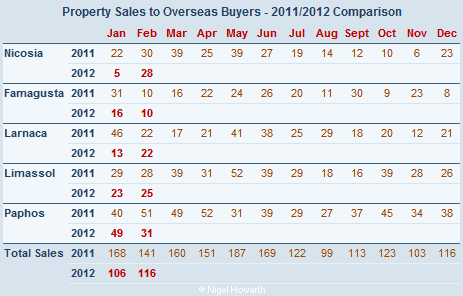
During February, overseas sales fell to 116 compared with 141 in February 2011; a drop of 17.7%.

Sales in Paphos fell by 39.2%, while those in Limassol and Nicosia fell by 10.7% and 6.7% respectively. Foreign sales in Famagusta (10) and Larnaca (22) were the same as February 2011.

Source: Department of Lands and Surveys

In 2011, foreign demand for property hit a 10-year low.

Construction sector in recession for second year

THE CONSTRUCTION sector continued in recession for the second year running in 2010 according to a report “Construction and Housing Statistics, 2010” recently published by CySTAT.

The main developments in the sector during 2010 were:

  1. The construction sector continued for the second year in a row to exhibit signs of recession. The rate of growth of the sector in 2010 (in terms of value added at constant prices) is provisionally estimated to have recorded a decrease of 7.0% compared to a decline of 18.6% in 2009.
  2. The gross output of the sector at current market prices was reduced in 2010 by 9.7% to €3,048.8 million compared to €3,376.3 million in 2009. The subsector of buildings construction and civil engineering recorded a decrease of 6.2%, while the subsector of land and buildings development registered a decline of 22.7%.
  3. New residential buildings accounted for 46.4% of the total gross output of the subsector of buildings construction and civil engineering, new non-residential buildings (offices, shops, hotels, factories, airport buildings, etc.) for 20.9%, new civil engineering projects (roads and bridges, water supply and sewerage networks, telecommunications and electricity lines etc.) for 24.5% and repairs and maintenance for the remaining 8.2%.
  4. Employment in the sector reduced from 36,384 persons in 2009 to 34,937 in 2010, accounting for 9.3% of the gainfully employed population.
  5. The number of persons registered as unemployed increased from 2,598 persons in 2009 to 3,497 in 2010.
  6. Labour cost in construction increased by 3.5% compared to an increase of 4.8% in 2009. The price index of construction materials recorded a rise of 2.7% compared to a decline of 3.5% in 2009.
  7. The number of new dwellings completed decreased by 19.3% to 13,434 dwelling units compared with 16,644 in the previous year. By administrative district, the number of new dwellings is distributed as follows: Lefkosia (Nicosia) 3,921, Ammochostos (Famagusta) 1,221, Larnaka (Larnaca) 2,378, Lemesos (Limassol) 3,108 and Pafos (Paphos) 2,806.
  8. The average area per dwelling completed in 2010 was 205 square metres for houses and 125 square metres for apartments, compared to 203 and 122 respectively in 2009.
  9. The cost of construction per square metre (excluding the value of land) rose from €896 in 2009 to €920 in 2010 for houses and from €783 to €808 for apartments.
  10. The dwelling stock at the end of the year amounted to 409 thousand dwelling units, of which 62.7% were in the urban areas.

Further reading

Construction and Housing Statistics, 2010 (Greek & English)

Cyprus in the dock over second home restrictions

THE EU Court of Justice has announced that it has been introduced to hear the appeal of the Commission against the Republic of Cyprus concerning the acquisition of second homes by EU and EEA nationals.

The Commission considers that the Cypriot authorities should have amended the laws to remove the restrictions imposed on EU/EEC nationals buying second homes on the Island by 1st May 2009. In its appeal application the Commission said that these restrictions are a direct violation of freedom of the movement of capital set out in Article 63 of the Treaty on the Functioning of the EU.

According to the Commission, the Cypriot Government forwarded a draft law amending the restrictions and claimed that the draft had been put before the Council of Ministers for approval with the intention of examining the Bill and putting it to a vote by Parliament without delay.

The Commission highlighted the facts that a violation of the Treaty with provisions of national law of a Member State may only be lifted by the establishment as mandatory provisions. As a consequence, Cyprus cannot simply attach a draft law in their letter of reply. Such a letter has no regulatory force and cannot be treated as a removal of the existing restrictions on the acquisition of secondary homes by nationals of EU/EEA States.

By failing to adopt these new laws, the Commission considers that Cyprus has failed to fulfil its obligations under article 24 of the Act concerning its accession to the European Union.

(The Commission referred Cyprus to the EU Court of Justice on this matter last November)

Update

Earlier today the Cyprus Government has responded to the above report (which appeared in the Greek language media yesterday). It confirmed that the relevant changes to the law have been approved by parliament and that they were published in the Official Gazette of the Republic on December 16th, 2011.

The government is consulting with its Legal Services Department and anticipates that the EU Commission will arrange for the suspension of any legal action concerning this matter.

All concrete production stops due to lack of cement

THE CONCRETE-MAKING industry will halt work as of today after running out of cement due to the ongoing strike at the island’s only cement factory, concrete makers said yesterday.

Employers at Vassilikos Cement Works went on strike last Thursday over their collective agreements.

“Supply stopped on Thursday and we have been using our stock. But we have run out,” said Neoclis Kyriacou, the head of the Cyprus Association of Ready-Made Concrete Manufacturers.

“We managed to stretch our stocks,” Kyriacou said.

Cement sales fell by over 40 per cent last year in comparison to 2010.

Fewer building permits are being issued and most new projects are classified as ‘small’.

Concrete makers said that business has marked a “drastic fall” of 70 per cent from 2008, when the property market was at its peak before the bubble burst.

The employees of Vassilikos cement factory said their collective agreements were not being met. They went on indefinite strike following the introduction of cost-cutting measures, including the scrapping of wage rises.

Cement works’ “employees have seen a 12.3 per cent increase of wages over the last three years as the company saw sales fall by 40.6 per cent,” said an announcement from the Chamber of Commerce and Industry (KEVE), to which the concrete members’ association belongs.

KEVE said the fact employees were looking for wage rises “diametrically opposes the kind of behaviour everyone is asked to adopt at times of financial crisis”.

Over 74 per cent of the company’s 170 employees earn more than €32,500, before overtime, according to Cement Works statistics.

British pensioner hospitalised following brutal attack

A 71 YEAR-OLD British pensioner was rushed to hospital following a vicious attack allegedly carried out by a construction worker building a retired couple’s dream retirement bungalow.

The attack took place last Saturday as the pensioner was inspecting the progress being made on the couple’s new home. He was rushed to Larnaca hospital where he remained overnight under observation and was released on Sunday after receiving treatment for his injuries. He is now waiting to see a specialist.

The couple signed contracts to build the bungalow in late 2005 in the eager anticipation of spending their retirement in Cyprus. However, their dream turned into a nightmare as the builders ran out of money and started demanding further payments to complete their new home.

Last year a lawyer, who the couple had recently appointed to help resolve their problems, obtained a judgment from the court in their favour instructing the landowner, from whom they bought the property, to complete the bungalow at the price originally agreed.

Many of their belongings, which they had stored in the bungalow, have gone missing; presumably stolen.

We understand that the 71-year-old has made a statement to the police and we will bring you further news on this story as we receive it.

Although rare, such attacks have occurred before. Most notably the two attacks on Conor O’Dwyer in 2006 and 2008. The later attack left Mr O’Dwyer hospitalised for several days. In that case the judge sentenced property developer Marios Karayiannas and his son Christoforos to 10-months in jail, suspended for two years.
