Vanishing Cyprus: bank domination

WHAT the people of Greece are going through is certainly a crime against humanity! We are seeing a human tragedy unfolding in front of our eyes where people are driven to suicide; ending up homeless; sleeping rough in the streets; banks repossessing homes while marriages and families are shattered.

There is the stench of desperation in the air…! Greek citizens are experiencing a national calamity that will take years to recover, if ever! Worse, this burgeoning economic tsunami will certainly wreck other EU countries; Portugal is the next likely victim; and all this, because of the Big Lie!

A worried man, the European Commission President, Jose Manuel Barroso declared that, “the present financial, economic and social crisis in the EU has resulted in a crises of confidence and trust not seen in decades”, and urged the European Central Bank (ECB), to “do everything in its power to maintain financial stability in the euro zone”. His statements confirm the public view, that banks today, control political, economic and decision-making policies affecting entire nations.

Never in the history of mankind has so much power been concentrated into the hands of so few institutions such as the banks, and yet, governments go along with this criminality at the expense of their own people. It seems that governments are for governments…and not for the people!

Could it happen in Cyprus?

Can a similar predicament develop in Cyprus? Most probably, yes! The signs are not only obvious, but they are written on the wall for everyone to see… A few years ago, Cyprus enjoyed zero unemployment, a good trade balance and had a surplus of funds in the kitty: all excellent indicators for a sustained growth! That positive economic climate has now evaporated into thin air. The government has accrued over 1.0 billion Euros in debt and is now looking to borrow an additional 2.5 billion to service its national debt – certainly a massive burden for the taxpayer.

To understand the Big Lie one has to look at the creation of the European Union. It is also necessary to make it abundantly clear, that the EU, it’s neither a country nor a nation, but a corporation aimed to control entire nations. A Frenchman named Jean Monnet, believed that Europe should be fused into one supra-corporation – like the Zollverein (1834) did for Germany. He set up his deceitful trap in motion: first came the Common Market, then it progressively changed into the European Economic Community and later to become European Community and finally European Union.

Promises of free trade and prosperity became the buzzword, but in reality, no government disclosed the hidden agenda behind the entire exercise of fusing independent nations together. This social and economic supra-corporation was to be controlled by bankers and a horde of inglorious politicians. To convince the public, they built-up peoples’ expectations with empty promises, until the trap was finally tightly shut; the EU had been transformed into a political entity rather than an economic community…and the ECB, has become the controlling master for more than 450 million Europeans.

So much for democracy

Cyprus behaved no differently than the rest of the European governments! Obsessed with an ungodly policy to secrecy and no transparency, the government colluded with the rest of the political parties to safeguard the real truth from the people. Consequently, the citizens of Cyprus were never offered the opportunity to vote on a Referendum for, or against joining the European Union. Petty-politicians decided for them. So much for democracy!

Sir Josiah Stamp, Director – Bank of England 1928-1941 and the 2nd richest man in England at the time stated: “The modern banking system manufactures money out of nothing. The process is perhaps the most astounding piece of sleight of hand ever invented. Banking was conceived in iniquity and born in sin. Bankers own the Earth. Take it away from them, but leave them the power to create money, and with the flick of a pen they will make enough money to buy it back again…Take this great power away from them, for then, this world would be a better and happier world to live in. But if you want to continue to be slaves of the banks and pay the cost of your own slavery, then let bankers continue to create money and control credit”.

Across the Atlantic, Thomas Jefferson, the author of the Declaration of Independence (1776) and the third President of the United States, he too had something to say about banks: “If the American people ever allow private banks to control the issuance of their currencies, first by inflation and then by deflation, the banks and corporations that will grow up around them, will deprive the people of all their prosperity until their children will wake up homeless”. Plato also had some fine words to say about moneylenders – the godfathers of bankers: “If contracts for loans were made at the lender’s risk there would be a good deal less shameless money-making and evil”.

Banking greed and corruption

Greece’s problems can be attributed as the direct result of banking greed and speculators as well as corruption. To appease the EU and international banks to so Greece can borrow more billions and avoid bankruptcy; a lame government was compelled to introduce severe austerity measures never seen before. Greece’s economic affliction is spiralling out of control and the public is forced to pick up the tab. It is no wonder such criminal measures have triggered nationwide-riots and a national morbid depression and recession. If the present situation does not improve soon, a mass rebellion cannot be excluded!

It is also been suggested that by borrowing so heavily to sustain the unsustainable, this decision will cause many years of misery for the Greek people. World- renowned economists, such as Nobel Laureate Paul Krugman, believe that Greece should have pulled out of the Euro altogether. A more humane and economically sensible approach is to allow Greece to default on its obligations and to devalue its way back to competitiveness by leaving the euro. Argentina and Iceland did precisely that: they defaulted by turning their back on the banks that were bleeding their countries to death.

If that was the case, Greece could then devalue its Drachmas currency and let it float – as it did on numerous occasions in the past – to overcome its economic crisis. However, being part of the euro, Greece is trapped; it does not have the flexibility to manoeuvre out of its quandary! The only alternative available to them is to borrow billions from banks, but as a failed economy, Greece cannot determine the terms or conditions of loans raised. Banks thrive on calamities. They have been known to provide loans to warring factions to purchase weapons to kill one another, as long they guarantee the loan repayment of the loser!

Not too long ago, Argentina faced a similar economic predicament; the IMF and American banks strangulated the nation while its GDP was free falling, dropping by an annualized rate of 20%. Under those terms, it could never catch up to repay the ever increasing exorbitant costs of its loans and reluctantly decided to default. The move to float did not lead to hyperinflation as some scaremongers were predicting, instead, the move to a floating currency rate, boosted the economy and started to grow at very rapid rates.

It is a known fact that a country that does not control its own currency, it’s an enslaved nation! In economics, the rule of thumb has always being very simple: control one’s monetary system; have a flexible currency to devalue if necessary; be competitive; increase exports; seek out new markets; never be complacent and be thrifty at home. This well and tested philosophy has always worked in the past and still does today. Many governments unfortunately, are controlled by international banks and have lost sight of this formula.

Banks must be accountable for their devious practices

This may well be a lesson for Cyprus and take measures to avoid the fate of Greece. If not, the alternative would be much worse. Most importantly make banks accountable of their devious practices, for they have now become the masters of the state. The United States recently has begun to make the right moves by prosecuting banks for their bad practices and the exploitation of the public in the name of profit. In real terms, banks should be treated like all other enterprises and not be given special preferential treatment, for they are drones that “make money out of nothing at the enslavement of the people”, as Sir Josiah Stamp stated.

The bottom line is quite simple: People have the ability to make good things happen, and the misfortune to allow bad things to happen! All considered, the question arises… which government dares to do the right thing?

Andreas C Chrysafis is the published author of:

Who Shall Govern Cyprus – Brussels or Nicosia? -Political analysis
Andartes – a revolutionary riveting novel
Porphyra in Purple – a metaphysical spellbinding novel

All books are available from: Bookshops, Barnes & Noble, Amazon.co.uk, Amazon.com, Waterstone’s, Kindle and the Internet.

Other published articles can be found on Google under “Vanishing Cyprus” or under “Andreas C Chrysafis”.

Editor’s note

In his article, Mr Chrysafis refers to now looking to borrow €2.5 billion to service its national debt. Yesterday the Council of Ministers approved an agreement with the Russian Federation for a €2.5 billion loan with a yield of 4.5%, which is valid for 4.5 years.
Cypriot real estate sales in freefall

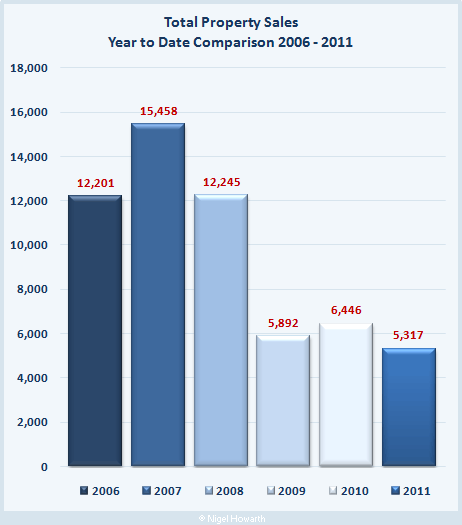
DEPARTMENT of Lands and Surveys published yesterday show that the number of contracts for the sale of property deposited at Land Registries throughout Cyprus in September fell for the fifteenth consecutive month.

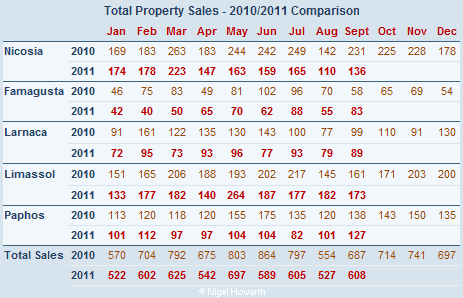
Last month’s hope that the decline in sales may be slowing were dashed as sales fell by 11.5% last month with the number of contracts deposited reaching 608 compared with the 687 deposited in September 2010.

Famagusta performed well, with sales during September up 43.1%. Limassol also saw an increase, with the number of sales rising by 7.5%. But sales in Nicosia, the capital, fell by 41.1%, while those in Larnaca fell by 10.1% and those in Paphos fell by 8.0%.

Total sales during the first nine months of this year stand at 5,317, a decline of 17.5% on the 6,446 sold in the first nine months last year. Sales are now down by nearly 10% on those of 2009; the year the market collapsed.

Source: Department of Lands and Surveys

So far this year, Limassol is weathering the storm well with sales by just 0.8% below those of last year. But in Larnaca sales have fallen by 27.5%, in Nicosia they are down 23.7%, in Paphos they are down 22.5% and sales in Famagusta have fallen by 15.9%.

Overseas sales

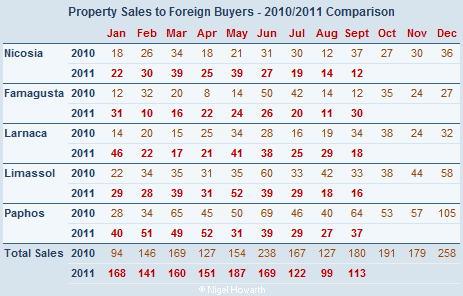
Overseas property sales, which account for a quarter of all sales, fell by 37.2% last month with the number of contracts deposited reaching 113 compared with 180 deposited in September 2010.

Although sales during September went up in Famagusta by a startling 150.0%, they fell in all other districts. Sales in Nicosia fell 67.6%, while those in Limassol fell 51.5% followed by Larnaca, where sales fell 47.1% and finally Paphos, where sales were down 42.2%.

Source: Department of Lands and Surveys

Total overseas sales during the first nine months of the year totalled 1,310; a fall of 6.6% on the 1,402 sold in the first nine months of last year.

Comment/opinion

The problems in the domestic market are due to the economic uncertainty, the lack of liquidity and high interest rates. Also, unemployment levels are at an unprecedented high, having more than doubled over the past thirty months.

Overseas sales have been hit by the global downturn and the well-publicised problems associated with buying property on the Island.

Many of the properties built in the past for the overseas market were specifically targeted at British buyers. However, according to their report “Spotlight on Second Homes Abroad” published last month, Savills Research said that:

“Buyers favour more spacious units, in line with traditional overseas property buying trends. This reflects that today’s buyers are motivated by lifestyle reasons rather than simply the opportunity for financial returns” and that the proximity of cultural/historical attractions are important factors when choosing a holiday home overseas.

What do holiday home buyers look for?

According to Savills Research “Preference for low density environments and good accessibility, proximity to beaches, and the opportunity to sample local cuisine and culture, are all factors influencing choice of holiday home destination. Almost 60% of holiday home owners prefer quiet rural and village environments to urban areas.”

Source: Department of Lands and Surveys

Cyprus buyers stage protest at overseas property show

Protesters at the NEC in Birmingham

VISITORS to the ‘A Place in the Sun Live’ exhibition at Birmingham’s NEC were greeted by a group of protesters who were raising awareness and distributing leaflets on the potential problems associated with buying property on the island of Cyprus.

Many of the protesters believe they have been defrauded or mis-sold property and are taking advice from their lawyers on possible legal remedies.

Some of the exhibitors complained that the protesters were damaging their business and demanded that they be removed, but the police turned them away and made sure there were no problems.

‘A Place in the Sun Live’ claims to be “the UK’s biggest and best-attended overseas property exhibition” and is organised in conjunction with the popular Channel Four television programme, which attracts millions of viewers each week. The exhibition, which ended on Sunday, attracted 4,076 visitors.

Property in Cyprus action support group

Property Ownership Problems?
Support Group Launches New Website

If you’ve bought a property and have problems in dealing with your developer or an unfamiliar legal system, knowing what to do can seem like an uphill struggle. Thanks to the Property in Cyprus Action Support group (PICAS) advice and guidance is readily available – and it’s free! In addition to regular monthly meetings at the Dhekelia Leisure Resort, information from PICAS can now be accessed on a new website: http://www.picas-cyprus.com/

The Group’s mission statement is a clarion call to anyone needing help:

‘If you have a problem related to property ownership in Cyprus, we can offer access to reliable, qualified information and advice to help you find a solution in a friendly, safe and confidential environment’.

Formed in October 2010, PICAS is the brainchild of two members of the Cyprus Eastern Owners & Buyers Forum, an online community where people ‘talk’ about their experiences of buying property and living in Eastern Cyprus. ‘Cyprussmoothie’ and ‘Baileyboy’ (to quote their Forum usernames) believed that those in distress needed personal support and freedom to share their problems with others in a safe, secure and confidential setting.

It was clear from the outset that many property buyers in Eastern Cyprus feel isolated, alone and abandoned in their efforts to resolve a bewildering range of problems – from securing their Title Deeds to dealing with ‘rogue’ developers and lawyers to navigating a path through a slow-moving and complex official bureaucracy.

Meetings have also dealt with non-property issues such as Pensions and new rules for passport applications.

The monthly meetings are attended by members of the PICAS Advisory Panel, which include: Stelios Stylianou, a respected lawyer from Nicosia; Nigel Howarth, an independent property advisor, and Steve, the owner of the Cyprus Eastern & Buyers Forum. Guests have included the British Vice-Consul in Cyprus.

‘Cyprussmoothie’ is passionate about what PICAS has achieved. She says: “Buying a property in Cyprus should be a dream come true – but for too many people it has turned sour. The message to anyone struggling to cope with the pressure and uncertainty is that they are not alone – support and guidance is available whether you are in Cyprus or living abroad. Join our meetings if you can – or become part of the PICAS family through our website. Our aim is to make living in Cyprus a positive experience – after all, this is our home”.

PICAS meetings are held on the last Wednesday of the month at the Dhekelia Leisure Resort in  Larnaca, starting promptly at 14:30. A schedule of planned meetings and directions to the venue can be found on the PICAS website.

Resale villas and apartments offer safer investments

SINCE the end of the Island’s off-plan building boom that left abandoned and mothballed developments littering the island’s once popular hotspots, resales appear to be enjoying a revival, re-emerging from their back seat position during the years of frantic investor speculation.

In recent weeks three resale properties have been sold in my area, close to the town of Limassol.

Resales are ready-built, pre lived in properties that remove all the risks, uncertainties and doubts that engulf buying off-plan property in Cyprus at this time providing, of course, that the property has been issued with its all-important Title Deed.

The key benefit of buying resale is that there will be no delay between purchase and completion as EU citizens can pay the Property Transfer Fees at the Land Registry and obtain legal ownership of their property on the day of purchase; its Title Deed will follow a few days later in the post.

You can inspect the property with your very own eyes to see precisely what you are getting for your money, its size, its orientation, its layout and its build quality. Properties built before the investment fever started tend to be larger and occupy larger plots of land offering increased privacy from the neighbours compared with more recent builds.

You could also find that the property has an established garden and some properties are sold complete with furniture and other useful extras such as household appliances, satellite dish, television, etc.

Traditional stone houses have more character, but they can also be damp, draughty, and their electrics and plumbing may be in dire need of modernisation. More modern houses too may be in need of remedial work.

It is essential to have a survey carried out on the condition of the property and its market value assessed by an independent firm of property surveyors. This should identify any unforeseen problems with the property that could end up costing a fortune to repair and whether the asking price is fair.

An independent lawyer is also essential to check that the vendor is the property’s legal owner and that there are no mortgages or other debts or liens registered against the property. In some cases a lawyer could discover that the property is owned by several family members, in which case all of them need to give their permission before the property can be sold. It is also important that the lawyer establishes that no illegal changes have been made to the property and that any changes that you wish to make will be acceptable to the Planning Authorities.

Do not try and cut corners or beat the system. In Cyprus buyers may be asked to pay for part of a property in cash. These under-the-table payments are illegal and you could well find yourself with problems if you agree.

Legislation changes will not end Title Deed nightmare

LAST week, the Nicosia City Council circulated an email encouraging householders to apply for planning permission to changes made to their property in return for (renewed) Title Deeds. This followed on from a Ministry of the Interior planning amnesty brochure I’d received by post a couple of months ago.

The planning amnesty opens with a thousand words of gobbledygook entitled General Information, followed by Key Features of the Legislation broken down into eight separate clauses, then Town and Country Planning Law which outlines Permanent Provisions with five separate clauses followed by Temporary Provisions 1, 2, and 3, which contains sub-clauses (a, i to iv, b to d) then clauses four to 18.

If you are not totally bemused at this point you then proceed to The Streets and Building Regulation Law – Permanent Provisions, seven clauses followed by Temporary Provisions, one to 15, and finally, The Immovable Property (Tenure, Registration & Valuation) Law, clauses one to four.

Who are you trying to kid?

Come on, Interior Minister Sylikiotis, who are you trying to kid? I bet you don’t understand a word of it.

Here below are a few examples of the pitiful state of the Cyprus property market.

At the time of purchase, Mr X’s developer told him that the planning ratio in his area was 20 percent although recently, he learnt through the grapevine, that it was only 15. He immediately applied to the District Office and Town Planning Department in Limassol for a copy of both the building and planning certificates.

The District Office was very helpful and on payment of a small fee, he was given an authenticated copy of the building certificate and associated drawings, which showed that the developer had lodged false drawings.

The Town Planning Department, on the other hand, was not at all helpful, so Mr X engaged a surveyor to check the dimensions of his property after acquiring a copy of the planning permit, which also stated 15 percent build. His surveyor reported that the developer and architect had committed a criminal act, Mr X’s house having been overbuilt by 34 percent.

If Mr X decides to go down the planning amnesty route (amnesty being quite the wrong word) he will end up with “tainted Title Deeds” which will hinder the future sale of his home, although he is not required to do so since he is not yet the legal owner of the property, this making his developer liable for specified irregularities and any fines. If, on the other hand, he was to proceed down the Planning Amnesty route, there is no mechanism for withdrawal – highlighting overbuild of more than 30 percent which may require he knocks down part of the property.

Mr X then carried out an N.50 survey (developer’s assets/liabilities) and found that his developer had assigned mortgages to the bank and had outstanding debts to the Inland Revenue. If Mr X went for the amnesty, it would be like signing three blank cheques: a fine for overbuild, share of mortgage debt and share of tax debt without knowing in advance how much each would be.

Another householder wrote to me, “At the moment I’m going for the amnesty through an independent ETEK architect and I don’t want my developer to know anything about it. I have been negotiating with the developer relating to the original lease of 1998. Guess what, he produces a new sub-lease for me to sign that implies I’m leasing my own house as well as the plot. He must think I’m stupid!”

Another wrote, “Most developers build illegal properties trapping the buyer into selling the house back to them due to non issuance of Title Deeds.

“Most buyers have no idea that their properties are riddled with illegalities. It is only when they choose to add an extension or sell up that the illegalities become apparent. The amnesty is really designed to get developers and architects off the hook by transferring the financial burden of correcting their ‘mistakes’ to the per se owners.”

He goes on to say, “A renowned property journalist suggested in one of his articles that if an estate of ten houses has a developer’s mortgage of a million Euros on their properties,  they could band together and pay €100,000 each of the developer’s mortgage and hence get their Title Deeds.

“Fundamentally, almost all properties built in Cyprus are in some way illegal. Cypriots aren’t bothered because they buy the land first and he who owns the land owns what’s on it. This is not the case for the majority of foreigners, who buy from developers who ‘own’ the land.

“The amnesty says that even when you have corrected all illegalities, the property still belongs to the owner of the land, and the government can’t in law transfer the property rights to the buyer without the owners’ consent.”

Yet another wrote, “In my case, I had an independent lawyer and she did identify a mortgage on the land that was written into my Contract of Sale. I have withheld about euro 18,000 pending payment of the mortgage. What was not identified was that the land ratio was only 15 percent when it was spelt out in the contract that the house was built to 20, which would have taken my lawyer five minutes to check. I am very angry, but it seems that the responsibility for overbuild lies with the developer and the architect. I foolishly used the developer’s architect.”

Of course, there are thousands of similar examples of the chaotic and illegal meanderings of planning departments, developers, architects, lawyers and land registries – few expats own homes in accordance with planning laws and most of these homes sit on land either owned by developers or mortgaged to banks.

The present mess is irretrievable

The tardy, dishonest and purposefully complex manner in which Cyprus chooses to sell property will rebound explosively on those involved in the supply chain. Amnesty or not, it is self evident that this present mess, propounded over many years by ineffective planning departments (and the governments of the day) is irretrievable no matter how many new planning laws the Interior Ministry introduces. It is not surprising that the uptake for the planning amnesty has been very low to date.

When a major developer/hotel owner bursts into a council meeting with his bodyguards, threatening to sue all the councillors for refusing planning permission to build homes on a public beach, things have gone far too far.

The Cyprus Property Action Group is applying to the European Court of Human Rights for issuance of clean Title Deeds to all who have paid for their property in full. I wish them well and diddling developers to rot in hell.

Hermes Solomon’s book, Cyprus on the Rocks, is available from Hellenic Distribution Agency tel: 22878500