Construction investments continue downward trend

FIGURES from the Cyprus Statistical Service released earlier today show that the decline in the Island’s construction sector is continuing as the number of building permits issued continues to fall.

A total of 601 building permits were authorised by the Municipal Authorities and the District Administration Offices in July 2011. Compared with the 763 permits authorised in July 2010; a fall of 21.2% over last year.

In July 2011, building permits were issued for:

  • Residential buildings – 428 permits
  • Non-residential buildings – 99 permits
  • Civil engineering projects – 28 permits
  • Division of plots of land – 41 permits
  • Road construction – 5 permits

The total value of these permits reached €177.1 million and the total area 186.8 thousand square metres.

During the period January to July 2011, 4,625 building permits were issued; a fall of 14.1% compared to the same period last year. The total value of these permits fell by 23.8% and their total area fell by 28.4%.

Residential buildings

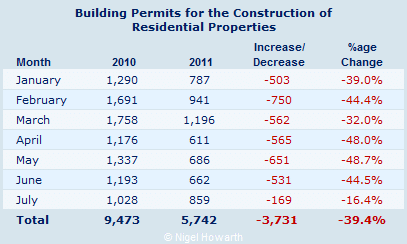
The 428 permits were approved for the construction of 859 dwelling units, comprising 289 single houses and 570 multiple housing units such as apartments and other residential complexes.

Compared with the July 2010 total of 1,028 dwelling units, this represents a fall of 16.4% and an overall year-to-date fall of 39.4%.

Source: Cyprus Statistical Service

According to the Cyprus Statistical Service, building permits constitute a leading indicator of future activity in the construction sector.

Cyprus falls to twelfth spot in Top of the Props

CYPRUS has slipped out of the top ten places for overseas property investors, according to the latest Top of the Props survey from TheMoveChannel.com.

The top five spots remain unchanged since last month with Spain, France, USA, Portugal and Italy accounting for more than 50% of the total number of enquiries.

Cyprus has moved down three places from ninth into the twelfth spot with 2.16% of the total number of enquiries.

The full breakdown of the Top 40 from TheMoveChannel.com is as follows:

RankCountryShareChange
1Spain13.35Non-mover
2France11.49Non-mover
3USA9.01Non-mover
4Portugal8.64Non-mover
5Italy7.82Non-mover
6Brazil4.49Non-mover
7Turkey4.4Up 1
8Bulgaria3.16Down 1
9Cape Verde2.94Up 5
10Morocco2.43Up 3
11Barbados2.29Down 1
12Cyprus2.16Down 3
13Malta1.88Up 4
14Germany1.76Up 2
15Greece1.52Non-mover
16Thailand1.47Down 4
17Poland1.43Up 2
18India1.18Up 4
19UAE1.13Up 4
20Cayman Islands1.1Down 9
21Canada0.93Down 1
22Slovenia0.9Down 4
23Croatia0.75Down 2
24Switzerland0.73Up 5
25Mexico0.6Up 1
26Indonesia0.6Up 11
27Hungary0.53Down 3
28Montenegro0.47Non-mover
29Egypt0.47Down 2
30Jamaica0.38Non-mover
31Philippines0.38Up 8
32Bahamas0.32Up 4
33St Lucia0.32Down 8
34Panama0.27Up 4
35Malaysia0.24Down 2
36Austria0.21Up 8
37Australia0.21Down 6
38Romania0.13Up 8
39St Kitts and Nevis0.11Up 1
40New Zealand0.09

Founded in 1999, TheMoveChannel.com is the leading independent website for international property, with more than 400,000 listings in over 100 countries around the world, marketed on behalf of agents, developers and private owners.

VAT reduction for first-time home buyers agreed

FOLLOWING a series of proposals, counter proposals, discussions and debates, a compromise deal has been reached on the VAT reduction for first-time home buyers.

With 33 MP voting in favour and 18 against, the bill reduces the VAT payable on new homes measuring up to 275 square metres to 5%.

In addition to the 275m2 for the dwelling, there are additional allowances of:

  • Up to 36m2 for covered parking
  • Up to 5m2 for an engine/boiler room
  • Up to 7m2 for storerooms
  • Up to 40m2 for covered verandas

If the government accepts the bill, the changes will come into effect on 1st October.

Agreement on the compromise bill was reached yesterday following an urgent meeting between the Cyprus Finance Minister, Kikis Kazamias, and the House Finance Committee.

It is hoped that the reduction in VAT will help boost the Island’s residential property market and help young families to get a foot on the housing ladder.

Cyprus property buyers – now is the time to act!

Limassol Land Registry Offices

THE ACT of depositing a Contract of Sale at the Land Registry creates an ‘encumbrance’ against the title that gives a buyer a legal claim to his/her property, which can be pursued by a simple procedure though the courts should this become necessary.

Failing to deposit a Contract at the Land Registry can result in serious complications for a buyer. For example: a buyer would have no legal claim to the property and would only be able to make a legal claim against the vendor for the value of the Contract, the vendor could also renege on deal and sell the property in question to someone else.

Designed to provide those buying property with added legal protection, a ‘new’ Sale of Immovable Property (Specific Performance) Law, N81(I)/2011, which replaced the Sale of Land (Specific Performance) Law, was introduced earlier this year’ (see New specific performance law increases safeguards).

We are aware that there are many Contracts of Sale which, for various reasons, have not been deposited at the Land Registries and therefore those buyers are not adequately protected under the law. However, under the provisions of the ‘new’ law those buyers have been given the opportunity to deposit their contracts regardless of how long ago they were signed.

Act now

If you have signed a Contract of Sale that has not been deposited at the Land Registry, now is the time to act!

You have until the 29th January 2012 to deposit your Contract of Sale at the Land Registry and avoid the potential serious consequences that may arise.

If you are unable to deposit your Contract of Sale personally, your lawyer, the vendor (developer) or a registered estate agent can carry out this task on your behalf – and will be able to provide you with a copy of the receipt issued by the Land Registry.

Reduced VAT for first-time home buyers

THE GOVERNMENT yesterday handed to the House Finance Committee its counter-offer on a legislative proposal on lower tax rates for homeowners, the outcome of which could set the tone for parliament’s acceptance of the second austerity package, which legislators have branded as inadequate.

Finance Minister Kikis Kazamias has proposed a compromise to the legislative proposal, under which 150 square metres of a residence are to be taxed at five percent VAT instead of 15 percent.

The proposal concerns homes of an area up to 388 square metres – including building additions such as covered verandas and parking space. Legislators wanted the tax relaxation to apply to 200 square metres of a residence, up from the 130 square metres currently. They say the measure will give a boost to the lagging housing market and benefit first-home buyers, like young couples.

The president had refused to sign the legislative proposal into law, and sent it back to parliament.

In presenting his counter-proposal yesterday, Kazamias nevertheless urged politicians to reconsider the size of residences affected by their legislative proposal, arguing that state coffers stand to lose some €80 million in tax refunds.

A technical point that needs to be ironed is whether applicants will be paying two separate VAT rates – five and 15 per cent, as applicable – or pay a single rate of 15 per cent for the whole house and later receive a rebate from the government.

Agreement on this legislative proposal could set the mood for how the government ‘sells’ its second batch of economic measures, which include cutbacks in the state payroll but also raising VAT from 15 to 17 per cent.

Comment

Delays in agreeing and implementing a VAT reduction will slow property sales as it is likely that those contemplating buying their first-home will not do so until the legislation has been passed.

Property revaluations to start in 2012

UNDER the Cyprus ‘Immovable Property Tax’ laws 1980-2004 all property owners, regardless of whether they’re resident in Cyprus or not, are liable to pay an annual tax based on the total value of all the ‘immovable property’ (houses, apartments and land) registered in their name.

Immovable Property Tax (IPT) is calculated on the Land Registry’s assessment of the market value of a property at 1st January 1980 and is paid annually the Inland Revenue Department. In addition, this 1980 market value is used to calculate an annual property tax payable to the Community or the Municipality in which the property is situated. Local councils have the power to raise and set these local taxes which are typically in the region of 0.15% of a property’s 1980 market value.

The government has recently announced changes to the IPT tax bands, and these will come into effect in 2012:

These changes will not affect the amount of the local property tax payable to the Community of Municipality – and they are unlikely to affect the amount of IPT paid by owners of a single property to the Inland Revenue; but they could affect those owning a number of properties. To check whether these changes will affect you, simply add the 1980 values shown on each of your Title Deeds; if the total is less than €120,000, you will not be affected.

These IPT changes will undoubtedly affect a number of the Island’s property developers as they are the registered owners of property whose value runs into many millions of Euros. Some nefarious developers fraudulently demand money from those who have yet to receive their Title Deeds claiming that it is to pay their IPT and this illegal practice may continue and possibly proliferate as a result of these changes.

Property revaluations

FOR some years now, it has been recognised that the 1980 values are out of date and bear no relation to the worth of a property. Market values have increased dramatically over the past 31 years and the levels of increase vary across the Island.

As a consequence, the Department of Lands and Surveys plans to revalue all property on the Island starting in 2012 and will set the ‘new’ market values as they stand on 1st January 2012, which will be used for the purposes of taxation.

Earlier reports on this subject suggest that it will take up to five years for the Department to complete the revaluations.

Statistical information for the Department provides some idea of how property prices have risen since 1980 and the increase factors are presented in the chart below.

For example, a house in Paphos with a 1980 market value of €90,000 will have a 2012 market value of €80,000 x 7 = €560,000. (This figure must be treated with caution as even within the Paphos District property value increases will vary in different areas.)

We hope that once the Department has completed the revaluations that the government revises the IPT bands; but downwards this time please!