Cyprus property sales slump slows

DEPARTMENT of Lands and Surveys published yesterday show that the number of contracts for the sale of property deposited at Land Registries throughout Cyprus in August fell for the fourteenth consecutive month.

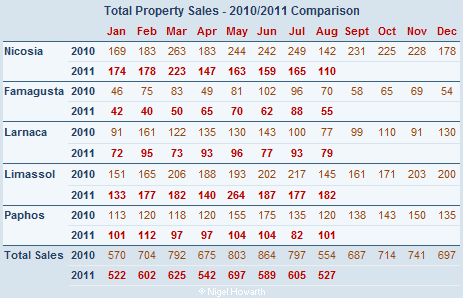
However, the 4.9% fall in sales is the smallest for almost a year giving hope that the devastating decline may soon be coming to an end. Last month 527 contracts were deposited compared with the 554 deposited in August 2010.

Limassol performed well, with sales up 25.5%. Larnaca also saw an increase, with the number of sales rising by 2.6%. But sales in Nicosia, the capital, fell by 22.5%, while those in Famagusta fell by 21.4% and those in Paphos fell by 15.8%.

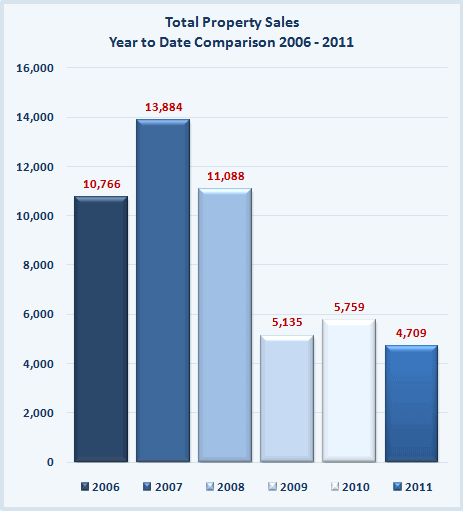
Total sales during the first eight months of this year stand at 4,709, a decline of 18.2% on the 5,759 sold in the first eight months last year. Sales are now down more than 8% on those of 2009; the year the market collapsed.
Source: Department of Lands and Surveys

So far this year, Limassol seems to have escaped the general downturn with sales just 1.7% below those of last year. But in Larnaca sales have fallen by 29.3%, in Paphos they are down 24.4%, in Famagusta they are down 21.6% and sales in Nicosia have fallen by 21.3%.

Overseas sales

OVERSEAS buyers now account for some 25% of the Island’s total property sales. However, this increase is due to the collapse of the domestic market rather than an increase in interest by foreigners as reported elsewhere.

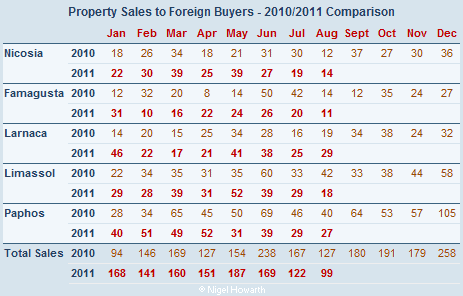
Overseas property sales fell by 22% in August to just 99; the lowest number since January 2010. Although sales were up in Larnaca by 52.6% and by 16.7% in Nicosia, they were down 57.1% in Limassol, 32.5% in Paphos and 21.4% in Famagusta.
Source: Department of Lands and Surveys

Total overseas sales during the first eight months of the year were 1,197; a fall of 2.0% on the 1,222 sold in the first eight months of last year.

Comment/opinion

Property valuer Polys Kourousides believes that the downturn will continue. “I don’t think that things will change in the next months. Limassol recorded an increase in August due to the purchase of properties by non-Cypriots, Russians mostly”, he said.

Antonis Loizou, the boss of Antonis Loizou & Associates, believes that the downturn is due to the economic conditions and the downgrading of the banks by the ratings agencies, which affect foreign investment. “If uncertainty continues, property prices might be reduced further”, he said.

Commenting on parliament’s approval to cut VAT for first-time buyers to 5%, Mr Loizou said that it will be helpful but it is not expected to contribute significantly to the sector. Mr Kourousides said that the VAT cut will give a boost to those buying big houses, but for 1-bedroom or 2-bedroom apartments things will remain the same.
Source: Department of Lands and Surveys

Ceiling set on value of Swiss Franc

IN A PRESS release issued earlier today the Swiss National Bank, which conducts Switzerland’s monetary policy as an independent central bank, announced that it will enforce a minimum exchange rate of CHF 1.20 to the Euro:

“The current massive overvaluation of the Swiss franc poses an acute threat to the Swiss economy and carries the risk of a deflationary development.

The Swiss National Bank (SNB) is therefore aiming for a substantial and sustained weakening of the Swiss franc. With immediate effect, it will no longer tolerate a EUR/CHF exchange rate below the minimum rate of CHF 1.20. The SNB will enforce this minimum rate with the utmost determination and is prepared to buy foreign currency in unlimited quantities.

Even at a rate of CHF 1.20 per euro, the Swiss franc is still high and should continue to weaken over time. If the economic outlook and deflationary risks so require, the SNB will take further measures.”

The Euro, which had been trading around CHF 1.10 before the announcement, shot up to 1.2024 afterwards.

Those who have purchased property in Cyprus with the help of CHF mortgages will welcome the announcement. Many have seen their repayments soaring in recent years and fear that they could lose their home in the UK if they are pursued by the banks for the money that they owe.

Investments in construction at lowest level in years

FIGURES released today by the Cyprus Statistical Service offer no encouraging signs of an upturn in investments in the construction sector as the number of building permits issued continues to fall.

A total of 696 building permits were authorised by the Municipal Authorities and the District Administration Offices in June 2011. Compared with the 792 permits authorised in June 2010, this reflects a fall of 21.1% over last year.

In June 2011, building permits were issued for:

  • Residential buildings – 515 permits
  • Non-residential buildings – 93 permits
  • Civil engineering projects – 31 permits
  • Division of plots of land – 46 permits
  • Road construction – 11 permits

The total value of these permits reached €163.1 million and the total area 174.0 thousand square metres.

During the period January to June 2011, 4,024 building permits were issued; a fall of 12.9% compared to the same period last year. The total value of these permits fell by 24.6% and their total area fell by 229.3%.

Residential buildings

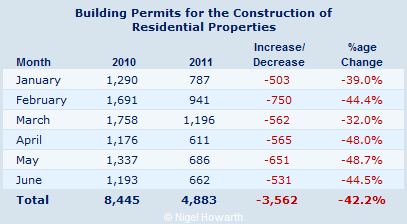
Of the 515 permits approved for the construction of residential buildings, these were issued for the construction of 662 dwelling units comprising 293 single houses and 369 multiple housing units such as apartments and other residential complexes.

Compared to the June 2010 total of 1,193 dwelling units, this represents a fall of 44.5% and an overall year-to-date fall of 42.2%.

Source: Cyprus Statistical Service

Limassol has suffered the worst fall, with the number of dwelling units for which permits have been issued down by 51.0% compared with last year. Limassol is followed by Larnaca (-48.8%), Famagusta (-37.4%), Nicosia (-36.2%) and finally Paphos (-31.6%).

According to the Cyprus Statistical Service, building permits constitute a leading indicator of future activity in the construction sector.

Town Planning Amnesty explained

AS REGULAR readers of Cyprus Property News will be aware, approximately 130,000 properties in Cyprus have yet to be issued with their all important Title Deed.

One of the measures introduced by the government in efforts to resolve the Island’s long-standing Title Deed problem is legislation known as the Town Planning Amnesty. In addition to simplifying and modernising the procedures involved in issuing Title Deeds, the legislation provides a one-time window of opportunity for those whose property has been built illegally or which suffers from planning infringements to apply for their Title Deeds.

At a seminar held at the Paphos United Kingdom Citizens Association (UKCA) Yiannis Koutsolambros of the Scientific and Technical Chamber of Cyprus (ETEK) explained the provisions of the Town Planning amnesty to a packed audience. Click on the image below to view the full presentation.

As we have reported previously, many companies and individuals are asking outrageous sums of money in return for helping buyers submit amnesty applications.

Readers are strongly advised to ignore these offers of help and contact ETEK in Nicosia (tel: +357 22877644). ETEK is preparing a list of architects and engineers who are capable and willing to assist with amnesty applications. Once you have obtained a list of architects and engineers in your area, phone them to get competitive quotes.

VAT and other tax reductions on the table

GOVERNMENT lobbying by the Land & Building Developers Association (CLBDA) and the Land & Property Owners Association (KSIA) has been successful as proposals to reduce the tax on properties are now being discussed.

The tax reduction proposals comprise:

  • Reducing the VAT to 5% for first-time home buyers for residences up to 250 square meters – and maintaining it at 15% for residences between 250 and 300 square metres.
  • A suspension of property transfer fees for a three year period.

A draft law concerning the reduction in VAT to 5% is expected to be discussed at today’s House Plenary session.

The Island’s property market has been in trouble for quite some time. Sales have fallen for thirteen consecutive months and are now down by almost 20% on the numbers sold last year. Unemployment in the sector has risen and the business climate deteriorated.

Assuming that these proposals are accepted by parliament and become law, they should go a long way in relieving the problems of the industry and should also help to clear the backlog of Title Deeds waiting to be issued.

Paphos development plans received with scepticism

THE MAYOR of Paphos Savvas Vergas reported that a Russian investment company had expressed an interest in the development of the western coast of Paphos.

It proposed to build restaurants, cafes, functions halls, beach amenities, a small marina and an area that could be used by sea-planes, which would fly to destinations in the surrounding areas. Impressive plans, but they would require approval not only by the local authorities but also by the government.

Then there would be the issue of political objections and claims that the Russian company would be favoured, at the expense of local companies, in being given permission to develop a coastal area and build a marina. Vergas should have known better than to make public these plans, before consulting the government, sounding out the political parties, which could block the development and ensuring that the company had the funds for such an ambitious project.

The Cyprus public, we think, has learned not take the announcement of such grandiose plans very seriously.

Only a few months ago, a dubious Russian charity organisation announced it would build the biggest statue in the world in Cyprus but never informed us how this €100 million project would be funded.

Then there was the case of the big Qatari-funded project in the centre of Nicosia, which, according to the government, was a done deal. Is that going ahead or has it been abandoned, like so many other grand plans?
