Complimentary tickets to A Place in the Sun exhibition

The next A Place in the Sun Live overseas property exhibition will be taking place at the NEC in Birmingham between 30th September and 2nd October 2011.

It will feature thousands of overseas properties for sale, from hundreds of exhibitors showcasing properties from popular countries like France, Spain, Italy, Portugal, Turkey and Florida, and it’s the perfect opportunity for visitors to meet the agents face-to-face and ask them all kinds of questions.

There’s a packed programme of free-to-attend seminars on the main stage with advice from Amanda Lamb, Jonnie Irwin and Jasmine Harman, gained over years of taking house-hunters around the world with the A Place in the Sun TV shows, as well as expert guests in the form of leading overseas property experts.

Then there’s the Buying Advice Seminar Theatre which will play host to sessions on buying property in Spain, Italy, Cyprus, Turkey, plus many other destinations.

This year, a number of complimentary tickets are available.

Banks could face 1 billion Euro hit

BANK of Cyprus and Marfin Popular Bank have not yet committed to join a voluntary private sector plan to rescue Greece, whereby investors will take a 21 percent loss on the country’s bonds.

Marfin held 3.4 billion euros of Greek bonds at the end of last year, and is the biggest overseas creditor not yet to pledge to join. It faces a loss of more than 700 million euros. Bank of Cyprus held 1.7 billion euros at the end of May.

“It’s potentially a big hit and they would probably need to raise capital if they took a 21 percent haircut,” said one analyst, who asked not to be named.

The banks are waiting for more details to emerge on the offer. These are due to come in mid-August and investors are expected to sign up in early September, sources have said.

The Central Bank and Bank of Cyprus have warned Cyprus could need a bailout if it does not take urgent action to repair its finances. It would become the fourth state in the euro zone to request a rescue after Greece, Ireland and Portugal.

A new finance minister said on Friday that Cyprus does not need a bailout for the moment and must do all it can to avoid one.

Cyprus, which accounts for only about 0.2 percent of the 17-nation euro zone’s economy, would not strain Europe’s resources but it would show how the crisis can spread and how intertwined banks are with sovereign borrowers.

“We see three risks for Cypriot banks – there is the high exposure to Greek sovereign debt, there is their exposure to Greece through their lending into the country, and thirdly, given the high uncertainty in the region banks may face a challenge to sustain their current funding and liquidity profiles,” said Christos Theofilou, analyst at ratings agency Moody’s.

“There is a risk the banks will need some state support over the medium term, although it’s not our base case scenario,” he added.

Energy crisis

All three major credit rating agencies have downgraded Cyprus in recent months because of the Greek sovereign debt its banks hold and the exposure to Greece through trade and loans.

Marfin had 18.7 billion euros of loans to Greece at the end of 2010 and Bank of Cyprus had 11.2 billion euros. The risk is that those loans will sour as Greece’s austerity plan bites.

The domestic economy is in better health, but an explosion a month ago at the island’s main power plant has sparked an energy crisis and may derail growth and increase losses on loans.

Other threats are that losses on Greek bonds may exceed the 21 percent earmarked, and if Cyprus needs to support its banks it will hurt sovereign debt, creating a negative circular loop, analysts said.

A bailout could also damage Cyprus’s reputation and see the withdrawal of some of the 27 billion euros it has in overseas deposits, with much historically coming from Russia.

Those overseas deposits leave its banks well-funded, with 71 billion euros in deposits at the end of June, more than the 65 billion they lend, according to central bank data.

Cyprus offers tax breaks to international businesses. The risk is it might not be able to continue providing all of them under the terms of an international rescue, or depositors could retreat to other safe havens.

Cyprus’s banks are seen as profitable and well-regulated and have successfully raised capital in the past, so the risk of a full-blown crisis was low, analysts said.

Marfin raised 488 million euros in a rights issue in February, which lifted its core Tier 1 capital ratio to 9.4 percent. But under a stress test of Europe’s bank, which assumed a two-year recession, that core capital ratio would drop to 5.3 percent at the end of 2012.

Under the test, conducted last month by the European Banking Authority (EBA), banks had to raise funds if capital fell below 5 percent under the adverse scenario. The EBA said banks just above the pass mark that had significant exposure to strained sovereign debt should also strengthen capital.

Marfin said the sale of its Australian subsidiary, the issuance and exchange of securities into equity and a plan to trim its assets will increase its capital cushion. It declined to comment further.

Bank of Cyprus said it successfully passed the EBA stress test and its Greek bonds were held at a 13 percent discount based on end-March prices. It declined to comment on its participation in the Greek rescue plan or the possible impact.

Bank of Cyprus’s core Tier 1 capital was 8.2 percent at the end of March but would fall to 6.2 percent under the 2-year adverse scenario. (Reuters)

Construction activity showing no signs of recovery

FIGURES released today by the Cyprus Statistical Service show that 691 building permits were authorised by the Municipal Authorities and the District Administration Offices in May 2011.

Compared with the 761 building permits authorised in May 2010, this reflects a fall of 9.2% over last year.

In May 2011, building permits were issued for:

  • Residential buildings – 470 permits
  • Non-residential buildings – 106 permits
  • Civil engineering projects – 40 permits
  • Division of plots of land – 70 permits
  • Road construction – 5 permits

The total value of these permits reached €173.5 million and the total area 180.8 thousand square metres.

During the period January to May 2011, 3,328 building permits were issued; a fall of 13.0% compared to the same period last year. The total value of these permits fell by 24.1% and the total area fell by 28.8%.

Residential buildings

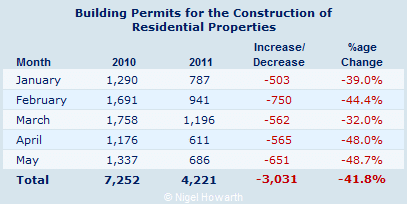
Focusing on the 470 permits issued for the construction of residential buildings, these were approved for 686 dwelling units – 294 single houses and 392 multiple housing units such as apartments and other residential complexes.

Compared to the May 2010 total of 1,337 dwelling units, this represents a fall of 48.7% and an overall year-to-date fall of 41.8%.

Source: Cyprus Statistical Service

According to the Cyprus Statistical Service, building permits constitute a leading indicator of future activity in the construction sector.

Brit Gary Robb remanded over property scam in north

CROOKED property developer Gary Robb was slapped with an eight-day remand order by a Cyprus court on Thursday for cheating fellow Britons out of millions for holiday homes he could not deliver in the Turkish occupied north of the island.

Robb was arrested in the U.K. under a European arrest warrant and was handed over to Cyprus Police in London on Wednesday.

The Nicosia District Court heard that the 48-year-old Briton is being investigated for conspiracy to commit felony and misdemeanour, unlawful possession, distribution and use of property registered to another person, obtaining money under false pretences and other offenses related to the illegal exploitation of Greek Cypriot properties in the occupied village of Klepini in the Kyrenia district.

The case focuses on the fact that of the development’s total expanse of about 274,000 square metres, 261,589 belongs to Greek Cypriot refugees who fled when Turkey invaded in 1974, a further 4,661 sq.m. is property held in the name of the Republic of Cyprus and 7,550 sq.m. was owned by Turkish Cypriots.

Robb’s company, Aga Development Ltd., launched the project of 335 villas in August 2004. Construction began in January 2005 and by April 2005, 85% of the buildings were sold.

But the potential owners knew little about ongoing property cases whereby Greek Cypriots had resorted to the European Court of Human Rights and were suing the Turkish government and other occupants of their abandoned properties for illegal use, demanding compensation and return of their properties.

Robb’s  lawyer, Giorgos Coucounis, said that Robb “had nothing to do with AGA developments”.

The Cyprus police investigator told the court that so far 25 persons have been questioned in connection with the case and another 27 are pending while a large number of documents have been obtained.

According to newspaper reports, Robb escaped to northern Cyprus after being released on bail for drug dealing in the UK in 1996. After 13 years of hiding out in the north, Robb was recaptured in January 2009 and sentenced to five years in a UK jail.

In June, England’s Crown Prosecution Service (CPS) told the Cyprus Mail he would be extradited to Cyprus based on a European arrest warrant issued by the Cypriot authorities in relation to the usurping of Greek Cypriot properties in the occupied areas.

The newspaper added that the CPS said the warrant listed nine offences and stated that “between 2004 and 2005, the defendant conspired with others (named as Tuncel Tahir Soycan and Akan Kursat Talat) to develop land which did not belong to them, and to sell villas built without permission upon that land by means of false representations to the prospective purchasers”.

Following his release on parole last month in the UK, Robb was re-arrested ahead of his intended extradition.

British police believe around 400 Britons collectively lost in the region of 35 million UK pounds in deals with Robb’s AGA Developments. AGA’s notorious Amaranta Valley project located close to the north coastal village of Klepini still consists of 500 rapidly decaying half-built properties.

Property title deed transfers fell in July

FIGURES released on Tuesday by the Department of Lands and Surveys show that 989 property transfers took place at District Lands Offices throughout Cyprus during July; a fall of more than 300 on the transfers that took place in May.

So far this year 7,202 property transfers have taken place compared with the 2,601 contracts for the purchase of property deposited at the District Lands Offices this year. But with an accumulated backlog of properties for which Title Deeds have yet to be issued, which is estimated to be in the region of 130,000, it is going to take several years for many of those who have purchased property on the Island to receive their all important Title Deeds.

Source: Department of Lands and Surveys

The Land Registry’s assessment of the market value of the 7,202 properties transferred so far this year totalled €1,201,595,662.48. This is 7.8% more than the sale price of €1,114,575,389.98 declared by vendors and purchasers.

Disastrous decline in real estate market continues

ACCORDING to Land Registry figures published earlier today, the number of contracts deposited at Land Registries throughout Cyprus in July for the purchase of property fell by almost a quarter to 605 from the 797 deposited in the same period last year. July was the thirteenth consecutive month during which sales have declined.

Compared with last year, total sales this year have fallen 19.7% to 4,182 from the 5,205 sold during the same period of 2010. Sales are now down by almost 7% on those of 2009, the year the market crashed, when 4,493 properties were sold over the first seven months of the year.

During July, sales fell in all areas. Worst hit was Paphos, where sales tumbled 39.3% compared with July last year. Paphos was followed by Nicosia (-33.7%), Limassol (-18.4%), Famagusta (-8.3%) and Larnaca (-7.0%).

Source: Department of Lands and Surveys

The Federation of the Building Contractors Associations of Cyprus (OSEOK) announced last Friday that turnover is declining, contracting companies are terminating or suspending their operations and that unemployment in the sector is increasing dramatically. It expressed its concerns that if no immediate measures are taken to support the construction sector, the impact on the sector and the economy will be “tragic with dimensions that will have huge economic and social costs”.

Overseas sales

PROPERTY sales to foreign buyers also fell in July with a total of 122 contacts in favour of foreigners being deposited at Land Registries compared with 167 in July 2010; a fall of 26.9%.

Although property sales were up 56.3% in Larnaca, they fell in all other areas. In Famagusta, sales more than halved, falling 52.4% compared with July last year. Famagusta was followed by Paphos, where sales fell by 37.0%, Nicosia (-36.7%), and finally Limassol (-12.1%).

Source: Department of Lands and Surveys

During the first five months of the year overseas property sales were up 17% compared to last year. However, the sharp decline in sales during June and July has resulted in the year-to-date improvement in sales falling to a mere 0.3%.