Fitch cuts Cyprus rating on exposure to Greek debt

Fitch ratings agency has cut Cyprus’ sovereign credit rating from AA- to A- and is warning of another possible downgrade because of its banking sector’s large exposure to Greece.

“The downgrade reflects the severity of the crisis in neighbouring Greece and the risk this poses for the Cypriot banking system and consequently the public finances of Cyprus,” said Chris Pryce, Director in Fitch’s Sovereign Group.

Cyprus is a small economy with a large banking system equivalent in terms of assets to approximately nine times its GDP. Exposure to Greece is a significant source of vulnerability that has intensified with successive downgrades of the Greek sovereign since January 2011, when Fitch put Cyprus on Rating Watch Negative citing fiscal and financial sector risks.

Roughly one third of the banking system’s assets are booked as Greek exposure, including that of Greek subsidiaries based in Cyprus. This exposure includes almost €14 billion of Greek sovereign bonds and an estimated €5 billion of Greek bank bonds. In addition, Cypriot-owned banks have lent through their substantial networks in Greece significant amounts to Greek companies and households.

Most Greek-related exposure is held by three major Cypriot banks: Bank of Cyprus, Marfin Popular Bank and Hellenic Bank. These “are relatively well placed to absorb the impact of a sovereign debt crisis in Greece that entailed an assumed 50% haircut to face value of Greek government bonds,” Fitch said.

But in a more severe scenario, in which “non-performing loans rose to 25%, Fitch estimates that the cost of recapitalizing the banks could rise to 25% of GDP, necessitating more extensive sovereign support.” The government likely “would be willing and able to provide effective support to Cypriot banks in a stress test of this magnitude,” but this “could materially alter the government’s debt profile in a manner that would be negative for the sovereign ratings.”

Fitch says developments in Greece will continue to have an important bearing on Cyprus’ ratings, underlining the importance of sound public finances and a robust, well-capitalised banking system.

The latest move by Fitch follows similar downgrades by ratings agencies Moody’s and Standard and Poor’s in recent months based on similar concerns.
Slowdown in construction sector continues

ACCORDING to figures released earlier today by the Cyprus Statistical Service, 740 building permits were authorised by the Municipal Authorities and the District Administration Offices in March 2011.

Compared with the 966 building permits authorised in March 2010, 740 reflects a fall of 23.4% over last year.

Building permits were issued for:

  • Residential buildings – 541 permits
  • Non-residential buildings – 105 permits
  • Civil engineering projects – 29 permits
  • Division of plots of land – 58 permits
  • Road construction – 7 permits

The total value of these permits reached €236.4 million and the total area 266.7 thousand square metres.

During the first quarter of 2011, 2,077 building permits were issued; a fall of 13.4% compared to the first quarter of last year. The total value of these permits fell by 23.6% and the total area fell by 27.6%.

Residential buildings

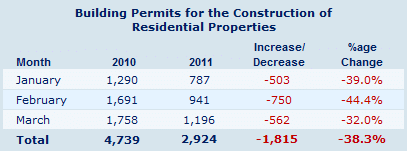
Focusing on the 541 permits issued for the construction of residential buildings, these were approved for 1,196 dwelling units – 453 single houses and 743 multiple housing units such as apartments and other residential complexes.

Compared to the February 2010 total of 1,758 dwelling units, this represents a fall of 32% and an overall year-to-date fall of 38.3%.

Building permits issued in Cyprus - March 2011
Source: Cyprus Statistical Service

According to the Cyprus Statistical Service, building permits constitute a leading indicator of future activity in the construction sector.

Working together to end title deed scam

REPRESENTATIVES of over 50,000 British buyers of Cypriot properties, who have yet to receive their title deeds from the property developers and are thus not the legal owners of their homes, want MEPs to campaign on their behalf to end this scandal.

The scam is that developers fail to inform potential buyers that the title deeds for their homes will be withheld for an unspecified time and that the land on which their property is built has only been mortgaged by the developer.

The consequences for buyers are that they are liable to high property charges, burdened with huge legal fees and unable to sell the property.

But what is worse is that if the developer goes bankrupt, they will lose their home despite having paid in full for it. This is because the title deeds and full legal ownership cannot be transferred to buyers until the developer has settled his mortgage on the land in full.

Given the worsening economic outlook for Cyprus and its property industry, the risk of developer default and the repossession of these homes can only become much greater. The developer debt has doubled in size in the last three years and now stands at nearly six billion Euros.

The MEPs have been asked to jointly sign letters to the European Commission and the British Government as well as the Consumer Protection Service, the agency that enforces the European Union’s Directive on Unfair Commercial Practices law. In their letter to Prime Minister David Cameron, the MEPs request immediate action.

They wrote:

“The undersigned trust that you will agree that British citizens need to be afforded more consumer protection against the unfair practices of Cypriot developers.

“We therefore respectfully urge you to ensure that the Office of Fair Trading’s priorities include investigating the illegal practices of Cypriot developers as soon as possible, including taking the appropriate measures to ensure adequate consumer protection.

“We have written to the Chief Executive of the OFT and the Secretary of State for Business, Innovation and Skills with the same request. It is important to remember that EU member states could be liable to pay damages to individuals who have been adversely affected by the non-implementation of an EU Directive. We can confirm that the European Commission is now referring British buyers who complain directly to them to the OFT.

“Finally, we would urge that the British Foreign and Commonwealth Office website is updated to strengthen the warning to prospective buyers of the potential pitfalls of buying property directly from Cypriot developers.”

Nick Griffin MEP was very pleased to be able to put his name to the letters. Mr Griffin told our News Team:

“I have been actively involved in a campaign to highlight the plight of the many thousands of ex-pat property owners in Spain whose homes have been effectively confiscated by the Spanish Government. I am, therefore, well aware of the difficulties faced by individuals struggling to gain a fair outcome in the face of systematic collusion between the authorities, property developers and the legal profession.

“I am happy to support the campaign to win justice for the many constituents similarly affected by the organised deception of Cypriot property developers, lawyers and bankers.”

MEP supports those affected by the property scandals

Sajjad Karim MEP
Sajjad Karim MEP - Conservative Legal Affairs Spokesperson

IT IS believed that over 50,000 British buyers of Cypriot properties are yet to receive their Title Deeds and are thus not the legal owners of their homes. Under Cypriot law, Title Deeds and full legal ownership cannot be transferred to buyers until developer mortgages are settled in full.

The consequences of this for buyers are far-reaching and include being liable to high property charges; being burdened with huge legal fees; being unable to sell the property, and being encumbered with the mortgage of a developer who has gone bankrupt.

In light of this Mr Karim has co-signed, with his Conservative colleagues, a letter to the EU Justice Commissioner, Viviane Reding, asking for the EU to take action against unscrupulous property developers who are selling properties without giving information as to the ownership of the Title Deeds.

The letter to the Commission requests:

1. The Commission to confirm that, in its view, the practice of withholding property Title Deeds is, in all circumstances, an unfair commercial practice and thus an infringement of Directive 2005/29/EC (on Unfair Commercial Practices).

2. The Commission to confirm that the law applies to all current cases where Title Deeds have not yet been transferred, regardless of when any sales contract  was signed.

3. The Commission to recommend that the withholding of Title Deeds or legal ownership of immovable property after purchase be added to Annex 1 of Directive 2005/29/EC, which lists 31 “Commercial practices which are in all circumstances considered unfair”.

Commenting on this issue, Mr Karim said:

“As the Conservative Legal Affairs Spokesperson, I am very much aware of the problems regarding outstanding developer mortgages in Cyprus and the far-reaching consequences these are having on British individuals who have supposedly bought their homes outright.

“I am also acutely aware that the worsening economic conditions will only serve to exacerbate the problems caused by developers going into liquidation and therefore heighten the risks involved when buying a property in Cyprus.

“Along with my colleagues in the Conservative Group, I have continued to raise this matter with the European Commission and within the European Parliament.  I believe that continued pressure should be put on the EU Commission to act on, and intervene in, these wrongful practices by unscrupulous property developers, which are affecting thousands of EU citizens every year.”

To read more information about this issue, visit the Cyprus Property Action Group website.

About Sajjad Karim MEP

Sajjad was first elected to the European Parliament in 2004 and was re-elected in June 2009. He represents more than 7 million residents of the North West of England – covering Cumbria, Cheshire, Greater Manchester, Merseyside and Lancashire.

In 2009, he was promoted to the Conservative front bench in the European Parliament as the Legal Affairs Spokesperson.

While visiting India as part of a European Parliament Committee on International Trade delegation, he was caught up in the Mumbai attacks in the lobby of the Taj Mahal Palace & Tower hotel.

Sajjad qualified as a Solicitor of the Supreme Court of England and Wales in 1997 and became a partner in several specialist law practices across the North West of England, including his own practices in Pendle and Manchester.

His first taste of political life came when he was elected as a local Councillor on Pendle Borough Council in May 1994. He served in this role for eight years, during which time he held many key chairmanships.

Police in move to get touts out of Paphos

Paphos toutsPAPHOS police have issued special hotlines where locals and tourists can anonymously report public nuisances such as touts, bad drivers and noise pollution.

Nassos Hadjigeorgiou, the tourist manager of the Paphos regional board of tourism said he had promised months ago to “fight to clear our streets”, a promise that was now being fulfilled.

“It was our initiative to introduce hotlines where the members of the public can call up anonymously if they wish and report any instances of touting, traffic problems and noise pollution in the main tourist areas, which are mostly in Kato Paphos,” he said.

Callers will be able to report all three types of incident and according to Hadjigeorgiou, the police will respond immediately, sending officers to investigate.

“The whole idea is to ensure that Paphos keeps its reputation as a low crime and high security area. I know of so many complaints by visitors to Paphos, who have been hassled by touts trying to sell them timeshare and other packages, and in some instances they have been verbally abused by these people. This is terrible for the image of Paphos and some of these people will never come back again,” he said.

The tourist board manager said that his department had joined forces with the municipality and other concerned bodies and approached the police for help. He said their response had been positive and they issued two new phone numbers in addition to the emergency number 199.

Hadjigeorgiou said that callers should request to speak with the officer on duty to lodge their complaint and that it would be dealt with swiftly.

“We don’t want to frighten people by announcing these numbers, we just want to ensure that any problems we may be having are dealt with before they get out of hand and we need to get rid of the headache of timeshare touts bothering people on our streets,” he said.

In addition, the tourism board has issued a circular with the relevant information and contact number to all of the restaurants and bars in the tourist area, the Paphos chamber of commerce, which has over 500 members, hoteliers and travel agents. They have also placed announcements in the local press.

“We need to raise awareness of these numbers and hopefully we will be able to completely clear the area of touts,” said Hadjigeorgiou.

He said that complaints he was aware of ranged from people being bothered to holidaymakers being sworn at, and derisive comments made about their race, when they had not shown an interest in the touts.

“The problem of touting is most prevalent in Paphos because we have many holidaymakers here who fit the criteria of a lot of these companies.”

According to Hadjigeorgiou, companies operating in Paphos target the 35-60 year old age group who are married, holidaying in Paphos and who have a credit card.

“These still tend to be the British market, but not exclusively,” he said.

The tourism manager pointed out that he is not opposed to timeshare as a concept, but added that most of the companies operating in the tourist area of Paphos are doing so illegally.

“We want to stop selling in the streets and also the selling non-licensed accommodation, which most of these offers are,” he said.

The tourism manager added that these companies are ‘becoming more organised,’ one has even opened a shop just behind the shops on the sea front in Kato Paphos.

“They are trying to grab people from the street and hustle them into their office to sign them up.” He said that Paphos police are now aiming to get other governmental departments involved.

“The social security and labour offices need to be involved now. Are these people employed or self-employed,’ he questioned,” and are they paying VAT on any transactions that are being made.”

The hotline numbers are: 199, 26806060 and 26806049

Cyprus: a concrete jungle

CYPRUS IS turning into a concrete jungle at a faster rate than its population growth, as soil is being replaced by impermeable surfaces, or ‘soil sealing’ at a rate three times that of the EU average.

According to an EU soil quality report, Cyprus is “under enormous land use pressure”.

The report, says the rate of soil sealing on the island is “considerably faster than population growth” that the authorities have no specific measures or targets in place to tackle it:

“Between 2000 and 2006, the average increase in artificial areas in the EU was three per cent, with figures exceeding 14 per cent in Cyprus… Due to rapidly growing population and touristic infrastructure land use pressures are significant in Cyprus.”

The report adds: “Water pollution, erosion, and wildlife preservation (in Cyprus) are major environmental challenges.”

Sweden remains the greenest EU state, with an overall ‘sealed’ rate of 0.4 per cent and an “insignificant” land take, despite its growing population.

Throughout the EU, the rate of sealing has decreased from around 275 hectares per day between 1990 and 2000 to 252 hectare per day in recent years.

In other words an area the size of Cyprus has been lost to urban sprawl and transport infrastructure, leading to an irreversible loss of the ecological functions of soil.

This is a problem because it means rainwater cannot infiltrate or evaporate, leading to heavy flooding in some areas and reduced capacity for food production.

The report says: “The Commission’s Joint Research Centre estimates that four million tonnes of wheat are potentially lost every year to soil sealing.”

The report proposes a three-tiered approach to address the issue, focusing on limiting the progression of soil sealing, taking mitigation actions to reduce damage, and take compensation measures to partially offset soil losses.

In particular, the report suggests limiting the progression of soil sealing with improved spatial planning or by reassessing ”negative” subsidies that indirectly encourage soil sealing.

The report said: “Efficient protection of soils from further sealing can only be achieved by following an integrated approach, requiring the full commitment of all policy levels, by improving awareness and competence within all concerned stakeholders, by freezing counterproductive policies, by  establishing clear financial incentives, and by introducing binding legal requirements.”

To mitigate the impact of soil sealing, the Commission recommends the use of permeable surfaces instead of asphalt or cement, and building green roofs.

Environment Commissioner Janez Potocnik called for a more sustainable approach, saying: “We rely on soils for some fundamental ecosystem services, and without them life on our planet would grind to a halt”.

Potocnik added that this does not mean halting economic development or the upgrading of infrastructures.

Further Reading

Overview of best practices for limiting soil sealing or mitigating its effects in EU-27 by Gundula Prokop, Heide Jobstmann and Arnulf Schönbauer Environment Agency Austria