Tala homes slipping down hillside

A TALA development appears to be sliding down the hillside it is built on, prompting police to close the road, diverting traffic from the area.

The development – of 14 units, villas and apartments, of which only four have been sold – is situated along the main road leading to the Kamares village development in Paphos.

President of the Paphos branch of the Cyprus Civil Engineers and Architects association, Chrysostomos Italos recently visited the development, which has remained unfinished for a number of years.

“I saw there is no danger to the public at this time or for people using this road but it is necessary for specialists/civil engineers to investigate the situation in more detail and special efforts should be taken to ensure the buildings will be safe for ever,” he said.

Italos pointed out that building on a cliff side is not usually dangerous as long as all of the correct procedures are followed.

“We are all very shocked that this has happened and distressed and concerned for our customers,” commented customer service administrator at Top properties, Anthoulla Christou. Tremetoushiotis Developers Ltd was responsible for the construction of the development, and they operate under the umbrella of Top Properties.

Christou confirmed two of the properties are inhabited, but the owners are currently abroad.

“We have contacted them to inform them of the situation; of course they are unable to live in the properties until all of the studies have been completed and the problems rectified.”

However she said Tremetoushiotis Developers were not to blame for the construction sliding downwards but said it was due to “movement in the mountain”.

“It’s not just our development that has been affected, properties above and around have also experienced problems,” she said. In addition, a large crack has appeared in the tarmac on the road surface below.

According to one resident, who lives close to the troubled development, Tala Council’s engineer will investigate the matter further. In addition, he said that subsidence is visible in at least two of the properties and cracks have appeared in the road below the development, which is a busy hub for traffic to and from Kamares village.

Italos said that similar cliff side development in Pissouri village resulted in three houses collapsing.

Concerned residents and motorists are questioning what steps can be taken to ensue the area is made safe.

Italos underlined the importance of finding out what has caused the buildings to slip, as the soil under this development is not clay.

He said, “The property should be protected from rainwater and underground water close by and also around the land. Water should be diverted away from the footings.”

He said that with further investigation, and with the cooperation of the developer along with the authorities, the problem would soon be solved.

Christou added, “The matter is now in the hands of the authorities and we will wait to see what the outcome is. If the situation can be rectified, we will of course do so.”

Photos of the stricken homes

(Click to enlarge)


Title Deed fight heads to European court

European Court in Brussels

FED-UP property buyers have decided to change tack and pursue their Title Deeds through Brussels, arguing that holding back of the deeds violates the EU directive on unfair commercial practices.

The Sunday Mail has seen  copies of letters which are being sent to the EU Commission and also to British Prime Minister David Cameron from UK MEPs, which they and the Cyprus Property Action Group (CPAG) hope could prompt some action.

It is expected that most or all of the 72-MEPs will sign the letters which are part of a coordinated plan, said CPAG’s Denis O’Hare, who believes the move could be a “title-deeds game-changer”.

EU Directive 2005/29/EC – Unfair Commercial Practices ‘ was transposed into Cypriot law via 103 (I) /2007, effective December 2007 with the Commerce Ministry as the enforcement agency, yet was never properly promoted publicly as required under the Directive,” said O’Hare. “Lawyers we have talked to had not even heard about it.”

O’Hare said that currently the English-language version of the Commerce Ministry’s website contains no reference to the Directive “nor does the consumer protection legislation section of the Cyprus Consumers’ Association website”.

According to O’Hare, the role of the Competition and Consumer Protection Service (CCPS) has also been kept under wraps.  He said EU documents show that: ‘Where the Competition and Consumer Protection Service of the Ministry of Commerce, Industry and Tourism, upon an investigation, considers that there is a violation, it may – if it deems necessary – apply to the District Court for the issue of a prohibitory or mandatory order, including the interim order, against any person who, according to the Court’s opinion is liable for this violation.’

O’Hare said this suggests that the CCPS would take any court action on behalf of complainants. “To the tens of thousands without Title Deeds and whose homes are at risk due to developer mortgages, the withholding of their deeds would seem the most unfair commercial practice of all,” he said.

It is believed that well over 100,000 home buyers are without Title Deeds, one third of them foreigners, “Moreover, this grossly unfair practice also gives rise to other unfair practices by developers, such as cancellation’ charges, Immovable Property Tax and other scams,” O’Hare added.

An official at the CCPS told the Sunday Mail that she was aware of the Directive and said campaigns had been launched in the past to inform the public. Petros Markou, the head of the Cyprus Consumers Association said he had never heard of the Directive but would look into it.

The MEP letter to the Commission, coordinated by MEP Daniel Hannan, requests confirmation that the developer practice of not transferring deeds infringes this Directive, regardless of when the property was purchased, referring to the clause ‘unfair practices occurring before, during and after a commercial transaction’.

The letter concludes: ‘Finally, we strongly urge the Commission to recommend that the withholding of Title Deeds or legal ownership of immovable property after purchase be added to Annex 1 of Directive 2005/29/EC, which lists 31 Commercial practices which are in all circumstances considered unfair’.

The letter to David Cameron calls for the investigation of the selling practices of Cypriot developers and their agents and the taking of appropriate measures, under UK law.

It is understood that a new CPAG website will be going live in the near future which will, among other things, give instructions on how to complain to the CCPS. O’Hare said: “Given the nature and size of the problem it is difficult to see how the CCPS will cope, however this itself will give grounds for complaint to the EU about the failure of Cyprus to enforce the Directive – our MEP powerbase will then push for EU action to be taken.

“Finally, should buyers not obtain satisfaction through the CCPS it could be that having exhausted this designated local legal remedy, they will also be at liberty, in their droves, to use the European Court of Human Rights, which is also free,” O’Hare added.

Cyprus housing market stumbles

THE Cyprus housing market was amongst the worst performers in the European Union during 2010 according to the Knight Frank Global House Price Index and the RICS Cyprus Property Price Index.

Perhaps not surprisingly, Ireland had the worst performing housing market in the European Union with prices slumping 10.8% over the year. Lithuania was next poorest with prices declining by 10.1%. Cyprus came third from bottom with price falls averaging 9.3%.

Apartment prices

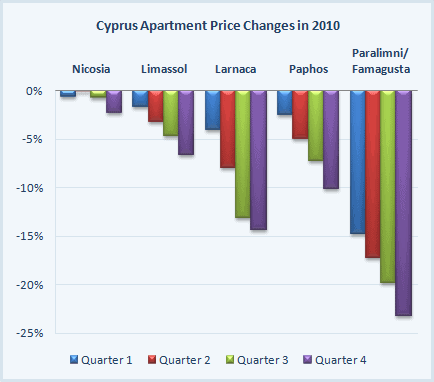
Prices of residential apartments fell by an average of 11.2% across Cyprus. The areas popular with overseas investors and local summer home buyers experienced the worst of the falls; prices in Paralimni/Famagusta slumped 23.2%, those in Larnaca dropped by 14.4% and those in Paphos fell by 10.2% over the year.

Prices in the port town of Limassol fell by 6.6%, while those in the capital Nicosia fell by just 2.4% over the year.

House prices

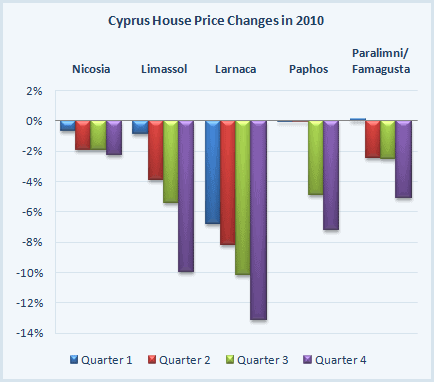
House prices in residential areas fell by an average of 7.4%. The worst hit area was Larnaca, where prices fell by 13.2%, followed by Limassol (-10.0%), Paphos (-7.2%), Paralimni/Famagusta (-5.1%) and finally Nicosia, where house prices fell by just 2.3% over the year.

Disappointing drop in Cyprus real estate prices

THERE was a ‘disappointing’ fall in property prices across the Island during the fourth quarter of 2010. Houses and apartment prices dropped by an average of 2.6% and 2.4% respectively according to the fifth issue of the RICS Cyprus Property Price Index, which tracks property prices and rents across 46 locations.

Residential prices for both houses and flats fell by 2.6% and 2.4% respectively, with the biggest drop for houses taking place in Limassol (-4.8%) and for flats in Famagusta (-4.2%).

Values of commercial properties fell across all cities by an average of 2.5% for retail, 3.4% for offices, and 2.4% for warehouses. Year-on-year, prices dropped by 10.8% for apartments, 7.4% for houses, 7.0% for retail, 6.3% for office, and 4.8% for warehouses.

Across Cyprus, rental values for apartments fell by 5.5%, for houses 5.9%, retail units 3.8%, warehouses 4.4%, and offices 2.7%. Year-on-year, rents dropped by 7.2% for apartments, 11.8% for houses, 8.5% for retail, 3.0% for office, and 3.9% for warehouses.

The quarterly change in capital and rental values shows that all aspects and geographies of the property market are now affected, and that landlords are lowering their rents in order to attract tenants. In parallel, many tenants are renegotiating their leases or moving to smaller or lower cost accommodation.

The reduction in rents will have a profound effect on the incomes of many local and overseas owners, and is likely to increase the downward pressure on prices as the mismatch between rent and capital values is accentuated.

Investment Yields

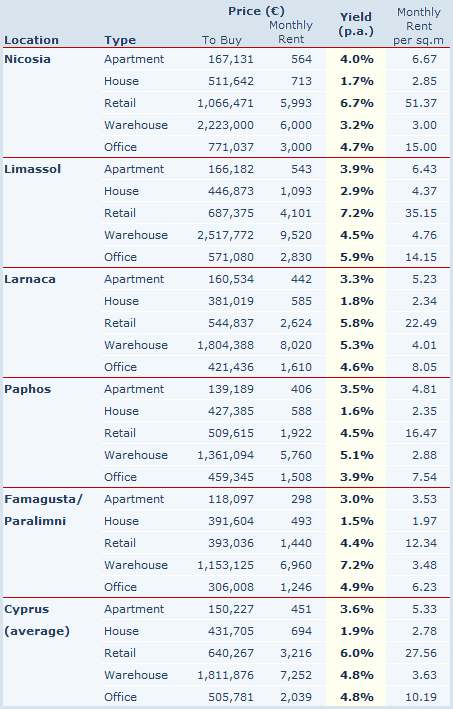
Yields are a useful tool showing the relationship between rent and property prices. At year-end, yields for commercial property stood at 6.0% for retail, 4.8% for offices, and 4.8% for warehouses, while yields for residential property stood at 3.6% for apartments and 1.9% for houses. These suggest that there is still room for rebalancing to take place.

Initial (or gross) yields, as shown in the chart below, is the total yearly gross rent divided by the price, expressed as a percentage.

Derived from the RICS Cyprus Property Price Index for Q4 2010

According to Pavlos Loizou MRICS, Board member of RICS Cyprus During the second half of 2010 Cyprus bore the aftershock of the global economic crisis, with the economy slowing down and the government’s income decreasing. The fourth quarter saw the Cypriot economy showing some signs of stabilisation and muted growth, although the increased uncertainty about Greece and the local economy affected sentiment.

Towards the end of the year there were some early signs of price stabilisation, with local buyers returning to the market taking advantage of lower prices for holiday homes and for permanent residence. Also, there seemed to be some renewed investor interest, particularly for city centre, prime, properties. Evidence of this however is anecdotal, as there have been no significant transactions to support it.

These signs need to be viewed within the wider context of a continuing curtailing of loans by financing institutions, reduced income as a result of inflation and salary reductions, and to a change in people’s expectations of future changes in capital values.”

Outline of properties used to calculate the index

Apartments: Residential, two bedroom, 85sqm, Medium quality.
Houses: Residential, three bedroom with garden, Semi-detached, 250sqm, Medium quality.
Retail: High-street retail, 100sqm ground floor area with 50sqm mezzanine.
Warehouse: Light industrial area, 2,000sqm, which includes 200sqm office space.
Office: Grade A, City centre location, 200sqm

Methodology

The methodology underpinning the RICS Cyprus Property Price Index was developed by the University of Reading UK and may be viewed by  clicking here.

Remaining planning amnesty bills passed

PARLIAMENT yesterday concluded discussions on the remainder of the “town-planning amnesty” legislation, completing the legal framework that aims to put an end to the title-deeds fiasco.

Cyprus MPs unanimously approved the Immovable Property Sales (Specific Performance) Law, thus giving land contracts power over any mortgages owed to the banks by the property’s seller.

The law was an integral part of the government’s so-called amnesty package. Tens of thousands of real estate buyers across the island – local and foreign – remain without Title Deeds to their properties after the sellers failed to settle their bank debts.

The fact that rights to the property were automatically transferred to the bank left many exposed, even if they had settled their entire debt on the property.

The second bill – in which the government pushed for all land contracts to be in writing and to be registered at the Land Registry Office in order to be considered valid – was rejected by majority vote, with opposition DISY, EDEK and EVROKO, as well as coalition partner DIKO voting against.

The plenum also unanimously approved a number of last-minute amendments submitted by the parties.

Presenting the two bills before the vote, Chairman of the House Legal Affairs Committee, DISY’s Ionas Nicolaou said the laws corresponded to society’s demand for better protection of buyers’ rights.

“The new law will allow the buyer to have Title Deeds, independent of whether the seller owes money on that property,” said Nicolaou. “It is important as it will help reactivate the property market in Cyprus.”

The new legislation, along with the amended town planning laws that were passed last month, aims at legalising real estate property that lacks a Title Deed due to town-planning or building irregularities. With around 130,000 Title Deeds currently pending – mainly due to developers failing to pay up mortgages on properties buyers have already paid for – this news is bound to be welcomed by many.

Now buyers will have the ability to pay up the amount they owe on their property straight to the bank, while their land contract will have precedence over any mortgage owed by a third person on the property.

Meanwhile, the House also approved a law proposal by DISY that enables owners of a co-owned plot to develop their share of it as they wish, without having to present the signatures of the remainder of the co – owners.

Until now, if a plot was co-owned, for someone to build on his part of the land, he would have to seek the approval of the other owners, otherwise the Town Planning Department would not grant authorisation.

But with the new law, people will be able to develop without needing the co-owners’ signatures.

It was not clear yesterday, however, what would happen in cases where persons have already paid developers in full for a property but have not received the Title Deed because of outstanding debts by the developer to the banks for the plot of land.

Is this the worst overseas property market in Europe?

WHEN it comes to defining a frightening overseas property market, a lack of mortgage finance, declining prices, chronic oversupply, relentless negative press coverage, government corruption and rock-bottom transactions volumes are sure to be the key ingredients.

Fortunately most countries in Europe no longer fit into all of the categories above. France and Italy seem relatively stable and even Bulgaria, which experienced some of the biggest price declines seems to be turning the corner.

As for Portugal, although a debt default now seems likely and an exit from the Euro is a possibility, sound planning laws and a relatively benign government have saved it from some of the worst effects of the crisis.

Spain on the other hand would seem to be a strong contender for this dubious honour. Prices are still falling in many areas, banks seem only willing to lend on their own stock and planning corruption trials are consistently in the news. Oversupply is also an issue in many popular holiday home destinations.

However even in Spain, things seem to be getting a little better. Actual sale prices in many areas have come down 30% to 40% to a level where agents are beginning to see transactions volumes returning.

Spain was always the largest overseas property market in Europe and there is pent-up demand waiting in the wings as prices begin to reach more realistic levels. There is also less chance of a sovereign debt default than in other countries on the periphery of Europe.

If there was a prize for the worst overseas property market in Europe, Cyprus would be the hands down winner.

Prices have fallen significantly but transaction volumes are still a trickle. The banks are in even more trouble than in most other countries as not only have huge real estate exposure but much of this exposure is in Greece.

Standard & Poors and Moody’s seem to be falling over themselves to downgrade Cypriot banks and this can only mean one thing: even tougher mortgage market conditions.

Furthermore, Cyprus is afflicted with a title deeds process which can at best be described as complex, slow and confusing and at worst has been described as fraudulent.

There have been many recent cases of banks repossessing properties from owners through no fault of their own. Unable to produce title deeds, the owners have been evicted when the managing developer defaulted on a loan the owner knew nothing about.

Business seems to be improving in many markets but even if things are not going as well as expected; it could be worse…..you could be selling in Cyprus.

About Global Edge

Global edge is an-award winning media business which provides news, market information and events for professionals working in the international residential real estate industry.

Over 40,000 property professionals use the site each month to keep up-to-date with the latest news, find market information and to source development projects and business partners across the world.