Property sales fall for ninth consecutive month

ACCORDING to Land Registry figures published earlier today, the number of contracts of sale deposited at Land Registries throughout Cyprus in March was 625 compared with the 792 deposited in March last year; a fall of 21% and the worst monthly drop since October 2009.

Sales fell in all areas. Worst hit was Larnaca, where sales fell 52% followed by Famagusta (-46%), Paphos (-24%), Nicosia (-10%) and Limassol (-8%).

During the first quarter of 2011, property sales have fallen to 1,749 from 2,066 during the first quarter of 2010 (-15%) despite last year’s low base.

In a statement to Stockwatch, property valuer Polys Kourousides said that the downward trend will continue in the next few months and until prices drop, emphasising that “prices must be cut to increase sales due to the lower liquidity and the lack of interest on behalf of the investors”.

Total sales of property in Cyprus March 2011
Source: Department of Lands and Surveys

Overseas sales

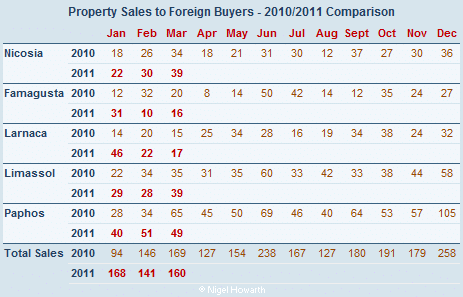
Property sales to foreign buyers also fell in March with a total of 160 contacts in favour of foreigners being deposited compared with 169 in March 2010; a fall of 5%.

Compared to March last year, sales increased in Nicosia (+15%), Larnaca (+13%) and Limassol (+11%), but these increases were outweighed by a drop in sales in the coastal towns of Paphos and Famagusta, where they fell by 25% and 20% respectively.

Sales of property in Cyprus to foreign buyers March 2011
Source: Department of Lands and Surveys

Property disaster a self-fulfilling prophecy

DESPITE brave and confident statements from the government and some developers there appears to be little or no movement. It is tempting to blame the worldwide recession for this crisis, but the reality is much closer to home.

The market has dried up because the reputation of the property market has been destroyed by appalling controls, a ridiculously lengthy process and corruption.

Potential investors would be mad to trust their money here without effective safeguards. The international crisis has merely provided the catalyst for putting property markets under the spotlight.

In Cyprus this spotlight caused many vulnerable home buyers who thought their purchases were secure to question and protest through such organisations as the Cyprus Property Action Group. This travesty was predicted at least three years ago and much to the annoyance of the government was called the Cyprus Toxic debt!

But who destroyed this reputation? It is tempting to focus on one particular group or another, but the blame must be shared by many.

Unscrupulous developers have raised capital by reselling (mortgaging) property that they had already sold to someone else through a contract lodged with the respective lands office. This is fraud. It must have been committed if, on their mortgage application, the developers signed to say that no one else had a call on this property.

If the developer had sold the property and signed a contract with the purchaser knowing that a bank had first call upon it then this is also fraud. But it takes more than one party to commit these acts of fraud and the banks must also accept their share of culpability.

If the banks had carried out due diligence, they should not have loaned money on property to which someone else had a legal call. Indeed, did they even ask the question of the loan applicant? If not, they are guilty of negligence and should be fired! This is not shutting the stable door after the horse has bolted but merely complying with banking rules.

The lawyers who advised the property buyers must also be held responsible for not conducting thorough searches to discover whether the purchase was sound and whether the developer had borrowed money with the property as security. The Law Society bears a huge responsibility for not enforcing its own rules and disbarring members of its profession who both represent the buyer and the seller, thereby causing a conflict of interest.

The legal and judicial system deserves mention. Had the police investigated acts of fraud and the judiciary found perpetrators guilty and effectively punished them it would have demonstrated a serious resolve to stamp out such crime.

The next category may be uncomfortable to many, but the purchaser must also take some measure of responsibility. Those purchasers who came from the UK are well aware of the stringent safeguards that are in place to protect them when buying property there. Yet when they come to the sun they forgot all common sense and seemed to believe that the nice developer’s solicitor would be fine working for them as well!

They also failed to ask the nice solicitor whether his firm would conduct a thorough search on the property and the financial circumstances surrounding it! How do we know what level of search is conducted unless we ask? We cannot assume that standards are the same as those of our own country.

And what of the purchaser who does not want to pay their transfer tax? There are probably in excess of 130,000 people who are awaiting their Title Deeds. Many have waited for over a decade and may not wish to pay this additional tax, particularly if they are to be fined for any improvements and additions they have made to their property over these intervening years! Transfer tax is an unfair tax in that it cannot be predicted when it is due. It is also open to corruption, both from the purchaser/seller and the state. In addition there is no compunction to accept your Title Deeds.

Would it not be better to increase stamp duty (an incorruptible system because the revenue from the stamp purchase goes directly to the government) a little because a “little of something is better than a lot of nothing”. Stamp duty is also collected at time of purchase not at some indeterminate later date when titles are transferred. Those property purchasers who did not want to pay transfer tax would no longer have any incentive to delay or obstruct.

Finally, the government needs to take its share of the blame. But wait a moment, which government? This problem has been going on for many years, but the advent of the Internet has meant that this dirty washing is now being thoroughly aired world-wide, and the uncertainty of the economy has caused panic amongst those who now know that their properties are at risk. Certainly, to my recollection, there were incidents of developer malpractice dating back at least 12 years.

And how many governments have tried to address this problem and introduce legislation in an attempt to improve the credibility of the property market? Only one: the current AKEL led administration. However their attempts to drive the five complex strands of legislation through Parliament are continuously obstructed by special interest groups leaning on Members of Parliament to support their vested interests. It is not the government who should take all the blame – indeed they have tried to do something about it – but parliamentarians. They have failed to realise that, in their bid for popular support, they have put the future of Cyprus’ property market and indeed the economy at risk.

In the same way that the UK property market is dependent on first time buyers the Cyprus property market is dependent on foreign buyers because its domestic market is not large enough to stimulate a recovery. The foreign market was traditionally dominated by British purchasers who fell in love with this island on frequent holidays. Other nationalities, notably the Russian market, are being touted, but, guess what? The Russians use the Internet as well and are increasingly cautious. We now have a prophecy which has become self fulfilled!

(Name and address withheld)

Offices of a Cyprus developer bombed for a second time

LAST SATURDAY, an explosion occurred at the offices of Famagusta Developers in Protaras. This is the second time that the company has been targeted by bombers in less than five months.

On Monday, a 50-year-old man from Limassol was issued a five-day remand by the Famagusta District Court in connection with the explosion. His 25-year-old son was released due to lack of evidence.

The pair allegedly agreed to sell to the director of the company two flats in Larnaca for €220,000 and received a deposit of €30,000. The director then decided to annul the agreement and asked for the deposit back, the court heard. The court heard that the father and son had insisted on full payment.

Both father and son deny any involvement with the bombing.

In November last year, an explosion shattered the company’s front window and caused minor damage to the entrance of the building. The total cost of the damage was estimated to be in the region of €1,000.

Last August, the Cyprus police announced that the company was under investigation in connection with eight complaints filed against it since 2007 – seven in Famagusta and one in Larnaca. The cases mainly concerned alleged forgery, obtaining money and property under false pretences and usurping property belonging to another person.

In one of the cases investigated by police, the developer allegedly sold the same flat twice and when was asked to return the money to one of the buyers he issued him a dud cheque twice.

This legalised theft must end

daylight robberyA BANK in Cyprus and the Island’s Inland Revenue Department are pursuing the clients of a property developer who has fled the Island. They are demanding that buyers repay the developer’s mortgage and his unpaid taxes.

When is the Cyprus Government going to put an end to this ‘legalised theft’. Can you imagine this happening in any other civilised country? If you were to buy a car from a dealer and pay for that car in full, would the Inland Revenue and the bank chase you for the dealer’s debts if he absconded or his company went into liquidation?

Unfortunately, this is not the way the law works in Cyprus. If your developer fails to pay his mortgage and you do not have the Title Deed to the property registered in your name, the banks will demand money from you using the threat of taking your home away from you to elicit payment.

And if your developer fails to produce a ‘tax clearance certificate’ at the Land Registry when your Title Deed becomes available, the Land Registry will refuse to transfer ownership of the property into your name.

Bearing in mind that you will have already paid for your house in full, why does the law allow you as a buyer to be penalised for the transgressions of your developer? Why does the Inland Revenue not pursue the developer for the taxes he owes? After all it is he who owes the taxes and has the money to pay; so why does the law allow this to happen?

The situation in Cyprus reminds me very much of some graffiti I once read on a wall of a gents toilet in the House of Commons. It read:

“is there any intelligent life in Westminster?”

Someone had scrawled an answer:

“yes, but I am only visiting!”

The Cyprus Government has promised to introduce legislation to resolve these issues (yawn). Whether it will remains to be seen; discussions are continuing.

Cyprus economy downgraded again

IN A STATEMENT released yesterday, ratings agency Standard & Poor’s said it has cut Cyprus’ long-term sovereign credit rating from A to A- and the short-term rating from A-1 to A-2. This is the rating agency’s second cut in five months.

In its statement, S&P said: “Standard & Poor’s views the Cypriot financial system’s significant exposure to the Hellenic Republic as a ratings weakness for Cyprus in the context of the deterioration in the creditworthiness of the Greek government and the Greek financial sector.”

“In our view, the increasing likelihood that the Greek government will restructure its debt heightens the risk that a significant portion of the Cypriot government’s large financial sector contingent liabilities will become explicit liabilities migrating to the Cypriot government’s balance sheet.”

The outlook on the ratings remains negative.

Larnaca golf property action group announcement

THE Larnaca Golf Property Action Group (LGPAG) has been set up by a group of UK property investors who consider they have been mis-sold property in the Larnaca village of Tersefanou close to Cyprus’ southern coast.

Although the area was planned to have a Golf Resort and Country Club designed by the European Golf Federation and maintained by PGA Golf Management, LGPAG says that construction of the 18-hole professional golf course has yet to make any progress.

According to LGPAG, when property investors purchased up to three years ago, they were promised by the developers that the golf course would be built any-time soon. But the delay in the construction of the golf course has left many with properties worth significantly less than when they purchased and hundreds of properties in the area are sitting empty.

LGPAG has been advised that there are no funds to build the much-hyped Tersefanou golf course in the foreseeable future and are putting together a team to seek compensation from the developers through their lawyers.

For more information and to register your interest, visit the website of the Larnaca Golf Property Action Group.

Postscript

The PGA terminated its relationship with MedGolf Properties in January 2014.