Double selling fraud: the O’Dwyer judgement

FOR at least five years, the main complaint by Cyprus property buyers, particularly foreigners, has been non-issuance of Title Deeds. Typically, the developer has taken a prior mortgage on the land, which was either unannounced or deliberately hidden but, in any event, not revealed because of non-existent or negligent searches.

Non-discharged mortgages add to developer foot dragging and bureaucratic delays. Some 130,000 properties are still awaiting their Title Deeds, typically 7-15 years or more.

However, some cases have also involved alleged ‘double selling’ fraud whereby the developer sells a property to Party A, fails to lodge the contract with the Land Registry and then sells it again to Party B (possibly for a higher price) but fails to reimburse Party A. There are also alleged variants of this scam.

The most high profile case involves Mr Conor O’Dwyer who bought a property in Frenaros from Karayiannas developers. O’Dwyer brought a number of legal actions against the developers. One action, a private criminal prosecution for fraud under section 303A of the penal code, received judgement on 20th January 2011.

O’Dwyer had reported his allegations to the Police and the Attorney General who declined to act. He then felt obliged to prosecute both the developers and Michelle McDonald, the second buyer who now occupies the property.

This whole saga has received massive coverage in the English media but scant attention in the Greek language media. However, it would be unwise for anyone to ignore the huge negative implications for property buyers and for Cyprus.

Real protection or a mirage?

For many years, the standard claim by the Cyprus government, developers, lawyers and estate agents has been that a buyer of immovable property is absolutely protected once his sales contract is lodged with the Cyprus Land Registry.

This claim, supported by a precedent Supreme Court ruling, has been their main counter to the avalanche of allegations, criticism, anger and demands for justice from property buyers, largely from foreigners and their MEPs.

Indeed, on 22nd July 2009 the Minister of the Interior Mr Neoclis Sylikiotis issued a lengthy official statement about the Title Deeds scandal, noting that “those allegations are entirely unsustainable”.

He further clarified that “the current system and the existing legislation protects buyers and their ownership status”. He went on: “…..the ownership status of a buyer-owner of immovable property in Cyprus is definitely secured and cannot be challenged, as long as the buyer-owner has submitted the buying-contract to the Department of Lands and Surveys”.

Finally, he emphasized that “….there is something that one must not forget. Nobody and no Authority anywhere can ever challenge the property rights or ownership status of buyers of immovable property within the territory which is under the control of the Republic of Cyprus”.

A few days earlier, in a letter to Graham Watson MEP, Mr Sylikiotis had stated: “……buyers of immovable property are protected, once they deposit the Contract of Sale at the appropriate District Office of the Department of Lands and Surveys according to the Sale of Lands (Specific Performance) Law, Cap 232”.

What possibly could be doubted from such emphatic statements from the Minister himself, backed up a Supreme Court ruling? Well, the judge in the private criminal prosecution brought by O’Dwyer clearly thought otherwise.

The judgement

The defendants were found not guilty of ‘double selling’ fraud. Apparently, the judge decided that the prosecution had failed to prove, as required under criminal law, that the defendants had committed fraud ‘beyond all reasonable doubt’.

In my opinion as a non-lawyer, the prosecution would have had to prove a deliberate intention to permanently deprive the rightful owner of his property.

The judge acknowledged that O’Dwyer was the rightful owner and that he had lodged his sales contract at the Land Registry. She further acknowledged that he had made stage payments as per contract and that the developers had not returned his money, despite having re-sold the property to another person. The fact that the developers apparently have never offered or made any reimbursement of his money appears to demonstrate a deliberate intention to permanently deprive him of the property.

Under civil law, res ipsa loquitur (the thing speaks for itself) and ‘on the balance of probabilities’ would apply.

However, this was a criminal case and the judge felt that intent was not proven beyond all reasonable doubt.

What other logical reason can be put forward for what they did? It cannot have been just an error or forgetfulness, as the matter was brought swiftly to their attention. By eliminating other potential defences such as insanity and intoxication, that just leaves ‘lack of intent’ and the purposefulness with which they went about it strongly suggests intent. After all these years and no hint of a repayment, the intent also looks pretty permanent!

However, just as disturbing, and contrary to the precedent Supreme Court ruling, the judge also stated that lodging of a sales contract at the Land Registry does not automatically confer protection against ‘double selling’: “the fact they (plaintiffs) submitted a sales contract to the Land Registry did not mean they automatically and in perpetuity have become the ‘owners’ (as they mean it) of the residence.”

This judgment thus cancels the standard claim by government, developers, lawyers and agents that buyers are absolutely protected.

An appeal is being lodged with the Supreme Court and so the judge’s reasoning would be examined and evaluated formally when the appeal is heard.

The implications

Nevertheless, regardless of the final verdict on appeal, immense and irreversible damage has already been inflicted internationally by this and other cases on the Cyprus property market and the general reputation of Cyprus.

O’Dwyer alone is engaged in several other cases against his developers. They have already been found guilty of assaulting O’Dwyer in two separate cases and a civil claim for damages against them is still pending.

The Cyprus Property Scandal is not just about Title Deeds but the totality of factors that influence potential new buyers. Many existing foreign buyers report that they now feel terrified and their ‘Cyprus dream’ has been shattered. Potential new buyers simply strike Cyprus off their prospect list when they see earlier buyers being treated so badly.

Cyprus courts have no juries but millions of media and Internet users around the world, including potential new buyers of Cyprus properties, have become the proxy jury in the O’Dwyer cases and all the other horror stories they read or hear about. With yet more TV exposés imminent in the UK, there seems no end in sight to Cyprus’s property market woes.

Decent developers, lawyers and estate agents that I know (yes, they do exist) are exasperated and fearful of the obvious negative long-term impact on an already flat market. No sizeable developer can rely solely on domestic sales but what foreigner will buy here now?

The Cyprus economy also cannot afford to delay any recovery of its property sector. Prior to the downgrading of Cyprus’s financial ratings by Moodys, S&P and Fitch in recent weeks, Moody’s had cited Cyprus’s ailing property sector as a factor “as it remains a risk area with weak demand and unclear growth prospects”.

This deep self-inflicted wound requires urgent, radical treatment – not a sticking plaster, an aspirin and a hope that the patient will simply recover naturally. However, on Cyprus’s past record of inaction on these matters, the prognosis looks decidedly bleak.

Dr Alan Waring is an international risk management consultant with extensive experience in Europe, Asia and the Middle East with industrial, commercial and governmental clients. He is a Fellow of the Institute of Risk Management and is a founding member of the IRM Cyprus Regional Group. Contact [email protected].

©2011 Alan Waring

(This article first appeared in the Financial Mirror)

Thousands of Title Deeds waiting to be transferred

ACCORDING to a recent media report 15,000 new Title Deeds were issued by the Land Registry between June 2009 and November 2010. Amazingly though, only 4,200 of these were transferred to their purchasers.

One might reasonably wonder: How is it possible for purchasers on the one hand to complain about the long delay in issuing Title Deeds and on the other hand to fail to complete the transfer to their names?

There are several possibilities for this situation:

  1. The new title is still burdened with mortgages and/or other impediments which the developer has failed to remove;
  2. the developer has not cleared his tax commitments;
  3. the purchaser has not paid the whole purchase amount; the purchaser is not available, as e.g. he has left Cyprus since the date of sale, or;
  4. the purchaser has resold or intends to resell the property.

In the last case the (not exactly legal) practice of «Cancellation Agreements» comes into play. By such agreements, which are signed by the developer and the first purchaser, the original Contract of Sale is cancelled and at the same time a new Contract of Sale is concluded between the developer and the second purchaser.

By this practice, both the developer and the first purchaser obtain financial benefits: The developer obtains a considerable amount of money as «cancellation fees» and the first purchaser avoids the payment of Transfer Fees, as the title is transferred directly to the name of the second purchaser.

Needless to say, the only loser in this case is the public purse which is deprived of a considerable amount of taxes (Transfer Fees and, in many cases, Capital Gains Tax).

It is worth mentioning that, even if the transfer is completed, if a long time has elapsed since the signing of the contract of sale, the public purse is still a loser, because the Transfer Fees and other taxes are estimated as at the date of the contract of sale, without any interest or other charges being added to this amount.

According to the same press release, the issuing of 120,000 Title Deeds for residential and other units which have been sold is still pending.

The Authorities are doing their best to accelerate the issue of Title Deeds. At the same time, a package of legislative amendments is under way, (known as «planning amnesty» package), aimed at easing the problem. One might ask what will be the practical result of this effort if, in spite of issuing Title Deeds, most of them are not transferred, for one reason or another.

It is for the benefit of all parties, including the State, that Title Deeds are issued promptly and that they are transferred without delay to their rightful owners/purchasers. In the long run, the practice of playing games either with the issuing or the transfer of titles is not to the benefit of anyone.

The holding of a title is the only real safeguard to a purchaser, as there is always the risk that the developer goes bankrupt or that the property is burdened with such encumbrances that make the transfer of the title impossible.

It is up to the authorities, who are the main losers from the absence of titles and/or the failure to transfer existing titles, to take measures to make the issuing and transfer of titles compulsory.

Possible actions, in addition to the existing legislative proposals, may include:

  1. the clear condemnation of the practice of cancellation agreements as illegal by appropriate legislative measures;
  2. the setting of a time limit within which a transfer must be completed after the issuing of Title Deeds and;
  3. the imposition of penalties on developers who fail either to issue or to transfer Title Deeds for one reason or another.

Andreas D. Symeou LL.B, M.Sc (U.L.A.) is a property consultant and a Member of the Royal Institute of Chartered Surveyors (MRICS). He may be contacted at [email protected]

Time for a property commissioner

THE increasing number of public notices issued in the local press regarding banks’ claims against mortgage defaulters, is worrying and calls for the immediate establishment of a Property Commissioner in Cyprus.

There is no doubt that any political party in power or the opposition would have no difficulty to find people to fill the post. Naturally, they would have to be the ‘right’ people for the job and not just some party has-been who did not make it on the candidate list.

The Commissioner would need to have executive powers, just like the regulators of certain sectors of vital economic activity (telecoms, post, transport, broadcast), but to learn from the mistakes of establishing the Environment Commissioner, a crucial office which has been undermined by the present and past administrations as it has insufficient staff to deal with the huge workload of legislative changes and inter-ministerial coordination.

One of the main issues that the Property Commissioner would undertake would be to push the relevant government departments or parliament to enact the much-delayed laws on the dreaded Title Deeds, but it would also monitor the situation with lax mortgage facilities provided to buyers with a poor credit history, simply to keep the property developers afloat.

The problem now is that the Ministry of Interior throws its hands up in the air saying it passed the proposed bills to parliament and could do nothing more, while the MPs say it is all delayed at other government departments or draft legislations are inefficient.

Up to now, banks have been acting against developers who default on their mortgages and then extending the action to individual buyers (who had no involvement in the mortgage) instead of going after the developer’s guarantors which logically, legally and ethically they should do.

The new twist, inferred from the latest notices in the newspapers, is that when an individual buyer defaults on his own mortgage the banks are now going after the developer as well! The individual buyer will then simply say “go after the developer’s guarantor, not me”.

Either way, not a good advertisement for the Cyprus property market or the banks.

Time for a property commissioner in Cyprus

Property sales in Cyprus slump to a 2 year low

JANUARY 2011 saw property sales in Cyprus falling to a 2 year low. Industry watchers expect that the lack of sales will lead to further price reductions while developers believe that the negative climate will persist if no support measures are taken.

Demand has fallen in all of the seaside towns, while sales in Nicosia appear to be stabilizing.

According to the Land Registry, the number of contracts of sale deposited at Land Registries throughout Cyprus during January was 522 compared with 570 in January 2010; a fall of 9%.

Sales fell in all the seaside towns: Larnaca (-21%), Limassol (-12%), Paphos (-11%) and Famagusta (-9%).

Nicosia, which constitutes the largest part of the total demand, saw property sales increase by 3% to 174 from 169 in January 2010.

Cyprus property sales - January 2011
Source: Department of Lands and Surveys

In a statement to StockWatch, property valuator, Polys Kourousides said that sales will continue to drop in the next few months in all cities. “Nicosia will show stabilization trends”. Mr Kourousides believes that prices will fall slightly.

Chairman of the Pancyprian Association of Land Developers, Lakis Tofarides, said that “The market reacts as expected. As long as no measures are taken, the problems will not be solved.”

Overseas sales

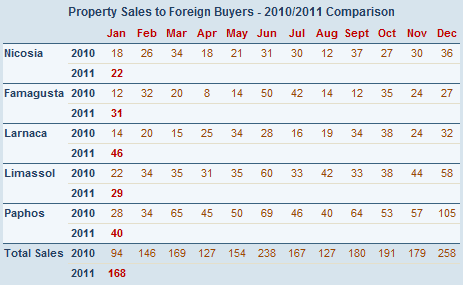
Somewhat unexpectedly, property sales to foreign buyers improved in January with the total number of contracts of sale deposited throughout the month up 79% compared to January 2010.

Demand rose in all areas: Larnaca (up 229%), Famagusta (up 158%), Paphos (up 43%), Limassol (up 32%) and Nicosia (up 22%).

Cyprus property sales to foreign buyers - January 2011
Source: Department of Lands and Surveys

Who is the real culprit?

PARLIAMENT is apparently preparing legislation that will protect crooked developers and their bankers by loading the innocent buyers with the responsibility for paying off mortgages taken out on their properties without their knowledge or consent.

This legislation will let off Scot-free those really responsible.  I refer, of course, to the lawyers who played a key role in virtually every property transaction.  The innocent foreign buyer comes to this country and immediately engages a lawyer to look after his interests.

Among the lawyer’s professional responsibilities is to ensure that there are no encumbrances on the property to be purchased or, if there are, to inform the would-be buyer in good time.  All of the problems related to developers’ mortgages on the property, undisclosed to the buyer, obviously stem from the lawyer’s failure to do his job through either negligence or criminal intent to deceive, in collusion with the developer.

In a word, who is the real culprit here?  Only partly the developer, who took out the mortgage, or the banker who may well have acted in good faith.  The real culprit is the lawyer for the buyer.  It is he who should be required to pay off the mortgage taken out on the property without the knowledge of the wholly innocent buyer, who had trusted the lawyer whom he had hired to represent him and to protect his interests.

We call upon Parliament to place the blame where it really belongs by ensuring that, where appropriate, the lawyers are held personally and financially responsible for this title deeds/mortgages fiasco.  Failure to resolve this issue honestly and fairly in this way is contributing directly to the destruction of both the property market and the Cypriot economy in general.

Whether Parliament, largely made up of lawyers, will do its sworn duty, is another matter entirely.  But it’s almost unbelievable readiness to call upon the victims to pay the bills, will surely destroy what little credibility this country’s justice system still has in the eyes of the outside world.

John Knowles, Peyeia

Couple assured of stay of execution

Ken and Mary Hudson
Ken and Mary Hudson (Photo: Cyprus Mail)

AN EXPATRIATE couple who faced eviction and homelessness last September after a developer sold them a flat with outstanding mortgage payments have at last been assured that they can stay in the flat for the rest of their lives.

However, for Ken and Mary Hudson, both 72, it is a bittersweet outcome, as they will not be allowed to pass the flat they paid €41,200 for onto their children; it remains the bank’s property.

Speaking from her home in Larnaca yesterday, Mary Hudson said: “The Land Registry was very understanding, and they told us that we could rest assured that ‘as the case stands’ we can stay where we are ‘until we go to heaven'”.

Asked what would happen after that, Hudson said: “It will go back to the bank then. For now it is just a case of waiting until someone does something.”

In the mean time, Hudson said, the property developer who formerly owned a kiosk in Larnaca has reportedly disappeared.

The Hudsons first visited Cyprus in 2000 and “Fell in love with the people, culture and community”, so when a charity job in Cyprus came up in 2002, they jumped at the chance to buy.

Hudson said: “A suitable property was found through an estate agent, registered in our name and paid for. We were told that solicitors were not necessary in Cyprus.”

They paid £24,000 Cypriot pounds (€41,200) for the flat, and even received paperwork from a notary to confirm their ownership.

However, shortly after they completed the purchase, they learnt that the bank had retained the Title Deeds because the owner had not completed mortgage payments for the property. Until the payments were completed, the Hudsons could not receive the Title Deeds.

The flat was put up for auction but there were no interested buyers, and so they remained in legal limbo until the Land Registry told them they could remain in their home for the rest of their lives.