Domestic property sales improve

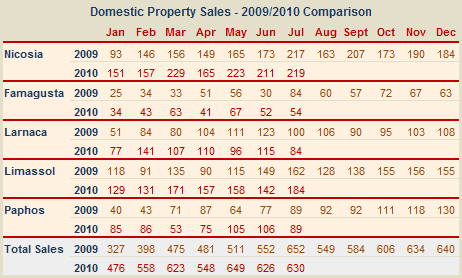
ACCORDING to the latest figures published by the Department of Lands and Surveys, domestic sales of property in Cyprus during the first seven months of this year increased by 21% over the same period in 2009; in contrast with the 0.3 percent fall in sales to overseas buyers.

Cypriot buyers deposited 630 contracts of sale at Land Registries throughout Cyprus during July compared to the 652 deposited during July 2009; a fall of 3.4 percent.

But despite this decline in July, domestic demand during the first seven months of this year has increased by 21 percent over the same period last year with 4,100 contracts being deposited this year compared to the 3,396 deposited last year.

The largest increase in demand this year is Paphos (up 27.2 percent), followed by Limassol (up 24.7 percent), Nicosia (up 23.3 percent), Famagusta (up 13.1 percent) and finally Larnaca (up 11.8 percent).

Domestic property sales in Cyprus to July 2010
Source: Department of Lands and Surveys

Although these figures confirm that the number of properties being bought by Cypriots is increasing, some analysts are concerned by the fall off in sales during July in the coastal regions of Paphos, Famagusta and Larnaca where a growth in sales usually occurs during the summer months.

Time to buy? House prices fall 20-30 percent

A SIGNIFICANT drop in real estate values is creating new opportunities for buyers of second or holiday homes, with commercial and retail properties, primarily in the capital, remaining unaffected. But property consultants still advise caution.

Residential property prices have fallen by as much as 20% and 30% in the past three years, with the most affected being Paphos, Sotira and other areas popular with foreign holidaymakers and retirees, according to a leading expert in the field.

Areas that rely on local buyers, mainly from Nicosia, have been doing relatively better with prices in Protaras and west of Larnaca (Pervolia, Kiti, Tersefanou) recording smaller drops, real estate valuer Anthonis Loizou wrote in an article that appears in our Greek section, ????? & ?????.

Title deeds affect British, Russians; Cypriots “unconcerned”

The drop in property prices can also depend on other factors, which, apart from location, also have to do with quality, facilities (pools, etc.), as well as the bad publicity, especially in the Paphos area, over the problem with Title Deeds,” Loizou wrote in his article.

This bad publicity, primarily generated by owner action groups, has also reached the Russian market, with many Russian buyers now primarily concerned if there are Title Deeds or not,” Loizou added.

Strangely enough, this phenomenon does not seem to concern other foreign buyers in other areas, while local Cypriot buyers are not at all worried with the problem,” he added.

Loizou cites an example whereby the price for a beach-front apartment in Protaras (with permit), dropped from €5,000 per sq.m. in 2008 to €4,000 per sq.m. in 2009/2010, despite the fact that this was in one of the more competitive and high-value projects in the area.

the risk in the market has increased and calls for extreme caution on behalf of the buyers and their lawyers

Holiday units and apartments in the Kappari area dropped from €1,700 per sq.m. in 2008 to €1,200 per sq.m. with sluggish interest, recording a fall of 30%.

The opportunities when British owners would sell their properties at rock-bottom prices have been limited to just a few, while due to the financial troubles of the sellers as well as the developers, the risk in the market has increased and calls for extreme caution on behalf of the buyers and their lawyers,” Loizou warned.

Own vs holiday

Prices for own homes in Paphos dropped 8% in 2008, 10% in 2009 and 5% in 2010, for an accumulated 3-year drop of 23%.

In Limassol, prices dropped an accumulated 10%, with no change in 2010, -25% in Larnaca, -20% in Protaras, -35% in the Famagusta area and -25% in Nicosia.

Holiday homes in Paphos lost an accumulated 35%, in Limassol -25%, in Larnaca -33%, in Protaras -35% and in the Famagusta area -40%.

Commercial demand

Within the commercial property market of Nicosia there is significant demand, which is balanced by the available supply, according to a report by property consultants and valuers Danos. Therefore, the vacancy rate is very low, estimated at 5% to 8%.

Supply is expected to be steady throughout next year, the Danos report said, adding that investment gross yields are in the range of 5.5% – 6.5%, while average rental prices have decreased by 15% since 2000. Current rental levels are considered sustainable, despite traffic congestion and parking problems.

In the broader area of Nicosia, investment yields for shops and offices fluctuate between 5.5% and 6%. Market values for shops that outside Nicosia centre appear to be lower, but in many areas can be as high as the ones in the centre, with a parallel demand for decentralised retailing formats (malls, DIY stores) remaining strong.

The property market has been in recession since mid-2008 with sales down 40% and the second homes and holiday homes sector hardest hit. A lack of property investment from the UK and the drop in the value of Sterling are regarded as reasons for the fall, especially in Paphos. The decline in property sales has also affected state revenues with earnings from capital gains tax falling by 18% a year.

Furthermore, banks, which already screen property investors, developers and non-Cypriots who want to borrow, have raised the level of collateral required and changed payment terms. The lenders are also taking risk into account and the popular coastal resorts are regarded as more of a risk at present as that is where the steepest price falls are being found.

Nicosia most active

Nicosia remained the most active in terms of property contracts sold during the first seven months of the year, registering a 26% year-on-year increase in property contracts followed by Limassol (up 18%) and the Famagusta area, up 12%. The districts of Larnaca and Paphos were the laggers recording increases of 6% and 10%, respectively.

Despite a decline in property sale contracts in July, which fell by 11.6% y-o-y to 797 from 902 property deals concluded in July 2009 and by 7.8% compared to the June 2010 figures, the Land Registry Department revealed that overall, the trend for 2010 remains upward.

The negative performance in the number of sale contracts in July is a direct result of the reversal in the positive trend from foreign sales which ended the period at -0.2% y-o-y (vs.+9.6% y-o-y in 1H 2010). Demand for locals however, decelerated from +26.8% in 1H 2010 to 21.0% for the first seven months of the year.

The biggest property deal in Nicosia is the purchase of prime land by Hayasa Properties, a Lebanese-Armenian group which bought a plot on the corner of Stassikratous/Mnassiadou streets for €18 million in addition to another plot purchased next to Pralina Café for €5.5 million.

For the period January – July 2010, the number of property sale contracts increased compared to the same period in 2009 by 15.8%.

Is it time to buy in Cyprus

MEP questions Cyprus on planning and building regulations

Ashley Fox MEP
MEP Ashley Fox

I have been approached by constituents in the southwest of England angry and disappointed by the building and planning regulations in Cyprus.

British families seeking to retire abroad are being caught by unscrupulous builders who are selling properties without planning permission, without access and without utilities. It seems that once this happens there is little protection for expatriate residents caught in the system.

Please could the Commission answer the following questions:

  1. Is the Commission monitoring the problems in the planning and building regulations in Cyprus?
  2. What measures is the Commission proposing to help Cyprus tighten up its building and planning legislation?
  3. What redress do expatriates living in Cyprus have after being sold an illegal construction?

Further reading: Property in Cyprus

The European Commission’s response

Answer given by Mr Tajani on behalf of the Commission

Building and planning regulations fall within the competence of the authorities of the Member State which should ensure their appropriate application and enforcement (monitoring and control of application and inspection).The EU’s intervention is only justified in cases of potential discrepancy regarding the conformity of the national practices with the principles of the Treaty and EU secondary law, in particular in the domains of the internal market of construction products, energy efficiency and renewable energy sources, natural resources and environmental protection as well as health and safety at work.

According to the principles of the Treaty, all the provisions of building and planning regulations should be applied in an impartial, transparent and proportionate manner on the territory of competence of the authorities, whatever undertaking or citizen is concerned by these provisions.

As to the possibilities of judicial redress which expatriates living in Cyprus might have after being sold an illegal construction, the type of action available and the way to introduce it are governed by the national procedural law of the Member State where the competent court is located. European Union legislation only intervenes to determine which court is competent in a dispute involving two or more Member States and ensures that a judgment rendered in one Member State can be recognised and declared enforceable in another Member State. More specifically, Regulation (EC) No 44/2001 on jurisdiction and the recognition and enforcement of judgments in civil and commercial matters(1), provides that a claimant can bring an action for damages against the other party either at his place of domicile or at the place where the damage occurred unless the parties have agreed that a specific court should have jurisdiction to settle their dispute. Where the dispute concerns rights in immoveable property, e.g. the transfer of ownership, only the courts at the place where the immoveable property is located are competent to hear the case. From the limited facts submitted to the Commission, it would seem that where British nationals residing in Cyprus are seeking redress against the seller of an illegal construction, an action for damages would have to be brought in the Cypriot courts unless the parties have agreed in the contract of sale or otherwise that their dispute should be settled in the courts of another Member State.

Directive 2005/29/EC(2) provides a legal framework applicable against unfair business-to-consumer practices, including those for immovable property. Claiming that a planning or a building approval has been authorised by a public or private body when this is not the case, or not complying with the terms of such an approval, endorsement or authorisation is considered an unfair commercial practice. According to the directive, Member States shall ensure that adequate and effective means exists to combat unfair commercial practices. However, the directive leaves to Member States the choice of the concrete legal and administrative measures to be put in place. Cyprus has adopted such transposition measures by the Law on the Control of Misleading and Comparative Advertising of 2007 and the Law on the Unfair Commercial Practices from Businesses to Consumers of 2007.

(1)          OJ L 12, 16.1.2001.
(2)          OJ L 149, 11.6.2005.

Editor’s notes

Ashley Fox was elected to the European Parliament in June 2009 as the MEP for the South West of England and Gibraltar.

As a British Conservative he is a member of the European Conservatives and Reformists Group (ECR). He sits on the Internal Market Committee where he takes a particular interest in the Aerospace and Pharmaceutical Industries.

Ashley also sits on the Economic and Monetary Affairs Committee and the Committee for Constitutional Affairs.

Interior Minister surrounded by corrupt advisors

Cyprus Interior Ministare Mr Neoclis Sylikiotis
Neoclis Sylikiotis the Cyprus Minister of the Interior - Source: sigmalive.com

WE have great respect for the Minister of Interior who is genuinely trying his best to fix the mess that has been created in the uncontrolled property sector. Unfortunately, he is surrounded by incompetent and corrupt advisors who would rather Mr Sylikiotis gets wrong information than uncover their own interests.

A year ago, he promised that tens of thousands of Title Deeds would be pushed through a fast-track system in order to lessen the burden on the Town Planning Dept. and appease the concerns of many citizens who are unsure if they will ever get Title Deeds for their permanent, retirement or holiday homes. Little has happened since then.

Then came the fuss from a “disgruntled group” of property buyers who kept on insisting that there are crooked developers, corrupt lawyers and incompetent public officials who are giving Cyprus a bad name by double selling properties or running off with the initial depositor’s money. Mr Sylikiotis and the Attorney General got insulted, perhaps because the complaints came from a bunch of “bloody foreigners” who saw wrong in every action that we, in Cyprus, shrug our shoulders and have taken for granted as “C’est la vie”.

Unfortunately, all these property owner groups, including the ones harassed by respectable property developers, will now declare to Mr Sylikiotis: “We told you so!”

Has the case of the single property developer who made news headlines last week for being caught 1 over several scams, been allowed to leak in order to become the scapegoat for the bigger crooks who are getting away?

When will Mr Sylikiotis apologise to the disgruntled owners, roll up his sleeves and get going with serious reforms in the Town Planning Department? Does he not realize that by the delay in the property reforms and amnesty packages, he is depriving the state coffers tens if not hundreds of millions in fresh revenue?

Please don’t tell us that last week’s revelation of the crooked developer was a “solitary case” and that all else is fine in the property sector. We don’t need an apologetic Neoclis Sylikiotis constantly on the defensive, covering up other peoples’ mess. We need to see the Interior Minister whom he trust and have great faith in taking charge and getting things done.

Perhaps also to whisper in the Attorney General’s ear to get off his high horse and take other allegations more seriously.

You have your brief summer vacation to think about it. We will be back…

I would not have bought in Cyprus had I known

A RECENT mini-poll conducted by the on-line Cyprus Property News magazine revealed that some 98% of the 1,035 readers who voted would not have bought property in Cyprus had they known that their developer had mortgaged the land on which it was built.

Poll results - Buying property built on mortgaged land

This follows a poll we carried out earlier this year in which more than 90% of our readers who voted called on the Cyprus government to ban the sale of mortgaged property.

Speaking last year to an audience of property sector professionals, MPs and mayors Interior Minister Neoclis Sylikiotis said that “The seriousness of the current situation is creating dangers for the property market in the future” – and went on to speak about the problem of “taking out a second or even third mortgage in order to recycle capital into other projects, or postponing things to suit.

However, it remains to be seen whether the government has the courage to introduce legislation outlawing the sale of mortgaged property if it is opposed by political heavyweights in the real estate industry.

Given the fact that a number of property developers have already collapsed and that many of those who bought property from them have been left to the mercy of the banks, it is absolutely essential that anyone considering buying property in Cyprus engages an  independent lawyer to act on their behalf and obtains a Title Search from the Land Registry to discover whether their potential purchase is mortgaged.

Qatar deal still in the balance

Meeting between the official delegation of the emirate of Qatar and representatives of the Republic of Cyprus
Source: Cyprus Press & Information Office – Photograph by: George Hadjipavlou

THE MULTIMILLION euro deal signed by the Cyprus government last April with a state-owned Qatari company to build a luxury hotel, residential and commercial complex opposite the Hilton Hotel in Nicosia is still in the balance, due to a lack of agreement on a fair value for the project site.

A well-placed source has confirmed to the Mail reports earlier in the week that one of the crucial conditions precedent stated in the agreement – that each side should obtain an independent valuation of the 25,000 square metre project site and then agree on a fair value for the purposes of the project – had still not been met at the beginning of this week.

If any one of the conditions precedent of the agreement is not met, the agreement simply does not come into force.

The government had submitted a valuation of €134 million produced by Land Registry (LR) officials, but this was rejected last month by the Qataris as being unreliable, referring to their own valuation of €60 million.

The submission of a valuation by the LR rather than independent valuers appears to contradict a statement by Finance Minister Charilaos Stavrakis after a meeting in June with the three Cypriot members of the joint venture’s board. The Minister said then that, in line with the signed agreement, the LR had decided to hire three independent valuers from the UK, all members of the Royal Institute of Chartered Surveyors, to prepare the Cypriot valuation.

Under the agreement, the Cypriot state will contribute the land – currently the Andreas Panagides military camp, opposite the Nicosia Hilton – to the 50:50 venture, which will jointly agree how much it is worth. In turn, the Qataris, acting through state-owned Qatari Diar Real Estate Investment Company, will match that agreed value in cash for the project – which is slated to involve a 230-room luxury hotel, apartments and a commercial complex covering 53,000 square metres of built area – and any extra required funding would be sourced through loans.

It could be argued that the signs that the deal might not run smoothly were present when the agreement was signed in April. Qatari Diar CEO Mohammed bin Ali Hedfa told reporters at the time that the project would be completed in two phases, costing a total of around US$150 million (€112 million) – which is in line with the Qataris’ recent €60 million valuation. Stavrakis told reporters then that he expected the total investment to exceed €300 million.

Asked why the value of the land for the project was not agreed in advance, thereby allowing a specific figure for each side’s binding commitment to be included in the agreement, the well-placed source said that with all the fuss surrounding the deal, the government was in a hurry to sign before every detail was settled.

From a commercial point of view, the Qataris thus appear to have the stronger negotiating position over the land valuation, as the government’s need for the project to go ahead is clearly bigger, for political as well as economic reasons.

How the Qatar deal evolved

11 November 2008: The Cypriot government signs a preliminary agreement with the government of Qatar, providing for feasibility studies to be carried out on the project.

16 February 2009: Hotel project revealed through comments to the press by Finance Minister Stavrakis.

21 April 2010: After 14 months of high-level contact with the Qataris, fevered press speculation and political in-fighting, the agreement for the hotel project is signed.

29 April 2010: A bill ratifying the deal is tabled in the House of Representatives.

17 June 2010: Ratifying bill passed.

21 June 2010: Stavrakis hosts meeting of the three Cypriot members of the joint venture’s board, to push ahead and “make up for lost time”.

July 2010: Reports appear in the media that the Cypriot valuation of the site has been rejected by the Qataris. Government begins an emergency tendering process for an independent valuation.

2 August 2010: Deadline for receiving tenders from the five companies invited to bid.

3 August 2010: Company that made winning tender begins valuation work.

Qatar deal still in the balance - Cyprus Mail