Cyprus welcomes EU-stress test results

THE Ministry of Finance welcomes the undertaking and the outcome of the stress test for the EU banking sector, which will contribute substantially to the enhancement of transparency in the banking system, contributing positively towards strengthening of the conditions of financial stability.

The particular objective of the EU-wide stress test, which covered 91 credit institutions, was to assess the resilience of the European banking system to possible adverse economic developments in the period 2010-2011.

The results of the stress tests in relation to the two participating Cypriot banks (Bank of Cyprus, Marfin Popular Bank) are positive, showing the resilience of the Cypriot banking system to withstand possible negative shocks.

It is pointed out that the results of the stress tests should not be considered as representative of the current situation of the European and Cypriot banking system and their possible present capital needs. A stress testing exercise does not provide forecasts of expected outcomes since the adverse scenarios are designed as “what-if” scenarios reflecting extreme assumptions, which are therefore not very likely to materialize.

The scenarios, included a fall of GDP by 3%-points in the EU as compared to the forecasts of the European Commission for the years 2010 and 2011 as well as a deterioration in the markets of Government bonds worse than the situation that was observed at the beginning of May 2010.

Ministry of Finance
Friday of 23 July 2010

AIPP set to launch new disciplinary code

SPEAKING exclusively to OPP this week, new Association of International Property Professionals (AIPP) chief executive Professor Mark Sharp said “we are preparing to make a series of changes that will really boost the way in which we handle complaints about the industry.

The current system will be scrapped. “In the past AIPP has taken all responsibility for complaints,” says Sharp. “We tended to use a mediation process to handle the process and this used to take up huge amounts of time. It just wasn’t a good way to do things in terms of organisational efficiency.

Sharp is also concerned that handling everything in-house “left AIPP open to criticism.” He was worried that “you could argue that we ran a closed shop and that our process lacked independence.” Things were not as open and transparent as open as he would have liked.

In future, AIPP will outsource all complaints to The Chartered Institute of Arbitrators. “They will look at the complaint from outside” says Sharp. “And they will bring a much better level of credibility. It will give us our independence back and free up AIPP staff time for other things.

The new process will be unveiled officially in the next few weeks.

Sharp is also in the process of rewriting the AIPP disciplinary code for members.

Editor’s comments

I know that a number of the property developers in Cyprus who are members of AIPP are involved in some dubious practices, including selling property built on land that they have mortgaged to the bank. Hopefully the AIPP’s new complaint handling procedure and disciplinary code will result in these developers being thrown out of the Association and help to put an end to their nefarious practices.

(Earlier this year Professor Mark Sharp from Key Housing affordable home developers took over from Paul Owen as AIPP’s Chief Executive; he is also a Professor at the University of Salford.)

Demolition and black-listing threat in Cyprus

OVERSEAS property investors in Cyprus face a double hammer blow from the Cyprus Scientific and Technical Chamber (ETEK) which is demanding that the government there should demolish illegally-built properties that are unlikely to be approved under the new planning amnesty and also set up a black-list of property developers who sell off-plan before full permission is granted.

In an effort to sort out the long-standing problems in Cyprus over Title Deeds and illegal development schemes, the government has established a new system to regularise and officially recognise unauthorised projects. Wherever possible the developments in question will be made official.

But ETEK (which is the statutory technical advisor to the state) is not happy with this approach and wants the government to send out a clear signal that illegal property developments will not be tolerated. ETEK argues that demolition will not just be a penalty for those who have broken the law but also serve as a warning to those who may consider breaking the law in the future.

ETEK is angry and is lobbying for a black list of property developers who sell apartments off-plan without first having secured the necessary permissions and who then make false claims regarding completion and withhold the Title Deeds. It is also angry with developers who, having been refused a loan, remortgage property for which no Title Deed has been issued in order to fund the development of their next illegal project.

Spokesman Costantinos Constantis said various companies were destroying Cyprus’ international reputation and the authorities should reject applications made by land developers who were known to have broken the law.

There is still considerable doubt in Cyprus that the measures currently being adopted with solve the problems faces by tens of thousands of property buyers who don’t have Title Deeds and who may face having their properties demolished.

There is also concern about how long it is taking to put the new bill into action. It also claimed that some of the provisions in the proposed legislation being proposed will lead to stagnation in the construction industry.

Meanwhile European Parliament MP Daniel Hannan has called on the European Commission to send a fact finding mission to Cyprus to investigate the Title Deed problems. He is concerned that the new legislation will not address the main problems especially those relating to buyers whose properties have second developer mortgages on them and therefore they do not have Title Deeds.

In a written question to the parliament he has also asked for specific official figures on the number of property sales contracts that are encumbered with developer mortgages, the current balance of the total mortgage debt of Cypriot developers and the year-on-year percentage increase of that debt over the last three years.

Editor’s Comment

The proposed legislation allegedly designed to speed up the issue of Title Deeds to some 130,000 properties that currently do not has them have yet to be approved by Parliament.  An attempt was made to get the legislation approved during the last parliamentary session failed and discussions are planned to continue after the summer recess.

Regular readers will be aware that the proposed legislation has been widely condemned by various groups and organisations including the Cyprus Bar Association.

Cyprus banks try to protect themselves

ALTHOUGH the Cypriot banks are still in better condition than the Greeks according to Moody’s, the fear of possible pressures on their balance sheets from bad debts alarmed their leaders, who are seeking to protect them.

Last Thursday, the Bank of Cyprus announced that it will issue a Tier 1 Capital of €345 million via rights, while the Hellenic Bank proceeded with the issue of a Tier 2 Capital of €150 million. Marfin has already absorbed €295 million through hybrid capital and stated that it has no capital issue.

The rights of the Bank of Cyprus, which will be issued to the ratio of 1 right/share, may be converted in shares to the ratio of 2 shares for every 7 rights. To ensure that the issue will be successful, the Bank determined a sale price of €2, which represents a discount of 44% from Thursday’s closing price.

The Bank of Cyprus reassured its shareholders that the capital increase does not represent any deterioration in its activities or a stress test.

As announced on Wednesday, the Bank of Cyprus and Marfin will participate in the stress tests to be carried out on 91 European banks to ascertain whether they can absorb possible crises.

With the capital, the Bank will take advantage of the opportunities in the market that it is active in, achieving a strategic target for the strengthening of the bank’s capital “in a period of uncertainty and increasing regulatory requirements Bank of Cyprus pre-emptively strengthens its capital base with high quality capital”.

The proposed rights issue further enhances the Bank’s strong and high quality capital base raising its pro forma 31 March 2010 total adequacy ratio to 12.6%, its Core Tier I ratio to 8.4%, and its Tier I ratio to 11.5%”, the bank added yesterday.

As far as financial performance is concerned, results to date continue to be within the profit target set by the Group in the beginning of the year (€300 million to €400 million profit after tax for the year 2010)”, it said.

The market for certain Greek government bonds became inactive in the second quarter of 2010 and the Group reclassified these from the ‘Available for Sale’ category to the ‘Loans and Receivables’ category.

The Hellenic Bank proceeded with a capital absorbance, offering capital securities to its shareholders and non-shareholders.

The Hellenic Bank announced the issue of Non-Cumulative Convertible Capital Securities of indefinite duration of up to €150 million.

Taking into account the current conditions in the economic environment and for the strengthening of the bank’s capital adequacy, at the meeting held today, the Board of Directors of Hellenic Bank Public Company Ltd decided to propose to the Extraordinary General Meeting to take place on Wednesday, August 4, 2010, the issue of the aforementioned capital securities”, the announcement said.

According to the bank, the main capital index as at December 31, 2009 stood at 9.9% and the total capital adequacy index as at March 31, 2010 at 14%.

We have absorbed recently hybrid capital of €295 million and, therefore, we are covered as far as capital adequacy is concerned”, a Marfin representative told StockWatch. Adding that “Capital is not an issue for us”.

According to Marfin, the Tier 1 Capital index stands at 10.1% and the total adequacy index at 12.1%.

Marfin Popular and Bank of Cyprus to face CEBS tests

Bank of CyprusTWO Cypriot banks will be included in the stress tests of 91 banks, which will determine whether they are in the position to absorb possible crises; the Bank of Cyprus and the Marfin Popular Bank.
The stress tests will be completed on July 23 and, in addition to the two Cypriot banks, it will include the National Bank, the Eurobank, the Alpha Bank, the Piraeus Bank, the Agricultural Bank and the TT Hellenic Postbank from Greece.

The objective of the Committee of European Banking Supervisors (CEBS) extended stress test exercise is to assess the overall resilience of the EU banking sector and the ability of the banks to absorb further possible shocks on credit and market risks, including sovereign risks, and to assess the current dependence on public support measures.

The exercise is being conducted on a bank-by-bank basis using commonly agreed macro-economic scenarios (baseline and adverse) for 2010 and 2011, developed in close cooperation with the ECB and the European Commission”, the CEBS’ statement said.

The macro-economic scenarios include a set of key macro-economic variables (e.g. the evolution of GDP, of unemployment and of the consumer price index), differentiated for EU Member States, the rest of the EEA countries and the US. The exercise also envisages adverse conditions in financial markets and a shock on interest rates to capture an increase in risk premia linked to a deterioration in the EU government bond markets”, it added.

On aggregate, the adverse scenario assumes a 3 percentage point deviation of GDP for the EU compared to the European Commission’s forecasts over the two-year time horizon.

In each EU Member State, the sample has been built by including banks to cover at least 50% of the national banking sector, as expressed in terms of total assets. For the EU banking sector as a whole, the 91 banks represent 65% of the EU banking sector.

The Committee of European Banking Supervisors (CEBS) is composed of high level representatives from the banking supervisory authorities and central banks of the European Union.

CEBS was mandated by the ECOFIN, in December 2009, to coordinate a second EU-wide stress testing exercise of the banking system, which was extended by the EU Council in June.

View the CEBS’ statement on key features of the extended EU-wide stress test.

Cyprus property sales improving

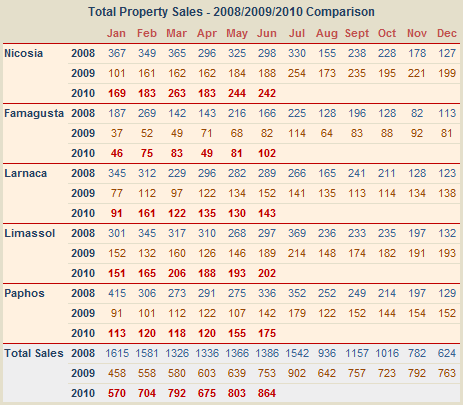
ACCORDING to figures released by the Department of Lands and Surveys, 864 property sale contracts were deposited at Land Registries throughout Cyprus during June, the highest number since June 2009.

Throughout the first six months of 2010 the number of property sale contracts deposited at Land Registries throughout Cyprus amounted to 4,408 compared to 3,591 during the same period last year; an increase of 23%.

As we reported last Wednesday in the article Sales to non-Cypriots improving slowly, foreigners account for 928 (21.1%) of these contracts.

So far this year, property sales in Nicosia are up by 34% followed by Limassol and Famagusta, where sales have increased 22% and 21% respectively, while sales in Paphos have increased by 19% and sales in Larnaca 13% compared to last year.

Sales of property in Cyprus to June 2010
Source: Department of Lands and Surveys

Although property sales so far this year are up by nearly a quarter on last year, they are still less than a half of the number sold during the same period in 2008.
