MRI Overseas Property subject of MEP question

Roger Helmer MEP
Roger Helmer MEP

IS THE Commission aware that a company operating under the name ‘MRI Overseas Property’ has been the source of numerous complaints by customers all over the European Union?

Is the Commission further aware that under the allegations that they have broken several property management and furniture contracts they continue to operate, presumably under the impression that international clientele may be unaware of their dubious reputation?

Is the Commission prepared to take steps in order to alert potential customers of ‘MRI Overseas Property’ to the risks they may be taking by entering into a contract over international borders – particularly in the newer EU Member States Bulgaria, Cyprus and Romania?

About Roger Helmer

Roger Helmer was first elected to the European parliament in 1999. He was re-elected in 2004 as the local MEP for Derbyshire, Lincolnshire, Leicestershire & Rutland, Nottinghamshire and Northamptonshire. Roger has published two books on European issues, “Straight Talking on Europe” in 2000, followed by “A Declaration of Independence” in 2002.

Further reading: MRI Overseas Property written questions to European Commission E-4966/2010

Massive development planned for Cyprus

IN AN EXCLUSIVE video report we can reveal that plans are under way for the construction of a massive real estate development on the coast of Cyprus.

Consultants working on behalf of a consortium of European investors believe that the development will provide outstanding opportunities for overseas property investors and will also bring many benefits to Cyprus. It will create 6,000 new jobs and attract more than half a million well-heeled tourists from the EU every year.

Although the precise location of the development has yet to be revealed, we believe it will cover an area of around 250 hectares and will most probably be situated on the coast somewhere between Paphos and Limassol.

If given the go ahead the development, codenamed ‘Papholand’, will be ”the most luxurious and exclusive development in the whole of the Mediterranean” according to the developer heading up the construction consortium.

In addition to luxury apartments, villas and housing complexes, the scheme includes a huge shopping mall, a 1,000 room luxury five star hotel, an artificial ski-slope, theatres, cinemas – and various other attractions including a central pillared structure to be known as the “Acropolis”.

Plans are also being drawn up for a marina that will provide berthing for 5,000 luxury yachts and an 18-hole championship golf course rivalling those of the Augusta National Golf Club, St Andrews and Turnberry.

Armed with a hidden camera, our undercover reporter managed to sneak into a project briefing and filed the following video report.

[youtube=http://www.youtube.com/watch?v=Yw4c0UeEIac&w=470&rel=0]

Holiday home swimming pool safety

Swimming pool safety in Cyprus holiday homesI RECEIVE many emails from people who are concerned about swimming pool safety; particularly those who have purchased holiday homes in Cyprus and other types of property that share swimming pools.

Regular visitors to the magazine will have read articles about the confusion that exists in Cyprus’ current laws and regulations which designate all shared swimming pools as being subject to the same strict regulations as public pools.

Recently the Cypriot authorities have been tightening up on the regulations and have been refusing to issue operating licences and Certificates of Final Approval (a necessary pre-cursor to the all-important Title Deed) until developers provide them with all the necessary documents proving they have complied with the regulations.

However, there are many holiday homes whose Title Deeds that were issued before the recent clampdown. Swimming pools in these complexes often provide little, if any, protection for their users.

If you own a property in such a complex, then you can improve child safety. Published by the European Child Safety Alliance EuroSafe, ‘Protecting Children and Youths in Water Recreation’ contains a section on swimming pools and child safety.

Child safety: Swimming pools on holiday properties

Swimming pools pose the greatest risk of death and injury to children in a home or holiday setting. In Greece, famous for its countless beaches, almost all drownings of young children occur in swimming pools.

Similarly, in Algarve Portugal, a tourist region with over 150 kilometres of coastline, 83% of child drownings over the last 7 years have occurred in swimming pools. As well, more British children drown on holiday abroad than in Britain itself, most of them in swimming pools.

However, research shows that swimming pool drownings are preventable. The two most important factors in swimming pool drowning prevention are supervision and four -sided isolation fencing. The following information targets swimming pools in private holiday residences and apartments, although many of the same measures are applicable to other large pool settings. For more information on hotel pools specifically, please see the following page.

Why swimming pools can be risky for children and youth

Swimming pools present different dangers to children of different ages. Toddlers and very young children are at risk of falling into the pool and drowning, which usually happens in a brief lapse of supervision. Therefore, four-sided fencing is critical in blocking access to the water. Some drownings occur when children get caught under a pool cover, where they can not be seen nor free themselves. A firm cover as opposed to a soft cover is recommended to prevent this.

Pool alarms too are inadequate as a stand alone preventative measure. Alarms, which must be reset after every swim, are more likely to be incorrectly and inconsistently used, especially by tourists who might not understand the alarm system or who might not know what water level is needed for the alarm to be effective. Furthermore, most alarms have a “re-activating time” of at least 10 minutes between swims when they can not be activated until the water settles again, which leaves a frequent gap in protection. This underlines the importance of proper fencing and constant supervision for protecting young children.

Older children are at risk for head-first diving injuries. Recreational diving injuries cause 10% of all swimming injuries to children 14 years of age and younger. Recreational diving injuries also account for over 70% of all spinal cord sports/recreation injuries and occur most frequently in private pools to boys 11 – 15 years of age. A study of teenage diving victims with spinal cord injuries (causing paralysis) shows that 87% took place in swimming pools, that depth indicators were not present in 75% of the pools, and that there were no warning signs at 87% of the pools. In particular, pools in which there is a gradual incline have a dangerous transition area where 95% of spinal injury accidents occur. It is important that pools be adequately marked for safe diving depths.

Recommendations for residential/private swimming pool safety

  • The best protection is a four sided isolation fence with a self-closing, self-latching gate. Isolation fencing means that the pool is surrounded on all sides (rather than one side being connected to the house). The gate should be regularly checked and all guests instructed to double check its proper closure.
  • Depth markers should be used poolside to indicate safe diving and wading depths. Diving in water less than 1.2 metres deep should be expressly forbidden, a safer depth for recreation divers is 1.8 metres.
  • A spa or whirlpool should be covered at all times when not in use, with a fitted firm cover. Be sure the spa drain has been secured against entrapment risk (hair, small hands).
  • If you will not be providing personal flotation devices, instruct guests with young children to bring them themselves.
  • A telephone should be kept poolside for emergencies, and to prevent caregivers from dashing inside to take a call, leaving children unsupervised.
  • If you are using a pool cover or pool alarm, guests will require specific instruction and rehearsal on how to use these measures consistently and correctly.
  • Instruct guests to never reduce supervision of their children regardless of the precautions that are in place.

EU Swimming Pool regulations

In 2008, a new European Union standard relating to the design and operation of swimming pools came into effect. The standard is split into two parts:

EN 15288-1: 2008 Swimming pools – Part 1: Safety Requirements for Swimming Pool Design

EN 15288-2: 2008 Swimming pools – Part 2: Safety Requirements for Swimming Pool Operation

Both France and Spain have introduced laws to protect youngsters in both private and public pools. It is only a matter of time before EU laws, based on the above standards, are introduced.

In France the penalty for not having a pool safety barrier is up to €45,000.

Yet another Immovable Property Tax scam

YET ANOTHER Immovable Property Tax (IPT) scam in Cyprus has come to light. A magazine produced by a well-known Paphos-based property developer includes the following information on IPT for potential buyers in its advertising literature:

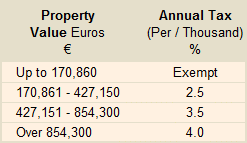
There is also an annual taxation, Immovable Property Tax, which the registered owner is required to pay based on the value of the property. The rates for these are as follows:

Fraudulent Immovable Property Tax table

This information which, needless to say is totally inaccurate, has resulted in some people paying as much as 15 times the amount of Immovable Property Tax they should have been paying to this particular developer.

How much of this overpayment has ended up in the developer’s pocket and how much has been paid to the Inland Revenue Department, we will leave you to guess!!

Here is what the magazine article should have said:

There is also an annual taxation, Immovable Property Tax, which the registered owner is required to pay based on the assessed value of the property as of 1st January 1980. The rates for these are as follows:

Correct Immovable Property Tax table from the Cyprus Inland Revenue Department

As you can see, there is a significant difference!!

How should Immovable Property Tax calculated?

IMMOVABLE Property Tax in Cyprus is a bit like the old rating system in the UK, which was also based on assessed 1980 property values.

  • All property has an assessed 1980 value (which is calculated by the Land Registry) which entered on its Title Deed. And so a plot on which a property is built will have a Title Deed containing its 1980 value. (Where a plot has to be subdivided into smaller plots, so that a Title Deed can be issued for each of the properties built on the plot, the Land Registry will apportion the 1980 value of the undivided plot across the Title Deeds of the smaller plots.)
  • As developers build on the land, they declare how much input they have put into the land (i.e. the value of materials and work undertaken in building the properties) to the Inland Revenue Department every year. The Inland Revenue assesses the 1980 value of that input, adds it to the 1980 value of the land and presents the developer with a tax demand.
  • Once the bill has been paid, it is a very straightforward task for the developer to apportion it fairly between buyers who have yet to receive their Title Deeds.

Note that a developer’s total Immovable Property Tax liability isn’t calculated on a property by property basis; it is calculated on his total property portfolio. Similarly, if someone were to own two houses, their Immovable Property Tax liability would be calculated on the total value of both properties, not the sum of the Immovable Property Tax on each of them.

Reclaiming legitimate Immovable Property Tax overpayments

Once a Title Deed has been issued for each of the properties and ownership has been transferred to their buyers (i.e when a buyer has paid the Property Transfer Fees and the Land Registry has issued a Title Deed bearing their name as the property’s registered owner) buyers may claim a refund from the Inland Revenue Department for any overpayment they may have made to their developer.

However, the Inland Revenue will only refund legitimate overpayments; it will not refund illegal amounts charged by property developers as shown in the example above.

Anyone who has been charged illegal amounts of Immovable Property Tax should report the matter to the Cyprus CID; fraud is a criminal offence!

Those wishing to reclaim legitimate overpayments of Immovable Property Tax should read this letter from the Ministry of Interior.

Cyprus joins EU excessive deficit watchlist

Cyprus joins EU excessive deficit watchlistCYPRUS, Denmark and Finland have joined the ranks of member countries with government deficits deemed high enough to pose a threat to the wider European economy. The commission is now recommending they be placed on its list of countries warranting further scrutiny of public finances.

With the addition of the three, the watchlist would include all but one of the EU’s 27 countries. Only Luxembourg is not running a deficit well over 3% of gross domestic product – the EU limit. Luxembourg finished 2009 with a shortfall of around 2%.

So far, 12 member countries have taken what the commission considers to be effective action to close their gaps, cutting government spending and introducing revenue-boosting measures as promised. Among them are Ireland, Italy, Portugal and Spain – 4 countries at the centre of concern about high national debt looming over the eurozone.

Germany, meanwhile, has moved to boost consumer spending – in response to worries that the country’s fat trade surplus is hurting other EU economies. But the country has also outlined deficit-reduction measures for 2011 and beyond.

The other countries reviewed in the latest commission report are Austria, Belgium, the Czech Republic, France, the Netherlands, Slovakia and Slovenia.

As it does with all countries under scrutiny, the commission has proposed deadlines for Cyprus, Denmark and Finland to correct their deficits. Finland would have until 2011, while Cyprus and Denmark would have until 2012 and 2013 respectively.

Cyprus recorded a shortfall of 6.1% of GDP last year. Deficits are expected to reach 5.4% this year in Denmark and 4.1% in Finland.

Until recently, these countries seemed to be doing well. EU monetary commissioner Olli Rehn said the sudden turnabout shows the severity of the economic crisis, which has wreaked havoc with public spending.

The 3% limit on deficits – part of the EU’s stability and growth pact – is meant to prevent imbalances that could undermine confidence in the eurozone, as happened last month during the Greek debt crisis.

More on EU’s excessive deficit procedure

ETEK calls for demolition of illegal buildings

THE Cyprus Scientific and Technical Chamber (????) has urged the government to demolish illegally constructed buildings that will not be granted relief under the proposed town planning amnesty. This will serve as a penalty for those who have broken the law and as a warning to those who may consider breaking the law in the future.

Speaking on behalf of ETEK in front of the House Committee on Internal Affairs, Costantinos Constantis, referred to recent actions taken by the Spanish government, which send a clear message to law breakers. The Spanish the town planning amnesty is not open-ended and, in future, town planning laws will be rigorously enforced without exception.

ETEK also proposed the creation of a ‘black list’ of property developers who:

  • Sell apartments off-plan without first having secured the necessary permissions and who then make false claims regarding completion and withhold Title Deeds;
  • Having been refused a loan, remortgage property for which no Title Deed has been issued in order to fund the development of their next illegal project.

Mr Constantis drew the Committees attention to the fact that various companies were destroying Cyprus’ international reputation. He said that the authorities should reject applications made land developers who were known to have broken the law.

Mr Constantis report, which was made in an earlier debate on the proposed planning amnesty bill, provoked a response from the property developers’ representative, Mr Leptos. He blamed the delay in issuing Title Deeds and Certificates of Final Approval on public sector bureaucracy and on buyers who make changes to their properties illegally, such as constructing BBQs and enclosing balconies. It also claimed that some of the provisions in the proposed legislation being proposed will lead to stagnation in the construction industry.

About ETEK

The Cyprus Scientific and Technical Chamber (????) is the statutory Technical Advisor to the State and is the umbrella organisation for all Cypriot Engineers.