Bad omens for Cyprus economy

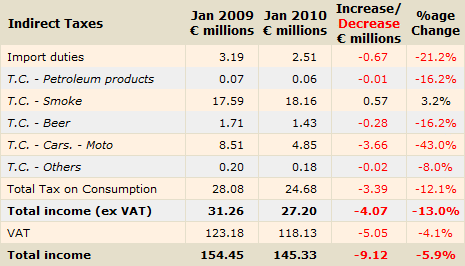
MORE bad news for the Island’s Finance Ministry has come in the last week from figures published by the Customs and Inland Revenue Departments. Indirect taxes and Inland Revenue tax collections were down in January by a total of €9.9 million on January 2009; a fall of 2.6%.

State revenues from indirect taxes fell by €9 million to €145.3 million last month from €154.4 million in January 2009.

  • VAT revenues fell 4.1% to €118.1 million from €123.2 million last year.
  • Import duties slumped 21.2% to €2.5 million as a result of lower consumer demand.
  • Consumer tax on vehicles and motorcycles fell 43% to €4.9 million from €8.5 million last year.

These figures are even more alarming considering that that last year’s base was very low. The Finance Ministry has based its fiscal plan on the assumption that state revenues from indirect taxes will grow by 9% in 2010.

One good piece of news was that consumer tax from tobacco rose 3.25% to €18.2 million from €17.6 million, despite a smoking ban being in operation since the start of the year.

Indirect taxes in Cyprus for January 2010
Source: StockWatch

Figures from the Inland Revenue are more encouraging; collections fell by €0.8 million to €228.5 million last month from €229.3 million in January 2009; a drop of just 0.4%.

Immovable Property Tax, Stamp Duty and Capital Gains Tax revenues all made gains, which may result from the slight improvement in the number of property sales during January and the efforts of the Interior Ministry to accelerate the issue of Title Deeds.

Cyprus Inland Revenue Tax Collections for January 2010
Source: Cyprus Inland Revenue Department

MRI clients in Cyprus – no furniture, no refund

1

DOZENS of Irish customers of MacAnthony Realty International (MRI), an overseas property company owned by Darragh MacAnthony, have said that furniture they bought for their apartments has not been delivered and that the company has refused to refund them.

The MRI clients, who bought apartments in Cape Verde, Morocco, Romania and Cyprus, say that furniture “packs” costing an average of €15,000 per apartment had still not been delivered months, in some cases years, after they were due. Some say they have been unable to let their properties as they remain unfurnished.

A number also allege that MRI failed to meet the obligations of a “lifetime’s after sales service” bought for up to €800 each. Under the agreement, MacAnthony should have “snagged” customers’ properties and found tenants.

Eoin Morgan from Clontarf bought a furniture pack for his two-bedroom apartment in Royal Seacrest in Paphos, Cyprus in 2007, paying a 50% deposit of €6,500. In September 2008, Morgan was told by MRI that the company supplying the furniture, Decora, had ceased trading. He was told that MRI would honour his agreement if he paid the remaining 50%.

Morgan paid the balance but when he was told that his furniture would not be ready until six to eight weeks after he signed for the property, he asked for a refund.

I had lost all faith in MRI. The furniture was never delivered and MRI never provided a refund,” he said. “I eventually managed to source furniture privately and, luckily, as I had paid with my credit card, I managed to get a refund through the card company.

John Andrews of Ballycarry, Northern Ireland, who paid €29,440 for two furniture packs for two MRI apartments in Vila Verde, Cape Verde, has yet to get his furniture, despite having paid for one unit before Christmas. He says the lifetime afters ales service had not been provided either.

The apartments were delayed in construction for nearly a year,” Andrews said.

I was given regular assurances that the furniture would be shipped and installed as promised. But in November, new terms and conditions were supplied relating to the furniture deal. I hired a Spanish lawyer to either get my furniture or a refund but neither has happened.

When Andrews asked MRI to “snag” his apartment, he was referred to another company, Solutions Overseas, which told him it would cost another €900.

Desmond Curran from Santry, north Dublin, is still awaiting delivery of a furniture pack he bought for his apartment in Bucharest in February 2008 for €11,000. Curran said communication from MRI had ceased in the past six months.

There’s no word about getting the furniture or the money back. I’m stuck in limbo. Do you just write it off? – it takes a long time to save €11,000 – and pay a new company to furnish it. I haven’t been able to afford to furnish it anew, while at the same time I’m paying utility bills,” he said.

Dominic Pickering, the chief executive of MRI, has denied some of the claims made by clients of his company. For example, he said that Andrews “has never confirmed to us that his property purchases in Cape Verde have been completed despite us requesting this numerous times since the middle of last year”. Andrews claims that he has attempted to contact MRI through his lawyer, but the company refuses to deal with his counsel.

Pickering said that Morgan got “a full refund of the money he had paid us”. Morgan denied this, claiming he got only 50% of his money back.

The MRI chief executive said that he had not been given enough time to investigate other clients’ complaints passed on by this newspaper. He recently issued a circular to clients saying that “a stream of furniture companies” that MRI had dealt with had fallen victim to the global recession.

Some went out of business through bad luck, others through bad management,” he said. “However, it left MRI with a huge challenge, as we had paid these companies millions to supply clients with furniture.

Pickering admitted MRI had problems with suppliers in Bulgaria, “but there were also sizeable challenges in Morocco, Cape Verde, Turkey, Cyprus, to name but a few”. He claimed “matters had been resolved” in Turkey, Spain, Portugal and Germany. “Solutions to the situation in Italy and Cyprus have been found and they will be completed in early 2010,” he said. “The outstanding countries are being tackled gradually with an immediate concentration on Bulgaria.”

Pickering also said that the company was “90% of the way through solving [the problems] having installed over 1,000 furniture packs in 2009 alone”.

A previous Sunday Times investigation found that MRI staff used hard-sell tactics and lies to sell second homes to Irish and British buyers. Some employees were also found to have oversold the investment potential of overseas properties. Customers were told their mortgages would be covered with “guaranteed rents”, which never materialised.

Orams decision could open Pandora’s Box

REFUGEE Meletis Apostolides took a risk when he decided to sue David and Linda Orams because they had built villa on his land in Turkish-occupied Lapithos.

His subsequent decision to apply to a British court for the execution of the Cyprus court order and the positive outcome – after the ruling of the European Court of Justice – was greeted as a triumph of justice and the principles of the European Union.

The court decision recognised the right to ownership and put the brakes on the continuing development of Greek Cypriot properties in the north. The legal value of the decision is significant, but if it is not utilised rationally, it could turn into the nightmare of the Cyprus problem.

Recently, the Cyprus Republic settled a case that had been brought before the European Court of Human Rights by Turkish Cypriot Sofi Nezire. It agreed to pay her €500,000 as damages for loss if use of one-and-a-half houses (she is co-owner in the second) in Larnaca in which Greek Cypriot refugees are living. This settlement has opened Pandora’s Box with regard to Turkish Cypriot properties in the areas controlled by the Republic.

After 1974, the Republic put all Turkish Cypriot properties under the guardianship of the Interior Minister, who prohibits their sale, exchange and transfer because of the state of emergency. So far so good. However, without following proper expropriation procedures, the Republic took large expanses of Turkish Cypriot-owned land for development projects and for refugee estates.

The whole of the old Larnaca Airport and a part of the new one were built on Turkish Cypriot land. The owner of the land is a citizen of the Republic lives in Larnaca and has a Cyprus passport and ID card. The government has been paying him a handsome monthly allowance as part of its efforts to persuade him not to claim his property in the courts.

What would happen if he applies to a Cyprus court demanding the demolition of the old Larnaca Airport? How can the court reject such an application, given its decision in the Orams case?

Like Apostolides, the man is a Cypriot citizen. And what would happen if Turkish Cypriots come to our courts en masse, demanding compensation for loss of use of their properties and restitution? Will our government demolish the refugee estates? Will it expropriate all the Turkish Cypriot land now? The amounts involved would be prohibitive and the political consequences devastating.

Until now, the Republic had the Law of the Guardian which froze all transactions of Turkish Cypriot-owned properties and prohibited restitution. But part of the settlement reached with Sofi Nezire, includes the written undertaking by the Cyprus Republic for the amendment of the Guardian Law so as to allow all Turkish Cypriots living outside Cyprus or in the unoccupied areas, to take back their properties.

At least 100,000 Turkish Cypriots are registered citizens of the Republic. A large number of them live in the UK but should we be surprised if more and more of them decided to move back to the island to take back ownership of their properties which could be worth millions of euro at today’s prices? The financial incentive cannot be underestimated.

This is not just idle speculation or alarmism. After the government’s undertaking at the ECHR it is a very real possibility. This would not be the only unpleasant development. Soon, the ECHR is expected to refer the thousands of recourses filed by Greek Cypriots against Turkey to the compensation commission in the north. In other words, while the Greek Cypriots would have to apply to the commission of a non-recognised entity and receive peanuts as compensation for their properties, Turkish Cypriots would apply to the Republic’s courts and be given back their properties.

The only thing that could spare us from this scenario would be a political solution, even though prospects for this are not very rosy. Resorting to the law as tool for securing a better solution might be useful, but the idea that the legalistic approach could supplant political negotiations is now totally discredited.

Cypriot economy still in recession

CYPRUS’ Gross Domestic Product shrunk on a seasonally adjusted by just 0.3% In the fourth quarter of 2009 compared to the previous quarter and by 2.7% compared to the corresponding quarter of 2008.

According to CYSTAT, the shrinkage of economy in the fourth quarter was mainly due to “the very negative growth rates” of construction and hotels and restaurants, as well as the negative performance of manufacturing, retail and wholesale trade, and transport activities. The broad Services sector remains the only sector recording positive performance, as the Financial Intermediation activities present marginal growth rates.

Cyprus’ economy continues to deteriorate while the European economy recovers, although slower than expected. According to Eurostat, the Euro area economy grew by 0.1% in the fourth quarter of 2009 compared to the third quarter and the economy of the EU27 also grew by 0.1%.

The Greek economy has shrunk by 0.8%, while the German economy has remained unchanged on a three-month basis. The Italian economy also shrank although it grew in the third quarter.

In the Euro area, Cyprus’ economic performance is the worst after Greece but it has performed better than those countries outside the euro area such as Latvia, Romania and Hungary.

On Thursday, Finance Minister Charilaos Stavrakis said that if the government’s plan to save the economy was not pushed through there was a danger Cyprus would end up with the same economic crisis as Greece.

Construction & Housing Statistics (2008)

THE CYPRUS Statistical Service announces that it has published the annual report “Construction and Housing Statistics, 2008”.

The report contains detailed data on the construction sector, pertaining, inter alia, to output, capital formation, inputs, new dwellings completed, building permits authorized, labour cost index and price indices of construction materials.

The main developments in the construction sector in 2008 were:

  1. The sector continued to record a positive rate of growth, registering an upwards trend in its value added in real terms of 4.5% compared to 7.7% in 2007 and 6.8% in 2006.
  2. Gross output at current market prices rose by 9.7% and reached €3,058 million compared to €2,788 million in 2007. New residential buildings accounted for 51.1% of the gross output, new non-residential buildings (offices, shops, hotels, factories, airport buildings, etc.) for 22.9%, new civil engineering projects (roads and bridges, water supply and sewerage networks, telecommunications and electricity lines etc.) for 17.4% and repairs and maintenance for the remaining 8.5%.
  3. Employment in the sector increased from 36,758 persons in 2007 to 38.321 persons in 2008 and accounted for 10.1% of the gainfully employed population.
  4. Labour cost in construction increased by 6.0% compared to 4.6% in 2007. The price index of construction materials recorded a rise of 9.8% compared to an increase of 5.3% in 2007.
  5. The number of new dwellings completed increased by 10.3% to 18,195 dwelling units compared to 16,501 in the previous year. By district, the number of new dwellings is distributed as follows: Nicosia 4,788, Famagusta 1,847, Larnaca 3,575, Limassol 3,981 and Paphos 4,004.
  6. The average area per dwelling completed in 2008 was 199 square metres for houses and 118 square metres for apartments, compared to 191 and 117 respectively in 2007.
  7. The cost of construction per square metre (excluding the value of land) rose from €803 in 2007 to €844 in 2008 for houses and from €727 to €767 for apartments.
  8. The dwelling stock at the end of the year amounted to 374 thousand dwelling units, of which 63.1% were in the urban areas.

The complete report is available from the CYSTAT website.

Property prices in Cyprus ‘distorted by local factors’

ACCORDING to the first results of the new quarterly Cyprus Property Price Index (PPI), launched by the Royal Institution of Chartered Surveyors (RICS) Cyprus two weeks ago, low yields – the annual rental income from a property compared to its market value – strongly suggest that the market is overvalued.

Professor Patrick McAllister of the School of Real Estate and Planning at the University of Reading (UK), who was one of two academics commissioned by RICS Cyprus to develop the methodology underpinning the PPI, said at the index’s launch:

What is striking is that yields on commercial property are quite low by European standards, but also hugely variable, even within Cyprus.

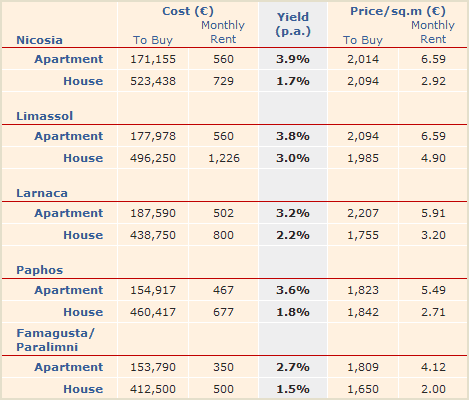
Yields on residential property, for example 1.7% in Nicosia, are also extremely low. These incredibly low yields suggest that people pay over fifty times the rent [to purchase] a property. That would be a strong signal of a market being overvalued.

Yields derived from the RICS Cyprus Property Price Index

Yield is just one of many tools that can be used to provide a snapshot of the strength of a property market at a given moment. If a property is valued at €100,000 and its rental income per year comes to €5,000, then the yield on that property is five per cent.

The results for the first quarterly RICS PPI gave an average unit price of €523,438 for a medium-quality three-bedroom, semi-detached, 250sqm house with a garden in Nicosia. An average monthly rent of €729 for such a house would give a yield of just under 1.7%, in other words one would have to pay around fifty times the annual rental income to buy it.

On the other hand, the average unit price of €171,155 for a medium-quality two-bedroom, 85sqm apartment in Nicosia would give a yield of 3.9%, based on an average monthly rent of €560. This is much closer to the normal EU range of 4%-7% yield, suggesting that it is mid-range houses that are over-valued rather than all residential property.

Costas Apostolides, an economist working with consultancy firm EMS, told the Mail: “My view is that properties are not overvalued.” He said that, although yields are typically very low in Cyprus, factors particular to the Cyprus market have historically constrained supply and so are the main reason behind the steady rise in property prices.

With the exception of the time periods of the 1963-1964 inter-communal conflict, 1974 and 1991 (the first Gulf War), values have been steady, mainly gaining, in Cyprus,” Apostolides said.

One of the main reasons for this, he added, was a very high foreign demand for properties in Cyprus, due to its price competitiveness relative to other comparable locations within the EU, shored up over time by favourable exchange rates. Another major factor has been the very high tax on land, which continues to restrict supply by discouraging people from selling easily, thus distorting the market.

Cyprus Land & Building Developers Association President Lakis Tofarides said that a person in Cyprus can expect to pay 10 or 11 times the average annual salary to buy a property, compared to four times the average annual salary in the UK.

Tofarides said that this “affordability” gap is due to the fact that financial contributions by parents and relatives towards purchases by younger first-time buyers are common in Cyprus, and this family network support has fed price inflation in the property market.

So an alternative explanation for the low yield on houses – especially when compared to apartments – could be that this is simply the result of the limit to what people can afford to pay in rent on a regular independent basis, in other words without the benefit of the kind of financial support one might receive from family members as a one-off when buying a house.

Former Finance Minister Michalis Sarris, who spoke at the launch of the RICS PPI, said that the banks had also helped to stoke up the property market, first of all by lending 100% or 110% of property valuations on the basis that their loan portfolios were secure in a rising market.

He also suggested that the banks are now helping to sustain inflated prices: “Some people would argue that over the last few years, there was an explosion in property prices connected with the profitability of developing.

Prices have not been affected (currently) because banks have chosen not to press developers to repay their loans – they have extended more loans to allow the original ones to be paid. So the developers are now saying: why should I reduce my price, if I’m not forced to sell?

However, property indexes cannot be regarded as an absolute measure. “Measurement is one thing, interpretation is quite another,” McAllister said. The result is that different indexes can produce “conflicting messages” about what is happening in the market.

The RICS PPI is not based on actual sale prices of properties in specific areas, but on three valuations of sample properties carried out by surveyors in various areas of five urban centres in the island’s government-controlled area. Thus, for the first quarter of 2010 it has recorded what can only be described as the anticipated spread of property prices across major urban area.

A true index can only be based on transaction prices, otherwise it is just an opinion poll, albeit an experts’ opinion poll,” said another economist who preferred to remain anonymous.

Cyprus Mail