Heavy January rains bring relief from water cuts

ALL WATER restrictions are to be lifted as from today following the wettest January for six years, which has left dams almost 50 per cent full, and ahead of the completion of planned desalination plants.

Agriculture Minister, Michalis Polynikis said: “I am pleased to announce that we are close to resolving this lingering problem, particularly as a result of the desalination plants and recent rainfall.

Reservoirs were yesterday at 47% capacity with 137 million cubic metres from a total capacity of 284 million cubic metres, after a wetter than average January, in which 42 million cubic metres flowed into the reservoirs.

This time last year reserves stood at only 22.4 million cubic metres, or 7.7% of capacity.

January’s rain accounted for over three times the amount that fell in the same month last year, and around 16 times the amount that fell in January 2008. The last January that it was as wet as this was in 2004, when 89 million cubic metres went into the dams.

Polynikis defended the government’s decision to re-impose restrictions a month ago, saying that he wanted to be sure that he could meet future needs of consumers. Now, he is certain that he can do that.

We analysed two scenarios of water influx, taking into account both the completion of desalination plants and increased demand for consumption (compared to 2007) and we found the system can now meet the water needs with continuous water supply.

Nicos Nicodemou, Deputy Director at the Water Development Board, confirmed the cuts will be lifted today. “We have decided that from Tuesday we will lift the cuts permanently,” he said.

He explained added that, with the near completion of a fifth desalination plant near Paphos, Cyprus should have enough water to last until the end of 2011. Next year the Electricity Authority of Cyprus will complete a desalination plant in Akrotiri.

Nicos Zambakides, Head of the Nicosia Water Board, said: “The government has made the right decision, as long as the customers recognise that they need to conserve water. Our plea to customers is to save as much as possible.

In December, water use in all areas increased by an average of 10%, with increases of up to 20 per cent in Nicosia, compared with the same period in 2007 when water restrictions were last lifted. Asked about this marked increase, Zambakides said: “Customers weren’t wasting the water in this time. In most cases they were filling up their tanks (which were less full during the restriction period) Also, the water board based estimated 2009 consumption based on 2008 levels, but there was a 10 per cent increase in population that year.

Nicosia currently consumes around 50,000 cubic metres per day, of which 5,000 is supplied to the north.

Is property in Cyprus overpriced?

THERE can be no doubt that property prices in Cyprus are high, particularly when you consider that the cost of building materials fell to a 10-year low recently.

Last Friday the Chairman of the Cyprus Land and Building Developers Association, Lakis Tofarides, blamed high property prices on the cost of land which has rocketed over the last ten years and which now accounts for 40% – 50% of a property’s overall cost.

But Dr Michalis Sarris, the former Finance Minister, had a different opinion and suggested that the banks had helped to sustain inflated prices. “Some people would argue that over the last few years, there was an explosion in property prices connected with the profitability of developing. Prices have not been affected (currently) because banks have chosen not to press developers to repay their loans – they have extended more loans to allow the original ones to be paid. So the developers are now saying: why should I reduce my price, if I’m not forced to sell?” he said.

But regardless of who or what has caused the price of property to rise to today’s levels, the question remains whether or not property in Cyprus is overpriced.

How to tell if property is overpriced

It is quite straightforward. Any asset, such as a property, has a ‘return’; i.e. what you make for holding the asset. For example, if you put your money into an instant access savings account, you will receive a ‘return’ on your money – perhaps 3% per annum.

Traditionally, investments in property provide a ‘return’ in 2 ways:

  • Capital appreciation (property price growth as shown by a price index)
  • Rental income (if you own a property, you could rent it out).

It is difficult to create a simple formula that takes both of these elements into account individually. So they are usually combined to give an easy way of comparing the required sale price of a house against its ‘true worth‘. It is a simple calculation:

  • If the annual rental income you can expect achieve from a property is around 6% or more of its price, then it is a ‘good’ investment. And the higher its annual rental income is compared to its price, the better an investment it becomes.
  • Conversely, if the annual rental income you can expect achieve from a property is less than 5% of its price, then it is a ‘poor’ investment. And the lower its annual rental income is compared to its price, the poorer an investment it becomes.

A property is ‘fairly priced’, for both the buyer and seller, when its annual rental income is between 5% and 8% of its price. This percentage return is known as its ‘Yield’ – and it is an industry standard formula for assessing the value of property.

Is property in Cyprus overpriced?

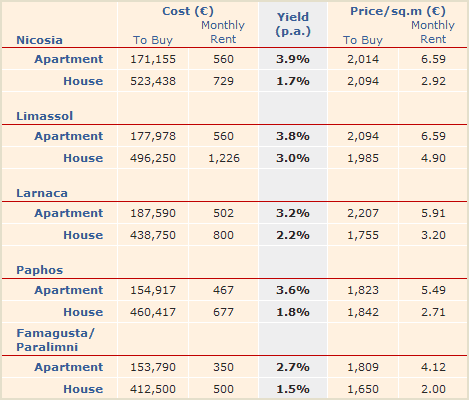
Using the RICS Cyprus Property Price Index published last Friday, I have calculated the ‘Yields’ of apartments and houses in Nicosia, Limassol, Larnaca, Paphos and Famagusta/Paralimni using the industry standard formula; the results are presented below.

Yields have been derived from the RICS Cyprus Property Price Index

As you can see, ‘Yields’ are extremely low indicating that property is overvalued; in some cases by more than three times what would be considered a ‘fair price’.

So yes, Cyprus property is overpriced using an industry standard ‘fair price’ model.

(Note that the RICS Cyprus Property Price index is based on residential properties located in residential areas. For more information please see the report prepared by Reading University).

The Irish experience

THE property bubble in Ireland built up between 2000 and 2007, as with many other western European countries, with a combination of increased speculative construction and rapidly rising prices.

Prices stabilised in 2007 and the bubble burst in 2008. By the first quarter of 2009, house prices had fallen by 23% compared with the second quarter of 2007, and the number of housing loans approved fell by 73%. The fall in domestic and commercial property prices contributed to the Irish banking crisis.

Last year, the Irish Government established the National Asset Management Agency (NAMA) in an effort to resolve the situation. NAMA will buy all of the land and property development loans off the six Irish banks covered by the State guarantee. This means the total potential value of the loans which will be taken on by NAMA will be between €80 billion and €90 billion. By taking problem property loans off the hands of the banks, the Irish Government hopes to put those institutions in a position where they can resume lending.

According to NAMA, spiralling property prices arose from:

  • Massive growth in property-related lending 2004-2007.
  • Insufficient attention within banks or within overall banking sector to basic risk management principles such as stress-testing.
  • Insufficient attention to key issue of supply/demand.
  • No rigorous analysis of whether scale of the rise in property prices could be justified by economic fundamentals.
  • Enormous scale of lending to individuals who had little or no supporting corporate infrastructure or access to capital markets.
  • Poor quality of credit appraisal.
  • Over reliance on wholesale money markets.
  • Failures of governance on the part of lending institutions’ Boards.
  • Regulatory failures.

Is Cyprus heading in a similar direction?

Building permits down again

IN A PRESS release issued yesterday, the Cyprus Statistical Service (CYSTAT) announced that the number of building permits authorized by the Municipal Authorities and the District Administration Offices during November 2009 was 771, comprising:

  • Residential buildings – 559 permits
  • Non-residential buildings – 119 permits
  • Civil engineering projects – 32 permits
  • Road construction – 8 permits
  • Division of plots of land – 53 permits

Focusing on the permits issued for the construction of residential buildings, these provide for the construction of 1,285 dwelling units – 563 single houses and 722 multiple housing units such as apartments. Compared to the November 2008 total of 2,252 dwelling units, this represents a fall of 42.9%.

Building Permits for the Construction of Residential Properties
Month 2008 2009 Increase/
Decrease
%age
Change
January 1,229 1,585 356 29.0%
February 1,583 1,587 4 0.3%
March 1,593 1,381 -212 -13.3%
April 1,658 1,252 -406 -24.5%
May 1,715 1,191 -524 -30.6%
June 1,659 2,125 466 28.1%
July 1,925 1,161 -764 -39.7%
August 931 900 -31 -3.3%
September 1,692 1,557 -135 -8.0%
October 2,088 1,020 -1,068 -51.1%
November 2,252 1,285 -967 -42.9%
Total 18,325 15,044 -3,281 -17.9%

Source: Cyprus Statistical Service

Building permits constitute a leading indicator of future activity in the construction sector.

CPAG update on transfer taxes and IPT

Transfer Taxes (Property Transfer Fees)

IT appears that currently an increasing number of the lucky few who are at the point of safety through Title Deed transfer (possibly after many years), are receiving yet more unpleasant surprises, this time courtesy of the Land Registry.

Instead of using the sale price on the contract the Land Registry are randomly coming up with values in excess of the actual amounts paid for properties in order to charge the unfortunate buyers much more transfer tax.

(Just imagine if this concept was applied to VAT or income tax – e.g. ‘You paid too little for that settee you bought in the January sales ten years ago and now we want more VAT from you’!)

Currently, the only way of appealing against these demands is to first pay them and then apply to the Supreme Court to contest the decision, and of course in Cyprus this can take years in the failing justice system.

In late November 2009, CPAG met with the Minister of the Interior and the subject of transfer tax was raised, resulting in the Minister requesting that we write to him. However, despite chasing by CPAG for a response to our letter, no such communication has been forthcoming so far. (Note, we deleted the names of the buyers in this copy in order to protect their privacy.)

Moreover, rumours are rife and many buyers are contacting CPAG for guidance as they are worried that they may not be able to pay these inflated demands, especially if their developer is scamming them on IPT at the same time.

As a result we have prepared a sample letter which may be of help in limiting the current unjust and random practices of the Land Registries where this is taking place. (Note : the addresses for the Land Registries and Ministries can be obtained from the Government portal via our links page.)

We also feel that it is our duty to inform desperate buyers of another practice which is commonplace. Nevertheless in doing this we stress that CPAG can neither recommend nor endorse this approach, in any way.

Namely, we are aware that in some cases where buyers, once they receive their Title Deeds are planning to sell their property, suggestions are made that these first buyers do not in fact transfer the Deeds; but that the first sales contract is simply re-assigned to the second buyers, and that the transfer tax which the original buyers should have paid is shared with the developer, who then transfers Deeds to the second buyers.

Obviously, this deprives the State of some tax, but for years developers have effectively been doing much worse by holding on to Title Deeds and exploiting buyers who wish to sell, through illegal cancellation charges, whilst the State has missed out on transfer taxes which would have accrued from the buyers with the early issuance of Deeds.

Clearly, successive Governments have stood back and allowed this to happen!

Immovable Property Tax and Completion Certificates

CPAG also previously met with the Minister of the Interior in June 2008 and once again were invited to write to him as he pledged to help wherever he could. We subsequently wrote to him on two specific matters and – 16 months later – we have received a less than comprehensive reply.

N50 search/IPT

The first issue concerned a British gentleman and his Greek Cypriot wife attempting to do a search (N50) at the Limassol Land Registry on 5th May 2008 to find out about developer mortgages, 1980 values, etc. The couple could not obtain the results of the search from the Land Registry staff, despite several subsequent visits.  We therefore asked the Minister to intercede, even supplying him with the search number and the receipt number for the €59.78 the couple had to pay.

As of today, 18 months later, they still have not obtained the results of the search they paid for, so clearly the Ministry is either unwilling or unable to intervene in this situation.

By the way, the developer has abused and defrauded the clients on their development, particularly on IPT. For example one gentleman on the same development has checked with the Inland Revenue and was told he should pay €1,954 in IPT whereas the developer is demanding over €17,000! Unfortunately, together with transfer taxes, this buyer cannot therefore now raise the monies to obtain his Title Deeds.

CPAG have previously accompanied buyers from this site to the police in order to report these frauds and attempted frauds and whilst the local police agreed they were indeed crimes and even took statements, the message subsequently came from their superiors that this (fraud and theft!) was not a police matter. We have escalated it to the Chief of Police, and only after intervention by the British Consul, received a reply stating that this was nothing to do with the police. We have provided our rationale as to why this is obtaining monies under false pretences, a criminal offence, yet the police give no counter arguments whatsoever.

We have also previously written to the President to request a review of this situation, who despite the Constitution (and some would say common courtesy) requiring him to respond, he has so far declined to do. We have also contacted GRECO (Group States against Corruption), an EU body, who are responsible for evaluating corruption in EU states.

It should be noted that during the Cyprus evaluation GRECO have been ‘repeatedly told that corruption is not a big problem in Cyprus as there were very few such cases’.

In addition ‘that by by virtue of Section 369 of the Criminal Code, all citizens including public officials, are obliged to report information on (possible) criminal offences to the police’.

With respect to the IPT Offices in the five District Land Registries there are now public officials who are handling more and more IPT reclaims by buyers who have obtained Title Deeds, since buyers have been alerted to this facility by ourselves. Obviously, they can only reclaim the legitimate amount paid by their developers and not the full amounts extorted from them by the developer.

Clearly therefore, not only are all these officials aware of the IPT scam, they even have the hard evidence in the receipts buyers have obtained from their developer and thereby showing the exact amount of the fraud versus the reclaim amount.

Yet the Government does nothing to stop the practice, which, although significantly lessened due to more buyers challenging developers’ false claims, is still taking place.

Nevertheless, the actual response from the Ministry does confirm that by law developers should provide proof of payment of IPT to buyers and you may wish to use this as appropriate with your developers and lawyers.

Completion Certificate

The second issue concerned the Certificate of Final Completion Law and the consumer protection of buyers, the enforcement of which has been completely abandoned by this and previous Governments. At our meeting in 2008 the Minister stated that he could not enforce this (criminal) law because there was no penalty prescribed for breaking it!

We therefore wrote proposing that he should use an ongoing case (brought to court by his own Ministry) to produce a ruling and a suitable penalty.

You will note from the update case study however, that on 10th December 2008 (several months after our letter) the buyers were once again summoned to court and since then a Certificate of Final Completion has been issued and the case dropped.

However, there still appears to be no penalty for breaking this criminal law!

Nevertheless,  the Ministry letter to CPAG confirms that even though they have no plans to enforce this important consumer protection law, the District Officer still has the powers to summons unwitting buyers (on criminal charges) who have been deceived into believing that they have moved into a fully approved and legal property.

With regards to the proposed legislation which initially (and misleadingly) was passed off by the Government to all and sundry as a solution to the Title Deeds problems, we now can see that it is largely an amnesty for developers who have failed to obtain Completion Certificates because of various irregularities.

However, as one part of this new legislation the Government seeks to issue to buyers who bought in good faith, a Title Deed (restricted title – serious irregularities) with such restrictions that may even make the property worthless because of the inability to be able to then sell or mortgage that property.

Also this type of Title will be issued where no Completion Certificate can be issued, making the building illegal and also the buyers presumably still open to criminal prosecution. Leaving the buyers to have to take to the failing Cypriot courts for redress against their developer and lawyer – and most shockingly, with this Government simply off-loading responsibility for a situation created by their own inability or refusal to enforce the law specifically designed to protect these buyers.

We believe this part of the proposed law not only to be unconstitutional – Article 23 gives owners (i.e. with a Title Deed) the right to freely dispose of their property – but, along with others, to be sheer madness for the image of the property industry in Cyprus.

In addition, we have communicated to the Ministry that in our opinion no buyer in their right mind would pay transfer tax to obtain a Title Deed which effectively gave their property the kiss of death!

Managing Cyprus apartments and building complexes

EVERY apartment building and units in some other types of building complexes contain common areas (such as lifts, corridors and swimming pools) which need maintenance.

It is in the interests of all of the owners of units in a building to ensure the good upkeep and repair of such areas which (when kept properly) help to boost the value of the individual units, not to mention the quality of life of the current occupants.

However, the law in relation to the management of common areas and shared facilities is an area which can cause considerable confusion and, sometimes, unpleasant disputes. So, how and when should a management committee be established and (once set up) what powers does it really possess?

When is a management committee needed?

The Law states that where a building consists of at least five units then it should be registered as a jointly owned building at the Land Registry. Where there are between two and four units then, if the owners of at least 50% of the joint ownership or any two owners of units wish, they make a request that these premises are also registered as jointly owned.

The registration of a jointly owned building at the Land Registry is made by an application submitted by the owner of the building. The owner is defined by the law as the person entitled to be registered as the owner or the actual person registered. Therefore, a project without separate deeds can be registered.

Regulations for the management committee

The owners of the units of jointly owned buildings may (by 75% agreement) draw up their own rules for a Management Committee or amend the Regulations in the Law, providing for the manner in which their building will be controlled, managed and enjoyed.

Such Regulations should be drawn up by a lawyer in order to ensure that they comply with the law. Most particularly the Regulations may not:

  • Limit transfer rights of the units;
  • Terminate or alter the rights of any owner of a unit;
  • Impose an obligation or payment not specified by law or Regulations;
  • Allocate a specific part of the jointly owned property as limited unless this is done in accordance with the law.

Registration of regulations

Registration of Regulations, or any amendment of the Regulations, is effective by submission of a certified copy of such to the Director of the Land Registry.

The nature of the management committee

Once established, the Committee’s duties (amongst others) will be:

  • To control and manage the jointly owned property;
  • To keep the jointly owned property in good condition;
  • To hold a general meeting of unit owners at least once a year;
  • To arrange appropriate insurance (as prescribed by law) for the jointly owned property;
  • To establish and maintain a fund for management expenses and insurance.

The Committee may:

  • Sue and be sued in relation to matters concerning the jointly owned building;
  • Sue for and in relation to any damage or injury caused to the jointly owned building by any person;
  • Enter into contracts in relation to the maintenance and management of the jointly owned building;
  • Sue and be sued in relation to matters of applications of the Law and their governing Regulations.

Unit owner’s responsibility

The unit owners of a building must each contribute towards the expenses necessary for the insurance, maintenance, restoration and management of the jointly owned property.

The calculation for the proportion of each unit’s share can often cause conflict. The proportionate use of the facilities is irrelevant and in fact each unit owner is responsible for a share which will be determined on the basis of the area of his unit.

Non-contribution

If any unit owner does not comply with his obligation to contribute to the insurance and upkeep of the building then the Management Committee may take legal action against him to recover the outstanding sums.

A problem encountered by many Management Committees (particularly where a number of the units are owned for the purposes of holiday lets) can be tracking down the owners and ensuring contributions are made. Unfortunately, whilst the Committee does have powers to sue in such cases, the costs of bringing legal action mean it is only really worth taking action where the outstanding sums are sufficiently serious to justify the costs of litigation.

Conclusion

It is in the interests of all unit owners in a building to ensure that their jointly owned areas remain maintained and in good repair. For this purpose jointly owned buildings can be registered with the Land Registry by application of the owners. The owners may then create Regulations to establish a Management Committee. Such Regulations should be created by a lawyer in accordance with the law and (broadly speaking) will give the Committee the power to control, maintain and insure the building. Each unit owner is responsible to contribute towards the expenses necessary for management of the building and his share is proportionate to the area of the unit he owns. In cases of non-contribution the Management Committee will have the power to take legal action to recover the outstanding sums which are due.

Editor’s comment

I am grateful to Louise for allowing me to reprint this and other articles; I urge all those thinking of buying or selling property in Cyprus to follow her sound advice.

You may contact Louise at the Zambartas Law Offices on +357 25 373734 or by email or by visiting their website Cyprus Property Lawyers.

Questions and answers

I receive many questions regarding maintenance charges, a selection of which I have included below.

Q. As I rent my apartment isn’t it my tenant who should be paying the maintenance charges?

A. No. As the buyer/owner of the apartment payment of the maintenance charges is your responsibility.

Q. I have an apartment on the ground floor, should I pay for maintaining the lift when I do not use it?

A. Yes. You are required to pay for maintaining all of the common facilities, including the lift, whether you make use of them or not.

Q. I only live in the apartment for three months of the year; shouldn’t my annual maintenance charges be reduced accordingly?

A. No. Regardless of how long you live in the apartment, you are required to pay the full annual amount.

Q. The developer promised that our communal swimming pool would be ready when we moved in; it isn’t. Can I withhold maintenance payments?

A. No. If the communal swimming pool was not ready as promised, why did you accept delivery?

Q. We have now got our Title Deeds and a Management Committee has been set up by people living in the flats permanently and they want everyone to pay the same amount. Can they do this?

A. No. The amount you pay is based on the size of your flat in relation to the others on the development. If your flat is 50m2 you should be paying half as much as someone with a 100m2 flat.

Q. I have a 2-bedroom flat with a separate dining room but am being asked to pay more than my friend in the same block who has a 3-bedroom flat. Is this correct?

A. See the answer to the previous question. The amount you pay is based on the relative size of your flat compared to the others in the development.

Q. I look after a small garden outside our block of flats. I’ve planted shrubs, made a stone path and bought a garden bench. I also do all the weeding and keep it looking nice. Am I entitled to a discount on my management fees?

A. I’m afraid not. But perhaps the Management Committee would agree to paying you for the plants, etc. you bought and your labour.

Q. Our developer gave four of the sixteen flats in our block to the original landowner in exchange for the land our flats are built on. Our developer has told us that the rest of us have to pay for their maintenance because the landowner refuses to pay him. Can he do this?

A.  No. You only need to pay your share. It is up to the developer to pursue the landowner for payment. Suppose you were the only person in the block paying maintenance, would the developer expect you to pay for the other fifteen?

Q. We have just taken delivery of our apartment and have received a bill for maintenance. This has come as quite a shock to us as we didn’t know about maintenance payments. Do we have to pay?

A. Yes. It sounds as if your lawyer did not advise you correctly when you bought the apartment. He/she should have determined whether a Management Committee had been established and drawn up a contract for the payment of maintenance charges and insurance of the common areas.

Bank of Cyprus loan for Limassol marina

THE Bank of Cyprus will organize a loan of €130 million for the construction of the Limassol marina, after an agreement was reached with the construction company, Limassol Marina Ltd.

The agreement was signed by Mr. Vasos Siarlis, Higher General Manager of Bank of Cyprus and Mr. Marios Lanitis, Chairman of the Company’s Board of directors.

After signing the agreement, Mr. Siarlis said that the Bank of Cyprus’ commitment for financing of this significant project falls under the bank’s policy to finance large infrastructure projects on the island that will improve the tourist product and will boost growth and construction in a period of crisis.

Mr. Siarlis added that this agreement is a proof that Bank of Cyprus is consistent to its commitments for the support of the island’s economy via the funding of big development projects.

Limassol marina will cost €360 million. “It will be able to host 1,000 vessels of different sizes and will include 274 houses and flats as well as restaurants, cafes, bars, shops, gym, SPA and a cultural centre”, the Bank of Cyprus announcement said.

The marina will be constructed with the PPP method (Public Private Partnership) and a long-term lease. The companies that participate in Limassol Marina Ltd are Cybarco Plc, Francoude & Stephanou Ltd, J&P Avax, Joannou and Paraskevaides Ltd, Athena SA, CADS Holdings Ltd and Limassol Marina Development Co Ltd.

The construction of the new Limassol marina, a project expected to enhance and enrich the tourist product in Cyprus, has started officially and is expected be ready in the autumn of 2012.