Approach to property tax causing confusion

DEPUTIES from the all the political parties, except AKEL, have slammed the plan and so have representatives of businesses, who argue that the government could not have chosen a worse time to impose higher taxation on a struggling sector – land development companies.

Everyone is right. Taxing real estate on 1980 valuations is ridiculous, considering prices have risen by about 20 times in the last 30 years causing a big distortion in the real estate market. Developers, who would be faced with an exorbitant tax bill if the adjustment was made, are also right, as property sales have ground to a halt and they are currently struggling to make their loan repayments.

DISY deputy Averof Neophytou’s proposal that bank deposits and shareholdings should also be taxed if the government wanted to tax wealth was also correct. Why tax a man who invested millions in real estate and not a man who keeps his millions in a deposit account or in company shares?

It was a perfectly legitimate point that undermined AKEL’s effort to turn the row into a confrontation between the protectors of the poor and the guardians of the wealthy. Of course the mention of the idea of taxing bank deposits terrified finance minister Charilaos Stavrakis. Any such measure would simply lead people to move their deposits to banks abroad said Stavrakis urging politicians to refrain from repeating such a disastrous idea.

All this confusion and bickering was caused by the government failing to do its homework and thinking the idea through. The change in the valuation of real estate is a complex procedure, which according to one deputy took 15 years to complete the last time it was undertaken in 1980. It was ready in 1995 when the valuations were already out of date. Is the government now expecting the Land Surveys Department to complete the task in a few months? It did not even consider who would have to pay the real estate tax. Initially we heard it would be people whose property holdings were in excess of €300,000 and then Stavrakis said it would be those whose holdings were in excess of €1 million.

Neophytou claimed that the new measure would affect 90 per cent of the population, but in the last couple of days the interior minister was at pains to assure everyone that less than two per cent of the population would be affected by the measure. This is what happens when a policy decision is not properly prepared and thought out. The government has been improvising this policy relative to the daily political criticism leveled against it, and exhibiting an unbelievably slapdash approach.

The professional approach, would have been to work out everything in advance – the tax threshold, the amount of money that would be raised, the time needed for the new evaluations, the date the measure would be put into force and percentage of the population that would be affected. Only then would the confusion, misinformation and scare-mongering have been avoided.

Cyprus overseas property market collapse

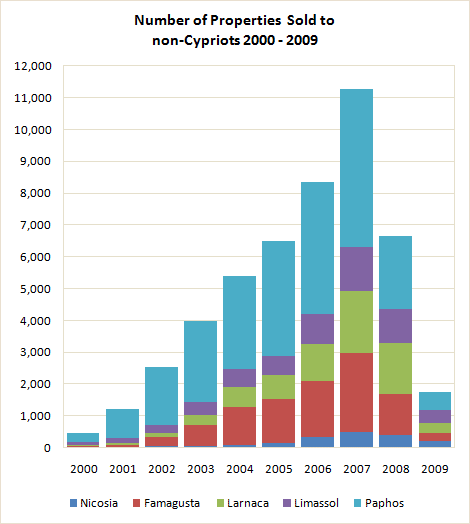
IT seems hard to believe that in 2007 the Cyprus property market was extremely buoyant with the number of properties being sold to non-Cypriot buyers reaching an all time high of more than 11,000.

But since that time the global financial crisis, the fall in the value of Sterling, the Title Deed fiasco, and reports of developers abusing property laws making headlines in the UK have all precipitated a collapse in sales of property to foreigners. And it is the British in particular who have all but deserted the island in search of safer places to invest their money.

Media reports

The first major UK media report on the problems appeared on 24th October 2007. Watched by millions of viewers in the UK, the Channel 4 TV show “Selling Houses Abroad” showed Andrew Winter on a mission to help British home buyers who were having major problems.

This was followed by more reports appearing in the national UK press, questions being raised in the House of Lords and the European Parliament, and the establishment of the Cyprus Property Action Group (CPAG).

The Cyprus government has been extremely slow in resolving the issues. Indeed, one of those interviewed by Andrew Winter during the making of his program is still fighting his case in the Cyprus courts!

Overseas property sales

Earlier today, figures released by the Department of Lands and Surveys reveal that the number property contracts of sale deposited at Land Registry offices throughout Cyprus by non-Cypriots fell by 73% last year compared to 2008. Famagusta was the worst hit area with sales falling by 81%, followed by Larnaca with a fall of 80%, Paphos with 75% Limassol 62% and Nicosia 44%.

However, when you compare 2009 sales with those of 2007, the situation is even worse. Over the last two years property sales to non-Cypriots have fallen by a colossal 84%. Once again, Famagusta is the worst hit area with sales falling by a massive 90%, followed by Paphos with a fall of 89%, Larnaca with 84%, Limassol with 70% and Nicosia 55%.

Number of Properties Sold to Non-Cypriots between 2000 and 2009
Nicosia Famagusta Larnaca Limassol Paphos Total
2000 10 31 33 89 287 450
2001 3 85 54 145 920 1,207
2002 40 289 133 246 1,840 2,548
2003 59 644 331 385 2,562 3,981
2004 90 1,183 635 566 2,910 5,384
2005 151 1,379 755 586 3,614 6,485
2006 339 1,758 1,149 967 4,142 8,355
2007 483 2,480 1,950 1,397 4,971 11,281
2008 390 1,285 1,605 1,083 2,273 6,636
2009 219 249 314 415 564 1,761
Total Sales 1,784 9,383 6,959 5,879 24,083 48,088

Source: Cyprus Department of Lands and Surveys

Sales of property to non-Cypriot buyers 2000 to 2009

Reversing the collapse

A major factor in reversing the collapse in the property market is the ability of the Cyprus Government to develop, introduce and enforce effective legislation to deal with the many problems.

Proposals to resolve the Title Deed issue have been put forward by the Minister of the Interior, Neoclis Sylikiotis. But the Cyprus Bar Association has publicly called for three of the five bills proposed to be opposed, George Strovolides the President of the Cyprus Property and Landowners Association (KSIA) remains sceptical, and CPAG believes that the new laws will not resolve the unethical lending practices of the banks that contribute to the situation.

Property sales in Cyprus fell in 2009

ACCORDING to the latest figures from the Cyprus Land Registry, there was a modest increase in the number of properties sold during December last year compared to December 2008.

Overall, 763 contracts of sale were deposited at Land Registries throughout Cyprus in December 2009, compared to 792 in the previous month and 624 in December 2008. December is traditionally the quietest month of the year for property sales.

Total sales for the year were 8,170 compared to total sales of 14,667 in 2008, 21,255 in 2007 and 16,953 in 2006.

Over the year, Nicosia suffered the least from the slump with property sales falling by 31%, followed by Limassol where sales fell by 38%.

Worst hit areas are those favoured by foreign buyers – sales in Larnaca fell back by 49%, Paphos by 52%; worst hit of all was Famagusta where sales fell by 56% compared to 2008.

Number of Properties Sales – 2008/2009 Comparison
Location Nicosia Famagusta Larnaca Limassol Paphos Total
Month 2008 2009 2008 2009 2008 2009 2008 2009 2008 2009 2008 2009
January 367 101 187 37 345 77 301 152 415 91 1615 458
February 349 161 269 52 312 112 345 132 306 101 1581 558
March 365 162 142 49 229 97 317 160 273 112 1326 580
April 296 162 143 71 296 122 310 126 291 122 1336 603
May 325 184 216 68 282 134 268 146 275 107 1366 639
June 298 188 166 82 289 152 297 189 336 142 1386 753
July 330 254 225 114 266 141 369 214 352 179 1542 902
August 155 173 128 64 165 135 236 148 252 122 936 642
September 238 235 196 83 241 113 233 174 249 152 1157 757
October 228 195 128 88 211 114 235 182 214 144 1016 723
November 178 221 82 92 128 134 197 191 197 154 782 792
December 127 199 113 81 123 138 132 193 129 152 624 763
Total Sales 3256 2235 1995 881 2887 1469 3240 2007 3289 1578 14667 8170
% Change -31% -56% -49% -38% -52% -44%

Cyprus Property Sales in 2009 (Source: Cyprus Land Registry)

However, to end on a more positive note it is encouraging to see the number of properties being sold improving marginally over the past two months of the year.

Cyprus ministers confirm property tax plan

ONLY 2% of Cypriots and those who have properties exceeding €1 million will be affected by the measure and not 90% as reported by the opposition”, said Mr. Stavrakis after his meeting with Interior Minister Neoclis Silikiotis earlier today.

The Finance Minister reiterated that the Cyprus government under the leadership of President Christofias “will not allow the taxation of the poor but the global economic crisis will burden those who have huge properties”.

Interior Minister Neoclis Silikiotis also referred to the hidden interests behind opposition party DISY’s reactions to the plan.

Everybody must think of his/her position before speaking publicly. Maybe the taxation of real estate is something that bothers them too”, he said.

Today, only 1.3% pays taxes on properties while 98.7% do not”, he clarified.

Based on 1980 values, properties valued below €170 thousand are not taxed. With the new revaluation, properties valued below €1 million will not be taxed and with this new readjustment more than 80% of the citizens will not be taxed”, he added.

Officials expect more precise details on the changes in the law in four weeks or so.

Initial estimates from the Ministry are that the law would pass in less than a year but more probably in around three to four months.  However, its application requires land and asset valuation surveys to be completed across the entire island. In a press release, the Landowners’ Association (KSIA) said this was likely to take four or five years to complete “at a minimum”.

Mr. Silikiotis reminded commentators that the bill on urban land consolidation is still pending before the Parliament, while deliberations on the measures for undeveloped plots and the simplification of the procedures involved in issuing Title Deeds are still in progress.

Taxing meeting for Cyprus ministers

IT is not surprising that the reappraisal of property taxes announced by Cyprus Finance Minister has been attacked. It will discourage further investment in real estate and will cause yet more problems for the Island’s struggling property industry.

Chairman of the Cyprus Land and Building Developers Association, Lakis Tofarides, said that the state already receives 27% of a property’s price and wonders how much more money the government wants from an industry that is in decline.

There are hundreds of thousands of properties in Cyprus and reappraising their value will not be a straightforward task and will surely take many years to accomplish.

A similar reappraisal was carried out in the UK which resulted in the introduction of the now familiar ‘Council Tax’. The Council Tax was the successor to the very unpopular Poll Tax (Community Charge) which contributed to the downfall of Margaret Thatcher following the Poll Tax riots in London earlier that year.

Each dwelling is allocated to one of eight bands coded by letters A to H (A to I in Wales) on the basis of its assumed capital value (as of 1 April 1991 in England and Scotland, 1 April 2003 in Wales). Newly constructed properties are also assigned a nominal 1991 (2003 for Wales) value. Each local authority sets a tax rate expressed as the annual levy on a Band D property inhabited by two liable adults.

Many reappraisals were carried out by driving past homes and allocating bands via a cursory external valuation, which resulted in many properties being placed in the wrong band. And as a local councillor I helped a number of my constituents successfully appeal their band allocations.

The reappraisal of property values in Cyprus is complex

  • Firstly, there is a much higher percentage of ‘individual’ homes in Cyprus than there is in the UK requiring much more investigative work to give each one a fair valuation.
  • Secondly there are currently some 130,000 properties without Title Deeds and have no 1980 value to be reappraised.

Also, the proposed reduction in state employees by freezing recruitment for two years, halting the employment of part-time workers and cancelling full-time positions that been vacated begs the question – who is going to carry out the reappraisals?

An alternative approach

Another country not too far from Cyprus managed a 24% increase in property sales during the first nine months of 2009 according to a report in the Overseas Property Professional. The report said that a cut in that country’s Title Deed fees and Value Added Tax, as well as promotions by property developers, helped it to sell 416,000 units between January and September.

Maybe the Cyprus government should consider a similar move which could result in increased sales of property and a consequential increase in much needed Tax receipts to help replenish government coffers.

And if the government could somehow manage to issue all of the Title Deeds for the 130,000 properties without them, it would receive a massive €1,040,000,000 – based on the Interior Minister’s assumption that the average charge to complete the issue of a Title Deed is €8,000.

The Island’s Interior and Finance Ministers are meeting today to discuss the technical issues involved in implementing the recently announced proposals for reassessing property tax rates. We will bring you further news as it becomes available.

More attack Cyprus property tax grab

ALTHOUGH the government’s austerity package has been widely welcomed, a proposed tax regime on property ownership has triggered a backlash.

Finance Minister Charilaos Stavrakis had proudly pronounced no new taxes would be imposed, but he does want to increase revenue from property other than on a first home by adjusting valuations on real estate unchanged since 1980. Property and construction have been the hardest hit industries during this recession and a slump in the property market is the prime reason why the economy has lost €1 billion in earnings this year.

The Cyprus Chamber of Commerce (Keve) yesterday expressed its “grave concern” over plans to reassess the property tax system for real estate that is not the owner’s permanent residence.

Business leaders argued that re-evaluating the system at today’s prices would deal a “new blow” to the property market already struggling to survive the fall out from plummeting demand.

This will discourage foreigners from purchasing property because the tax on real estate will increase,” said a Keve statement.

This issue must be addressed comprehensively with all the consequences for the economy accounted for.” It said the government’s core aim must be to bring the economy out of recession not to create conditions that will prolong the slump.

Needless to say, developers and estate agents were far from happy that an industry mired in stagnation is being hampered with a disincentive.

If the government implements this measure without incentives then there will be a backlash from us,” said developers association chief Lakis Tofarides.

Nicosia estate agents boss Costas Kadis said property was already heavily taxed and an additional burden would crush the market and scare off potential buyers.

Mr Stavrakis defended the harsh criticism by saying that the tax would be targeted at the minority who own a ‘huge’ property portfolio.