

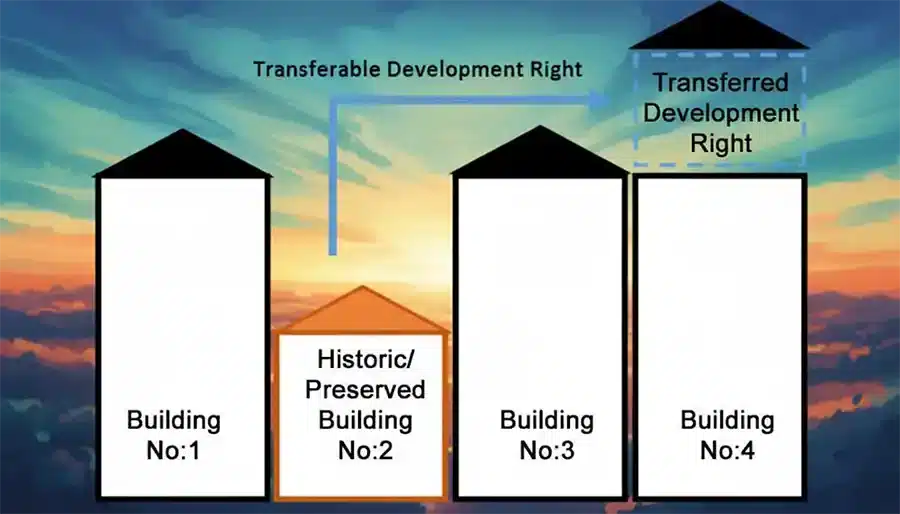
I expect many readers will be aware of the concept of development rights that I wrote about in my previous article. However, I expect many are unaware that in Cyprus, unused development rights can be sold or transferred to increase development rights elsewhere, in certain situations.
I believe the practice originated in the US where the sale of “air rights” allows property owners to sell unused building capacity to developers, enabling them to build beyond zoning limits in other areas.
Development rights define how much can be built on a piece of land. They are determined by:
- Plot ratio (building coefficient) – total buildable floor area
- Building coverage
- Height and number of floors
- Zoning designation (residential, commercial, industrial, etc..)
For example, if a plot has a plot ratio of 120% and measures 500 sq.m., the owner has the right to build 600 sq.m. of covered area. (If the owner only builds 500 sqm. they have 100 sqm. of unused development rights, which in certain circumstances, they can sell or transfer.)
Development rights and listed buildings
The concept becomes especially important with listed (preserved) buildings. Owners of listed buildings are often restricted from fully using their development rights because:
- Demolition is prohibited
- Extensions are limited or heavily controlled
- Preservation obligations increase costs
To compensate owners, Cyprus allows the transfer of unused development rights.
Transfer of Development Rights (TDR)
This mechanism allows owners of listed buildings to:
- Sell or transfer unused building coefficient to another plot
- Receive financial compensation for development potential they cannot use
The buyer (usually a developer):
- Gains additional buildable area on a different site
- Must comply with planning approval and location rules
This system aims to:
- Protect heritage buildings
- Avoid unfair financial loss to owners
- Channel higher-density development to suitable areas
Monetary value of development rights
Development rights in Cyprus have:
- A market value, influenced by location and demand
- A regulated transfer process, overseen by planning authorities
However, the system has historically faced challenges, including:
- Delays
- Limited liquidity
- Administrative complexity
That’s why recent discussions, like the proposal for a “development rights bank”, are significant. Such a mechanism would centralise transactions, manage funds, and improve transparency.
Why this matters for the property market
Development rights directly affect:
- Land value
- Project feasibility
- Density and urban planning
- Investment returns
For developers and investors, understanding development rights is essential when assessing:
- Acquisition potential
- Maximum buildable area
- Regulatory risk
Development rights in Cyprus are a core planning tool, balancing urban growth, heritage protection, and market viability.
