Cyprus property sales fall in all market segments

AS WE reported on Tuesday, June saw a slump in Cyprus property sales of 17 per cent compared with June 2019. The latest official figures published by the Department of Lands & Surveys earlier today show there was a decline in all segments of the market, i.e. domestic, EU, and non-EU.

Of the 714 contracts that were deposited for the sale of commercial property, residential property, building plots and land, 395 (55.3%) were deposited by Cypriots and the remaining 319 (43.7%) were deposited by foreigners of whom 17% (120) were EU citizens and 28% (199) were non-EU citizens.

Domestic property sales

Sales to the Cypriot market fell 16% in June compared to June 2018. With the exception of Paphos, where the number of sales rose by 25%, they fell in the other four districts.

Although more properties were sold in Limassol than in any of the other districts in June, it saw the highest annual fall with sales down 33% compared to June 2018. Meanwhile, sales in Larnaca, Famagusta and Nicosia fell by 31%, 7% and 2% respectively.

During the first half of 2019, domestic sales rose by 35% compared with the same period last year.

Domestic Property Sale Contracts – 2018/2019 Comparison

District Year Jan Feb Mar Apr May Jun Jul Aug Sep Oct Nov Dec
Nicosia 2018 126 84 104 93 135 123 155 84 97 126 141 108
2019 127 164 115 137 168 121
Famagusta 2018 -3 18 18 12 34 27 18 29 21 36 14 29
2019 32 19 16 58 45 25
Larnaca 2018 60 44 67 41 55 61 41 47 60 46 82 52
2019 54 82 47 73 83 42
Limassol 2018 107 152 199 162 169 207 194 174 175 176 196 201
2019 166 152 192 291 329 138
Paphos 2018 18 8 43 21 43 55 62 48 32 24 64 60
2019 30 31 28 69 175 69
Totals 2018 308 306 431 329 436 473 470 382 385 408 497 450
2019 409 448 398 628 800 395

However, some of these domestic sales may have resulted from properties acquired by banks as part of loan restructuring agreements, etc.

Overseas property sales

Property sales to the overseas (non-Cypriot) market during June 2019 fell by 17% with 319 contracts of sale deposited compared with 385 in June 2018.

While sales in Paphos and Nicosia rose by 9% and 4% respectively, they fell in the remaining three districts. Sales in Famagusta fell 47%, while sales in Limassol and Larnaca fell by 38% and 17% respectively.

During the first half of 2019, sales to the overseas rose by 13% compared with the same period last year.

Total Overseas Property Sale Contracts – 2018/2019 Comparison

District Year Jan Feb Mar Apr May Jun Jul Aug Sep Oct Nov Dec
Nicosia 2018 20 12 22 24 18 23 21 7 21 19 20 23
2019 34 30 16 32 45 24
Famagusta 2018 51 34 22 40 45 34 43 21 24 21 33 17
2019 21 29 29 38 42 18
Larnaca 2018 52 55 49 42 58 72 71 47 61 70 61 51
2019 60 43 71 67 90 60
Limassol 2018 118 104 115 84 113 131 120 88 76 113 148 89
2019 85 104 95 137 217 81
Paphos 2018 146 155 129 136 158 125 171 108 120 180 166 170
2019 157 180 157 155 229 136
Totals 2018 387 360 337 326 392 385 426 271 302 403 428 350
2019 357 386 368 429 623 319

Overseas sales (EU nationals)

Property sales to EU nationals fell 5% in June compared with June 2018.

Although sales in Nicosia (the capital) rose 100% and sales in Limassol rose by 18%, these rises were more than wiped out by falls of 50% in Famagusta, 45% in Larnaca and 2% in Paphos.

During the first half of 2019, sales to EU nationals rose by 14% compared with the same period last year.

Foreign (EU) Property Sale Contracts – 2018/2019 Comparison

District Year Jan Feb Mar Apr May Jun Jul Aug Sep Oct Nov Dec
Nicosia 2018 10 8 8 10 9 8 11 5 10 8 7 15
2019 14 14 9 19 20 16
Famagusta 2018 15 24 8 12 19 16 20 9 0 7 13 6
2019 9 6 14 17 10 8
Larnaca 2018 9 9 9 6 9 20 15 11 15 13 11 19
2019 12 12 21 18 20 11
Limassol 2018 15 17 32 17 19 22 25 24 11 27 38 20
2019 16 25 20 21 28 26
Paphos 2018 41 58 55 49 70 60 79 55 49 91 74 73
2019 56 72 61 48 69 59
Totals 2018 90 116 113 94 126 126 150 104 85 146 143 135
2019 107 129 125 123 147 120

Overseas sales (non-EU nationals)

Sales to non-EU nationals fell 17% in June compared with the same month last year, with sales falling in all districts with the exception of Paphos, where they rose by 9%.

Sales in Limassol fell by 50%, sales in Nicosia fell by 47%, while sales in Famagusta and Larnaca fell by 44% and 6% respectively.

During the first half of 2019, property sales to non-EU nationals rose by 14% compared with the same period last year.

Foreign (Non-EU) Property Sale Contracts – 2018/2019 Comparison

District Year Jan Feb Mar Apr May Jun Jul Aug Sep Oct Nov Dec
Nicosia 2018 10 4 13 14 9 15 10 2 11 11 13 8
2019 20 17 7 13 25 8
Famagusta 2018 36 10 14 28 26 18 23 12 24 14 20 9
2019 12 23 15 21 32 10
Larnaca 2018 43 46 40 36 49 52 56 36 46 57 50 32
2019 48 31 50 49 70 49
Limassol 2018 103 87 83 67 94 109 95 64 65 87 110 69
2019 69 79 75 116 189 55
Paphos 2018 105 97 74 87 88 65 92 53 71 89 92 97
2019 101 108 96 107 160 77
Totals 2018 297 244 224 232 266 259 276 167 217 257 285 215
2019 250 257 243 306 476 199

Analysis of property sales since 2000

Cyprus Property Sale Contracts 2000 – 2019

Year Overseas Sales Domestic Sales Percentage
Overseas Sales
Total
Sales
2000 450 12,214 3.6% 12,664
2001 1,207 12,849 8.6% 14,056
2002 2,548 14,111 15.3% 16,659
2003 3,981 15,294 20.7% 19,275
2004 5,384 11,947 31.1% 17,331
2005 6,485 10,106 39.1% 16,591
2006 8,355 8,598 49.3% 16,953
2007 11,281 9,964 53.1% 21,245
2008 6,636 8,031 45.2% 14,667
2009 1,761 6,409 21.6% 8,170
2010 2,030 6,568 23.6% 8,598
2011 1,652 5,366 23.5% 7,018
2012 1,476 4,793 23.5% 6,269
2013 1,017 2,750 27.0% 3,767
2014 1,193 3,334 26.4% 4,527
2015 1,349 3,603 27.2% 4,952
2016
1,813 5,250 25.7% 7,063
2017
2,406 6,328 27.5% 8,734
20181 4,367 4,875 47.3% 9,242
2019 (Jun)
2,482 3,078 44.6% 5,560
Totals
67,873 155,468 30.4% 223,341

1 The Department of Lands & Surveys has advised that overseas sales in 2018 and subsequent year should not be compared to sales in previous years due to changes in the methodology used to classify ‘Aliens’ (foreigners).

MPs in new bid to help trapped buyers

A REVISED draft bill will go before the House Legal Affairs Committee next week as MPs continue to look for ways for ‘trapped’ property buyers to finally get Title Deeds.

Protracted efforts have been underway to help good faith property buyers who have paid for their property but have been unable to obtain Title Deeds because property developers and contractors used it as collateral.

A law that was previously approved by parliament ran into legal difficulties, thus the new effort to resolve the problem.

On Wednesday, the committee went through the bill clause by clause in the presence of the director of the land and surveys department and it was agreed that further tweaking was necessary.

“A revised bill will be drafted based on what was heard today. I believe that, after 16 meetings of the committee and in cooperation with the services of the House and of the Land and Surveys Department, the bill will to a large extent resolve the  long-standing problem with the non-issue of Title Deeds to good faith buyers,” said the chairman of the committee, Disy MP Yiorgos Georgiou.

The final text will be discussed on Tuesday and Wednesday so that the bill can go to the plenary on July 12.

According to the Cyprus News Agency, up until the end of May, a total of 6,089 Title Deeds had been issued or transferred to trapped buyers. Overall, 17,443 applications were submitted to district offices of the Land and Surveys Department.

Most pending applications concern cases where there is a Title Deed (9,567), while 7,876 applications concern properties without a Title Deed, which are more difficult to deal with.

The largest number of applications from trapped buyers were submitted to the Famagusta office (4,349), of which 2,925 concern properties without a Title Deed.

Next came Paphos with 4,235 applications, Larnaca with 3,365, Nicosia with 3,100 and Limassol with 2,394.  Numbers are up compared to last October.

Initially, the department had around 8,000 applications, the vast majority of which (7,773) concerned properties without a Title Deed.

© In-Cyprus.com

Pissouri sunshine dreams in ruins

Pissouri sunshine dreams in ruins
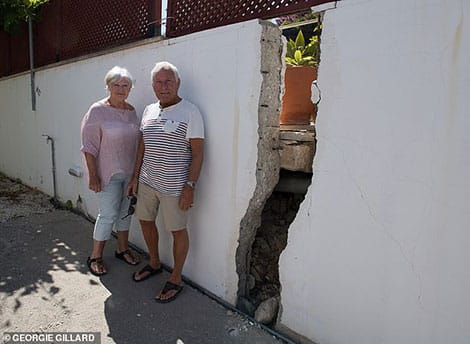
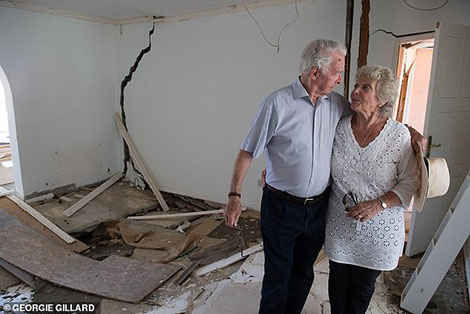
Devastated: Some of the stricken Pissouri residents whose homes are collapsing as a result of fissures which are thought to be caused by underground landslide

MAGNIFICENT views of the sparkling Mediterranean Sea, luxury villas at affordable prices, easy access to lush golf courses – and you drive on the left.

No wonder Cyprus has become the destination of choice for thousands of Brits seeking a new life in the sun.

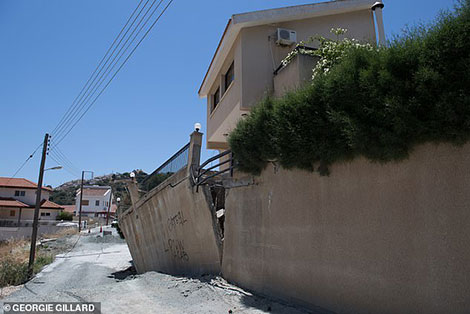
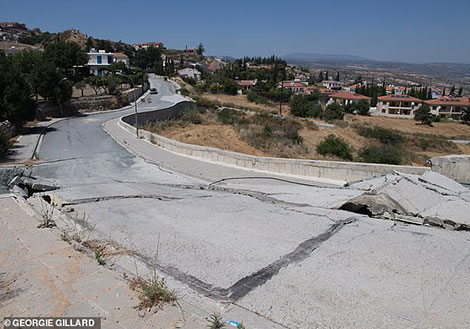
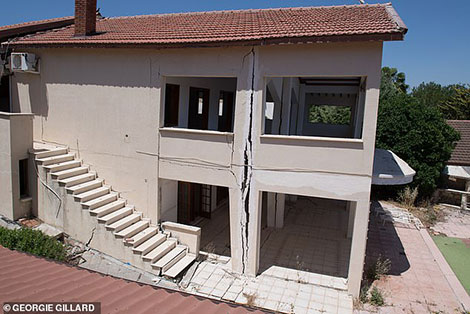
But one community nestled in the island’s hills has seen its dreams shattered as their homes are ripped apart and rendered worthless by gaping fissures opening up beneath them.

Already, 17 families have been evicted in Pissouri Village, where at least 70 houses are collapsing.

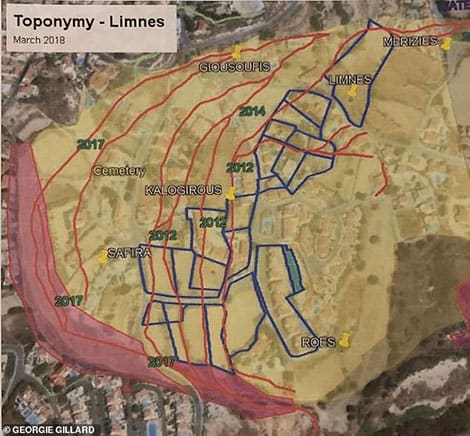
The fissures in Pissouri are thought to be caused by underground landslides created by water flowing beneath the earth into the valley, due to heavy rain and the fact that Cyprus does not have a robust sewerage system.

Dozens of desperate families have pleaded with the Cypriot government to help with their plight.

They argue that if the government had acted when they first identified the problem years ago then the scale of the disaster would have been much less.

In 2015 the then minister of the interior, Socratis Hasikos, said it was the government’s duty to intervene, but following his resignation in May 2017, no action has been taken.

“We have had nothing since; they haven’t even sent anyone down here to look,” says former chartered surveyor Antony Walker, 73, whose home is one of those affected.

“They have kicked the can down the road while our homes slip further every day.

“At first they said it was the fault of the developers, but each was built at a different time by different developers; and how would that explain why roads are collapsing?”

Already 17 families have been evicted in Pissouri Village, where at least 70 houses are collapsing
Village crumbling: Already 17 families have been evicted in Pissouri Village, where at least 70 houses are collapsing
General views of Pissouri village
General views of Pissouri village with the destruction of the landslide affecting houses and roads
Peter Field and Kayt Field's house in Pissouri
Peter Field and Kayt Field’s house that has been torn apart by a landslide

A group of 29 villagers, who have named themselves the Pissouri Housing Initiative Group (PHIG), believes the Cypriot government should apply to the European Union for money from its solidarity fund to help with the problem.

“No insurance company will insure against damage caused by landslides,” Mr Walker explains.

“So many are in this desperate situation wherein they have a mortgage to pay on a house that is collapsing into rubble, and they can’t afford to go anywhere else.

“Meanwhile the Cypriot government, which helped create this mess, has turned its back on us.”

The Daily Mail reported in May on the plight of the Phillips family in nearby Paphos, who plan to sue the government for allowing their home to be built on an unsafe site.

Unlike the Phillips family, villagers in Pissouri consider taking the government to court as a last resort because the process could take more than a decade due to the country’s clogged up courts and sluggish legal system.

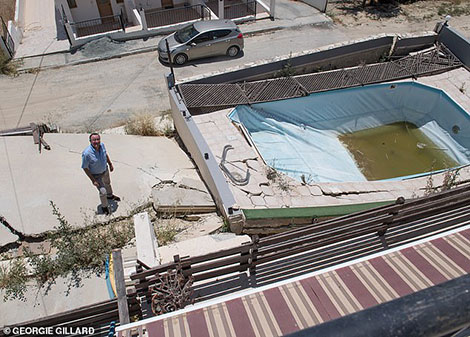
Michael Ellis' drive and swimming pool
Michael Ellis, 63 who’s drive and swimming pool has sunk over 12ft away from his house
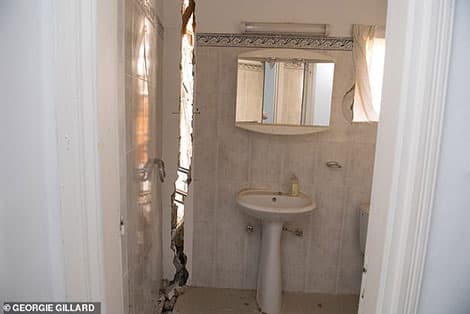
John Lamb's mothers house
John Lamb’s mothers house that has been evicted due to being cracked in half by a landslide
No insurance company will insure against damage caused by landslides
‘No insurance company will insure against damage caused by landslides,’ a resident explained
Anne Everett and Don Everett's garden and house twisting due to the landslide
Anne Everett and Don Everett, who’s garden and house has started to twist due to the landslide

‘The group’s lawyer, Elina Zoi, says: “These people don’t have ten or 15 years to fix this. Some are in their 80s and their homes will have crumbled to nothing well before then.”

There are around 70,000 British expats living in Cyprus and the property sector is booming.

Some 1,057 contracts were deposited at Land Registry offices for the sale of properties and land in April this year, up 62 per cent on the same month last year.

The British High Commission confirmed it is talking to the Cypriot government about a solution to the problems at Pissouri.

A spokesman says: “We are continuously pursuing with authorities in Cyprus for a solution to the problems residents in the area are experiencing.”

A spokesman from the Cyprus Interior Ministry admits there are “serious problems of soil instability” in the area and blamed the developers, even advising the villagers to sue them.

CASE STUDIES: “We could hear pieces falling away – it sounded like a gunshot”

It’s taken a toll on our health

Peter and Kayt Field’s luxury four-bed villa with swimming pool was declared ‘unfit for habitation’ in March 2016.

And since the couple fled the house, the home they shared for 25 years has crumbled and been looted several times for the belongings they left behind.

The pair, from Northamptonshire, bought the home in 1993 and for almost a quarter of a century there were no issues.

Peter and Kayt Field's luxury four-bed villa with swimming pool declared 'unfit for habitation'
Home now worthless: Peter and Kayt Field’s luxury four-bed villa with swimming pool was declared ‘unfit for habitation’ in March 2016

But former colonel Peter, 81, who spent 48 years in the Army, began noticing cracks in 2015.

It wasn’t long before the doors no longer fitted in their frames and the couple were forced to move into a downstairs bedroom while they searched for somewhere safe to live.

“While we were sleeping in the house you could hear pieces of it falling away – it would sound like a gunshot, then part of the house would crack and hit the floor,” Kayt says. “It has all taken a serious toll on our health — my husband has had to have two stents and a pacemaker put in.

An aerial view of Pissouri, Cyprus
An aerial view of Pissouri, Cyprus, showing the Fissure lines caused by landslide
Peter Field and Kayt Field's house torn apart by a landslide
Peter Field and Kayt Field’s house that has been torn apart by a landslide

“The notice of eviction was pinned on our door while we were out shopping. We had no warning. Limassol council offered to let us use the road sweeper for a day to help us move, but that was about it.”

The couple, who have two children and four grandchildren, say their home should be worth €700,000 but is now ‘worthless’. “It would have been nice to have been able to leave something to our children,” Peter says. “But that looks unlikely now.”

The couple hope the Cypriot government will be able to compensate them for the loss of their home, but are very frustrated with the lack of response from the authorities. “I think they are just waiting for us to die so the problem goes away for them,” Kayt says.

My family had to go back to the UK

The field outside Mick and Louise Ellis’s home opened up overnight in August 2016. Over the next two weeks their swimming pool and driveway dropped by 8ft.

Louise, 50, and the couple’s children Georgina, 19, and Isabel, 15, returned to Buckinghamshire in December 2018 after the drive of the house they’d only bought in 2013 had become too dangerous.

Mick Ellis' wife's home opened up overnight
Mick Ellis stands by his and wife Louise’s home opened up overnight in August 2016. Over the next two weeks their swimming pool and driveway dropped by 8ft.

Mick, 63, a quality manager at the Mediterranean Hospital in Limassol, says: “We sold our house in Aylesbury and everything we had to start our life out here.

“I do not earn enough to rent a property and at my age it will not be long before I retire — what then?

“My pension will not sustain me and my family as well as the rent.

“Going through the courts will take up to 15 years and the costs are enormous. We are being given no help at all.”

We heard concrete hitting the floor

Great-grandparents Bill and Sheila Potter bought the land for their home in 1992 after visiting Cyprus on holiday and ‘falling in love’ with it.

They sold everything they had in Huddersfield, West Yorkshire, and built the home themselves.

“The first Christmas present I bought Sheila was a cement mixer,” Bill, 69, says.

“It took two years to plan the house the way we wanted it; all the relevant surveys and checks were done and the architect told us everything was to a very high standard.

“We spent the next ten years gradually adding to the house, the pool and everything else.”

They lived there happily until 2015, when cracks opened up all over. By 2016 the pool had to be filled in because its boundary walls had collapsed.

Bill and Shelia Potter's bungalow twisted by a Pissouri landslide
Bill Potter, 69 and Shelia Potter’s bungalow which has been twisted by a landslide

“The fissure has not just ripped it apart but one part of the house has dropped half a yard,” the former probation officer says. “We could hear the cracks. You can hear the bits of concrete crumbling onto the floor. It is heartbreaking.”

The couple have been forced to borrow money and return to the UK. “We worked all our lives to have a decent retirement and then your dream literally collapses around your ears,” Sheila, also a former probation officer, says.

“We are having to face facts that our home for 25 years is gone and we no longer have a home.

“No one from the government has come to see it for themselves. They can’t predict a landslide, but they can help and they have a duty to do so.”

Our home shifted by 5ft in five years

Katherine Yeomans had been in love with Cyprus since holidaying there as a child. The mother of two and her husband Jeremy, 54, an accountant, sold everything and got a mortgage to buy their luxury three-bed house with a pool and moved over in December 2014.

They had no idea the home was next to what would become a gaping fissure. Just two months after they moved in cracks began to appear in the garden, and by 2017 the pool had collapsed.

The entire home has now twisted around by 5ft and is surrounded by rubble and fissures which widen every day.

Katherine says. “We’ve paid thousands to have things constantly repaired but it’s a losing battle. We still have €96,000 on the mortgage to pay off. We just don’t know what to do. It’s hopeless.”

© dmg media

The Daily Mail

The Daily Mail is the second largest selling newspaper in the UK. It has twice the readership of the ‘Daily Mirror’ and three times the readership of ‘The Times’. The Daily Mail also has the second largest on-line readership of any of the UK national newspapers.

The Pissouri landslide story featured as a double-page spread in yesterday’s ‘MoneyMail’ under the headline ‘Sunshine Dreams in Ruins‘.

June saw Cyprus property sales slump

Cyprus property sales slump in JuneHISTORICALLY June has been one of the better months for Cyprus property sales, but not June this year, which saw sales fall by 17 per cent compared with June 2017. Is this an omen of things to come?

According to the official figures published by the Department of Lands & Surveys, the number of property sale contracts deposited at Land Registry offices in the island’s five districts during June 2019 stood at 714 compared to the 858 deposited in June 2018.

As the Department has yet to publish a breakdown of sales, we cannot say whether the fall is due to reduction in sales to the local market or the overseas market (or both).

However, it’s possible that the tougher criteria introduced by the Cyprus Government on 15th May for those seeking to obtain Cypriot passports under the Cyprus Investment Programme have reduced the number of property sales to non-EU nationals.

As we reported on 23rd June in the article Cypriot passport Investment applications are falling, Costas Hadjipanayiotou, director of the Environment Department at the Ministry of Agriculture, said that “there are several applications under scrutiny, but added that no new applications have been received so far.” (This conflicts with the South China Morning Post article 3 days later stating that “Chinese investors are thronging the sunny shores of Cyprus in search of property and passports that will allow them to work, travel and live in the European Union.”)

Cyprus property sales – June 2019

With the exception of Paphos, where sales increased by 14% compared to June 2018, they fell in the remaining four districts.

Although more properties (219) were sold in Limassol that in any other district during June, the district experienced the highest fall (35%) in sales. Sales in Famagusta fell 30%, while sales in Larnaca and Nicosia fell by 23% and 1% respectively.

Total Property Sale Contracts – 2018/2019 Comparison

District Year Jan Feb Mar Apr May Jun Jul Aug Sep Oct Nov Dec
Nicosia 2018 146 96 126 117 153 146 176 91 118 145 161 131
2019 161 194 131 169 213 145
Famagusta 2018 48 52 40 52 79 61 61 50 45 57 47 48
2019 53 48 45 96 87 43
Larnaca 2018 112 99 116 83 113 133 112 94 121 116 143 103
2019 114 125 118 140 173 102
Limassol 2018 225 256 314 246 282 338 314 262 251 289 344 290
2019 251 256 287 428 546 219
Paphos 2018 164 163 172 157 201 180 233 156 152 204 230 230
2019 187 211 185 224 404 205
Totals 2018 695 666 768 655 828 858 896 653 687 811 925 800
2019 766 834 766 1057 1423 714

Property sales – year to date

Despite the fall of sales in June, the total number of Cyprus property sales in the first half of 2019 is 24% higher than the first half of last year.

In percentage terms, Paphos is leading the way with half year sales up 37% compared to last year. Sales in Nicosia are up 29%, while sales in Limassol, Larnaca and Famagusta are up 20%, 18% and 12% respectively. However, in terms of the total number of sales Limassol leads the way.

Chinese investors still wooed by Cyprus passports

Chinese investors still attracted by Cyprus passportsCHINESE investors are thronging the sunny shores of Cyprus in search of property and passports that will allow them to work, travel and live in the European Union.

“Cyprus is a beautiful place that offers a very high quality of life, access to Europe and good real estate investment opportunities. One of the big drivers of foreign investment is the Cyprus Investment Programme, which is very popular with mainland Chinese,” said Carrie Law, chief executive and director of property portal Juwai.com.

Under the programme, launched in 2013, buying a property worth €2 million (US$1.14 million) allows investors and their families to obtain Cyprus passports, which come with all the rights of citizenship of the EU. The scheme also requires donations of €75,000 each to Cyprus’ Research Promotion Foundation and the Land Development Corporation.

Permanent residency can also be obtained, by investing €300,000 in brand new property. A permanent residency programme provides ease of travel throughout the EU and requires just one visit to Cyprus by all family members once every two years.

Cyprus has raised €4.8 billion from the sale of passports under the investment programme since 2013, according to a recent study by international anti-corruption watchdogs Transparency International and Global Witness.

And while there is no official data on nationalities that have bought property in Cyprus, industry insiders said mainland Chinese and other Asian investors accounted for more than half of these transactions.

“There are no official records with the figures of nationalities that are investing in Cyprus. However, if we take our development, Limassol Del Mar, as an example, many of our buyers are from China,” said Pantelis Leptos, director at Cypeir Properties. He said Chinese buyers were among the top two investors in the company’s Limassol Del Mar project, which comprises seafront apartments in the southern coastal city of Limassol, and accounted for 30 per cent of sales. Apartments in the project are being sold from €2.02 million.

Data from Cyprus’ Department of Lands and Surveys shows in the first five months of this year sales of residential units, commercial real estate and plots of land hit 4,846, an increase of 34 per cent over the same period in 2018. Foreign buyers mostly buy residential property.

In May, property sales reached 1,423, beating a previous record of 1,157 sales set in September 2008. All transactions between January and May totalled €1.45 billion, an increase of 7.6 per cent from the €1.35 billion recorded during the same period last year.

“Chinese buyers and investors have contributed to a large extent to the construction sector in Cyprus. The Paphos area in the western part … attracts lots of Chinese buyers as property developers from this region were the first to visit China [to promote their projects],” said Sakis Hadjialexandrou, group marketing manager at Lepsos Estates.

Nicolai Caraseni, owner of property agency Casa Grande Cyprus, said: “Relatively low costs, avoidance of bureaucracy, sunny weather and short time frame – up to six months – for receiving a passport make Cyprus the best investment destination. With a Cyprus passport, investors can easily move to live in the United Kingdom, Switzerland or any of the 28 [EU] countries.”

Cyprus has no property, stamp duty and dividend taxes.

Kenneth Kent, country manager for Hong Kong at Australian online real estate advertising company REA Group, said Cyprus’ EU membership has boosted the confidence of investors. “Being a part of the EU confers much more legal protection and transparency. These are of major concern for overseas investors,” he said.

Copyright © South China Morning Post Publishers Ltd.

Cyprus property news recovers after attack

I EXPECT that many visitors to ‘Cyprus Property News’ will have noticed that the website was unreliable for several days earlier in the month. My hosting provider thought it was probably due to a DOS or a dDDOS attack that flooded my CPN server with traffic, which eventually resulted in it crashing.

No personal data was stolen or compromised by the attacker(s).

Cyprus Property News is working normally again.

But to avoid any possibility of personal data being stolen by a more sophisticated attack at some future date I decided to cancel my weekly newsletter and deleted my subscriber database.

Cyprus Property News is now hosted on a more robust server and stringent checks have been implemented to identify and deal with any possible future attack.

In addition, I am using a secure protocol (https) to protect against what are known as man-in-the-middle attacks.

Want Cyprus Property News updates?

For visitors wishing two receive updates on what’s happening in the Cyprus Property market, I have introduced two new facilities:

Push notifications

A push notification is an alert sent to your computer screen that will appear as a small alert style message.

Exactly where this alert message appears on your screen depends on your operating system. Clicking on this alert message will open the relevant page in your web browser.

If you wish to use this notification system, click ‘Continue’ in the banner at the top of the page when you Cyprus Property News.

After subscribing, the bell at the bottom of your browser window allows you to unsubscribe.

Problems?

If you do not see a white banner the blue continue button, I have made a one minute YouTube video that should help. The web browser I used is Google Chrome.

[youtube= https://www.youtube.com/watch?v=NxPorlmqFBo&w=470&rel=0]

(Although you can do this using other web browsers, the process of setting up the notifications will be different – unfortunately there isn’t a ‘one size fits all’ solution.)

Email notifications

If you wish to receive notifications of articles as they are published by email, enter your email address on the form below and press the subscribe button.

You will be asked to complete your subscription request and finally confirm your subscription in the email you receive from Google’s Feedburner service.

Enter your email address:

Delivered by FeedBurner


Thank you for reading and please remember that Cyprus Property News is the only truly independent source of news on the island’s real estate market.