Cyprus Property worth millions under the hammer

JUNE seems to be the month of auctions in Cyprus with numerous flats, plots of land and industrial-use buildings set to come under the hammer despite the poor sales recorded so far.

There are opportunities for all types of real estate in all of the island’s cities with prices ranging from a few thousand to a few million, according to posts on the website of the Ministry of Interior.

One that really stands out is an apartment complex being auctioned by Altamira at Skala, Larnaca, consisting of 10 apartments without separate title deeds. The price is only €940,500.

At the same time, a high value property auctioned by Hellenic Bank is a plot of land in Engomi, Nicosia, which goes for €1.02 million. Hellenic also sells a plot of land at Agios Dhometios suburb at the price of €1.87 million.

Alpha Bank auctions a two-storey apartment in Chrysopolitissa area, Larnaca, at the price of €1.06 million. At Skala, Larnaca, Altamira will also auction a retail store at the price of €995,500.

The most valuable properties are in Limassol district, reaching €2.9 million, followed by some in Larnaca with a real estate value of €2.1 million and then in Paphos with €1.5 million. In Famagusta district, the properties are estimated at around only €400,000.

In Nicosia, Hellenic Bank will auction an apartment in Engomi at the price of €104,000, and one on Kallipoleos Avenue at the price of €38,000. Bank of Cyprus is to auction an apartment in Aglantzia at the price of €46,400. A plot of land in Strovolos will be sold by Altamira at the price of €193,800.

In addition, the sale of eight apartments located in a complex in Stasinou Avenue, Nicosia, will be sold at prices ranging from €55,000 to €91,675. Hellenic will also auction an apartment in Nicosia at the price of €60,400 and a second one, in Strovolos, at the price of €144,800.

An industrial-use building in Ypsonas, Limassol district, is auctioned by Bank of Beirut at the price of €1.23 million. A plot of land in Moniatis will be sold by Bank of Cyprus at the price of €30,800, and another plot in Episkopi at the price of €104,000.

In Germasogia, six apartments located in the same building will be sold by Hellenic Bank at prices ranging from €152,000 to €190,000.

Up to date data shows that out of the 8,600 properties for which notifications have been received between the third quarter of 2015 and end of 2018, only 344 were sold at first auctions.

Properties sold are mainly fields and plots of land, houses and apartments already built or under construction, as well as commercial real estate.

© In-Cyprus.com

Avoid mass selling of mortgaged properties

Avoid mass selling of mortgaged properties in CyprusCENTRAL Bank of Cyprus (CBC) has advised commercial banks to avoid mass selling of mortgaged properties, expressing concern that this could lead to a sudden drop in real estate prices, a statement said on Monday.

“Mass selling of properties could lead to a sudden drop in real estate values, thus creating a negative interactivity between the real economy and the banking sector,” CBC warned in a report on financial stability posted on its web site.

CBC said that during 2018 the real estate market continued its gradual recovery which started in the first quarter of the previous year, thanks to the growth of the economy and the improvement in the real estate sector.

The prices of properties had contracted as much as 30 percent after the 2013 crisis.

However, the report said, since the start of 2017 an increase in demand of apartments by local buyers and luxury housing by foreign investors under the so-called residence for investment program was recorded.

Purchase deals submitted to the Land Registry Department during 2018 showed a yearly increase of 5.8 percent, the report added.

Investment by non-Cypriot buyers represented 47.3 percent of registered purchase deals, of which 15.5 percent came from EU nationals and 31.8 percent from nationals of countries outside EU.

The report said that the Paphos region recorded the biggest number of land deals by non-Cypriot nationals with 40.4 percent of the total deals in 2018, with Limassol in second place with a share of 29.7 percent.

Russians had the biggest share in property investment in Limassol.

Larnaca was third in foreign property investments with 15.8 percent, Famagusta was in fourth place with 8.8 percent and the capital Nicosia in fifth place with 5.3 percent.

“The rise in real estate prices and particularly of apartments in some areas of Limassol district reflects extensive large infrastructure projects development and demand for high-value residence housing by non-Cypriots in the context of the Cypriot Investment Program,” the report said.

The program, which has been criticized by the European Union as posing a possible security factor and as a risk of facilitating organized crime to launder money, enables non-EU nationals to invest in properties or in high yield business in exchange of a Cypriot (EU) passport of residence permit.

“Investment through the Cyprus Investment Program seem to have an indirect rising effect on real estate prices, and most notably on the prices of apartments, especially in sea-side areas of Limassol district,” the report added.

Apartment prices in Limassol went up by 6.9 percent, 6.1 percent and 8.7 percent during the first, second and third quarters of 2018 respectively, according to findings of the Royal Institute of Chartered Surveyors (RICS).

It said that these increases surpassed the increase in the price of apartments in other areas of Cyprus.

© XINHUANET.com

Daily Mail meets Pissouri landslide victims

YESTERDAY homeowners in Pissouri where a landslide continues to destroy their lives and homes met reporter George Odling and photographer Georgie Gilliard from the UK’s Daily Mail newspaper.

The two heard how the landslide had devastated many lives and put an enormous strain on people’s health, relationships and finances

Homeowners had sought medical help for the stress the situation is causing them, others had seen their marriage break apart, a mother with two young children whose marriage failed returned to the UK penniless and they are living in rented accommodation. She has applied for council housing and is currently on the waiting list.

One of the Cypriot families bought their Pissouri home with the aid of a mortgage from a bank. When it was damaged by the landslide, they asked the bank for a valuation. In 2015 the bank valued the property at €17,000 less €11,000 to remove the rubble, leaving them with €6,000. The valuer said he’d assessed the land as agricultural due to the geological problems in the area and noted (at that time)  that there was nothing wrong with the actual structure of the house. The bank reminded the family that, despite its low value, they had to repay their mortgage in excess of €200,000.

The landslide is moving daily. Homeowners have to endure constant breaks in their water, electricity and telephone supplies as the water pipes and cables continue break under the strain.

To date, seventeen homes in the affected area have been declared unfit for habitation and families have been forced to leave and find alternative accommodation.

Limnes: the red herring

The first area to be affected by the landslide was Limnes, which can mean lake when translated to English. This has given rise to numerous ‘fake news’ stories by elements of the media that the properties were built on land known for its lakes, which landowners filled in before selling, etc, etc. These stories are completely untrue. In fact Limnes is a relatively small part of the total area affected.

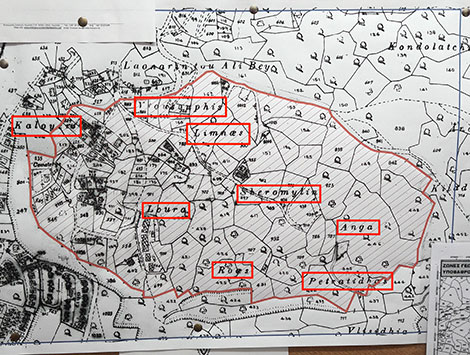
In addition to Limnes, the landslide affects other areas to the south of Pissouri village centre;  Sheromyli, Yiousouphis, Safires, Merika, Kalogeri, Merika, and Roes.

Map of Pissouri showing the area affected by the landslide from the Limassol District Office where Certificates of Approval and permits are no longer being issued.
Click here for a larger view of the map.

(Since I last visited the area in February, more homes have been affected. Kiminos street, which was passable in February, is now closed to traffic and the house at the top of the street close to the Pissouri amphitheatre, which was undamaged in February, looks close to collapse.)

Government response to the landslide

The Auditor General Odysseas Michaelides said that the complex was sold by “a single, well-known land development company which will now be relieved of its responsibilities”; this is patently untrue. (As he has not visited the area to see the damage for himself, I can only assume that he’s been given inaccurate information.)

The properties were designed and built by numerous architects, building contractors and property developers. (Some of those involved in the construction of the older properties have since died.) Independent structural checks carried out on the properties show there is no evidence of poor design or construction.

The Pissouri Housing Initiative Group (PHIG) commissioned an independent study by internationally recognised experts who concluded it’s a landslide triggered by uncontrolled groundwater and this was backed up by InSAR satellite imagery and analysis. A copy of this 22-page report, which contains the overwhelming and irrefutable evidence, is available on-line ‘Proving a landslide: ground behaviour problems at Pissouri, Cyprus‘ for US$30.

Reporter’s thoughts

After George and Georgie completed their interviews and tour, I asked George for his thoughts on what he’d seen.

“It’s a lot worse than I imagined.” He said. “Photographs can only tell you so much but seeing it in real life; it’s striking” adding that “It’s incredibly tragic to see what were obviously beautiful homes that people looked to spend the rest of their lives in under the Mediterranean sun crumbling like this”.

I asked him what he thought of the lack of support from the government. As he had yet to speak to the Interior Minister, he couldn’t comment. But he did say “It’s obviously disappointing that people feel they didn’t have the help they expected and feel they’re on their own.”

The full story should be published in the UK’s Daily Mail early next week.

The Daily Mail

The Daily Mail is the second largest selling newspaper in the UK. It has twice the readership of the ‘Daily Mirror’ and three times the readership of ‘The Times’. The Daily Mail also has the second largest on-line readership of any of the UK national newspapers.

Cyprus building & construction driven by passports

Cyprus building and constructionTHE CYPRUS building and construction industries are enjoying a revival and continuing to regain the lost confidence of the crisis years, with stakeholders encouraged by an increase in diversified activity such as demand for student accommodation.

Stakeholders feel that the barren years of the real estate crisis are behind them, however, the industry is still heavily dependent on the passport for investment scheme which focuses on new properties.

The Federation of the Building Constructors Associations of Cyprus (OSEOK) said developers see a brighter future as big projects are in the pipeline, while others are expected to be announced.

Manager of OSEOK, Frangos Prokopas said that the building sector has seen the upward swing that began in 2017 continued in 2018, with indications that it is to continue in 2019.

He said the federation’s Activity Index continues to record a positive trend since recovering in 2017 for the first time since 2010.

The index now stands (July-December 2018) at +16% compared to +12 in 2017. The Activity Index measures the percentage of developers who stated that they saw their business grow.

Meanwhile, the Work Cycle Index of the Federation measuring the percentage of contractors who have declared that their workload for 2018 was above normal or expected, minus the percentage of those who declare it to be below the norm, recorded a significant improvement too, standing at -20%.

The index improved from -37% in 2017 and -92% at the end of 2013, with the base year being 2007.

“However, these indices should not be taken literally but should be used as indicators rather than measurements of how many developers actually saw their business grow,” Prokopas said.

He said what’s important is the trend of the index, which has taken a positive swing in the past few years.

“For example, the Activity index in December 2013 stood at -74%. It was a time when a lot of smaller developers closed. Now we see these smaller developers, reopening their businesses and taking on projects along with bigger contractors,” said Prokopas.

Noting that the driving force behind the growing construction industry remains foreign money coming in through the country’s Citizenship for Investment scheme, there is a diversification of the market taking place which will keep the industry together in case the CIS weathers out.

“Public works had been put on ice during the previous years and the sector is now anticipating the declaration of big public projects by the government,” said Prokopas.

He is encouraged that the sector has started to disengage itself from its dependence on projects connected with the investment for citizenship scheme.

Housing projects

He said that apart from luxury projects on the south-western coast of Cyprus, there is a significant number of houses and other projects being built in the country’s capital, an indication of participation of local buyers.

“I’m encouraged that the building sector is reinventing itself and becoming more diverse and less dependent on one type of investment.

“In Nicosia, we see houses of all sizes being built, with a large number of luxury properties also being raised,” said Prokopas.

His insistence that a significant part of the industry’s activity is concentrated on housing is backed by Cystat figures showing that 69.5% of the 6,408 building permits issued in 2018 were for residencies. Building permits recorded an 11.9% increase compared to 2017.

Underpinning the argument that the industry is turning to the local market, 2,355 building permits issued were for projects in Nicosia, a market dominated by Cypriot buyers mainly for residential purposes.

A real estate analyst told the Financial Mirror that it comes as no surprise that a significant chunk of activity regards the construction of houses.

“It’s only natural that the key finding of all reports surrounding the sector is that a significant chunk of the industry’s activity concerns housing.

“Neither should it come as a surprise that Nicosia is leading the statistics regarding building permits. There is an upward trend since 2017 when building permits for Nicosia jumped to 1485 from 1200 the previous year,” the analyst said.

The analyst explained that the housing needs of locals were put on ice during the years of the crisis as people were living with the uncertainty of the times.

He also said that the significant increase in numbers of students studying at Nicosia-based universities has created a shortage in housing which has pushed up demand.

That along with the various student dorm projects being carried out, a significant number of blocks of flats are being built.

Also encouraged by the industry’s diversification, a Larnaca-based property developer sees the market not losing its dynamic, despite the decrease in sales to foreign investors eyeing the country’s CIS.

Marwan Bechara, managing partner of Infinity Properties, said he is encouraged by the industry’s diversification, noting that Larnaca will see its share of development as Limassol is at saturation point and to some extent so is Paphos.

“Larnaca is set to see the development of its marina with a number of housing units, while it will see its share of high rises being built.

“These high-rises, however, will not be targeting buyers eyeing the CIS, but rather locals and foreigners who are interested in making a long-term investment rather than a short term one,” Bechara said.

He said a number of foreign investors from countries like Lebanon and Jordan are interested to buy property in the town, either as an investment or as a holiday getaway.

“Larnaca could well be the next best thing.”

Bechara noted that there a number of smaller housing projects either in the pipeline or to be announced.

He also added that an increase in the country’s student population has put pressure on the industry, as demand for student housing was not immediately met.

Nicolas Ioannou, Danos Real Estates Associate, while agreeing that the CIS is still the driving force of the industry, believes the industry is diversifying.

“Increased demand for grade A offices at prime locations in the city centres, apartment units within close proximity to employment hubs, and housing units in specific suburbs, has pushed the industry to diversify,” said Ioannou.

He said this demand has brought about an increase in prices and rents due to the fact that the supply has been limited in the past few years mainly due to the unavailability of financing.

“It is expected that prices will continue on an upward trend for the next couple of years before finally stabilising, as the economy is completing a 7-year cycle of continuous expansion”.

Ioannou added: “It will be interesting to see how the high numbers of properties that the financial institutions have acquired through divestments or debt-to-asset swaps, will enter the market and the effects that they will have on the supply-demand equilibriums.”

Armou landslide victims sue Cyprus government

A BRITISH couple who bought a dream villa in Paphos that is now falling apart around them is suing the Cyprus government for allowing a housing complex to be built on unstable ground.

Simon and Jenny Phillips left the UK behind to buy their €228,000 home, in Armou village, Paphos district, in 2008 but the earth beneath them started to give way.

Now the couple and their two teenage daughters are stuck in ‘a cross between a building site and warzone’ – as their luxury home continues to slide downhill.

Simon Phillips, 50, an IT consultant, sold everything to buy the villa – but it was less than two years before cracks began to appear.

Now parts of the property, have slipped more than six feet below the earth – and the family, from Hemel Hempstead, Hertfordshire, are the only ones left on the development after five other British households deserted their crumbling homes, the UK’s Mail Online reported.

Simon Phillips argues the Cyprus government should not have allowed developers JNM 4U to build on the clay-based site at Armou in 2004, with an independent engineering report later finding the soil was ‘problematic’.

The report said the government was aware of the Armou site’s ‘geological problems’ and allowed the developers to build without taking ‘necessary precautions to stabilise and secure it,’ the Mail Online reported.

The developer is now defunct, but the distraught family are suing the Cypriot government for the value of their home – which experts believe could cost €240,000 to repair.

“No one in their right mind would buy this house or any of the other homes on the development,” Phillips told the Mail Online.

“We’ve had countless sprained ankles over the years, the place is just so dangerous…We can’t get to the front door because there’s a crater a few yards deep in front of it.”

Simon Phillips said he is ‘racked with guilt’ over the decision to relocate his wife, a 50-year-old waitress, and daughters – a 17-year-old student and 19-year-old animal rescue volunteer.

“I carry a huge amount of guilt with me all the time. I have ripped myself apart about this. Our dream has been ripped away from us. The life we wanted for our kids has been taken away.”

The independent report carried out in 2014 found the home ‘unfit for habitation,’ but the family continue to live there in defiance of a government order banning them from staying, the Mail Online said.

“We can’t afford to move house. Even though the whole hillside could one day slip down the valley, we have nowhere else to go and I am not making my family homeless.

“When we first moved out here I felt like the luckiest man alive, but this has just become a nightmare we are trapped in,” said Simon Phillips.

Protest at Olympia property exhibition

A PROTEST aimed at warning the British public not to buy properties in Cyprus took place on Saturday outside a major property exhibition in London.

A small group of people who had bought property in Cyprus gathered outside the Olympia in London where A Place in the Sun Live was taking place. Two Cypriot companies were among those taking part.

The aim of the protest was to warn off potential buyers from investing in Cyprus citing their own unfortunate cases that include homes destroyed in an ongoing land-slippage in Pissouri, Swiss Franc house loans and a double selling fraud.

The organiser of the protest is Conor O’Dwyer, who is the midst of a 14-year legal battle after buying a property in Cyprus in 2005 only for the developer to sell his house to another British family at a higher price. According to O’Dwyer not only was the original sale to him registered with the land registry department, but the developer also kept the money he had paid.

The protesters, holding placards saying ‘Do not buy property in Republic of Cyprus’, handed out flyers to potential buyers as they went inside the exhibition.

The event is the official exhibition of the Channel 4 TV series A Place in the Sun and, according to its organisers, “the largest overseas property exhibition in Europe”. It was described as the perfect place to seek guidance through the buying process for a purchaser to find their “dream properties” abroad.

On Saturday morning, a discussion was also held at the exhibition on buying property in Cyprus.

O’Dwyer said that the protesters were engaging with British buyers but also with property companies from other countries and media from the property industry.

“Enough is enough, that’s the theme of the protest,” he said.

The leaflets explain to potential buyers the reasons why they shouldn’t buy in Cyprus.

“Because corruption (in Cyprus) is rife,” he said.

Contracts

Developers, he said, will tell exhibition visitors they are secured as long as their contracts are in the land registry.

“No. My contract is in the land registry and my property developer sold my house to another person at a higher price to profit more,” he said. “A court case in the Republic of Cyprus takes 13 years.”

Pissouri landslide

Some of the protesters are victims of the land slippage in Pissouri, he said.

One of the homes destroyed in the Limnes land-slippage

The case, which has received widespread publicity in recent months, involves homes built in the Limnes area of Pissouri which have fallen victim to a serious and continuing land slippage.

The land is now slipping at almost double the rate it did in 2015 when the movement was up to 40cm per year. By early March, five families had been evicted, while, according to lawyer for the home owners, Elina Zoi, 15 houses are considered dangerous but the owners continue to live in them as they have nowhere else to go. The land slippage is due to failure to provide adequate infrastructure to manage groundwater, and allowing development to go ahead in the area.

“House insurance does not cover landslides and it’s the government’s duty to help,” O’Dwyer said, adding that the only action from the government is forced evictions with the homeless British returning to the UK.

Swiss Franc loans

Another group at the protest are victims of the mis-selling of Swiss Franc loans to purchase homes in Cyprus.

“These contracts have been found as abusive by the EU and settled in other countries, but for some reasons the banks in Cyprus are holding out and are individually putting these people through hell as they go through courts,” O’Dwyer said.

Even the consumer protection service in Cyprus deemed these contracts abusive but these people are getting no help at all, he said.

This practice, he said, “has seen hundreds of Brits forced to give up their dream homes or face a decade of court action to retain it”.

The trend in borrowing in Swiss francs emerged in 2006, when Cyprus was a candidate for euro area membership. Those taking out loans in Swiss francs benefited from considerably lower interest rates compared to the then cost of borrowing in euros. But some four years ago, when the Swiss National Bank moved to unpeg the country’s currency from the euro, led to a sharp revaluation of the Swiss franc and many debtors saw their instalments going through the roof. A debtors’ association had said at the time some 11,000 people were affected and spoke of a scandal, arguing that banks at the time did not adequately inform customers of the exchange-rate risks in taking out loans in a foreign currency.

The aim of the protest, he said, was to inform everyone on what’s happened to them “and what’s happening to Brits every day over there in Cyprus”.

He expressed hope that their presence there would minimise “the danger to the British buying public” since there were only two Cyprus real estate agents at the exhibition.