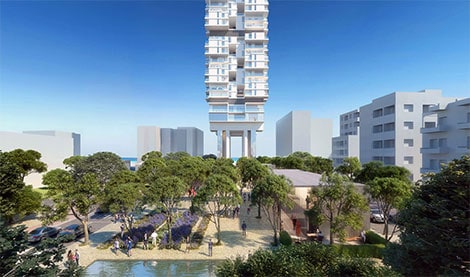
Limassol Aura high rise development

PLANS to redevelop the site of Debenhams Olympia shopping centre on the Limassol coastal road are moving forward and the construction of the high rise Aura development of luxury apartments should be completed by the end of 2022.

Designed by the award-winning British architectural design and engineering firm of Foster + Partners, the cost of building Aura are estimated at €108 million, while the demolition of the current building will cost around €500,000.

The 197 metre high rise Aura tower will be the tallest in Cyprus and will comprise 137 two-to-four-bedroom apartments and a five-bedroom penthouse with panoramic views of the Mediterranean.

The building will be raised 23.9m from ground level, creating the impression that it is floating high above the landscaped gardens below. Spanning 7,000 sqm and 200m long, the gardens seamlessly connect the beach and the park creating an urban communal space that is accessible for all of Limassol.

According to reports, the project is part of a loan restructuring agreement between the Cyprus Trading Corporation Plc (CTC) and the Bank of Cyprus. The aim is to transfer the site to the bank after the required licences for Aura‘s construction have been approved. With licences in place the site should have a higher value, benefitting both CTC and the Bank of Cyprus that could reasonably expect to sell it at a higher price with licences in place.

The Ermes Group has announced that the Debenhams Olympia department store in Limassol is fully operational and will continue to function normally until 2020.

Cyprus’ vulnerabilities remain significant

CYPRUS faces ‘excessive’ budgetary imbalances, the European Commission said on Wednesday in its winter package report approved by the College of Commissioners and presented in Brussels by Vice-President Valdis Dobrobowski, Commissioner Moscovici and the Commissioner Tysen.

In the category of countries with “excessive imbalances”, only three countries were ranked this year: Greece, Cyprus and Italy. Similarly, there was a softer ranking of countries with just “imbalances” in which Bulgaria, Germany, France, Croatia, Spain, Ireland, the Netherlands, Portugal, Romania and Sweden are included.

“Cyprus is experiencing excessive imbalances,” said the report. “A very high share of non-performing loans burdens the financial sector and high stock of private, public, and external debt hangs on the economy, in a context of still relatively high, even though declining, unemployment and weak potential growth.”

The commission warned that “the current account deficit is significantly negative, even taking into account the presence of special purpose entities, reflecting strong domestic demand as well as the negative saving among households, and is not adequate to guarantee a sustainable adjustment of the large stock of net external liabilities” and states that “deleveraging of private sector debt is ongoing but only slowly. New lending to the private sector remains limited.”

Meanwhile, it added, the transfer of a significant portfolio of non-performing loans from the Cyprus Co-operative Bank to the public sector in the context of the bank`s sale and wind-down reduced significantly the share of non-performing loans in the banking system. However, “non-performing loans remain high for both households and corporations.”

“The government support in the sale of the Cyprus Co-operative Bank had a one-off increasing impact on public debt in 2018,” it added.

Looking ahead, it said the high public debt was expected to be on a declining path on the back of a continued strong fiscal performance. Compared to last year, the reform momentum had been stepped up especially on the front of measures to address the vulnerabilities from non-performing loans, but more progress was needed on structural reforms to increase the growth potential.

In its report, the European Commission also noted that Cyprus had made “Limited progress on ensuring reliable and swift systems for issuing and transferring of title deeds.”

Further reading

Country Report Cyprus 2019

Pissouri landslide: the living hell

THERE IS overwhelming evidence in a report by internationally respected geological, geotechnical and geomorphological engineers that peoples’ homes (and their health), roads and other infrastructure are being destroyed by an active landslide in the Limnes and other areas to the south of Pissouri.

I met with lawyer Elina Zoi and Artemios Papageorgiou (a geotechnical engineer) on Thursday with and spent three hours with them visiting the most affected areas. I was shocked to see how much destruction the landslide had caused since my last visit. It looked more like a war zone than a residential area on ‘The Edge of Heaven’.

The landslide is gathering momentum; between 22nd December and 21st January land movements of 30cm were recorded in some areas.

Many dozens of properties have been damaged; some so seriously that they have been deemed uninhabitable and their owners evicted for their own safety.

close to collapse

Other homes looked extremely unsafe and on the brink of collapse. In two I visited, people had moved to a small part of the house that had not been so badly damaged. Another two had voids under the reinforced concrete foundations leaving enough space for a person to crawl.

As well as British expatriates there are many Cypriots with property in the area; some live there permanently, others have holiday homes and apartments.

I saw workmen patching a road within 50 metres of the  amphitheatre which, as yet, has been unaffected. Another was filling a crack that had appeared in a field with earth. The Electricity Authority and CYTA were also trying to make good damaged electricity cables and telephone lines.

I visited the home of a Cypriot family with two young children, which they’d bought for €265,000; damaged by the landslide they asked the bank for a valuation. The property was valued at €17,000 less €11,000 to remove the rubble, leaving them with €6,000 – and their heartless bank reminded them that they would still have to repay their mortgage.

I dread to think what could happen to those living in the area if there’s an earthquake or if the recent torrential rain causes the landslide to accelerate.

I was relieved to read that at long last the government is going to compensate families that have been forced to leave their homes. And I’m sure that many more families will be forced to leave when their homes become uninhabitable.

I trust that the government compensates families by providing them with a monetary sum or housing to the same value as the properties they were forced to leave – and not just cover the rent until they pass away. The banks could also help in this respect by providing properties that they have repossessed.

immediate action needed

But the government must act quickly. During the winter of 2001-2002, a landslide destroyed three newly-built homes on the northeast outskirts of Pissouri. Eighteen years later compensation claims by the victims are still in court.

During my visit I took photographs of some of the damage caused by the landslide, which I have compiled into a video (see below).

[youtube=https://www.youtube.com/watch?v=AbUqSfMlsdY&w=470&rel=0]

Compensation for Pissouri homeowners

Cyprus: Pissouri home damaged by landslideTHE GOVERNMENT is to compensate owners of homes affected by the land slippage in Pissouri, the head of the House interior committee, Andreas Kyprianou said on Monday.

The problems caused by the land slippage to residents was discussed by the committee in the presence of House President, Demetris Syllouris, who had recently visited the area and met with affected homeowners.

Following the meeting, Kyprianou said that the government has taken two political decisions; to compensate those affected by the land slippage in the Limnes area and to carry out a study on the stabilisation of the area.

“It seems that the problem is much bigger than it was initially estimated. It is a geological instability that affects the entire southwest of Pissouri,” Kyprianou said.

Kyprianou said that an amount would be given to families that had to leave their damaged homes. To date, four families have been informed that their house is inhabitable, but the number is expected to rise.

Deputies welcomed the measures announced but also criticised the government for the delay.

Greens’ MP, Giorgos Perdikis, said that the government moves at a snail’s pace. By the time measures are taken, he said, most of the buildings will have collapsed leaving scores of residents without a home.

The land slippage, which first appeared in 2012, seriously affected many houses and apartments. The affected area measures around 500 thousand square metres and is increasing. Four families have had to leave their homes.

In 2015, some of the property owners formed the Pissouri Housing Initiative Group (PHIG) and paid out thousands of euros to obtain studies and papers from various renowned international experts and also satellite imaging, at a cost of €25,000, which measures the movement of the land. According to the study, the movement is up to 40cm per year, which is a lot when it’s pressing against a house.

Damage includes cracks in interior and exterior walls, swimming pools, roads, pavements, footpaths, retaining walls, drains, water pipes and other infrastructure works.

The land slippage is due to failure to provide adequate infrastructure to manage groundwater, and allowing development to go ahead in the area. Residents blame authorities that have permitted large scale development but failed to carry out infrastructure works either to manage the groundwater, or to stabilise the sliding hillside.

Limassol land registry operating like a free-for-all

Cyprus: Limassol land registryTHE LIMASSOL district land registry is operating like a free-for-all, with staff frequently covering for one another by punching in co-workers’ cards – the most glaring case occurring recently where an employee punched in for a colleague who, unknown to him at the time, had died the night before.

The reveals came out at the House watchdog committee, discussing cases of misconduct reported to the auditor-general.

A land registry employee at the Limassol office had reported 24 instances of delinquency at the workplace. For his trouble, he was subsequently transferred elsewhere, in what he described as a vindictive act by his superiors.

The employee had initially tried to report these goings-on to his superiors, but was ignored, which was why he turned whistle-blower and contacted the auditor-general.

The man, who was also in parliament describing his experience, said he was told at the time by a colleague that the director of the land registry, Andreas Socratous, was “furious” with him for “being troublesome.”

In the most blatant example, an employee had punched in on behalf a colleague who was deceased at the time.

On January 14 this year, the employee punched in for his colleague Christos Michael, unaware that Michael had been murdered the previous night.

The cheating employee was issued a ‘severe’ written reprimand for trying to ‘cover’ for Michael.

Michael, 44, was shot dead in his car in a field in Polemidia on the evening of January 13. Police have charged three men, all brothers, who are to stand trial for premeditated murder in April. The men have reportedly confessed to the crime, saying they wanted to rob the victim.

On Michael’s person police found a gramme of cocaine and €4,200 in cash.

Commenting on employees cheating with their punch-cards, Auditor-general Odysseas Michaelides stated:

“The least that can be said about this is that the manager’s supervision is inadequate.”

Other complaints of dodgy practices at the land registry included irregular or entirely bogus reimbursement claims for travel expenses and for overtime pay, as well as apparent favouritism toward certain businessmen.

In one instance, the Limassol land registry office valued a plot of land in Ypsonas. It later transpired that a villa was located inside the plot. But the official ‘forgot’ to update the file with that information.

As a result, rather than pay €9,000 in property tax – to account for the residence as well – the land owner paid just €3,000.

The auditor-general will be asking the interior ministry to conduct an investigation into all these reports.

In parliament, MPs piled on Socratous, the director of the department of lands and surveys.

Socratous conceded that problems existed, but pushed back, arguing that complaints should go through the proper channels rather than being sensationalised.

He and MP Pavlos Mylonas had a heated exchange, with the latter accusing the former of seeking to sweep problems under the rug.

“This code of silence [in the civil service] needs to be broken. People who blow the whistle should be afforded protection,” Mylonas said.

Fewer new homes in November

Cyprus: Fewer new homes in NovemberTHE TOTAL number of building permits authorised in Cyprus during November 2018 stood at 597 compared with the 474 authorised during November 2017; a rise of 25.9% and provided for the construction of 580 new homes according to official figures published by the Cyprus Statistical Service.

Compared to November 2017, the total value of all building permits fell by 49.3% to €156.6 million and their total area fell by 32.9% to 151.5 thousand square metres.

During November 2018, building permits were issued for:

  • Residential buildings – 404 permits
  • Community residences – 2 permits
  • Non-residential buildings – 131 permits
  • Civil engineering projects – 15 permits
  • Division of plots of land – 39 permits
  • Road construction – 6 permits

The 404 residential building permits approved in November provided for the construction of 580 new homes (dwellings) comprising 235 single houses and 345 multiple housing units such as apartments, semis, townhouses and other residential complexes.

Of those 580 new homes, 210 are destined for Limassol, 200 for Nicosia, 114 for Larnaca, 52 for Paphos and 4 for Famagusta.

Building Permits Issued for the Construction of New Homes
(Number of Dwellings)

Month 2017 (Dwellings) 2018 (Dwellings) Increase/Decrease %age Change
January 381 476 95 24.9%
February 383 431 48 12.5%
March 412 467 55 13.3%
April 289 418 129 49.6%
May
424 541 117 26.6%
June
381 506 125 32.8%
July 537 632 95 17.7%
August 244 453 209 85.7%
September 362 576 211 59.1%
October 543 617 74 13.6%
November
658
580
-78
-11.9%
Totals 3,614 5,697 1,083 23.5%

During the period January – November 2018, 5,929 building permits were issued compared to 5,291 in the corresponding period in 2017; an increase of 12.1%, while their total value and area increased by 20.9% and 17.1% respectively.

According to the Cyprus Statistical Service, building permits constitute a leading indicator of future activity in the construction sector.