How will property values change in 2019?

FOLLOWING the rising demand in the Cypriot property market, a question that naturally arises is how much will property prices in Cyprus change in 2019?

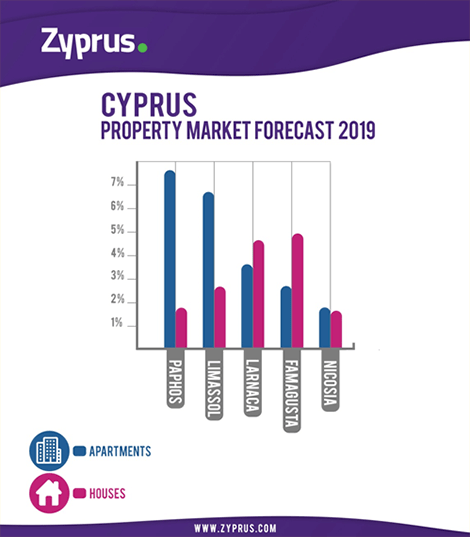
The Zyprus.com ZyForecast tool provides a starting point to gauge how much the price of the residential units by type (e.g. apartments, houses) will change in each Cyprus region. This analysis is based on a bespoke algorithmic model that utilizes numerous economic and housing data that might impact future residential values.

The results of the ZyForecast tool are summarized below:

Limassol

For Apartments in Limassol, it is predicted that for the year 2019 prices will rise by 6.63%, while the prices for Houses in Limassol are expected to increase moderately by 2.77%.

Paphos

Prices for Apartments in Paphos are expected to grow by 7.49% while Houses in Paphos are expected to grow by 1.90%.

Larnaca

The picture is different in Larnaca; Apartments in Larnaca are expected to show a lower annual trend of 3.57%. On the other hand, Houses in Larnaca are predicted to show a relatively strong rise of 4.73%.

Famagusta

On an annual basis, Apartments in Famagusta are predicted to grow by 2.57%, contrary to Houses in Famagusta where forecasting suggests a stronger increase by 4.99%.

Nicosia

Finally, an annual growth of 1.96% is expected for Apartments in Nicosia, while the projected annual growth for 2019 for Houses in Nicosia will be 1.81%.

A synopsis of the forecasting results reveals that for Apartments, Limassol and Paphos are expected to show the highest annual growth (6.63% and 7.49% respectively).

However, when it comes to the Housing market, the Zyprus.com ZyForecast tool predicts that Larnaca and Famagusta will show the highest pace of increase, by 4.73% and 4.99% respectively.

It is worth highlighting that overall, the output of the ZyForecast model expects that Cyprus property prices will not decline in any of the regions when it comes to Apartments and Houses.

How will the value of your Cyprus property change in 2019?

Short-term lettings, real estate & tourism

THE TREND in short-term lettings in Cyprus is gaining ground in 2019 and in the wider region in countries such as Israel and Greece. Since 2018 there has been a significant increase in the number of properties listed for short-term rent on Airbnb and other rental platforms; the response from tourists is very encouraging and positive.

According to statistics from Airbnb, 120,000 visitors from 125 different counties rented properties in Cyprus using their platform in 2017 – 2018 and this number is expected to rise significantly in 2019.

However, some hoteliers have voiced concerns that unregulated short-term lettings represent ‘unfair’ competition and have asked for changes to the legislation.

Nevertheless, the sharing economy undoubtedly offers numerous benefits to both tourists and Cypriot residents. Since 2008, the real estate market has been affected dramatically by the financial crisis, resulting in a large number of real estate assets remaining unsold for a considerable time, burdening their owners and the banks financially.

Through global platforms such as Airbnb, HomeAway and Booking.com, owners may rent their properties for short periods, earning income that they would not otherwise get and, at the same time, having a positive effect on the economy and society.

The large percentage of non-performing loans in Cyprus is a major problem in the real estate market and owners can benefit from the short-term lettings, helping them to pay their obligations to the bank. Also, a large number of people, from cleaners to taxi drivers, are employed in services that result from short-term lettings, creating new jobs.

Airbnb in Cyprus (Source: Airbnb, 2018)
120,000 Guest arrivals 31 Typical nights hosted per listing
40,000 Outbound guests 125 Total guest counties of origin
US$ 2,900 Typical income earned by host

At the same time, areas of Cyprus that are not very well developed, either in central locations or remote areas, are being upgraded and the local economy is strengthening as tenants spend money in the local services and facilities. It is also noteworthy that tourists using short-term rental accommodation would not choose to stay in hotels or purchase “all inclusive” holiday packages, thereby boosting the local market by choosing places to dine, visit and shop. This new form of rental accommodation helps to increase the number of tourists.

According to surveys, tourists who have a specific budget for their holidays, prefer short-term rental properties and visiting areas that without this option they would not choose as their holiday destination.

However, if heavy regulations come into effect, such as rent restrictions, undoubtedly the real estate market will be disturbed, and real estate prices will be negatively affected. As a result, demand for real estate will decline, apartments and dwellings will remain empty or will be rented for very low amounts.

For tenants, tourists, hoteliers and government to benefit, an appropriate legislative framework must be established that balances opposing interests rather than just one of the parties involved. However, it is acknowledged that those renting will have to adhere to hygiene and safety rules and pay tax to the state (e.g. 9% VAT per stay) – as hoteliers are doing.

In conclusion, those renting are required to comply with the law and pay taxes but, at the same time, government needs to promote and encourage innovative property rental practices. New ways of renting property are now part of the modern way of operating the market, offering impressive benefits to tourism.

The establishment of an improved legal framework can benefit all parties involved and help boost the Cypriot economy.

Vasia Kotlida
Analyst, Portfolio Underwriting
Delfi Partners & Company

Cyprus house prices rise 0.2 per cent

Cyprus house prices riseTHE CYPRUS Statistical Service (CYSTAT) has announced that prices for houses and apartments in Cyprus rose by an average by 0.2 per cent in the third quarter of 2018 compared to the second quarter in its latest House Price Index (HPI).

The HPI also reports that residential property prices in Cyprus have risen by 1.7 percent on an annual basis.

According to CYSTAT’s press release, the Cyprus House Price Index (HPI) “is a quarterly index which measures the change in the average prices of residential dwellings. It captures all types of residential properties, both new and existing. The land component of the residential property is included.

“The data source used for both, indices and weights, is the Department of Lands and Surveys, Ministry of Interior. The data cover all areas which are under the control of the government of the Republic of Cyprus.”

Year Quarter House Price Index (2015=100) Quarterly Change (Compared to the previous quarter) (%) Annual Change (Compared to the same quarter of the previous year) (%)
2010 Q1 114.37 -1.6 -6.6
Q2 112.79 -1.4 -6.9
Q3 112.39 -0.4 -5.7
Q4 112.05 -0.3 -3.6
2011 Q1 111.56 -0.4 -2.5
Q2 113.99 2.2 1.1
Q3 111.22 -2.4 -1.0
Q4 107.60 -3.2 -4.0
2012 Q1 106.40 -1.1 -4.6
Q2 106.02 -0.4 -7.0
Q3 110.14 3.9 -1.0
Q4 108.22 -1.7 0.6
2013 Q1 104.54 -3.4 -1.7
Q2 104.77 0.2 -1.2
Q3 103.05 -4.7 -9.3
Q4 100.78 0.9 -6.9
2014 Q1 98.08 -2.7 -6.2
Q2 103.55 5.6 -1.2
Q3 102.70 -0.8 2.8
Q4 101.56 -1.1 0.8
2015 Q1 97.52b
Q2 100.59 3.1
Q3 102.49 1.9
Q4 99.40 -3.0
2016 Q1 97.29 -2.1 -0.2
Q2 99.18 1.9 -1.4
Q3 101.87 2.7 -0.6
Q4 102.72 0.8 3.3
2017 Q1 99.64 -3.0 2.4
Q2 102.74 3.1 3.6
Q3 102.46 -0.3 0.6
Q4 105.24 2.7 2.4
2018 Q1 103.34 -1.8 3.7
Q2 103.98 0.6 1.2
Q3 104.19 0.2 1.7
Q4

b There is a break in the series in the first quarter of 2015 due to redefinition of the model variables.

A new property bubble in the making?

Cyprus property bubbleCYPRUS could be inflating another property bubble through the citizenship-by-investment programme, and at a time when such extraordinary policies are no longer necessary, distinguished economist Christopher Pissarides has warned.

Now based in London, the 2010 Noble Laureate in Economics tells the Sunday Mail he is monitoring developments on the island and is not sanguine about the economic policies implemented, calling them unsustainable in the long run.

“It looks like we may be creating another bubble in the property sector. The property market in Cyprus is growing at a rate that’s out of sync with the fundamentals of the economy at large, such as GDP, demand and demographics,” he said.

According to the RICS Cyprus Property Price Index as at June 30, 2018 property prices across Cyprus, on an annual basis flats increased by 7.6 per cent, houses by 4.8 per cent, offices by 11.6 per cent, warehouses by 4.2 per cent and retail by 1.7 per cent.

For comparison purposes, GDP growth for 2018 hovered around 4 per cent.

Pissarides says the upsurge in demand for property is being driven by artificial factors – a specific government policy, the citizenship-by-investment scheme.

“Fast-rising property prices and increased construction activity are risky, and not a good sign for the economy, which might be damaged in the future.”

Essentially, punters are looking not to acquire Cypriot citizenship so that they can live and work on the island, he said.

“What they’re after is a European passport. I’m in London now, and I bump into people who tell me they live in the UK but have a Cypriot passport.

“When I ask them how they got the passport, they say ‘Oh, I bought a house in Limassol’. This whole business reminds me of the sham marriages scheme.”

Official statistics show that during 2018, 4,367 properties were purchased by foreign buyers, of which 1,428 were EU nationals and 2,939 non-EU nationals.

Purchases by foreigners accounted for almost half of all sales, which totalled 9,242.

According to the latest data released by the Department of Lands and Surveys, in 2018 aggregate sales of property were 6 per cent up on the previous year.

But the 6 per cent growth marks a considerable slowing down from the 24 per cent increase recorded in 2017, or the 43 per cent growth in 2016.

In December 2018, compared to the same month of 2017, sales fell by 48 per cent.

In absolute numbers of property sales, Limassol led the way with 3,411.

Is there a property bubble? The jury is still out on that one.

George Mouskides, general manager of FOX Property Group, tells the Sunday Mail that the property market in Cyprus normally hovers between 9,000 and 10,000 transactions per year.

In this respect, the 9,242 sales contracts filed in 2018 are not out of the ordinary.

In fact, the 6 per cent overall rise in transactions is a “healthy increase”, Mouskides said, adding that the market may be correcting after previous years.

As for the proportion of foreign buyers, this has indeed been going up since 2013 and the introduction of the citizenship-by-investment scheme.

However, the apparent surge in foreign buyers from 24 per cent of all sales in 2017 to 47 per cent in 2018 is misleading.

The Department of Lands and Surveys has amended its definition of foreign buyers, although it has not explained in what way. The department itself includes a footnote in its statistics cautioning the public that comparisons to 2017 and before are therefore not reliable.

“I suspect that, if you account for the change in definition of foreign buyers, the percentage of foreign buyers was about the same in 2018 as in 2017,” Mouskides observes.

On the ‘sharp’ drop in December 2018 sales (domestic and foreign buyers) compared to December 2017, again a disclaimer is in order.

Average property sales stand at about 700 per month. But in December 2017, sales had soared to 1,537.

The reason: people were scrambling to buy or transfer property before the VAT came in on January 1, 2018.

The December 2017 spike was therefore a one-off, Mouskides explains.

Regarding prices, again it’s not cut and dry. Rates have shot up in coastal areas, especially Limassol, due to the construction of high-rise buildings.

That is because the cost per metre rises the higher up you go.

But elsewhere, the small increase in property prices is nothing to write home about.

Back to Pissarides who qualifies that, for the time being, the situation appears to be going well.

But, he muses, “Let’s say a meeting is convened at the European Commission, and as you know a new EC president is coming in this year. What if the new EC president says they can’t tolerate this passport scheme in Cyprus anymore, that it needs to be curtailed? The bubble will burst instantly.”

Moreover, in his opinion, at this stage there’s no need for Cyprus to pursue such emergency measures: the economy has come out of recession, the budget is balanced, while the banking system slowly regains the public’s confidence.

The absorption of the co-op bank by Hellenic and Bank of Cyprus’ handling of non-performing loans (NPLs) are steps in the right direction, albeit belated.

“Over the next two years I hope to see a significant decline in NPLs. But in order to restrict NPLs, debtors need to find money. And the only way for them to find the money is for the economy to rebound. If that happens, all well and good, the banking system will be on a sound footing.

“OK, but what happens next? People will start seeking loans to start up businesses. But where will these investments be made? This is what matters. The supply of loans has to be matched by demand.”

In short, Pissarides says that Cyprus needs a plan going forward.

“There’s many little things we can do, but frankly it’s beating about the bush. If you want real reform, you have to go the heart of the problem. And the core problem is the public sector and how it serves the private sector.”

The top priority should be to reform the public sector. This takes many forms: cutting red tape generally, proper enforcement of the law, expediting registrations for companies, making courts more efficient so that commercial disputes don’t take years to resolve as they do now.

All the above would encourage not only locals to invest in new businesses, but also foreign corporations to choose Cyprus as their base.

“There is much that needs to be done, but there are obstacles in the way. Privatising the state telecoms and power companies is a must, but the government seems to have walked back on its intention to do so, faced with opposition from the unions.

“And even where the government does show determination to press ahead with reforms, these stumble on resistance from parliament.”

Asked to grade the government, Pissarides offers: “Top marks on the fiscal side, but bottom marks on reform.”

House repossessions at a low ebb

Cyprus House repossessions at a low ebbRECENT changes to the law on house repossessions, aimed at giving the Cyprus banking system a tool to reduce their NPL portfolios does not seem to have contributed much to this end.

The banking system’s high rate of NPLs is viewed as the greatest risk to the economic revival.

According to data released by the Central Bank of Cyprus, despite more assets being scheduled to go under the hammer during the third quarter of 2018, a very small number of properties were actually sold.

Thousands of formal notice letters sent by the banks seem to have had little effect since total repossessions are around 3.5% of the properties for which notices were served.

The corresponding figure was around 3% in the previous quarters, but the slight increase did not change the overall picture.

Out of the 7,700 properties for which notifications have been received since Q3 2015 to date, only 272 were sold at the first auction.

In Q3 2018, a total of 863 notices were sent out, compared to 1496 in the previous quarter, which was the highest number of notices issued to date.

In Q3 2018, a first auction date was set for 930 properties compared to the 652 in the previous quarter. This is the largest number of real estate properties to be put under the hammer based on the quarterly data.

Property sold at first auction in Q3 2018 amounted to 58 against 41 in the Q2 2018 and 32 in the first quarter of 2018, the highest number of sales recorded.

Properties sold include agricultural land, houses and apartments (either built or under construction), and building plots, however, during Q3 2018 no primary home was repossessed.

December property sales crash

Cyprus property sales crashACCORDING to the Department of Lands and Surveys the number of property sales contracts deposited at Land Registry offices in the Republic during December 2018 fell 48 per cent compared to December 2017.

The fall follows nineteen consecutive months of increasing sales.

During December a total of 800 contracts were deposited at Land Registry offices for the sale of commercial and residential properties and land compared with 1,537 in December 2017; a fall of 48 per cent.

However, this fall may not be as significant as it may first appear. In December 2017 there was a spike in sales of building land  following the decision by Parliament in November 2017 to introduce 19% VAT on land sales from 2nd January 2018.

Of those 800 contracts, 450 (43.8%) were for properties purchased by Cypriots and 350 (56.3%) were for properties purchased by non-Cypriots; 135 by EU citizens and 215 by third country nationals.

Sales fell in all districts. In percentage terms, Famagusta saw sales fall by 73%, Nicosia fell 57%, while sales in Limassol fell 45%. Meanwhile Paphos and Larnaca saw sales falling by 43% and 34% respectively.

Total Property Sale Contracts – 2017/2018 Comparison

District Year Jan Feb Mar Apr May Jun Jul Aug Sep Oct Nov Dec
Nicosia 2017 72
73
79
80 118 162 124 76 87 117 170 306
2018 146 96
126
117
153
146
176
91
118
145
161 131
Famagusta 2017 21
19 40
29
38 46
59 47 57 51 52 169
2018 48 52
40
52 79
61
61
50
45 57 47 46
Larnaca 2017 102
100 113
69
119 96
103 88 107 111 151 181
2018 112 99
116
83 113
133
112
94
121 116 143 103
Limassol 2017 132
177 232
192
298 304
289 201 203 306 321 532
2018 225 256
314
246 282
338
314
262
251 289 344 290
Paphos 2017 96
87 162
136
183 235
184 160 148 183 212 349
2018 164 163
172
157 201
180
233
156
152 204 230 230
Totals 2017 423
456 626
506
756 843
739 572 602 768 906 1537
2018 695 666 768 655 828 858 896 653 687 811 925 800

Annual 2018 property sales figures

Despite the crash in December, the total number of sales during 2018 were the highest on record since 2008, when 14,667 properties were sold.

With the exception of Larnaca, where sales remained steady, they rose in all the other districts. Nicosia, the island’s capital and major business centre, saw sales rise by 10%, while sales in Limassol, a commercial centre and port, rose 8%. Annual sales in Paphos and Famagusta rose 5% and 2% respectively.

Overseas property sales

According to the Department’s statistics, a total of 350 property sale contracts were deposited by non-Cypriots during December 2018 of which 135 (38.6%) were deposited by EU citizens and the remaining 215 (61.4%) by non-EU citizens.

Paphos remains the most popular district with the overseas market with the number of property sales contracts deposited during reaching 170, while Limassol recorded 89, Larnaca 51, Nicosia 23 and Famagusta 17.

Over the course of 2018 a total of 4,367 contracts for the sale of property to overseas buyers were deposited of which 1,428 were deposited by EU citizens and the remaining 2,939 by non-EU citizens.

Overseas Property Sale Contracts – 2018

District Source Jan Feb Mar Apr May Jun Jul Aug Sep Oct Nov Dec
Nicosia EU 10 8 9 10 9 8 11 5 10 8 7 15
Non-EU 10 4 13 14 9 15
10 2 11 11 13 8
Total 20 12 22 24 18 23 21 7 21 19 20 23
Famagusta EU 15 24 8 12 19 16 20 9 0 7 13 8
Non-EU 36 10 14 28 26 18 23 12 24 14 20 9
Total 51 34 22 40 45 34 43 21 24 21 33 17
Larnaca EU 9 9 9 6 9 20 15 11 15 13 11 19
Non-EU 43 46 40 36 49 52 56 36 46 57 50 32
Total 52 55 49 42 58 72 71 47 61 70 61 51
Limassol EU 15 17 32 17 19 22 25 24 11 27 38 20
Non-EU 103 87 83 67 94 109 95 64 65 86 110 69
Total 118 104 115 84 113 131 120 88 76 113 148 89
Paphos EU 41 58 55 49 70 60 79 55 49 91 74 73
Non-EU 105 97 74 87 88 65 92 53 71 89 92 97
Total 146 155 129 136 158 125 171 108 120 180 166 170
Totals EU 90 116 113 94 126 126 150 104 85 146 143 135
Non-EU 297 244 224 232 266 259 276 167 217 257 285 215
TOTAL 387 360 337 326 392 385 426 271 302 403 428 350

Cyprus Property Sale Contracts 2000 – 2018

Year Overseas Sales Domestic Sales Percentage
Overseas Sales
Total
Sales
2000 450 12,214 3.6% 12,664
2001 1,207 12,849 8.6% 14,056
2002 2,548 14,111 15.3% 16,659
2003 3,981 15,294 20.7% 19,275
2004 5,384 11,947 31.1% 17,331
2005 6,485 10,106 39.1% 16,591
2006 8,355 8,598 49.3% 16,953
2007 11,281 9,964 53.1% 21,245
2008 6,636 8,031 45.2% 14,667
2009 1,761 6,409 21.6% 8,170
2010 2,030 6,568 23.6% 8,598
2011 1,652 5,366 23.5% 7,018
2012 1,476 4,793 23.5% 6,269
2013 1,017 2,750 27.0% 3,767
2014 1,193 3,334 26.4% 4,527
2015 1,349 3,603 27.2% 4,952
2016
1,813 5,250 25.7% 7,063
2017
2,406 6,328 27.5% 8,734
2018
4,367 4,875 47.3% 9,242
Totals
65,391 152,390 30.0% 217,781

Note: Last year the Department of Lands & Surveys published a notice on its website advising that the sales statistics presented for foreign buyers had been modified following improvements to the method of coding. As a consequence, readers must not compare the number of properties sold to foreigners in 2018 with sales figures published for previous years. ((Unfortunately the Department of Lands and Surveys has not made available details of these modifications.)