Cyprus property prices on the rise

Cyprus property price changesTHE THIRTY-FIRST publication of the RICS Cyprus Property Price Index reports that the average price of residential apartments and houses across the island rose by 1.5% and 1.6% respectively during the first quarter of 2017.

The largest increase was in Limassol where the prices of both apartments and houses rose by 3.8%.

Holiday homes also increased in value over the quarter with holiday apartments rising by 2.6% and holiday houses by 1.9%.

Limassol saw the highest rise in holiday apartment prices at 4.2%, while Paphos saw the highest rise in holiday houses at 3.0%.

During the second quarter of 2017 the Cyprus economy showed further signs of stability, with a seasonally adjusted quarterly GDP growth of 0.9% and an annual seasonally adjusted GDP growth of 3.5%. Unemployment remained at relatively high levels, on a continued downwards trend to around 10.8% (from the high levels of 17%).

Given prevailing economic conditions and the marginally improved confidence in the Cyprus banking system, there are relatively higher transactions during the quarter and improved market sentiment. Financial institutions, despite of their NPLs, have been more willing to provide access to finance and there is an increasing interest from locals.

Cyprus property prices

On an annual basis the Cyprus Property Price Index recorded increases in all in all cities and asset classes, with significant increases being  recorded  in  Limassol,  Nicosia  and  Larnaca,  whilst Paphos and Paralimni have shown smaller annual increases.

Apartment prices rose by 6.2%, houses prices by 4.7%, office prices by 1.6%, warehouse prices by 0.2% and retail prices by 2.0%

Rental values

Across Cyprus, on a quarterly basis rental values increased by 3.0% for apartments, 1.0% for houses, 2.0% for retail, 3.7% for offices and 0.7% for warehouses.

Compared to Q2 2016, rents increased by 8.3% for flats, 10.2% for houses, 6.8% for retail premises, 14.4% for offices and 4.2% for warehouses.

Gross yields

At the end of the second quarter of 2017, average gross yields stood at 4.1% for apartments, 2.1% for houses, 5.4% for retail, 4.3% for warehouses, and 4.9% for offices.

The parallel reduction and/or stabilisation in capital values and rents is keeping investment yields relatively stable and at low levels (compared to yields overseas). This suggests that there is still room for some re- pricing of capital values to take place, especially for properties in secondary locations.
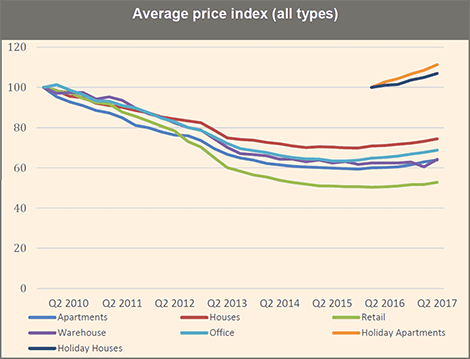
Cyprus property average price index (all types)

Further reading

RICS Cyprus Property Price Index Q2 2017

Home prices up says Cyprus Central Bank

Home prices up says Cyprus Central BankTHE CENTRAL Bank of Cyprus reports that home prices, which include apartments and houses, increased 0.5 per cent in the second quarter of 2017 compared with the first quarter in its latest Residential Property Price Index.

Apartment prices

Compared with the first quarter of 2016, apartment prices in Larnaca fell by 1.1% and by 1.0% in Paphos. However in the remaining districts of Nicosia, Limassol and Famagusta they rose by 2.3%, 2.2% and 2% respectively.

On an annual basis, apartment prices in Paphos fell by 3.2%, but rose in the other four districts. Prices in Limassol rose by 6.1%, prices in Nicosia rose by 2.7%, while prices in Famagusta and Larnaca rose by 2.3% and 0.9% respectively.

House prices

Compared with the first quarter of 2016, house prices in Nicosia fell by 0.7% while remaining steady in both Limassol and Famagusta and rising by 0.1% in Larnaca and 2.6% in Paphos.

On an annual basis, house prices in Larnaca fell by 2.3% and by 0.1% in both Nicosia and Famagusta. Meanwhile house prices in Paphos rose by 2.2% and in Limassol by 1.1%

Gradual recovery

The Central Bank considers that the pace at which home prices are increasing, both on a quarterly and annual basis, confirm the gradual recovery of the Cyprus real estate sector as suggested by other relevant indicators and, combined with robust growth in the wider economy, confidence in the sector is strengthened creating prospects for further development and a recovery in demand.

Further reading

Residential Property Price Indices Q2 2017 (Greek)

Scheme to alleviate bailout losses

Scheme to alleviate Cyprus bailout losses of depositorsCYPRUS will set up a scheme aiming to alleviate the losses suffered by uninsured depositors (over €100,000) whose deposits have been converted to capital as part of the bailout of the banking sector during the 2013 financial meltdown, Minister of Finance Harris Georgiades announced on Thursday.

As part of the 2013 bailout financed by the EU and the IMF, Laiki ?ank, the island’s second largest lender was liquefied, resulting in the loss of deposits over €100,000, while Bank of Cyprus, the island’s largest bank, was recapitalised with the bail-in tool, featuring the conversion of 47.5% of deposits over €100,000 to equity.

According to data by IMF and the Central Bank of Cyprus, a total of €8 billion was wiped out as part of the bailout agreed in March 2013.

“The government acknowledges that the bail-in measure brought an excessive financial burden to a portion of our citizens,” Georgiades said in statements to the press, adding the scheme will utilise the national solidarity fund, established in 2013.

He said the government will build up the fund’s reserves’ by depositing €25 million this year, with the second tranche to be deposited in the second half of 2018, while money will be deposited to the fund each year based on the fiscal performance.

“We believe that this is the only feasible prospect albeit it does not offer immediate remedy. This is an achievable proposal, compared with various unfeasible and inapplicable proposals that have been heard,” Georgiades added.

The Finance Minister noted that the government has decided to explore the possibility to grant the fund state land of significant value, which remains unexploited.

Replying to questions, Georgiades gave no further details as to who will be eligible to receive this compensation, noting that scheme’s details will be outlined in the scheme that will take into account a series of legal, financial and social parameters, while it will be constitutionally legitimate.

He noted that the scheme will be drafted as soon as the fund has adequate reserves.

“Instead of handing out promises, we begin placing money on the side, now that fiscal conditions allow it to gradually create a feasible prospect to partially alleviate the cost for a part of our fellow citizens,” he said.

– Cyprus News Agency

Construction of new homes slows

Cyprus: Construction of new homes slowsTHE NUMBER of building permits authorised in Cyprus during August 2017 stood at 410 compared with the 381 authorised during the same period last year; an increase of 7.6% according to official figures released by the Cyprus Statistical Service.

The total value of these permits reached €90.3 million and their total area reached 85.0 thousand square metres.

During August 2017, building permits were issued for:

  • Residential buildings – 302 permits
  • Non-residential buildings – 62 permits
  • Civil engineering projects – 9 permits
  • Division of plots of land – 33 permits
  • Road construction – 4 permits

During January to August of 2017, 3,772 building permits were issued compared to 3,434 during the same period in the previous year; an increase of 9.8%

The total value of these permits increased by 49.1% and the total area by 39.5%.

Building permits for new homes

The 302 residential building permits approved in August provided for the construction of 244 new homes comprising 142 single houses and 102 multiple housing units (such as apartments, semis, townhouses and other residential complexes); an increase of 6.6% compared with August 2016 when permits were issued for the construction of 229 new homes.

Building Permits Issued for the Construction of New Homes
(Number of Dwellings)

Month 2016
(Dwellings)
2017
(Dwellings)
Increase/
Decrease
%age
Change
January 243 381 138 56.8%
February 312 383 71 22.8%
March 306 412 106 34.6%
April 201 289 88 43.8%
May 278 424 146 52.5%
June 287 381 94 32.8%
July 382 537 155 40.6%
August 229 244 15 6.6%
Totals 2,238 3,051 813 36.3%

Construction and housing statistics

The Cyprus Statistical Service recently published Construction and Housing Statistics for years 1995 to 2016, which show the contraction of the industry in the years after the property bubble burst and the recession.

Between 2008 and 2016, constructions lost 73 per cent of their added value and although they are recovering gradually they are nowhere near the figures of a decade ago.

The number of new homes completed has yet to reach the number last seen in 1995. In 2015 the number of new homes completed reached 2,390, down by almost two thirds on the 6,891 completed in 1995. It’s worth noting that during the boom years the number of new homes completed soared reaching 18,195 in 2008.

Similarly the number of building permits authorised for the construction of new homes in 2016 stood at 3,649 compared with the 8,776 issued in 1995.

Although the construction sector has started on the long road to recovery, the journey is going to take many, many years.

Parliament approves VAT on building land

Cyprus parliament approves VAT on building landPARLIAMENT on Friday approved a bill imposing 19 per cent VAT on the sale of building land, fulfilling an EU condition some 10 years after the original deadline.

The bill passed with the votes of 26 MPs from DISY, DIKO, Solidarity, and the Green Party.

Eighteen MPs from AKEL, EDEK, ELAM, and one MP each from DIKO and Solidarity, voted against.

The law in question should have been passed by January 1, 2008 and delays prompted the EU Commission to warn Cyprus repeatedly with stiff fines.

The new law will come into force on January 2, 2018.

House finance committee chairman, DISY leader Averof Neophytou said VAT can be recouped and will only be imposed in cases where the land is sold by a company or businessman registered with the VAT service.

Neophytou said the new arrangement could create some short- or medium-term liquidity problems. He reminded parliament that Cyprus has already received a second official warning from the European Commission over the delay in passing the bill.

Some MPs voiced concern over the way the law would be applied by the tax commissioner who has the power to decide whether a transaction is commercial or not.

Main opposition AKEL warned about the possibility of newly-weds having to pay the tax when buying a plot to build their home.

AKEL MP Giorgos Loukaides said there was nothing in the bill ensuring it would not happen.

“We have not in any way ensured that new couples will be exempted from paying tax on their first house,” Loukaides said.

The land falling under the category of undeveloped building land will be determined by regulations passed by parliament.

Protected zones and farming land will be exempted.

VAT will be imposed on all sales of building plots taking place as part of economic activity. According to the tax commissioner, any other cases will be examined individually.

Cyprus building permits bureaucracy

Cyprus building permitsACCORDING to the World Bank ‘Doing Business’ report for Cyprus, dealing with building permits requires eight procedures and takes a mind-boggling 507 days!

This ranks Cyprus at 120 out of the 190 countries that were surveyed. According to the World Bank’s analysis it takes 240 days just to update the Title Deed!

In Germany, dealing with building permits takes 126 days, in the UK it takes 107 days, while the average time in Europe and Central Asia 168 days.

As we reported in September, Cyprus’ planning and building permit processes are  (hopefully) being overhauled with the ultimate goal of creating a modern legal framework for development licensing, significant strengthening of building control and reducing delays.

Cyprus has been working with the Austrian Finance Ministry to develop proposals and recommendations based on best international practices to rationalise Planning and Building Permits, Certificates of Approval, the enforcement of building control, the issuance of Title Deeds. (It takes the Austrian authorities 222 days to deal with building permits, which require eleven procedures.)

Cyprus also comes in at number 92 of the 190 countries surveyed regarding real estate registration. It involves seven procedures and takes 9 days, but of particular concern is the high cost; 10.4 per cent of the cost of the property compared with the average cost in Europe and Central Asia of 2.5 per cent.