AUTHORITIES in Cyprus have been reassuring that despite the influx of tall buildings scattered across the country with skyscrapers planned in Limassol, fire safety measures are firmly in place, following concerns rising from the London tower block blaze that killed many people.
The deadly fire at Grenfell tower in the early hours raised serious questions after it spread rapidly engulfing the 24-storey housing block. Prime Minister Theresa May has ordered a public inquiry, while British media reports outline the cladding used in the building has been banned in the US since 2012.
Closer to home, head of the House interior committee Eleni Mavrou, said the incident highlighted the need to bring fire safety laws in Cyprus up to speed so as to avoid any similar incidents, particularly while Limassol is boasting eight major projects set to be completed in the next few years, with seven permits currently being evaluated.
For instance, a 37 storey skyscraper at 170 meters high, the One Residence, is set to be the tallest residential seafront tower in Europe.
Fire services spokesman Andreas Kettis, however, said the measures Mavrou wanted approved in parliament within the next two weeks have already been in place for years.
“The difference is that now all the measures will fall under one regulation. Now we use one regulation from one bill, another regulation from another, and so forth. With the new rules, it will be a lot more simplified.”
The measures include a firefighting lift, fire sprinklers, rising mains and fire exit stairwells.
“Many measures are there to prepare in the case of a fire, such as having water systems or ensuring power won’t be cut off,” Kettis told the Cyprus Mail.
Additionally, there are pre-emptive steps taken from the planning stage such as proper material that will prevent a fire from spreading too easily.
“We don’t let anything slip past us,” Kettis said.
The Cyprus scientific and technical chamber (Etek) district secretary in Limassol Yiannis Kakoullis, however, said he did not feel so re-assured.
“The town planning department doesn’t go to inspect new properties being built,” he claimed.
Additionally, fire services equipment can only reach up to 30 meters. “How will they be able to put out a fire in a skyscraper over 100 meters tall?”
Kettis, however, dismissed such claims saying the height of fire trucks did not have to correspond to the height of the building.
The town planning department also said the procedure to grant any building permit, particularly for those of tall buildings, comes after dialogue with several departments including the fire service and they follow through with all the projects.
According to Kakoullis, earlier this month, Limassol municipality was also concerned about apartment blocks that are very old and in risk of collapse.
“There are about 10 to 15 of those in Limassol and if there is an earthquake it will be very dangerous.”
Although the municipality was not available for comment, Kakoullis said many apartment buildings do not have committees with tenants keeping an eye out on what maintenance work needs to be done.
Additionally, owners, even if the building is in dire need of being renewed, simply say “well I have no money to fix it,” according to Kakoullis.
THE CONTRACT for Cyprus’ first integrated casino resort, the only one of its kind in Europe, was signed on Monday in Nicosia between the gaming authority and the Melco Hard Rock consortium and is designed to provide for an investment of €500m, attract an extra 300,000 tourists a year, and to add 4,000 jobs.
The contract was signed at the Filoxenia Conference Centre between the president of the National Gaming Authority and Andy Choy, chief gaming officer, of the consortium of Melco International Development Ltd, Seminole HR Holdings LLC (Melco Hard Rock) and CNS Group (Cyprus Phassouri Zakaki Ltd).
Energy, Commerce and Tourism Minister Yiorkos Lakkotrypis, who addressed the event, touted the fact that the Limassol complex would be the only integrated casino resort in Europe, which will be based in Limassol, and will include four satellite casinos in Nicosia, Larnaca, Famagusta and Paphos.
The main resort will also be the largest casino in Europe, the minister said with 136 gaming tables, 1,200 gaming machines, a luxury hotel with 500 rooms with the capacity for expansion, a conference hall spanning 6,000 square metres that can accommodate audiences of 1,500, and a wellness centre covering 4,000 square metres.
“Total investment is expected to exceed half a billion euros and is estimated to create more than 4,000 jobs during the construction phase and the same number during operation,” Lakkotrypis said.
“This is undoubtedly, a project that will enrich our tourism product, attracting an additional 300,000 tourists annually and contributing significantly to combating seasonality,” he added.
The casino licence allows for the operation of an integrated casino resort in Cyprus for 30 years, as a monopoly for the first 15. Finance Minister Harris Georgiades said earlier this year that the casinos would bring in €100m a year in taxes.
The satellite casino in Nicosia is estimated to be up and running this year, and a temporary casino in Limassol – until the full-blown casino resort is ready. This will likely be located at the current premises of the Monte Caputo nightspot on Amathus Avenue. Construction on the resort – which will include a luxury hotel and theme parks – is expected to be completed by late 2019 or early 2020.
Lakkotrypis said that due to its size and importance, the casino was probably the most important project Cyprus has seen in decades.
He also said it was important that part of the government’s vision was that the casino would operate in a controlled manner so that vulnerable groups would be protected.
The previous government under Demetris Christofias had vowed to never allow a casino for social reasons but the financial crisis in 2013 prompted the current government to see it as a way to attract investment. Lakkotrypis said the age restriction has been set at 21.
“Our goal is the improvement of incoming tourism, increasing arrivals, and average spending per capita, and also to see this contribute to the ongoing efforts to address the problem of seasonality in the Cypriot tourism industry,” he said.
“Our other strategic objective was the creation of new jobs and additional tax revenue, supporting sectors that will be associated with the casino, and attracting further foreign investment.”
The casino operations will be overseen by the six-member National Gaming Authority, set up only five months ago, headed by Christos Mavrellis who said during the signing ceremony that its mission would be among other duties, to make sure the operation did not fall under criminal influence or exploitation.
The body will also make sure the games in the casino are conducted honestly, to make sure the operator complies with the terms of the licence and to monitor any negative social consequences.
“We shall exercise our authority and perform our duties and responsibilities in good faith always aiming at making this ambitious project a success,” he said.
Hard Rock International has venues in 71 countries, 168 cafes, 23 hotels and 11 casinos. Beginning with an Eric Clapton guitar, Hard Rock owns the world’s greatest collection of music memorabilia, which is displayed at its locations around the globe. The company owns, operates and franchises cafes in numerous cities including London, New York, San Francisco, Sydney and Dubai. It also owns, licenses and/or manages hotel/casino properties worldwide. Destinations include the company’s two most successful Hotel and Casino properties in Tampa and Hollywood, as well as other locations including Bali, Chicago, Cancun, Ibiza, Las Vegas, Macau and San Diego.
Cyprus Phassouri (Zakaki) Limited (“CPZL”), is a member of the CNS Group which, amongst others, conducts different businesses including real estate, telecommunications, dairy, large scale farming and export and mining in Cyprus. The group has a chain of hotels in Greece and the AKS Annabelle Beach Resort on the Greek island of Crete.
THE GOVERNMENT has vowed to continue issuing title deeds to some 11,500 ‘trapped buyers’ despite the recent court rulings that left them in a legal limbo.
“We decided to continue issuing title deeds for the remaining 11,500 properties despite the court rulings, we will appeal the court rulings and we will introduce legislative amendments to correct the problem,” Interior Minister Constantinos Petrides told the Cyprus Weekly.
Limassol and Paphos district courts ruled against the Director of the Land Registry to transfer the Title Deeds into the names of the purchasers following appeals by banks.
The Transfer and Mortgage Law was amended in 2015 for the main purpose of protecting the entrapped purchasers. It was a requirement from international lenders under the bailout terms.
“The issue of title deeds is huge, by 2010 2011, there were over 100,000 unissued title deeds and, over the subsequent years, the Land Registry Department, albeit with limited resources, managed to drop that figure to 34,000,” said Petrides.
“In 2015, we also passed legislation regarding the trapped buyers, which affected about 14,000 cases,” added Petrides.
‘trapped buyers’ are a reference to home buyers who have completed their obligations, paid off their house but are unable to receive their title deeds because developers had mortgaged their properties to the banks.
“We have managed to issue 2,500 out of the 14,000 over the last two years,” said Petrides adding that the recent court rulings had taken the government unawares.
He indicated that consultations with Attorney General Costas Clerides are underway while the Interior Ministry is looking for ways to remedy the situation.
“The bottom line is this; the process will continue, we will continue issuing title deeds,” Said Petrides.
Petrides said that the government was well aware and recognised the distortions, wrong practices and “strange legalities” due to a “complex system” of the past.
“We did not face a normal situation as a government when we took over; we are determined, though, to solve it,” said Petrides.
“Let’s just say that it is a matter of national pride,” said Petrides, adding that it was also offering the people who chose to invest in Cyprus the assurances they are looking for.
The minister’s stance was echoed by Nigel Howarth, a property advisor in Limassol.
“It really looks bad for Cyprus’ reputation abroad,” said Howarth.
Cyprus has embarked on a policy to attract foreign homeowners to the island in an EU-approved citizenship for investment programme.
According to Howarth, the whole mess basically boils down to “bad banking and legal practices”.
“Banks have claimed that they didn’t know what was going on; they knew exactly what was going on,” said Howarth.
“A specific case in Paphos involved a buyer and a developer who banked in the same branch of a commercial bank. The buyer would transfer funds from his account into the developer’s account in that same bank. Is it really possible for the bank not to have known what was going on?”
Howarth also took the legal profession to task for not looking after their clients’ interests.
“A lawyer is supposed to protect his client, he’s supposed to check that the property he is purchasing doesn’t have any outstanding dues or is wrapped up as collateral.”
“Unfortunately, the case took 10 years to settle, so there definitely has to be tightening of the law,” said Howarth.
The Legal Services have, in the meantime, indicated that they will appeal the decision of the Limassol and Paphos district courts, giving impetus to the government’s efforts to deal conclusively with the title deed issue.
The Legal Services received new orders to continue implementing the current legislation, while the House Justice Committee will tackle the constitutional element of the courts’ decision.
House Justice Committee chair George Georgiou admitted that there were loopholes in the current bill and said amendments were necessary to protect the thousands of ‘trapped buyers’.
INTRODUCED in 2015, the Trapped Buyers’ law was designed to enable those who had paid for their property in Cyprus to get their Title Deeds but were prevented from doing so because their developer had failed to repay mortgages on the land on which he was building and/or had failed to pay outstanding taxes.
Following recent decisions by District courts in Limassol and Paphos that ruled the law unconstitutional, the Land Registry suspended transfers until the authorities considered what to do.
Legal Services then directed the various departments to continue implementing the law pending the results of appeals filed at the island’s Supreme Court, which will have the final say on the matter.
In the meantime, lawmakers are looking to plug loopholes in the Trapped Buyers law and it is hoped that a revised law will be passed in September.
Trapped Buyers statistics
There has been much speculation as to the actual number of trapped buyers. But earlier today the Greek language newspaper ??????? (Daybreak) published statistics that it obtained from the Department of Lands & Surveys. These indicated that there are 71,000 cases currently in process involving 106,985 individuals and companies:
Applications from trapped buyers – 11,500 cases involving 15,640 purchasers (6,817 Cypriots, 8,146 foreigners and 677 companies).
Initiated by Land Registry directors – 28,000 cases involving 36,791 purchasers (12,216 Cypriots, 22,986 foreigners and 1,589 companies).
Applications from property developers – 6,000 cases involving 7,756 purchasers (2,363 Cypriots, 5,074 foreigners and 319 companies).
Title Deeds issued, transfers pending – 20,000 cases involving 38,970 purchasers (13,830 Cypriots, 24,003 foreigners and 1,137 companies).
The above are the cases where problems have arisen due to the court rulings; a further 165 court cases are pending.
Vendor documents filed after 1 January 2015 – 5,500 cases involving 7,828 purchasers (2,203 Cypriots, 3,937 foreigners and 1,688 companies). Note that these cases are not covered by the existing legislation.
Of the 106,985 persons and companies: 37,429 (35%) are Cypriot, 64,146 (60%) are foreigners and 5,410 (5%) are companies.
THE DECISIONS of the Paphos and Limassol District Courts regarding the trapped buyer’s law have created confusion and anger amongst property buyers in Cyprus.
It needs to be remembered that the Transfer and Mortgage Law 9/65 was amended in 2015 by introducing Articles 44IH-44KZ and the main purpose was to protect trapped buyers.
The amended law and subsequent transfer of title deeds using this law were challenged by the banks and the courts were of the opinion that the decision of the Director of the Land Registry to transfer the property into the names of the buyers violated Articles 23 and 26 of the Constitution, as these decisions were taken without the consent of the bank.
Two weeks after the issuance of the decisions, it seems that the Cyprus Land Registry has been instructed not to proceed with transferring any title deeds under the trapped buyer’s law. It seems that the Cyprus land registry will still work on applications which have already been submitted and they will accept the submission of new applications, but they will not proceed with any transfer of title deeds until the situation has been clarified.
It remains to be seen whether the Land Registry, developer or the buyers will appeal the District Court decisions to the Supreme Court of Cyprus. An appeal against a court judgement must be filed within 42 days from the issuance of the judgement, if there is still time.
In a statement issued earlier today the Interior Minister Constantinos Petrides said:
“An intensive consultation is taking place between the interior ministry and the attorney-general so that a lawful arrangement can be found that would free the trapped buyers of mortgaged real estate. I think we’ll have something more substantive to say in a few days.”
The outcome of these consultations will finally resolve the situation for the many thousands who were duped into buying property in Cyprus that was built on land that its developer had earlier mortgaged to the bank.
Update 2 – 19 June
The Law Office of the Republic of Cyprus has decided to appeal the recent District Court decisions regarding the trapped purchasers’ law.
It is understood that the purchasers are also appealing these decisions.
Further, it has been decided that law will continue to be applied until the Supreme Court issues a decision. This means that the Land Registry will continue examining applications under the trapped purchaser’s law and continue transferring title deeds.
In addition to the above, the Members of the Parliament are proceeding with amending the law so that all parties (bank, developer and purchasers) are legally protected.
Damage caused to Peter Field’s bedroom – photo credit: Cyprus Mail
CRACKS are opening in walls, water pipes bursting and electrical pipes tearing apart as the land moves beneath houses in the Limnes (lakes) area of Pissouri.
Three families have been evicted in the past year amid fears their homes might collapse because of the severity of the land slippage, but many more houses also appear at risk while residents accuse officials of dragging their feet and passing the buck. Another couple has simply left their house and gone back to the UK.
Matthew Kidd said to intercede with government
Many in the village are retired Britons who are now pinning their hopes on the British High Commissioner, Matthew Kidd. He visited the village in the Pissouri area on Friday to see the damage for himself and is said to have told residents he will intercede with the government.
Otherwise a battle for compensation in the courts could take years – and many of the Britons are elderly.
Although initially the government had seemed to take responsibility for the mess in 2015, it has since backtracked and made no mention of compensating affected homeowners.
British homeowners in Limni are not alone in complaining that officials are dismissive of their plight.
The most recent family to be evicted was Pandelis Karayannis, who received his eviction notice from the district office in March.
“I told the man (from the district office) that was handing me the paper, what am I supposed to do now? Where should I go? I have a wife and two kids. I don’t have a job,” Karayannis told the Sunday Mail.
“Do you know what he told me? He said ‘that’s your problem’.”
In the meantime, there appear to be no plans for what will happen to the remaining residents in the area which, according to the interior ministry, has been undermined by underground water close to the surface.
Although the town planning department found 60 properties with cracks in the walls, there are 14 houses and a complex of 28 apartments that have been particularly seriously affected and are seeking support from the state, according to lawyer Georgia Elina Zoi.
She has taken on their case “not to battle out in court but to find a solution on a political level with the government”, she said.
Unemployed since last November, Karayannis says the injustice has cost his family dearly.
“We found a place to rent for €450. My wife’s salary is €700. How are we supposed to get by?”
Further compounding the problem is that Karayannis is supposed to be paying off his mortgage for a house he can no longer inhabit. An agreement has been reached with the bank where he is currently not paying his instalments but the interest continues to pile up, Zoi told the Sunday Mail.
“I bought the house about five and a half years ago for about €200,000. Today, the value at the bank is €7,600,” he said.
Several affected property owners have grouped together since July 2015, to form the Pissouri Housing Initiative Group (PHIG). Chaired by Peter Fields, he told the Sunday Mail that they formed the group after he and his wife left Cyprus for a holiday “and the house was fine, but then when we came back it was full of cracks.”
Eviction notices issued
Fields was one of the three families that received an eviction notice and rents a house nearby. He told the Sunday Mail the third person that was evicted was a widow whose family helped pool together some money to help her buy a new place.
In April, PHIG commissioned engineer Dr Gareth J Hearn to do a study on the ground behaviour problems affecting the residential area of Limnes. Outlining that 2012 was the wettest year on record since 1974, and the winter of 2011 and 2012 the third wettest, he decided that it was “most likely that this rainfall, possibly combined with runoff from urban areas, leakages from water supply pipes and discharges from residential properties, played a significant role in triggering the ground behaviour problems observed.”
Nevertheless, the soil is not the principal reason for the damage as the displacement is lateral (downslope) rather than vertical, his report outlined.
“It is considered implausible that these phenomena can be attributed to any cause other than ground movement associated with slope instability.”
Gareth said a landslide had occurred twice, one in ancient times and one more recently that caused a failure within the surface layers at about 10 – 15 metres deep.
The heavy rainfall in 2011 and 2012, reactivated this movement and although it was probably small, it was “sufficient to trigger regressive slope failure” he said.
Since PHIG was formed, the group has been to parliament twice to outline the problems they face, according to Fields but nothing has come of it.
“Our aim is to get justice for the people whose houses are falling down,” he said this week.
Kidd’s visit has made residents feel “delighted that someone actually came to see the situation”, Fields said.
Kidd met with affected home owners, visiting their residences and according to Fields will arrange to meet with Interior Minister Constantinos Petrides to discuss their plight.
“He saw the extent of the damage, he saw the homes and now has a totally clear picture.”
According to Zoi, the affected residents are seeking a form of compensation. The majority of the houses are British owned and thus don’t have access to the bank system.
“At least half of them are too old to wait for another house to be built. They would be interested in another house bought for them,” she said.
“Different cases can be handled in a different way so we can come up with a just settlement for everyone. We don’t want to burden the state but we believe that everyone bought a house and they deserve to have a safe house to live in until the end of their lives.”
Following the resignation of former interior minister Socratis Hasikos in May, the residents feel that the process is now taking longer.
“In the army, when we had a new commander, he had 24 hours to be fully briefed. Over here, it seems to be an excuse to say ‘well he’s new, he needs time’,” Fields said.
In 2015, when the problems first appeared, everything looked more promising. Hasikos had announced plans to put measures in place that could resolve the problem and said projects designed to channel rain water away from the area would be expanded. New wells were also set to be drilled to monitor the underground water.
Hasikos: Government to pay for the mess
More importantly, Hasikos had attributed responsibilities to state surveyors for wrongly assessing that the ground was suitable for building and said the government would pay for the mess, with MPs quoting a cost of €20m.
Earlier this year, this changed when an investigation by the interior ministry put the blame on contractors saying, for instance, they had used inadequate filling-in works.
Zoi however argues this is a ploy by the ministry to avoid offering compensation
“They say that the retired British home-owners should move legally against the engineers who designed their houses 20-30 years ago. We can’t find everyone – the oldest one is either retired or dead.”
Additionally, litigation would take six to eight years and be very costly to the home owners, she said.
“All that, because the government doesn’t want to admit that we have a landslide and pretends that all engineers ‘wrongly assessed the ground’s endurance, didn’t take into account the type of soil and didn’t use foundation piles’.”
The interior ministry did not respond to repeated requests for comment by the Sunday Mail.
Attempts by Pissouri community council to offer a little help in the form of a small stipend to the evicted families have also fallen flat.
Pissouri community offered financial support
Pissouri community council leader Lazaros Lazarou told the Sunday Mail that a year ago, around the time when the first eviction notice was served in February 2016, the council had voted in favour of giving €300 every month to anyone affected.
“At the time it was only one family, but we knew there would be more to follow,” he said.
Limassol district blocked financial support
The motion however was rejected by the Limassol district office which said the council’s decision did not comply with the law, Nicoletta Gavrilidou who has been dealing with the case at the district office told the Sunday Mail.
On Thursday, the town council notified some of the residents that work would begin next week on one of the roads and pavements, said Katherine Yeomans, who lives in the area.
“Right now, the road is a mess, you can see cracks in it. They filled it about six months ago but within a few weeks it had opened up again. The pavements are really dangerous as well.”
Yeomans, along with her husband Jeremy, moved into their Pissouri home in January 2015 after leaving the UK.
Although their home was built in 2006, it wasn’t until a few years ago that cracks began to appear in the walls.
Now the house is an entirely different state. “Pipes are bursting, the pool is completely collapsing in itself, electrical wires are being pulled apart,” she said.
“Nobody wants to help.”
They’ve spent thousands in repairs, but have now given up.
“When we moved here, we thought this would be our dream home. Now it’s our worst nightmare,” she said. “It’s heart-breaking for us and the people that have to move.”
Moving back to the UK is not an option for the couple as they cannot afford it and sold everything before moving here.
“I have enormous regret. It’s the worst thing we ever did.”
Even worse, even if they lose their house, their mortgage will still need to be repaid, Yeomans said.
Pissouri landslips
A catastrophic landslip at the eastern end of Pissouri occurred several years ago, resulting in a number of homes being demolished.
Anyone approaching Pissouri from the east on the highway can clearly see the massive scar of the remedial work undertaken in efforts to prevent any further land slippage in the area.





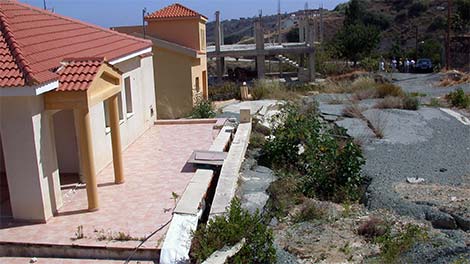
 Anyone approaching Pissouri from the east on the highway can clearly see the massive scar of the remedial work undertaken in efforts to prevent any further land slippage in the area.