Home Blog Page 2

Cyprus housing market hits record high in 2026

0

Cyprus’ housing market confirmed its role as the driving force behind the country’s property sector in the first half of 2026, reaching a new record for both the number and value of transactions.

Demand remained strong despite a more challenging economic backdrop, with higher inflation and geopolitical tensions in the Middle East creating greater uncertainty. However, local buyers continued to support the market, while overseas buyers are still choosing Cyprus as a place to settle permanently.

According to the Cyprus Market Insight Report S1 2026 by Danos, the Cypriot economy entered 2026 from a position of strength. The economy grew by 3% in the first quarter, the highest growth rate in the European Union. Private consumption, the services sector and business relocations continued to support property demand.

Record housing sales and values

Danos describes residential property as the leading sector of the Cyprus property market in the first half of the year. In the first quarter, 4,308 homes were sold, with the total value of these sales reaching €1.26 billion. The number of transactions rose by 43% compared with the first quarter of 2025, while their total value increased by 52%.

Strong activity continued into the spring, with transaction volumes in May also remaining above the level recorded a year earlier. The report says the key change is not simply the size of the market, but also the type of demand.

The market is gradually moving away from investment and seasonal purchases, with more buyers now looking for homes to live permanently. This includes people relocating to Cyprus and could provide a more stable base for future market growth.

Houses gain ground

One of the biggest changes is in buyer preferences. House sales increased by 63% year on year, compared with a 38% rise in apartment sales.

Danos says buyers are increasingly choosing larger homes, with space, quality of life and long-term housing needs becoming more important. This marks a shift from the smaller homes that dominated the market in previous years, when strong investment demand was a major driver.

Capital values also continued to rise across the main residential property categories. Apartments recorded the biggest increase, at 4.09%, while house prices rose by 3.60%.

Apartment rents also recorded the strongest annual growth, increasing by 5.10%. Apartment yields stood at 5.44%, keeping them attractive to property investors.

European buyers and business relocations

Overseas demand remains a key part of the Cyprus property market, although its make-up is changing. Buyers from European Union countries were the fastest-growing group, with sales contracts to EU buyers rising by about 31% in May. Demand from buyers outside the EU remained broadly stable.

Danos says Paphos has become a major centre of international interest. The end of the non-dom tax regime in the UK has also increased Cyprus’ appeal, making the island more attractive to wealthy individuals and businesses looking to relocate.

This trend is particularly strong in Limassol, which continues to attract multinational companies and corporate headquarters. Cypriot buyers remain the backbone of the market, accounting for about 63% of transactions in May. Their activity increased by around 6% compared with the same month in 2025.

Property supply still falls short

Despite strong construction activity in recent years, supply remains below demand in the most sought-after parts of the market. The biggest shortage is in modern homes and high-quality apartments, particularly in coastal and prime locations. This shortage continues to support higher property prices.

The largest price increases were recorded in Paphos and Famagusta, while Nicosia remains the country’s most stable property market.

Limassol and Paphos attract strong demand

The report also highlights the value of property transactions across Cyprus’ districts. Investment activity remains particularly strong in the country’s main urban and coastal markets.

Limassol recorded the highest transaction value in the first quarter, with sales worth about €442 million. This kept the city as Cyprus’ largest property market.

Paphos ranked second, recording about €401 million in transactions and 1,077 sales. Danos describes this as one of the most significant changes in the current property cycle.

Paphos was just 55 transactions behind Limassol, reflecting rising demand from buyers seeking permanent homes in Cyprus rather than purchasing solely for investment purposes.

Larnaca followed with about €187 million in transactions and 995 sales, while Nicosia recorded €174 million and 877 sales. Both remain more affordable markets, supported mainly by demand for owner-occupied homes and relocation.

The median apartment price was about €160,000 in Larnaca and €155,000 in Nicosia.

Investors spread across property types

Danos also highlights the largest individual transactions recorded in the first half of the year. These were mainly concentrated in Limassol and Nicosia and included office buildings, mixed-use developments and high-value residential plots. Luxury apartments and selected hotel properties also featured among the major deals.

Three trends stand out from the wider investment picture. Investment interest is spreading beyond Limassol, transactions are becoming more diverse across different property types, and buyers are becoming more selective about property quality and location. This is happening as financing costs stabilise.

Strong but more selective market expected

Danos expects investment activity to remain strong in the second half of 2026, although buyers are likely to become more selective.

The first half of the year shows that Cyprus remains a strong residential property market. Local demand continues to provide a solid foundation, while international buyers and business relocations are creating new sources of demand.

With supply still tight in key locations, the outlook for Cyprus property remains positive. The market is also becoming more focused on homes for permanent occupation, which could make the current growth cycle more sustainable over the longer term.

Cyprus construction sector: strong momentum amid rising uncertainty

Cyprus’ construction sector continued to perform strongly during the first half of 2026, with new research from Eurobank confirming healthy growth in development activity, investment and property demand.

Eurobank’s latest report highlights a strong pipeline of projects, rising mortgage lending and increasing property sales, showing that the market remains resilient despite growing geopolitical tensions in the Middle East.

Building permits show strong development pipeline

The construction pipeline expanded significantly during the first quarter of 2026. Building permits rose by 44% year-on-year to 2,276, while the number of approved homes increased by 58% to 5,403.

The total approved floor area reached one million square metres, up 40% from the same period last year. The value of approved developments also climbed by 41% to €1.3 billion.

These figures suggest developers remain confident and are investing in larger, higher-value projects across the island.

However, Eurobank notes that these building permit figures cover the period between January and March 2026, before the latest conflict in the Middle East escalated. Future data will provide a clearer picture of whether investor confidence remains at current levels.

Construction activity continues to grow

The report shows that construction activity remains strong across Cyprus.

Gross value added in the construction sector increased by 4.9% year-on-year during the first quarter of 2026, compared with 3.9% in the same period of 2025. This indicates that the growing pipeline of approved projects is translating into real construction work.

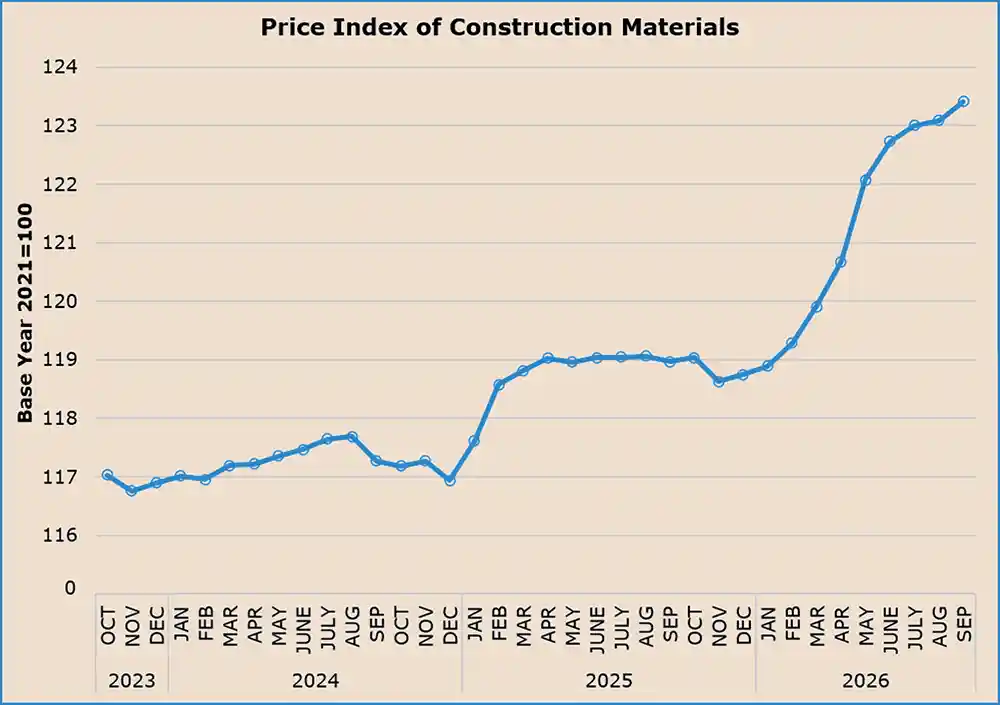
The construction production index also continued its upward trend, reaching 120.7 during the quarter.

Meanwhile, construction output prices rose by 4.7% year-on-year to an index level of 129.5, suggesting developers have maintained pricing power despite slower growth in production volumes.

Property market demand remains healthy

Cyprus’ property market also continued to perform well.

Sales contracts reached 10,007 during the first six months of 2026, representing a 15% increase compared with the same period last year. This builds on the strong performance seen in 2025, when annual property transactions also increased by 15%.

Demand remains strong among both local and overseas buyers.

Purchases by Cypriot nationals increased by 10%, while foreign buyer activity rose by an even stronger 23%.

Interest from European Union buyers was particularly impressive, with transactions increasing by 29%. Purchases by non-EU buyers also grew by 20%, underlining Cyprus’ continued appeal as an international property investment destination.

Importantly, property sales have remained resilient despite the recent escalation of tensions in the Middle East, suggesting regional uncertainty has not yet weakened buyer confidence.

Mortgage lending supports housing market

Mortgage lending continues to provide support to those buying property in Cyprus.

During the first five months of 2026, new mortgage lending increased by 19.5% year-on-year. This points to healthy demand for housing and suggests residential construction activity is likely to remain strong over the coming months.

Labour shortages become a growing challenge

Despite the positive outlook, the report identifies several challenges facing the construction industry.

Labour shortages have become the biggest concern for developers. Around 38% of construction firms now say a lack of available workers is their main production constraint, compared with just 11% in 2022.

Businesses are also reporting increasing uncertainty, with sentiment beginning to resemble the pattern seen during the COVID-19 pandemic. At the same time, expectations for future construction costs have continued to rise.

Outlook for the Cyprus construction sector

Overall, Eurobank believes Cyprus’ construction sector enters the second half of 2026 from a position of strength.

A strong project pipeline, rising construction activity and healthy property demand continue to support growth across the market. Although labour shortages and geopolitical uncertainty remain important risks, current indicators suggest the sector is well placed to maintain its positive momentum throughout the remainder of the year.

Cyprus property sales rise again as overseas demand grows

As reported earlier, Cyprus property sales continued to strengthen in July 2026, extending the steady growth seen across the island’s real estate market over the past year.

While Cypriot buyers remained the largest group of purchasers, overseas demand continued to make a significant contribution, particularly in the popular coastal areas.

The chart below shows the year-to-date performance of each market segment dating back to 2008. It is worth noting that the Department of Lands and Surveys only began reporting separate figures for EU and non-EU buyers in 2018. Before then, all foreign purchases were grouped together under the category of overseas sales contracts.

Cyprus property sales market analysis July 2026

Domestic buyers remain the largest part of the market

Cypriot buyers accounted for 1,211 property sales in July, representing 59% of all transactions completed during the month. This compares with 1,080 sales in July 2025, an increase of 12%.

Performance varied across the districts.

Domestic sales declined in Larnaca, where transactions fell 13% to 232, and in Famagusta, where sales dropped 9% to 49.

However, stronger activity elsewhere more than made up for these falls. Limassol recorded the biggest increase, with sales rising 39% to 445. Paphos saw sales climb 29% to 129, while Nicosia recorded a more modest 4% increase to 358.

Domestic (Cypriot) contracts of sale deposited – 2025/2026 Comparison (July)


During the first seven months of 2026, every district recorded higher domestic sales than during the same period last year. Limassol led the market with growth of 24%, followed by Famagusta at 10%, while Paphos and Nicosia reported increases of 3% and 5% respectively.

Domestic (Cypriot) contracts of sale deposited – 2025/2026 Comparison

EU buyer activity records marginal growth

Property purchases by European Union citizens edged higher in July.

A total of 277 sales contracts were deposited by EU buyers, compared with 274 in July 2025, representing annual growth of just 1%.

Sales fell in Famagusta (35%), Limassol (32%) and Nicosia (20%). However, these declines were offset by strong increases in Larnaca, where sales rose 91%, and in Paphos, where they increased by 16%.

Contracts deposited by EU Nationals – 2025/2026 Comparison (July)


Year-to-date figures show that demand from EU buyers continues to improve.

Paphos remains the strongest-performing district, with sales increasing 46% compared with the first seven months of 2025. Larnaca followed with growth of 36%, while Nicosia and Limassol recorded increases of 10% and 2% respectively. Famagusta was the only district to record a decline, with sales down 3%.

Contracts deposited by EU Nationals – 2025/2026 Comparison

Non-EU buyers continue to drive market growth

Demand from non-EU buyers remained particularly strong during July.

A total of 552 property sales contracts were deposited by non-EU purchasers, compared with 478 in July 2025, representing annual growth of 15%.

Although sales in Nicosia fell by 16%, the remaining districts all recorded increases.

Larnaca posted the strongest growth, with sales rising 42% to 150. Famagusta followed with a 35% increase to 31 sales, while Limassol recorded growth of 10% to 190. Paphos also continued to perform well, with sales increasing 6% to 155.

Contracts deposited by non-EU Nationals – 2025/2026 Comparison (July)


The year-to-date figures underline the strength of overseas demand.

Sales to non-EU buyers have increased by 19% during the first seven months of 2026 compared with the same period last year. Every district recorded double-digit growth over the period.

Contracts deposited by non-EU Nationals – 2025/2026 Comparison

Overseas buyers continue to support Cyprus property sales

The latest figures confirm the continued appeal of Cyprus among international buyers.

Combined purchases by EU and non-EU citizens accounted for 41% of all property sales completed during the first seven months of 2026. Demand remains particularly strong in Paphos, reinforcing its position as one of the island’s most popular destinations for overseas purchasers.

Market Segment Summary Analysis 2026 Year to Date

Outlook

The July figures highlight a Cyprus property market that continues to show resilience.

Steady domestic demand, together with sustained interest from overseas buyers, is supporting sales across the island. Coastal districts, particularly Paphos, Limassol and Larnaca, continue to attract strong levels of international interest, helping to maintain the market’s positive momentum as 2026 progresses.

Cyprus property market surges 14% in first seven months of 2026

The Cyprus property market maintained its strong momentum during the first seven months of 2026, with property transactions rising by double digits both year-on-year and in July, according to the latest figures from the Department of Lands and Surveys.

A total of 12,047 contracts of sale were lodged with district Land Registry offices between January and July 2026, compared with 10,561 during the same period in 2025. This represents an annual increase of 14%, underlining continued demand across the island’s residential and commercial property sectors.

July also delivered another positive performance, with nationwide property sales increasing by 11% compared with the same month last year.

All districts report higher transaction volumes

The data show that every district recorded more property transactions during the first seven months of 2026 than in the corresponding period of 2025, highlighting broad-based strength across the Cyprus property market.

Limassol retains top spot

Limassol remained Cyprus’ busiest property market, recording 3,959 contracts of sale during the first seven months of 2026, up from 3,304 a year earlier. The district posted an impressive 20% annual increase, reinforcing its position as the country’s leading property hotspot.

Nicosia recorded 2,564 contracts of sale, compared with 2,432 during the same period in 2025, representing a more modest but still positive 5% increase.

Larnaca continued its steady upward trajectory, with transactions rising to 2,599 contracts of sale, compared with 2,343 in 2025. This equates to annual growth of 11%.

Paphos also enjoyed a particularly strong performance. Property sales climbed to 2,387, up from 1,995 in the first seven months of last year, marking a 20% increase.

Meanwhile, Famagusta recorded 538 contracts of sale, compared with 487 during the corresponding period of 2025, reflecting annual growth of 10%.

Total contracts of sale deposited – 2025/2026 Year-to-Date Comparison

July sales up 11.4%

During July 2026, a total of 2,040 contracts of sale were submitted to district Land Registry offices, compared with 1,832 in July 2025, representing a nationwide annual increase of 11%.

Limassol once again delivered the strongest performance, with transactions rising by 20% to 695 contracts of sale, up from 579 in July last year.

Paphos followed with a 15% increase, recording 395 transactions compared with 342 a year earlier.

Larnaca also reported healthy growth, with sales rising by 10%, from 395 to 436 contracts of sale.

Nicosia’s market remained broadly stable, with 423 transactions recorded compared with 422 in July 2025.

Famagusta was the only district to record a slight decline, with property sales slipping 3% to 91 contracts of sale, down from 94 during the same month last year.

Total contracts of sale deposited – 2025/2026 Comparison (July)

Outlook

The latest figures suggest that the Cyprus property market continues to demonstrate resilience despite broader economic uncertainties. With all districts reporting higher transaction volumes over the first seven months of the year and Limassol continuing to outperform, the market remains on course for another strong year if current trends persist.

Cyprus extends ‘Mortgage to Rent’ scheme until 30 September

Borrowers seeking to join Cyprus’ Mortgage to Rent Scheme have been granted an additional two months to submit their applications, after the Ministry of Finance announced an extension in response to strong public interest.

The application deadline, which had been due to expire on 31 July 2026, has now been extended until Wednesday, 30 September 2026, giving eligible homeowners more time to apply for the government-backed housing support programme.

Extension follows increased demand

In a statement issued today, the Ministry of Finance confirmed that the extension was approved due to the growing number of applications received in recent weeks.

The scheme reopened in May 2026, allowing eligible borrowers another opportunity to participate. While applications resumed earlier this year, the eligibility criteria and participation conditions remain unchanged.

The decision to extend the deadline suggests demand for the programme has accelerated as the original closing date approached.

(According to KEDIPES, a total of 4,269 applications were submitted between 2023 and 31 July 2026, including 929 received between 4 May and 31 July 2026. Of these, 1,211 applications have been approved, with 846 properties already transferred to KEDIPES.)

Applications must be submitted in person

Although application forms are available online as well as from regional offices, the Ministry has reminded applicants that completed applications must be submitted in hard copy only at one of the regional offices of the Cyprus Asset Management Company (KEDIPES).

Applications can be lodged at KEDIPES offices in:

  • 7 Grigori Afxentiou Street, Nicosia 1096
  • 97 Gladstonos Street, Oasis Complex, Block E, 3rd Floor, Limassol 3032
  • 5 Giorgou Christodoulidi Street, Larnaca 6041
  • 7 Kinyras Street, Corner of Koroivou Street, Galaxias Building, Shop 4, Paphos 8011
  • 4 Griva Digeni Street, 1st Floor, Paralimni 5281

Applicants should ensure all required documentation is included before submitting their forms.

Further information

Anyone seeking further information or guidance on the Mortgage to Rent Scheme can contact the KEDIPES customer service centre on +357 22 743400.

The latest extension provides eligible borrowers with a further opportunity to benefit from the scheme before the revised 30 September 2026 deadline.

Cyprus valuers warn against relying on online property valuations

The Cyprus Association of Property Valuation Professionals (SEEAK) has urged homeowners, buyers and investors to exercise caution when using online property valuation tools, stressing that automated estimates are only indicative and should never replace a comprehensive professional valuation.

In a statement, the association, a member of the Cyprus Chamber of Commerce and Industry (CCCI), said online platforms and automated valuation systems can serve as useful supporting tools by providing an initial estimate of a property’s likely value. However, they should not be regarded as definitive assessments.

Automated models cannot reflect every property

According to SEEAK, most online valuation platforms rely on automated models, publicly available datasets and standardised assumptions. As a result, they often fail to capture the unique characteristics, condition and individual features that influence the true market value of a property.

The association warned that automated estimates should be viewed as a starting point rather than an accurate reflection of a property’s worth.

Professional inspection remains essential

SEEAK said a reliable, evidence-based property valuation must be carried out by a suitably qualified professional valuer.

A thorough on-site inspection, assessment of the property’s physical condition, detailed understanding of the local market and application of recognised professional standards all form essential parts of the valuation process.

The association also warned that automated valuation results should not be relied upon when making significant financial, investment or lending decisions.

To illustrate the point, SEEAK compared online property valuations to searching medical symptoms on the internet. Just as an online diagnosis cannot replace a consultation with a doctor, an automated valuation cannot substitute for the professional judgement of an experienced valuer who has personally inspected the property.

International standards draw a clear distinction

SEEAK said its position is fully aligned with both international and European valuation standards, which clearly distinguish automated valuation models (AVMs) from professional property valuations.

The International Valuation Standards Council (IVSC) states that a fully automated model operating without the involvement of a qualified valuer cannot produce a valuation that complies with the International Valuation Standards (IVS). This is because such models do not apply professional judgement and therefore cannot provide an expert opinion on market value.

The latest IVS 2025, which came into force on 31 January 2025, introduces enhanced governance, data quality, modelling and quality assurance requirements. It also defines automated valuation models as systems that generate calculations without applying professional judgement.

In its position paper on the growing use of artificial intelligence in property valuations, the IVSC further emphasises that professional valuers must remain responsible for selecting data, evaluating valuation models and verifying the accuracy of results.

RICS and European banking rules support the same approach

SEEAK noted that the Royal Institution of Chartered Surveyors (RICS) adopts a similar position through its globally recognised Red Book valuation standards.

Where artificial intelligence, automated valuation models or valuation software are used, the resulting assessment can only be considered a formal written valuation if it has been reviewed and endorsed through the professional judgement of a qualified valuer.

The 2025 edition of the Red Book strengthens mandatory standards relating to automated valuation models while introducing additional provisions covering automation and artificial intelligence.

The association also highlighted guidance issued by the European Banking Authority (EBA) on loan origination and monitoring. These guidelines require properties offered as loan security to be valued by a professional valuer. Even where advanced statistical models are used as supporting tools, responsibility for the final valuation remains with the qualified professional.

Similarly, the European Valuation Standards published by TEGoVA, together with the European AVM Alliance, classify statistical valuation methods separately from full professional valuations, recognising their role as supporting rather than substitute tools.

Property valuation is a regulated profession in Cyprus

SEEAK is encouraging members of the public to understand the capabilities and limitations of every online property valuation service before relying on the results.

Where an accurate and dependable assessment of a property’s value is required, the association recommends instructing a qualified professional valuer.

It also reminds consumers that property valuation is a legally regulated profession in Cyprus, with valuations carried out by registered members of the Cyprus Scientific and Technical Chamber (ETEK) who are authorised to practise in the relevant professional discipline.