Immovable Property Tax discount

Immovable Property Tax discountCABINET has approved a bill to extend the deadline for paying Immovable Property Tax until November 30, 2015.

The bill also provides for a 15% discount for those who pay by the end of October – plus a further discount of 2.2% is available if payment is made online via JCC Smart or through a bank..

The proposals were tabled by the Cyprus Finance Minister Harris Georgiades.

Immovable Property Tax rates and bands remain the same at last year:

Assessed 1980 Property Value
Tax Rate
Tax
Cumulative Tax
€1 to €12,500 nil €0 €0
€12,501 to ?€40,000 0.6% €240 €240
€40,001 to €?120,000 0.8% €640 €880
€?120,001 to €?170,000 0.9% €450 €1,330
€170,001 to €?300,000 1.1% €1,430 €2,760
€?300,001 to €?500,000 1.3% €2,600 €5,360
€500,001 to €?800,000 1.5% €4,500 €9,860
€800,001 to €?3,000,000 1.7% €37,400 €47,260
More than ?€3,000,000 1.9%

Those owning property(ies) whose total 1980 value exceeds €12,500 will pay tax on their total 1980 value.

August property sales weaken

CYPRUS property sales weakened in August, according to official statistics from the Department of Lands & Surveys, with the number of properties sold in August falling 10 per cent compared with the same month last year.

During August a total of 301 contracts for the sale of commercial and residential properties and plots of land were deposited at Land Registry offices across Cyprus, compared with the 335 contracts deposited in August 2014.

Of those 301 contracts 80% (241) were deposited on behalf of domestic buyers, while 20% (60) were deposited in favour of overseas buyers.

Although sales in Larnaca and Paphos increased by 39% and 16% respectively, these increases were more than offset by falls in the other districts. Sales in Famagusta fell 44%, while those in Limassol fell by 32% and those in Nicosia by 30%.

total property sales

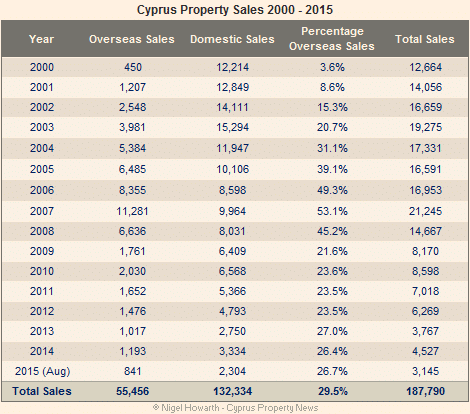
Sales during the first eight months of 2015 are up 6% compared with the same period last year with sales reaching 3,145 compared to 2,955.

While property sales in Nicosia and Famagusta have fallen over the period, they have risen in all other districts – with Limassol proving the most popular achieving 980 sales.

Industry pundits anticipate an improvement following the government moves to reduce Property Transfer Fees, new planning incentives and the approval of the ‘hidden mortgage’ bill by parliament that should resolve the issue of ‘trapped’ property buyers who are unable to obtain Title Deeds due to their developer’s debts.

Domestic demand should also be stimulated following a reduction in interest rates for new mortgages.

Domestic sales

Property sales to the domestic market in August fell 3% compared to August 2014, falling to 301 from 335 last year.

Although sales in Paphos increased by 205% and those in Larnaca by 38%, they fell in all the other districts. Sales in Limassol fell 40%, while those in Famagusta and Nicosia fell by 39% and 29% respectively.

domestic sales

Domestic sales during the first eight months of 2015 are up 6% compared with the same period last year with sales reaching 2,304 compared to last year’s figure of 2,176.

Overseas sales

Sales to the overseas market in August slumped 30% compared with August 2014. While sales in Larnaca and Limassol rose 44% and 22% respectively, they fell in all other districts.

Surprisingly no properties were sold in Famagusta and only one was sold in Nicosia, while sales in Paphos fell 56% compared to August last year.

overseas sales

During the eight months of 2015, sales to the overseas market have risen 8% compared with the first eight months of 2014, increasing to 841 from last year’s total of 779.

Cyprus has made changes to the law to provide those buying property with more protection, including the ‘hidden’ mortgage law referred to earlier. However Cyprus has to do much more to restore its tarnished reputation and instil confidence in foreigners looking to invest in its property market.

Cyprus property sales 2000-2015


Hidden mortgage bill passed

CYPRIOT MPs took a giant step to resolve the island’s Title Deed-cum-fraud mess that has blighted the property sector and tarnished the reputation of Cyprus at a plenary session of parliament earlier today.

They approved the ‘hidden mortgage’ bill that will sort out the mess created by the failure to provide Title Deeds to people who have paid for their property and fulfilled all their contractual obligations, due to their developer’s debts.

The new law gives the Land Registry the authority to exempt, eliminate, transfer and cancel mortgages and/or other encumbrances, depending on the case and under certain conditions – and includes all sales that took before the end of 2014.

Assuming President Nicos Anastsiades gives his assent to the bill, it should become law in a matter of days when its content will be in the public domain.

From early reports it seems that two amendments were made to the draft bill:

  • Title Deeds will not be transferred to buyers who have failed to comply with their contractual obligations to the vendor regarding Immovable Property Tax, local property tax and sewerage tax (a failure to pay communal charges to the developer will not prevent the transfer.)
  • If the purchaser effects the transfer of the property within 60 days, the Property Transfer Fees may be paid in twelve monthly instalments OR a 10% reduction in the fees will be granted.

From information I have gleaned today I believe that the outstanding debts include all claims that were lodged at the Land Registry before and after a contract of sale was deposited.

Trapped purchasers must be able to demonstrate that they that they have fully complied with their contractual obligations to the vendor and should gather together payment receipts to be presented as confirmation when they submit their application.

If purchasers have lost or were not provided with receipts, it should be possible to obtain cheques, transaction records, etc. from the bank. (A Cypriot who contacted me managed to get copies of his cheques confirming payments from his account with the Hellenic Bank.)

Those who paid in cash without receiving any form of invoice or receipt and who therefore cannot provide the necessary evidence to confirm that they have paid will face problems and may have to bring a civil action in a court if their vendor refuses to provide them with a receipt.

It is my understanding that in the longer term, legislation will be introduced that will enable Title Deeds will be issued for all dwellings that are habitable. However, those dwellings that infringe planning regulations may have ‘notes’ attached to their Title. Also money owed by the vendor will be deducted from payments received from the sale of property before being credited to his account (just like many other European countries.)

Hidden mortgage bill expected to pass

8

Cyprus hidden mortgage bill should passA BILL addressing the issue of ‘trapped’ home buyers without title deeds looks set to breeze through the House plenum this Thursday, following a final-hour consensus struck between the government and political parties.

The core of the government legislation addressed the cases of some 30,000 buyers for whose property title deeds have been issued but couldn’t be transferred to the buyer despite them fully honouring the repayment terms of the sale agreement.

After discussions in parliament, the bill was broadened to also cover an additional 48,000 – also honouring the terms of sale – that had no title deeds issued. Foreclosure proceedings on these cases will be suspended, allowing sufficient time to have the deeds issued.

“It has been demonstrated that the government’s policy was not about fast-tracking foreclosures en masse, which some used as scaremongering, but rather… about solving a long-standing problem for property buyers who, while being consistent with their obligations, saw their property remain in limbo and at risk because of the obligations of other parties or due to weaknesses in the system,” Prodromos Prodromou of the ruling DISY party commented.

He was speaking shortly after Tuesday’s joint session of the House interior and finance committees discussing the bill.

Main opposition AKEL said it will vote for the item, despite the fact it does not cover those who paid up to 80 per cent of the home’s price but were not consistent with the remainder of the balance. These cases are not protected from foreclosure.

The party intends to table a legislative proposal extending by two more years the suspension of foreclosure proceedings for this category. The foreclosure exemption for ‘trapped’ buyers currently expires on September 5.

DIKO meanwhile plans to table an amendment next week whereby ‘released’ home buyers would be allowed to settle outstanding transfer fees in 12 monthly, interest-free equal payments, after the property has been transferred to them.

The government bill is meant to sort out the mess created by the failure to issue title deeds to people who paid for the property, either because the property was mortgaged by the developer, or the state could not go ahead with the transfer because of outstanding taxes.

Since developers’ land and buildings are counted as assets that need to be offset against their debt to banks, this gives lenders a claim on people’s properties that had been mortgaged by developers.

The bill grants the head of the land registry department the authority to exempt, eliminate, transfer and cancel mortgages and or other encumbrances, depending on the case and under certain conditions.

It covers transactions up until December 31, 2014.

The bill provides for the balance on a property sale price to be paid into a special temporary account, allowing the director of the land registry department to initiate the transfer procedure.

The elimination or transfer of mortgages and or other encumbrances will take place within 45 days of a notice sent out to affected parties, who have the right to appeal.

Mortgagors (typically property sellers) may request that the encumbrance be transferred onto other properties they own. If they do not own other property, they may request that the encumbrance be transferred onto the property of persons who guaranteed their loans.

‘Released’ properties will be transferred to the name of the buyer, who will bear all transfer fees. The buyer is subject to a 100 per cent penalty on the fees if he or she does not pay them within the specified deadline.

The director of the land registry department will strike any encumbrances on a property with a title deed before it is transferred.

Resolving the title deeds muddle is a ‘prior action’ set by Cyprus’ international creditors for releasing the next bailout tranche.

Hole in hidden mortgage bill plugged

hidden mortgage billSINCE my comments concerning the draft bill designed to protect ‘trapped buyers’ from losing their homes despite having paid for them were published in the Sunday Mail, it appears that Interior Minister Socrates Hasikos has had a change of heart.

The draft bill, which enabled Title Deeds to be issued to property buyers who purchased property from nefarious  developers who had built and sold homes on land that they had previously mortgaged to the bank and who are now unable or unwilling to repay the debt, contained a flaw; it only applied to around 30,000 properties that had been issued with their Title Deed.

This left the buyers of a further 48,000 homes, which have not had their Title Deeds issued, at risk of foreclosure.

It appears that this ‘hole’ in the bill has been resolved. At yesterday’s joint meeting of the House Finance and Interior committees, Socrates Hasikos announced that the buyers of these 48,000 properties would also be protected from foreclosure.

The draft bill will be discussed by a special plenary session of parliament on Thursday (3rd September) – and there may be some changes to the draft discussed and agreed before a majority of MPs vote it into law – and then President Anastasiades has to give his assent.

Demetra Valianti Plati from the Association of Cyprus Banks has complained that the bill will leave the banks exposed, but Mr Hasikos has invited the media to speak with the presidents of the Cyprus Banks to see if they are concerned.

Although it may be possible for a bank to submit an objection to the issue of a Title Deed to a ‘trapped’ buyer, a representative from the Central Bank reported that if the banks knew about the sale of the property or gave a loan guarantee, their objection would be rejected.

However, there are a small number of cases (between 5% and 10%) where the bank will be entitled to object as it did not know about the sale. These cases would include cash buyers who did not require a loan from the bank. But even if the banks raise objections in these cases, there is no guarantee that they will be successful.

(On the last point, the banks must have known when monies from the sale of property were deposited in the developer’s bank account?)

Some relief for trapped buyers

THE government bill allowing the issue of Title Deeds to those who bought property from insolvent land-developers on previously mortgaged land is a step in the right direction, although more needs to be done to iron out more particular problems, property expert Nigel Howarth told the Cyprus Mail on Friday.

Such ‘trapped’ buyers have found themselves at risk of losing their properties in recent years despite having paid for them, since several developers defaulted on their loans, which were backed by properties they had since sold to unsuspecting buyers.

In the wake of the enactment of tougher foreclosure rules, parliament voted to suspend implementation on such special cases until 5th September, with the government hoping to pass the bill two days earlier.

“From what I hear, it’s a positive step in the right direction,” Howarth said.

“My understanding is that it only applies to properties for which Title Deeds have already been issued, so the rest of the cases need to be covered before the foreclosure ban is lifted. Which means, of course, that the ban – which expires on September 5 – should be extended until a comprehensive solution can be found.”

According to Howarth, cases in which no Title Deeds have been issued for the property are not covered by this proposal.

“The Land Registry is going to have a problem in these cases, because it won’t be able to calculate how much of the mortgaged property should be released,” he explained.

“Say, for example, that a developer has mortgaged a piece of land, on which he has built six houses of different sizes, of which only one has been sold and the buyer is now ‘trapped’. If there’s no Title Deed, how will the Land Registry calculate what part of the original mortgage should be removed or transferred to the developers’ other assets?”

While all parties have voiced support for the bill, most pointed out weaknesses and areas for improvement.

AKEL spokesman Yiorgos Loukaides said the party is willing to support the bill, provided its proposal to extend protection from foreclosure to all trapped buyers who honour their contractual obligations – i.e. have not missed loan repayments.

The Greens deputy Yiorgos Perdikis said one of the crucial issues that need to be clarified is the role of the Land Registry’s director, whom the bill names as having the final – and sole – say on approving or rejecting applications.

And Citizens’ Alliance deputy head Stelios Americanos said the law must not only cover those who have submitted the deed of sale to the Land Registry, but everyone who can demonstrate that they have paid for the property in full.