Banks to recoup loans by ‘hook or crook’

BANKS must “by hook or crook” find a way to recoup loans given to insolvent developers once ‘trapped’ properties are finally released to home buyers, Interior Minister Socrates Hasikos said on Thursday.

“Back when they were dishing out loans like there was no tomorrow, what were they thinking? Now let them work it out with the developers,” Hasikos said.

He was speaking to the Cyprus Mail after a joint session of the House interior and finance committees discussing a bill aimed at releasing house buyers from developers’ obligations to lenders.

The bill is meant to sort out the mess created by the failure to issue title deeds to people who paid for the property, either because the property was mortgaged by the developer, or the state could not go ahead with the transfer because of outstanding taxes.

Since developers’ land and buildings are counted as assets that need to be offset against their debt to banks, this gives lenders a claim on people’s properties that had been mortgaged by developers.

The bill grants the head of the land registry department the authority to exempt, eliminate, transfer, and cancel mortgages and or other encumbrances, depending on the case and under certain conditions.

It covers the period up until December 31, 2014. For transactions after that date, Hasikos said a separate bill would be submitted.

Banks object to the proposed legislation, arguing that lenders will take a hit once such ‘trapped’ properties are released.

Some 48,000 immovable properties lack a title deed, and another 30,000 do possess a deed but have not been transferred to their owners, according to the Department of Lands and Surveys.

Speaking in parliament, Hasikos differentiated between the two categories, explaining that a deed may be issued to buyers making regular payments toward their house, provided the property is ‘clean’, as in all the paperwork – such as town-planning permits – is in order.

Someone who made a down-payment of €1000 and has been paying €1000 a month in instalments would be protected under the new bill, he said by way of example.

For those with a title deed but where the property has yet to be transferred to them, the transfer could be completed within “approximately three months” of the owner applying to the Department of Lands and Surveys.

The banks association argued that the bill grants the Department of Lands and Surveys excessive discretionary powers.

Demetra Valianti Plati, a senior officer with the association, proposed that for complex cases the director of the Department of Lands and Surveys should assign the analysis of the data to a professional arbitrator, who will then decide the fate of the property.

For his part, Attorney-general Costas Clerides acknowledged the bill’s shortcomings, particularly the potential legal pitfalls.

“It is fair that buyers are protected by the law so that they can take possession of what they are entitled to. At the same time, this might interfere with the agreements between the banks and the developers.”

However, he added, the bill does give the option to transfer the mortgage from one developer’s property to another, so that the bank does not lose the security for the loan.

AKEL MP Yiannis Lamaris highlighted another drawback. The bill, he said, covers primarily those who have paid up in full for their residential unit or can settle the outstanding amount within 15 days.

But people who do not fall into this category would run the risk of having their homes repossessed.

Under an earlier deal struck between the government and the legislature, ‘trapped’ properties are to be exempted from foreclosure until September 5.

That is also the date by which the trapped properties bill must pass, so that Cyprus complies with the terms of its bailout programme and is eligible for the next loan tranche from its international lenders.

An extraordinary session of the House plenary is planned for next Thursday, September 3, to push the bill through.

Opposition MPs called for more time to discuss the legislation to get it right, even if it meant the €500m loan tranche is delayed by a few weeks.

But Hasikos sounded upbeat that a consensus can be reached by the September 3 date.

Asked by the Mail what would happen to developers’ obligations to the banks once a property is released to the buyer, Hasikos said the liabilities would not be written off.

“The developer’s obligation to the bank will remain. So the security for a developer’s loan for one building project could be transferred onto another asset.

“And if the developer has no other immovable assets, the bank will go for their liquid assets, cash, whatever,” he added.

“Let the banks find the money, by hook or crook. It’s on them,” he commented.

On the possible impact on the lenders, Hasikos said only that the Central Bank has done some number-crunching and “is OK with it.”

NPLs long road ahead

NPLs-long-roadNON-PERFORMING loans (NPLs) in the Cyprus banking system remain very high, two months after the implementation of the new foreclosures and insolvency laws.

Although some of the banks have started to initiate foreclosure proceedings on properties pledged as collateral, new figures from the Cyprus Central Bank show that the banks still have a very long way to go to reduce their NPLs.

According to the Central Bank, NPLs reached €27.04 billion at the end of June, an increase of €68.2 million from the €26.97 billion reported at the end of May.

Loans to households stood at €23 billion of which 54.97% (€12.6 billion) were non-performing.

Construction loans amounted to €6.6 billion, of which 77.5% (€51 billion) were non-performing.

Loans for real estate activities stood at €4.1 billion of which 54.5% (€2.2 billion) were non-performing.

Further reading

Aggregate data for the Cyprus banking and co-operative sectors (Cyprus Central Bank 20.08.2015)

Debt relief and foreclosures

foreclosuresSPEAKING with the Cyprus News Agency earlier today, head of the Cyprus Insolvency Service Giorgos Karotsakis said that the Service had received four applications since details of the scheme were published on 7th August.

Mr Karotsakis expects that many more applications will be submitted soon as private insolvency practitioners have advised the Service that they are preparing applications for the scheme.

The scheme enables individuals with assets below €1,000 and a monthly income of less than €2,000 to apply to the court, via the Insolvency Service, for an “order of debt relief” of up to €25,000 – providing they meet certain criteria.

Mr Karotsakis also said that the Service had received two applications from borrowers who had authorised two insolvency practitioners to draft personal repayment plans.

Meanwhile is seems likely that the Bank of Cyprus will be the first bank to initiate foreclosure proceedings on properties pledged as collateral for around €85 million worth of non-performing loans.

Speaking to the Cyprus Mail by phone an anonymous source was reported as saying: “There are about 25 cases, all of them dating back to 2013 or earlier, for which a court decision has already been issued. In five days, bailiffs will start notifying both borrowers as well as guarantors that the foreclosure procedure will be initiated.”

The properties include “commercial properties and land”; no primary residences are affected.

The source added that the foreclosures are expected to take place at the start of September.

Property sector challenges remain

Property sector challenges remainINVESTMENTS in the property sector are low and despite the significant decrease in mortgage rates, they remain well above the Eurozone average reports Ernst & Young Cyprus Ltd (EY) in its second edition of its Real Estate Dynamics Report, which provides a comprehensive analysis of recent developments in the island’s property sector.

Ernst & Young reports that while the number of contracts deposited at Land Registry offices and property transactions increased 7% and 2.9% respectively during the first half of 2015, the contribution of the construction and real estate sectors to the island’s Gross Domestic Product (GDP) continued to decline during the first quarter of 2015, albeit at a slower rate.

After fourteen consecutive quarters of economic recession, the island’s GDP grew 0.2% in the first quarter of 2015, but at the same time, investments in the construction sector remained low (€306.1 million or 7.1% of GDP) compared to the previous year.

The report notes that the parliament agreed foreclosure legislation in May, paving the way for Cyprus to take part in the European Central Bank’s quantitative easing program and that parliament passed a series of laws relating to property taxation on 9th July “aiming to stimulate activity and growth in the property and construction sector”.

The report emphasizes that dealing with the high-level of non-performing loans (NPLs) is the most significant challenge faced by Cypriot banks. Restoring the financial health of the banking sector is key step in the economic recovery of the island.

Further reading

Real Estate Dynamics – Issue 2 Ernst & Young Cyprus Ltd.

Insolvency service ‘inundated’

insolvency serviceTHE GOVERNMENTAL Insolvency Service has been inundated with information requests about the debt forgiveness scheme, the head of the service said on Thursday.

Giorgos Karotsakis told the state broadcaster that over the last week alone hundreds of people have been downloading the printable debt forgiveness applications available online.

The service’s website crashed and went offline for two days because of the high traffic.

“These are people who have tried other avenues, who are desperate,” Karotsakis told CyBC.

The application form consists of several pages.

Under certain criteria, borrowers are eligible for an up to €25,000 debt forgiveness from banks, and up to €2500 on tax dues.

A borrower may file a request for debt relief, along with a sworn statement, with the government’s insolvency service.

This applies to persons with net monthly income of up to €200 and owning assets worth up to €1000 (not including reasonable living expenses).

If the insolvency service is satisfied that the applicant meets the criteria set out under the law, it then issues a certified statement and the borrower will be represented in court for the issuing of a debt relief order.

Unless the creditor (bank) responds within 21 days of the filing of an application, the court will by default issue a debt forgiveness order.

July property sales up 22 per cent

Cyprus property sales increaseA TOTAL of 496 contracts for the purchase of commercial and residential properties and land in Cyprus were deposited at Land Registry offices during July; an increase of 22% increase on the 407 contracts deposited in July 2014.

Of those 407 contracts, 71% (350) were deposited on behalf of domestic buyers, while 29% (141) were deposited on behalf of overseas buyers.

The improving sentiment in the property market follows moves by the government to reduce Property Transfer Fees, introduce an amnesty for illegal building extensions and plans to issue Title Deeds to those duped by nefarious developers into buying property built on mortgaged land.

With the exception of Nicosia, where property sales declined 7.7% compared to July last year, sales rose in all other districts. In percentage terms Famagusta performed best with sales rising 96% with 45 sales compared to the 23 sold in the same period last year, while sales in Larnaca, Paphos and Limassol rose by 32%, 30% and 12% respectively.

Cyprus property sales

The total number of sales during the first seven months of 2015 is up 8.5% compared with the same period last year with sales reaching 2,844 compared with 2,620.

Domestic sales

Property sales to the Cypriot market rose 11% compared to July 2014, rising to 350 from 315 during July last year.

While sales fell in Nicosia and Paphos, by 8% and 7% respectively, they improved in all other districts. In percentage terms Famagusta performed best with sales rising 1300% to reach 28 compared to the 2 sold in July 2014, while sales in Limassol and Larnaca rose 15% and 7% respectively.

Domestic sales chart

During the first seven months of 2015, property sales to the domestic market have increased 7% compared with the same period last year having risen to 2,063 from 1,927.

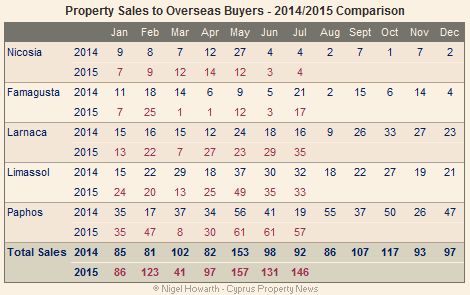
Overseas sales

Sales to the overseas market rose 59% in July compared to July 2014, rising to 146 from 92 sold in July last year.

Although sales in Famagusta fell 19% and remained steady in Nicosia, they increased in the other three districts.

Paphos performed best with sales rising 200% to reach 57 compared to the 19 sold in July 2014, while sales in Larnaca and Limassol rose 119% and 3% respectively.

Overseas sales chart

During the first seven months of 2015, property sales to the overseas market have increased 13% compared with the same period last year having risen from 693 to 781.

Cyprus property sales analysis 2000-2015