Building permits May 2015

Cyprus building permits statisticsTHE NUMBER of building permits authorised in May 2015 stood at 434 compared with the 460 authorised in May 2014; a fall 5.7%, according to the latest figures from the Cyprus Statistical Service.

Compared with May 2014, the total area of these permits rose 35.9% to 90,760 square metres from 66,760, while their value surged 97.5% to €123.4 million from €62.4 million.

During May, building permits were issued for:

  • Residential buildings – 272 permits
  • Non-residential buildings – 91 permits
  • Civil engineering projects – 25 permits
  • Division of plots of land – 39 permits
  • Road construction – 7 permits

During the first five months of 2015 the number of building permits authorised for both residential and non-residential projects has fallen by 3.0% to 2,034 compared with the 2,097 authorised in the same period last year, while their value has risen by 21.0% to €437.6 million and their area has increased by 17.9% to 384.5 thousand square metres.

New home construction

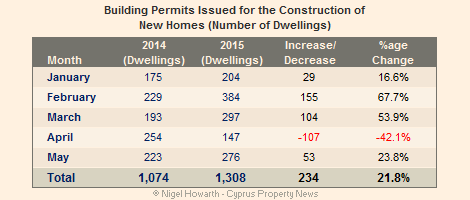
The 272 residential building permits approved in May provided for the construction of 223 new dwellings comprising 135 single dwellings and 141 multiple dwelling units (such as apartments, semis, townhouses and other residential complexes).

This is an increase of 23.8% compared with May 2014 when building permits were issued for the construction of 223 new dwellings.

Cyprus new home construction May 2015

According to the Cyprus Statistical Service, building permits constitute a leading indicator of future activity in the construction sector.

Guidelines on restructuring loans

restructuring loansTHE DEBTORS ASSOCIATION on Monday published guidelines advising borrowers of their rights and what steps they can take when being squeezed by the banks.

The detailed, step-by-step list of guidelines comes days after the Central Bank released its latest data on non-performing loans (NPLs).

Between January 2014 and end of March of this year, commercial banks restructured NPLs worth €4.9bn, or 19.2 per cent of NPLs in the entire system.

Borrowers, except those falling within the scope of the financial ombudsman laws may, within 14 days of the first bank notice proposing a restructuring plan for their debt, contact the bank and discuss the proposed plan.

Should a borrower reject the plan, or the bank fail to come up with any restructuring scheme, then the debtor is entitled to file an appeal with the lender’s dispute resolution committee. Where the borrower has rejected the bank’s restructuring plan, the committee will investigate whether the plan was suitable for the borrower.

Appeals to banks’ dispute resolution committees must be submitted within one month of receiving the bank’s response to the borrower’s rejection of the restructuring plan, or one month from the date of receipt of the bank’s decision by which the lender refused to deliver a restructuring plan.

Borrowers with outstanding debt up to €350,000 – secured by mortgage – may apply with the financial ombudsman to appoint a mediator, within 14 days of having submitted their financial data to the bank. The whole process – appointment of a mediator, the mediation procedure and the bank’s submission to the borrower of a restructuring proposal, as this arises after the mediation is concluded – may not take more than one month.

A bank may not initiate any legal or arbitration proceedings, nor initiate proceedings to sell a mortgaged property by auction, prior to the completion of a mediation procedure.

For financial disputes up to €170,000, borrowers who have a complaint against a bank – for example, for illegal charges – may submit their complaint in writing to the bank within 15 days of having been appraised of the issue.

The bank notifies the borrower that it has received the complaint within 15 days, and responds to the complaint within three months.

If the bank does not respond within this deadline, or if the borrower is not satisfied with the response, he or she is entitled within four months to submit a complaint to the financial ombudsman with the aim of settling the dispute. The ombudsman’s decision will be binding only where both the lender and the debtor have agreed to this.

Where debts do not exceed €25,000, a borrower may file a request for debt relief, along with a sworn statement, with the government’s insolvency service. This applies to persons with net monthly income of up to €200 and owning assets worth up to €1000 (not including reasonable living expenses). If the insolvency service is satisfied that the applicant meets the criteria set out under the law, it then issues a certified statement and the borrower will be represented in court for the issuing of a debt relief order.

Where a borrower’s total debt is €25,000 and over, the eligible debt is distributed among the various creditors. Once a debt relief order has been issued, the bank may neither continue nor initiate any procedure, legal or otherwise, against a borrower or his/her guarantors, in relation to recouping the eligible debt.

Borrowers who are insolvent – are unable to repay all of their debts – and who have not, for three years prior to filing for a personal repayment scheme – had their debt forgiven by a debt relief order, may appoint an insolvency consultant, who will prepare and submit a personal repayment scheme proposal to the creditors.

Before this proposal is submitted, the borrower files a request with the insolvency service which, if satisfied that all is in order, will issue a protective certificate, to be used in court for issuing a protective order for the borrower’s assets.

The protective order remains in force for 95 days, and while it is in force creditors served with the order may not initiate any legal or court proceedings against the borrower. Next, once the debt validation procedure has been completed, the insolvency consultant calls a meeting of the creditors to examine the proposed personal repayment scheme.

Where creditors have rejected the insolvency consultant’s proposal for a debt repayment scheme, and provided that the borrower’s total debts do not exceed €350,000, the borrower may seek a court order forcing the creditors to accept the scheme. This applies where at least one of the creditors has collateralised the borrower’s primary residence to the tune of up to €300,000, and where the borrower’s other total assets are worth €250,000 and less, and the borrower demonstrably has suffered an income reduction of 25 per cent due to the financial crisis.

When a personal repayment scheme is in force, and where the market value of the mortgage is equal to or greater than the principal’s debt, the guarantor is released of liability. If the value of the mortgage is less than the debt, the guarantor is liable only for the difference between the property value and the balance of the debt.

Creditors may not foreclose on a guarantor’s primary residence as a result of the principal’s failure to meet his or her obligations, unless the guarantor has expressly put up his or her residence as collateral for the debt in question. In addition, a bank may not take any legal action against a guarantor after two years have elapsed since a personal repayment scheme has entered into force.

If the debt relief order or personal repayment scheme does not produce a result, borrowers who are completely unable to repay their debts due to the financial crisis, may apply for a court-issued debt waiver, a bankruptcy discharge or an order suspending for six months foreclosure proceedings on a mortgaged primary residence or business premises.

Borrowers may at any stage, up until receipt of the first foreclosure notice (‘Type IA’), file a lawsuit against a bank in relation to inflated debt balances or unfair terms of contract. Also, within 30 days of receiving the above-mentioned notice, a debtor is entitled to file an appeal with a district court to set aside the notice, provided certain conditions are met.

Within ten days of being served with the ‘Type IB’ foreclosure notice, borrowers may appoint their own property valuer.

Once an auction is underway, the reserve price is fixed at 80 per cent of the property’s market value, and the mortgaged property may not be sold below the reserve price. If no sale takes place, the creditor may continue efforts to sell the property, either via another auction or directly, again at a reserve price of 80 per cent, for a period up to three months after the first auction.

After the three months have elapsed, the reserve price no longer applies. If the bank fails to sell the property within one year of the first auction, it may buy the property at its market value, or put it up for auction or sell it directly at a reserve price of 50 per cent of the updated market value.

Lenders must notify debtors in writing 20 days in advance of the sale of the property.

Aristo acquittal appealed

Theodoros Aristodimou MD Aristo Developers
Theodoros Aristodemou (Photo credit: ? ????????????)

THE STATE has appealed a court decision to acquit prominent developer Theodoros Aristodemou, his wife, and two others, in connection with a suspicious land development project in Paphos.

The decision was issued by the Paphos Criminal Court on July 28.

Aristodemou, wife Roulla, company draftsman Christos Solomonides, and former municipal engineer Savvas Savva had been charged in relation with the demarcation of land in Skali.

The court had heard that the company had been granted a permit for 177 plots but this was allegedly falsified later by replacing the approved architectural plans with amended ones, which ceded the company an additional area of 2,730 square metres for development at the expense of the legally mandated green space and road network.

The land was estimated to be worth around €1.1m.

In its verdict, the Paphos Criminal Court cleared the defendants of all charges. These included forgery, circulation of a forged document, conspiracy, abuse of authority, bribery, and obtaining property under false pretences.

Delivering verdict – which lasted three hours – presiding judge Dora Sokratous said the state prosecutors had failed to prove intent to defraud the public beyond a reasonable doubt.

The court concluded that, despite “certain irregularities” in the paperwork and the manner it was compiled, there was no deliberate intent on the part of the accused to secure a town planning permit under false pretences or to conceal the true dimensions of the green area within the land in question.

The court noted that during the initial police investigation, a statement by a Paphos municipality technician had pointed to discrepancies in the company’s architectural blueprints as these were submitted to the municipality.

It subsequently emerged during the trial that the police investigators had incorrectly transcribed the numbers cited by the technician.

The technician, Savoulla Kouspou, took the stand for the prosecution. During the end-stage of the trial, the state prosecutor had asked the court to strike her testimony from the record.

On the alleged bribery of former municipal engineer Savvas Savva by Aristodemou, the court likewise said this was not proven.

According to police findings, Aristodemou cashed a cheque for €20,000 in €500 notes in August 2010.

Two days later, Savva was found to have deposited the same amount, in notes of identical denomination, to his own bank account.

The court said that although the proximity of the two dates “may create suspicion, it is not sufficient, based on the defendants’ testimony, to lead to a certainty of guilty.”

Savva, who was facing charges of corruption, claimed the money had come from his aunt and uncle.

Aphrodite Hills sold

Aphrodite HillsBANK of Cyprus completed the sale of its stake in Aphrodite Hills Ltd to a group of investors, for €90 million, keeping a minority stake of 10%.

According to the announcement, “further to the agreement reached by the Bank of Cyprus for the sale of its equity stake in Aphrodite Holdings Ltd, the holding company of the Aphrodite Hills Resort, to a group of investors including Invel Real Estate Management Ltd and funds managed by York Capital Management, the Bank announces that the Commission for the Protection of Competition in Cyprus has declared the transaction compatible with the conditions of the competitive market.

“The agreement values the Company in excess of €90 million and according to its terms, the Bank will retain a 10% minority equity stake in the Company. The Bank had acquired 75% of the Company’s equity stake from the previous majority shareholder in October 2014.”

The execution of the transaction was subject to the Commission for the Protection of Competition’s consent.

The Aphrodite Hills Resort is involved in the development and sale of residential property and the ownership and administration of a golf resort and a 290 room hotel.

Immovable Property Tax 1980 values

Immovable Property Tax calculationTHE ANTICIPATED changes to property taxes in Cyprus that were scheduled to be implemented this year have been postponed until 2016.

The changes, which amalgamated Immovable Property Taxes imposed by the Tax Office and the municipality and community authorities into a single tax based on 2013 property values, will not be discussed by Parliament until after the summer recess – despite the government’s request to pass the bill before the summer break.

The Tax Office has started to issue IPT notices to home buyers and owners who should receive them later this month – and the municipalities and communities have also started sending out tax demands.

Immovable Property Tax rates

The rates remain the same as last year:

Assessed 1980 Property Value
Tax Rate
Tax
Cumulative Tax
€1 to €12,500 nil €0 €0
€12,501 to ?€40,000 0.6% €240 €240
€40,001 to €?120,000 0.8% €640 €880
€?120,001 to €?170,000 0.9% €450 €1,330
€170,001 to €?300,000 1.1% €1,430 €2,760
€?300,001 to €?500,000 1.3% €2,600 €5,360
€500,001 to €?800,000 1.5% €4,500 €9,860
€800,001 to €?3,000,000 1.7% €37,400 €47,260
More than ?€3,000,000 1.9%

Those owning property(ies) whose total 1980 value exceeds €12,500 will pay tax on their total 1980 value.

Early bird discount

Those who pay IPT to the Tax Office early will receive a 10% discount. (Last year the government offered a 15% early-bird discount, which was only valid for 2014. This may be offered again, but it will have to be discussed by parliament after MPs return from their summer break.)

Lawyers complicit in Title Deeds scandal

IT IS MY unhappy duty to point out that, in all of the discussions and bally-hoo about the Title Deeds problems in Cyprus, there is one glaring omission for which I can only blame the press, the presumed guardians of the people’s rights.

I should explain that more than 10 years ago my wife and I were in at the beginning of Denis O’Hare’s Cyprus Property Action Group (CPAG) whose investigations did so much to expose the rottenness of the real estate business in this country.

Much of the blame for the present state of affairs has rightly fallen on crooked developers and their accomplices in the banks. But in this vast field scarcely a word can be heard of the nefarious dealings of the fourth participant, the virtually invisible conveyancing lawyer whose perfidy has earned them as a group their designation as one of the largest, if not the very largest, criminal classes in Cyprus.

Case after case investigated by the Cyprus Property Action Group revealed that the real culprit in the transaction was the buyer’s lawyer, whom the typical British buyer had characteristically trusted to look after his or her interests, including title searches to ensure that the property was free of encumbrances. Without the lawyer’s witting or unwitting collusion, a large part or most of these mortgage problems would have been avoided as, had the buyer become aware of these obstacles, he or she would simply not have bought the property. CPAG also found that many lawyers had secretly represented both sides in the transaction or had even “gone over” to the other side later on.

The simple fact is that the prudent foreign would-be buyer almost invariably hires a lawyer to represent his or her interests and is only too frequently deceived and cheated by this fourth element in the transaction.

It is further pointed out that this is no secret. Everyone knows that “legal ethics” in Cyprus is a rather bad joke. But why has the problem so rarely been included or even mentioned in the course of all the publicity that has been given to the subject? In the whole vast area of property matters hardly a single whisper of legal chicanery can be heard.

One can only conclude that the legal profession, which provides the majority of MPs, is one whose faults and sins simply cannot ever be discussed or even raised. For this to be possible, one can only blame the newspapers that are clearly reluctant to report on these issues and fear even to talk about them.

Please prove me wrong by printing this letter.

John Knowles, Peyia

Further reading

CPAG report ‘Cyprus Property Pitfalls – a time for Action!‘ commissioned by the Cyprus Finance Minister in late 2007, delivered in January 2008 – and ignored by the Catastophias AKEL government.