Illegal building extensions amnesty

THE GOVERNMENT has decided to introduce special measures that will allow town-planning authorities to approve certain existing or planned constructions that would otherwise be illegal.

The amnesty involves additions or changes to existing structures and must have taken place before the end of 2020.

“With a simple application the town-planning authority, which will be obliged to issue a permit inside three months, all illegal cases will be legalised,” Interior Minister Socratis Hasikos said on Wednesday.

And it does not only involve verandas turned into rooms or construction of garages or sheds, which traditionally resulted in the owners being deprived of a title deed.

“We are giving our fellow citizens the right to add up to 20 per cent of the (building) coefficient,” he said. “They can add a small flat above their home, add a room, and so on.”

He said the measure would help people because it would offer them a better quality of life and afford them a title, allowing them to mortgage and sell their property.

The measure involves existing industrial and commercial units.

Asked what the gain for the state would be, Hasikos said this was not about the state.

“Honestly, this does not aim at compelling people to issue title deeds so that we can have revenues.”

He added that the government afforded incentives for large developments because of the economic crisis, and it was now also offering the same to ordinary people,

The government has recently decided to reduce transfer fees by 50 per cent until the end of next year.

Title Deed regulations approved (updated)

Title Deed regulationsTHE CABINET on Wednesday approved regulations needed to implement a law designed to protect house buyers without Title Deeds.

The law is expected to be approved by the House in early September.

“The regulations passed by cabinet today are in the hands of the MPs so that we gain time,” Interior Minister Socratis Hasikos said. “We expect the matter of trapped buyers to be resolved in a permanent way by September 3.”

The law must come into force by September 5, so that Cyprus complies with the terms of its bailout programme.

The bill is meant to sort out the mess created by the failure to give Title Deeds to people who paid for the property, either because the property was mortgaged by the developer, or the state could not go ahead with the transfer because of outstanding taxes.

Developers’ land and buildings are counted as assets that need to be offset against their debt to banks, giving lenders a claim on people’s properties that had been mortgaged by developers.

Thousands have been left without deeds as a result.

The government which had submitted the bill relatively late – in June – had wanted the House to rush it through before the summer break. Instead, MPs voted to extend the exemption of ‘trapped’ properties from foreclosure until the end of the year.

The president refused to approve the exemption and sent it back to parliament.

But after a deal struck between the government and the legislature, parliament amended the foreclosure exemption until September 5.

Parliament normally resumes work in the first week of October, but an extraordinary session will be held on September 3 to pass the legislation.

Banks oppose the bill since it would mean them taking a hit. Hasikos appeared to have little sympathy, suggesting they go and sort it out with the developer or the person who took the money, because banks were responsible for monitoring how it was used.

The bill grants the head of the land registry department the authority to exempt, eliminate, transfer, and cancel mortgages and or other encumbrances, depending on the case and under certain conditions.

Update 30.07.15

Title Deed regulations (Greek)

Title Deed regulations (English)

Cyprus property prices continue downward

THE TWENTY-third edition of the RICS Cyprus Property Price Index issued earlier today reports that the average price of apartments in Cyprus fell by 0.4% and the average price of houses fell by 0.3% over the second quarter of 2015.

Larnaca saw the largest fall in residential properties with apartment prices falling by 1.2% and house prices falling 3%. On a more positive note, house prices in both Nicosia and Paphos rose by 0.6%.

Elsewhere apartment prices in Nicosia fell by 1% over the quarter, in Paphos they rose by 0.1%, while they remained steady in Limassol and Paralimni/Famagusta.

House prices in Paphos rose 0.6% and remained steady in Limassol and Paralimni/Famagusta.

Compared to the second quarter of 2014, the average price of a residential apartment has fallen by 2.6% and the average price of a 3-bed semi has fallen by 2.3%. Retail property has fallen by 5.5%, while the prices of offices and warehouses have fallen by 1.4% and 2.4% respectively.

Rental values

Across Cyprus, rental values fell by 0.3% for apartments, 2% for houses, 1.4% for offices, 2.1% for retail units and 1.4% for warehouses.

Compared to the second quarter of 2014, apartment rents have fallen 3.0%, House rents by 2.9%, retail unit rents by 6%, warehouse rents by 2.8% and office rents by 3.6%.

Gross yields

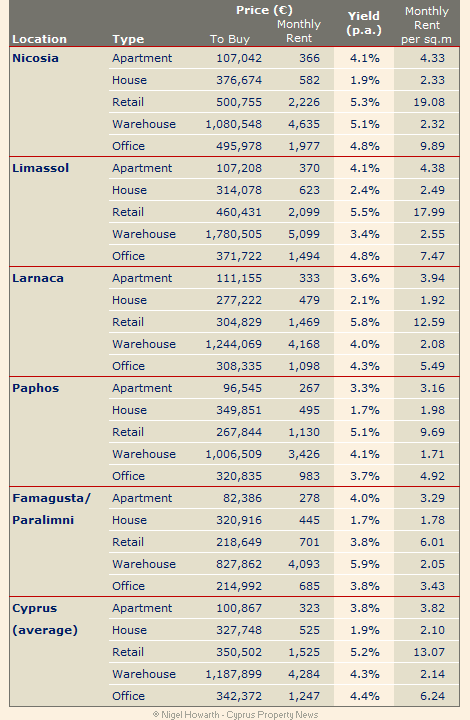
At the end of the second quarter of 2015 average gross yields stood at 3.8% for apartments, 1.9% for houses, 5.2% for retail, 4.3% for warehouses, and 4.4% for offices.

The parallel reduction in capital values and rents is keeping investment yields relatively stable and at low levels (compared to yields overseas). This suggests that there is still room for some re-pricing of capital values to take place, especially for properties in secondary locations.

Commentary

Speaking to Stockwatch, Charalambos Petrides MRICS, said that: “The downward trend in real estate prices continued on an annual basis. It is interesting that in the first and second quarters of 2015 for the municipality of Paphos and Famagusta the drop in prices has stopped thus annual losses have been reduced.

“What is positive in the first quarter of 2015, compared to 2014 and 2013, is the increased marketability, by about 20% annually. It seems that property transactions have rebounded and price reductions restore market activity.

“With regard to real estate prices, the downward trend is expected to continue on an annual basis in 2015 perhaps with smaller losses compared to 2014. In anticipation of developments in the banking sector, particularly as regards to non-performing loans, the strict lending policy market, the high interest rates and the foreclosures, the property market is in a downtrend.

“The legislation on foreclosures that has passed by parliament is a positive development and is expected to have a positive impact on non-performing loans and real estate over the longer term”.


RICS-Index-Q215

Prepared by RICS Cyprus in conjunction with the Cyprus Association of Quantity Surveyors (SEEOKK) and the Cyprus Valuers Association (SEEAK), the quarterly RICS index monitors property prices and rents in all districts using a methodology developed by Reading University in the UK.

Residential property prices

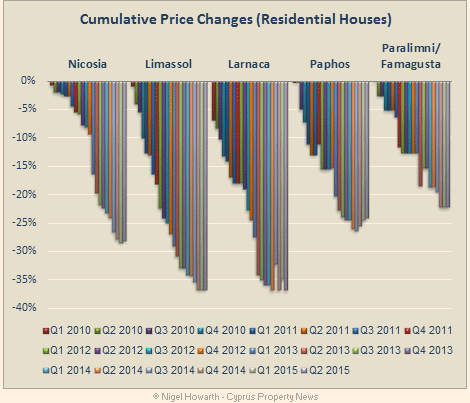
Since the first RICS Cyprus Property Price Index was published for the first quarter of 2010 residential house prices have fallen by an average of 29.7%, while those of apartments have fallen 40.3%.

Cyprus_apartment_price_changes_Q22015


Cyprus_house_price_changes_Q22015

(Note that the RICS Price Index does not include prices of holiday homes and all properties used to construct the index have clean Title Deeds.)

Reduced property transfer fees (update)

Cyprus Property Transfer FeesFURTHER details have emerged of the eagerly anticipated reduction in Property Transfer Fees, which are paid by the purchaser and become payable whenever a property in Cyprus changes hands and are the Cyprus equivalent of the Stamp Duty Land Tax (SDLT) payable in the UK.

The key features of the legislation are as follows:

For transfers that take place before the 31st December 2016:

(a) If VAT was paid on the property, no Property Transfer Fees are payable.

(b) IF VAT was not paid on the property, the Property Transfer Fees are reduced by 50%.

However if the Director of the Land Registry considers that the price stated on the contract of sale does not reflect the market value of the property at its date of purchase he may, at his discretion, charge the full Property Transfer Fees based on the market value of the property at its date of sale less the price stated on the contract of sale.

In addition, where a property is transferred from parent to child, Property Transfer Fees have been abolished.

Those who have or will purchase property between December 2, 2011 and December 31, 2016 will benefit from the reduced Property Transfer Fees regardless of when the transfer takes place. (Article Transfer fee abolition/reduction law published at last! refers.)

The law make no mention of a refund to those who have already paid their Property Transfer Fees.

However, in a statement he made last year, the Interior Minister was reported as saying that there was no point in putting off transferring the deeds as any reduction would have retroactive effect if it is decided and that amounts commensurate with the reduction will be returned to all impacted parties.

Further reading

Consolidated Land Registry Fees Law (Greek)

Consolidated Land Registry Fees Law (English)

Aristo innocent

Theodoros Aristodimou of Aristo Developers innocentTHE FOUNDER of Aristo Developers and former chairman of the Bank of Cyprus, Theodoros Aristodemou, his wife Roulla and the former municipal engineer Savvas Savva have been found innocent of all charges relating to the illegal division of land at Skali.

The decision of the court was announced following a three hour speech by the President of the Paphos Criminal Court.

They charges were in connection with permits that had been granted for 177 land plots in Skali, allegedly falsified later by changing the architectural plans. These changed plans enabled the company to build on 2,750 square metres of land that had been earmarked for green spaces and pavements.

The land had an estimated value of €1.1 million.

In its verdict, the Paphos criminal court cleared the defendants of all charges. These included forgery, circulation of a forged document, conspiracy, abuse of authority, and obtaining property under false pretences.

Reading out the ruling presiding judge Dora Sokratous said the state prosecutors had failed to prove intent to defraud the public beyond a reasonable doubt.

The court concluded that, despite “certain irregularities” in the paperwork and the manner it was compiled, there was no deliberate intent on the part of the accused to secure a town planning permit under false pretences or to conceal the true dimensions of the green area within the land in question.

“We have heard several witnesses testify and analyse situations, and their sincerity was not questioned,” Socratous noted.

“The difficulty in this case lay in the interpretation of the motives behind the recorded facts of the case. The witnesses relayed the events as they understood them.”

The court noted that during the initial police investigation, a deposition by a Paphos municipality technician had pointed to discrepancies in the company’s architectural blueprints as these were submitted to the municipality.

It subsequently emerged during the trial that the police investigators had incorrectly transcribed the numbers cited by the technician.

The technician, Savoulla Kouspou, took the stand for the prosecution. During the end-stage of the trial, the state prosecutor had asked the court to strike her testimony from the record.

The court took note of this: “It cannot be that any witness for the prosecution expressing views that lend credence to the account of the defence should be declared untruthful.”

On the alleged bribery of former municipal engineer Savvas Savva by Aristodemou, the court likewise said this was not proven.

According to police findings, Aristodemou cashed a cheque for €20,000 in €500 notes in August 2010.

Two days later, Savva was found to have deposited the same amount, in notes of identical denomination, to his own bank account.

The court said that although the proximity of the two dates “may create suspicion, it is not sufficient, based on the defendants’ testimony, to lead to a certainty of guilty.”

Savva, who was facing charges of corruption, claimed the money had come from his aunt and uncle.

Speaking to the media later, Aristodemou hailed the decision, saying that justice had been served.

The developer spoke of his trials and tribulations, contending that a conspiracy had been concocted to ruin him, his family and his company.

“We hope that…we are the last victims of such organised endeavours. It is a pity for innocent people to be pilloried and destroyed,” said Aristodemou.

“The injuries that remain, despite today’s ruling, are too great, and I am not sure how these injuries can be healed,” he added.

“All that we ask for is that no more people are victimised through similar persecutions and machinations. This is why, and not for vindictive reasons, that we shall look into moving legally against those who deliberately participated in committing this crime.”

Troika turns up the heat on Title Deeds

Troika turns up the heat on Title DeedsTHE SALE of loans to third parties and the issue of Title Deeds were among the prior actions Cyprus had to take before the next tranche of financial assistance was released, reports said on Wednesday.

According to the Cyprus News Agency (CNA), to receive some €500mln Cyprus must enact legislation allowing the sale or transfer of loans to third parties and approve a bill designed to protect those home buyers who have paid for their properties but have received no Title Deeds.

In January, MPs passed an amendment to the Banking Law (1997 to 2013), inserting a clause by which banks licensed in Cyprus may not sell a loan portfolio to credit institutions – such as hedge funds – operating here but licensed elsewhere.

This was in fear that defaulting mortgages, and in effect large swathes of property, could fall into foreign hands, with political implications.

Enactment of the Title Deeds bill, meanwhile, has been delayed due to the summer holidays, but it is expected to be discussed on September 3 by the House plenum.

The island’s lenders, known as the Troika, are currently carrying out their seventh evaluation of the bailout adjustment programme.

They discussed Cyprus’ progress during a closed-door meeting of the House finance committee.

“The Troika’s position is that the programme has succeeded, it is yielding results, and should continue,” committee chairman and opposition DIKO leader Nicolas Papadopoulos said afterwards. “After many years, Cyprus is looking at the prospect of positive growth.”

Papadopoulos said his party agreed that the programme has achieved some objectives but has failed in others.

One of the failures was the return of living standards to the time before the March 2013 bailout, which saw a seizure of bank deposits for the first time in the history of the Eurozone.

“This goal has not been achieved yet,” he said.

Papadopoulos admitted that Cyprus was in a better position than two years ago, but unemployment remained high, the economy has contracted, and important reforms like the national health scheme were delayed.

“Even worse, we have not managed to date to attract substantial foreign investment due to the uncertainty in relation with Cypriot banks,” he said.

Apart from the NHS, Cyprus must also reform the public sector, and privatise semi-state organisations, an uphill struggle considering fierce opposition of the unions.

Ruling DISY MP Prodromos Prodromou said the important thing was that the conditions were there to have a new path of growth for the economy.

What has been achieved, thanks to the people’s efforts, the correct government policies, but also the vote of opposition parties, was to restore the Cypriot economy’s credibility internationally he said.

“This is the ticket for a new course towards growth,” he said.

AKEL MP Stavros Evagorou, whose party is widely held responsible for the island’s economic woes, said the Troika ignored the fact that the economy was at a standstill.

“According to the Troika, unemployment has stabilised, but they ignore that it has stabilised at 16 per cent,” Evagorou said.

Evagorou said banks did not give loans to businesses or individuals and reiterated his party’s position that austerity was a dead end.

“What the economy needs are state investments and when expenditure is restricted to 30 per cent, growth will not come,” he said.