MP defends hidden mortgages delay

hidden mortgages delay
Green Party MP, Giorgos Perdikis

INTERIOR Minister Socratis Hasikos had a point when he slammed parliament for not passing a government bill designed to protect house buyers without title deeds, but he was not entirely right, an MP said on Saturday.

Green party MP Giorgos Perdikis was commenting on a scathing statement released by the minister on Friday, berating MPs for not passing the bill the previous day, the last parliamentary session before the summer break.

The bill, submitted by the government late in June, was meant to sort out the mess created by the failure to provide title deeds to people who had paid for their properties, either because it was mortgaged by the developer, or the state could not go ahead with the transfer because of outstanding taxes.

“Whom is parliament trying to protect? Trapped buyers of mortgaged real estate, or the banks,” Hasikos said.

Perdikis said he agreed, the legislation should have been passed on Thursday, but one reason it wasn’t was the government dumping a host of other bills on parliament, with a request that they be passed before the break.

The bills, which include tax breaks and other incentives to attract foreign investment, had been announced just days earlier.

“If they had wanted the (title deeds) bill expedited they should have asked,” Perdikis told the Sunday Mail, adding that they had not done so.

Developers’ land and buildings are counted as assets that need to be offset against their debt to banks, giving lenders a claim on people’s properties that had been mortgaged by developers.

Thousands have been left without deeds as a result.

The bill grants the head of the Land Registry department the authority to exempt, eliminate, transfer, and cancel mortgages and or other encumbrances, depending on the case and under certain conditions.

The director will have the power to transfer mortgages to other property belonging to the vendor. If no such property is available, the director can transfer the encumbrances on individuals who guaranteed the seller’s obligations.

Banks, which are expected to take a hit, had expressed opposition to the bill.

Perdikis said the postponement had been decided by the House Finance and Interior Committees during discussion of the matter at the end of June in a bid to give MPs more time to study the matter.

Hasikos had disagreed with the decision and asked parliament to vote on the bill before the break.

MPs voted instead to extend the exemption of such properties until the end of the year. The previous date was July 10.

At first glance there did not appear that anything suspicious was afoot but Perdikis did not rule out attempts in the autumn to accommodate bank objections.

Editor’s comment

The explanation given by Giorgos Perdikis contradicts an earlier report on Tuesday July 7, which said that the House had no time to examine the ‘hidden mortgages’ bill due to the summer vacation. The bill was delayed by a decision of the House Finance Committee (of which Giorgos Perdikis is a member.)

I understand that the Association of Cyprus Banks is claiming that the ‘hidden mortgages’ bill will cost the banks €1 billion.

Cyprus home construction weakens

THE NUMBER of building permits issued in April 2015 stood at 335 compared with the 384 issued in April 2014; a fall of 12.8 per cent, according to the latest figures from the Cyprus Statistical Service.

Compared with April 2014, the total area of these permits fell 22.7% to 44,318 square metres from 57,330, while their value increased 5.8% to €59.9 million from €56.6 million.

During April, building permits were issued for:

  • Residential buildings – 232 permits
  • Non-residential buildings – 57 permits
  • Civil engineering projects – 12 permits
  • Division of plots of land – 32 permits
  • Road construction – 2 permits

During the first four months of 2015 the number of building permits authorised for both residential and non-residential projects has fallen by 2.3% to 1,600 compared with the 1,637 authorised in the same period last year, while their value has risen by 13.2% to €293.7 million.

New home construction

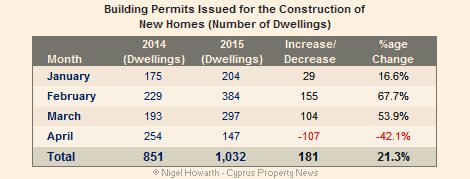
The 232 residential building permits approved in April provided for the construction of 147 new dwellings comprising 93 single dwellings and 54 multiple dwelling units (such as apartments, semis, townhouses and other residential complexes).

This is a fall of 42.1% compared with April 2014 when building permits were issued for the construction of 254 new dwellings.

Cyprus property construction April 2015

According to the Cyprus Statistical Service, building permits constitute a leading indicator of future activity in the construction sector.

MPs slammed over hidden mortgages bill

title-deed-issuesINTERIOR Minister Socratis Hasikos slammed parliament on Friday for shelving a government bill designed to protect house buyers without title deeds, asking whom the lawmakers were trying to protect.

The bill, submitted by the government in June, was meant to sort out the mess created by the failure to provide title deeds to people who paid for the property, either because the property was mortgaged by the developer, or the state could not go ahead with the transfer because of outstanding taxes.

“Whom is parliament trying to protect? Trapped buyers of mortgaged real estate or the banks,” Hasikos said.

On Thursday, parliament apparently decided to kick the can down the road, despite the universal demand by political parties for the government to resolve the problem.

“It is with surprise that we found out that parliament was asking the government for one thing but yesterday it did another,” Hasikos said in a statement.

Instead of putting the bill to the vote, parties chose to suspend foreclosure of such properties until the end of the year.

The reason for this development was not immediately known.

“The bill in question, which would have provided a final solution to the problem, has not been approved yet by parliament and it looks like the discussion is postponed for September or October or being shelved,” Hasikos said.

Developers’ land and buildings are counted as assets that need to be offset against their debt to banks, giving lenders a claim on people’s properties that had been mortgaged by developers.

Thousands have been left without deeds as a result.

The bill grants the head of the Land Registry department the authority to exempt, eliminate, transfer and cancel mortgages and or other encumbrances, depending on the case and under certain conditions.

Under the provisions, for a ‘trapped’ property to be eligible for release, the sale price must have been paid in full by the buyer. In case of an outstanding amount, the buyer can deposit it in an escrow account managed by the land registry director.

The director will have the power to transfer mortgages to other property belonging to the vendor. If no such property is available, the director can transfer the encumbrances on individuals who guaranteed the seller’s obligations.

Banks had expressed opposition to the bill.

They warned that transferring developers’ mortgages onto other properties or guarantors would likely leave the banks wanting for collateral.

For example, lenders would be left exposed where the guarantors did not have commensurate property of their own.

They also questioned how the land registry can determine whether the alternate property is of a similar value to be put up as collateral.

Shelving the bill also prompted the outrage of the Association for the Protection of Primary Residences, which issued a statement saying temporary protection from foreclosure is not a definitive solution.

“This bill gave an immediate and final solution to a distortion that has distressed thousands of people for several years,” the association said.

“During discussion of the bill at [parliamentary] committee level, all political parties supported it, leaving the Banks’ Association the sole dissenter.”

“So what prevented its immediate passing? Was it the usual pressure from the ‘usual suspects’ on political parties and deputies, or were all parties surprised by the paradox of coming to a unanimous decision for the good of the people?”

Property sales increase (Updated)

THE NUMBER of properties sold in Cyprus during June increased 15 per cent compared with June 2014 with sales improving in all districts with the exception of Limassol.

Industry pundits anticipate that the recent announcements by the government to resolve the ‘hidden mortgage’ problem and reduce Property Transfer Fees by 50 per cent will help boost the market. (Further announcements concerning a planning amnesty are anticipated.)

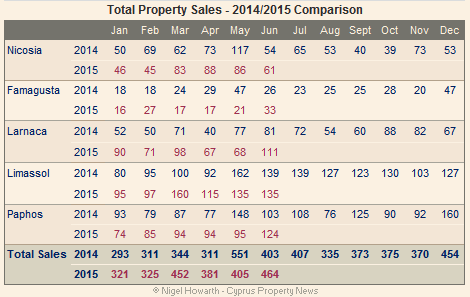
In June a total of 464 contracts for the sale of commercial and residential properties and plots of land were deposited at Land Registry offices across Cyprus, compared with the 403 contracts deposited in June last year.

Of those 464 contracts 72% (333) were deposited on behalf of domestic buyers, while 28% (131) were deposited in favour of overseas buyers.

Although sales fell 3% in Limassol, they increased in all the other districts. Sales in Larnaca rose 37% to reach 111 compared to the 81 sold in June 2014. Sales in Famagusta went up 27%, while those in Paphos & Nicosia increased by 20% and 13% respectively.

Cyprus property sales June 2015

Overall sales during the first half of 2015 are up 6% compared with the first half of last year with sales reaching 2,348 compared to 2,213.

Although sales in Limassol fell in June it remains the most popular place for those buying property, with half-year sales reaching 737. Paphos is in second place with 566 sales, followed by Larnaca (505), Nicosia (409) and finally Famagusta (131).

Domestic sales

Domestic property sales in June rose 9% compared with June 2014, rising to 333 from 305 last year.

Although sales in Limassol fell 8%, they increased in all the other districts.

Following last month’s fall in Famagusta sales in June increased 43% compared to June last year. Sales in Larnaca rose 30%, while those in Nicosia and Paphos rose 16% and 2% respectively.

Cyprus: Domestic property sales June 2015

During the first half of 2015, property sales to the domestic market have increased 6% compared with the same period last year having risen to 1,713 from 1,612.

Overseas sales

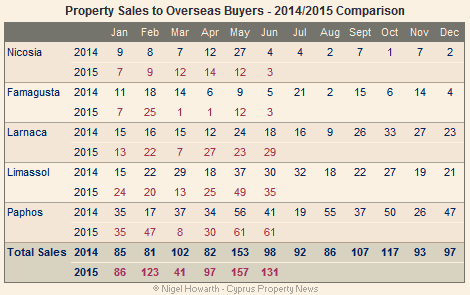
Sales to the overseas market in June rose 6% compared with June 2014.

Although sales in Famagusta and Nicosia fell by 40% and 25% respectively, they increased in the other three districts.

Sales in Larnaca rose 60%, while those in Paphos and Limassol rose 49% and 17% respectively.

Cyprus: Overseas property sales June 2015

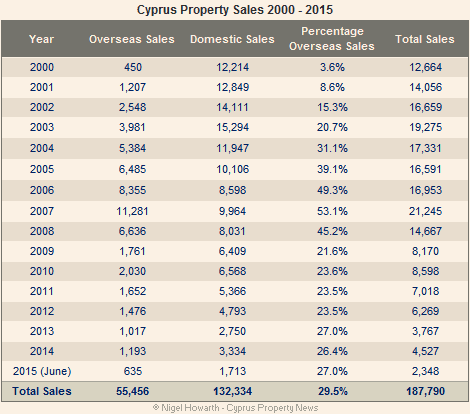
During the first half of 2015, sales to the overseas market have risen 6% compared with the first half 2014, increasing to 635 from last year’s total of 601.

Cyprus property sales 2000 – 2015 summary

Parliament approves casino bill

Cyprus casinoA LAW to regulate the establishment, operation, supervision and control of a casino resort in Cyprus was approved by a majority of Cypriot MPs earlier today.

MPs voted by 29 in favour to 22 against to approve the law, a key part of the government’s plans to stimulate the island’s economy, with most of the no votes coming from opposition Communist party AKEL.

The law approves the establishment of one major casino and four smaller satellite casinos, three of which will be limited to gambling machines. It contains several changes to the original proposed bill; a credit ban on players, it will not be built on government-owned land, Cypriots wishing to gamble will have their tax file checked before being issued with a special licence to play.

We understand that the minimum requirement for the casino resort is 100 gaming tables and 1,000 machines.

Opposition from the Greek Orthodox Church and concerns expressed by many Greek Cypriots about the dangers of gambling have prevented casinos being established in in the past. Six years ago former President Christofias declared that: “There will be no casinos in Cyprus as long as I am President,” adding that “Casinos are expression of corruption and can create a crisis to the system”.

Nicosia is expected to invite expressions of interest from major casino operators from Las Vegas and Asia next month.

The winning bidder for the 30-year license will choose where to build the casino and the government hopes it could be open by 2018 if everything goes smoothly.

Property transfer fees halved

Property transfer fees halvedCYPRIOT MPs voted unanimously to cut Property Transfer Fees by 50 percent as part of a wider tax reform package designed to modernise the island’s property tax system and encourage economic activity in the real estate sector.

The reduced transfer fees will apply to all property sales and registrations of leases or subleases that take place until 31 December 2016.

In addition, the transfer fees payable on transfers of property from parent to child will be abolished together with the fees payable when properties of an equal value are exchanged.

The Cyprus government believes that the reduction in Property Transfer Fees will help to stimulate economic activity in the property sector and reduce the backlog of titles that are waiting to be transferred to the property’s purchaser.

Due to the complexity of the bills to consolidate various property taxes into a single ‘real estate tax’ and set a tax rate of 0.1 percent of a property’s 2013 taxable value, the bill will not be discussed by parliament until September, after MPs return from their summer recess.

We expect the full text of the revised law to be published in the next few days.