Hidden mortgages & tax bills delayed

hidden mortgage bill delayedTHE debate on the Cyprus property tax reform and the ‘hidden mortgages’ bills agreed by the Government has been delayed, according to media reports.

The bill to reform property tax will be referred to the House in September, after the summer recess, due to a delay in its submission by the government.

The Tax Department disagrees with the delay as it needs four months to collect the tax, according to the Taxation Superintendent Yiannakis Lazarou.

The Union of Municipalities and Communities asked for bill to be submitted to the coming House plenary otherwise it will be forced to issue taxes demands based on 1980 prices. The Union also asked to collect the taxes themselves.

The General Manager of the Interior Ministry Costas Nicolaides said that if the Municipalities sent out tax demands based on 1980 values, 30% of immovable property would not be taxed.

We understand that submission of the ‘hidden mortgages’ bill to the House plenary has also been delayed by the House Finance Committee.

However, the bill on reducing Property Transfer Fees 50% by the end of 2016 will be placed before the plenary on Thursday. The bill proposes an extension to the reduction in transfer fees that was introduced in December 2011 until the end of 2016 – and extending the scope of the reductions to transactions agreed before December 2011 and resale property transactions.

The bills are aimed at modernising and reforming Cyprus’ tax framework and provide for the imposition of a single tax rate, the abolition of municipal and community fees, a reduction in Property Transfer Fees by 50% by the end of 2016, the setting of property tax 0.1% and the transfer of responsibility for their setting and collection from the tax department.

Fraudsters target property sellers

Fraudsters target property sellers in CyprusA COMPANY by the name of Prime Property Consortium LLC, which claims to be listed on the Emirates Stock exchange, has contacted a number of people selling their property in Cyprus in efforts to obtain their bank details.

If you receive emails from this company, I suggest you report the issue to the company advertising your property and also the police.

The first email you receive will probably be as follows:

Hello Seller,

how are you doing today? my name Mr. Luz Bayon from Prime Property Consortium LLC, our company is listed on the Emirates Stock exchange and it’s a well known and popular company in the GCC ,we buy , renovate and Sell / Lease properties,

Meanwhile i’ve went to download all the pictures and details about your property , but i need to let you know that i’m purchasing this property for a client who really needed it, we got his friend one property in Monaco ,France last April 2014 ,so the friend introduced him to us ,i’ve sent him all the pictures and the information of the property. Meanwhile can you please tell me the best price and every other fee attached to the property so that i can explain everything to the buyer. A Private notary will contact you about the property later. But most importantly what’s the best price of the Property ?

Thanks for the understanding and looking forwards to hearing from you soon.

Kind Regards
Luz Bayon Engr.
FOR: Prime Consortium
723-343-1391 ( SMS ONLY AT WORKING HOURS )

If you reply to this email you will receive a second email making an offer for the property saying that the company will pay 10 per cent of the price offered into your bank account if you have a contract of sale drawn up.

Eventually, after negotiating the price by email, you will receive an offer for the full asking price and you will receive the name and address of the alleged purchaser. The email will ask you for the full names and address to send the deposit check or the bank name, bank address, account name, account no. IBAN NO. for transfer of the deposit.

Property Consortium LLC has advertisements posted on a number of Internet sites. One advertisement offers employment with travel to the company’s head office in Abu Dhabi (at the company’s expense) to meet the management team. The contact provided is Wilson Churchill – [email protected]

Before doing business with any company or replying to unsolicited emails, ensure you do the necessary due diligence before engaging with the company.

Real estate tax restructuring a must

Cyprus real estate taxEACH and every property in Cyprus is taxed three times: at acquisition, while it is being held and on its sale.

It is a well-known fact that in Cyprus, properties are heavily taxed when they are sold or bought and they draw a negative comparison with what is the norm in other European countries.

It is also well known that the holding property tax was considered reasonable to low up to 2011, but when all taxes and levies were taken together Cyprus properties were burdened with average to high taxes when compared to other member states.

Since changes in the property tax were brought about in 2012, (from €12 million in 2011 to €105 million in 2014), taxes increased sharply placing Cyprus at the top of the list among European countries.

Vital

For the real estate sector to survive and prosper, owning a property for own use or as an investment, must be profitable.

Steep, unpredictable and complex taxes that currently exist in Cyprus make it not worthwhile and troublesome to own a property.

A good number of individuals and professional institutions have been suggesting for quite some time now, that property taxation must be simplified and set at a lower level. In addition, the government must offer incentives to boost sales.

Our suggestions are clear:

  • Reduction of the Capital Gains Tax (CGT) from 20% to 10%
  • The base of the evaluated price for CGT to be set taking into account 1/1/2013 values
  • Raise the ceiling for tax exempt amounts for CGT
  • Waive transfer fees if VAT is payable and adopt a set factor at 3% for all other case (instead of 3%, 5%, 8% in force at present)
  • If a property is sold by an owner who goes ahead and buys another property within a six-month period, the Capital Gains Tax should be waived. This would be helpful to owners who want to move to a smaller or bigger property but are hesitant to do so due to heavy taxes.

In principle, levies such as transfer fees or municipal immovable taxes should be in direct relation to the services offered by the state or municipal authorities.

Our suggestion is for every property to have its own, set ownership tax, irrespective of the owner. We also propose the setting of a ceiling both for the immovable property tax and the sewage fees so that the various authorities do not charge at will.

We applaud the government’s decision to incorporate the state and municipal property taxes. We object to the level of taxation which will be at the 2014 levels. This was a once-off cash injection for the state in 2013 and 2014 and should not continue.

Property transfer fees

We also agree with the reduction of transfer fees proposed and hope to see the legislation tabled soon. The Capital Gains Tax should also be lowered to compensate for the higher ownership tax.

Another injustice must be pointed out. Rent incomes are double-taxed. An income tax as well as a defence levy is imposed. Owners should be liable for either the one or the other.

We believe that our politicians mistakenly consider that anyone owning property is well off and must pay a wealth tax. If such a tax is to be introduced it must be done correctly. All assets should be taken into account not just real estate owned. Bank loans should also be an integral part of the equation.

It is vital to make sure that property tax is in no way related to the wealth tax. This would be a huge stumbling block to growth and will force many individuals to sell their properties. This will deal a deadly blow to the real estate sector, one of the main contributors to the government coffers.

Georgos Mouskides
Chairman Cyprus Association of Property Owners (????)
Director FOX Smart Estate Agency

Immovable Property Tax 2015

immovable property taxASSUMING parliament approves a series of bills aimed at modernising and reforming Cyprus’ tax framework, those who own or who have purchased and taken delivery of property will be asked to pay Immovable Property Tax at the rate of 0.1% on the property’s 2013 taxable value.

Those whose IPT liability is €25 or less will be exempted and those paying early will be receive a discount of 10 per cent.

At the same time the municipal property tax will be abolished and the government will compensate local authorities for the loss in revenue.

As the basis on which IPT is calculated has not been revised for 35 years, some people will receive IPT demands much higher than in previous years. One person commenting on yesterday’s article Tax incentives target rich foreigners has land whose taxable value has been revised from €14,000 in 1980 to €270,000 in 2013 and is facing a tax bill more than 200 per cent higher than last year.

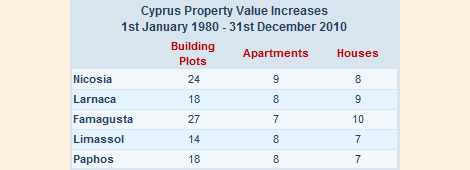
Between January 1980 and December 2010, property values rose considerably:

property-value-increases-1980-2010
Source: Leaf Research

Appealing the Land Registry valuation

Those wishing to appeal the Land Registry valuation have until the end of 2015 to do so by phoning the Land Registry help line on 77777730 and following the instructions.

You will need to have your passport and details of the property handy. The Land Registry officer will check if there has been a mistake in the valuation while you wait.

If they say there is nothing wrong and you then decide to object to the valuation you may file your objection on the relevant form, which you or your representative must submit to the District Land Office in which the property is located with the appropriate fee based on the 2013 valuation of their property:

  • For properties valued up to €100,000, the fee is €37.50.
  • For properties valued between €100,001 and €500,000 the fee is €75.00.
  • For properties valued between €500,001 and €1 million, the fee is €150.00.
  • For properties valued in excess of €1 million, the fee is €357.00.

(Note that you will need Adobe Acrobat to read the relevant form and to display an approximate English translation of each field, float your mouse over the yellow speech bubbles.)

Finding a property’s revised taxable value

Those wishing to find a property’s revised taxable value should follow my guide at Cyprus property valuations now online.

Registering with the Tax Office

Both residents and non-residents who own or who have taken delivery of a property in Cyprus need to register with the Tax Office and should refer to my article Paying Immovable Property Tax 2014, which contains a guide on how to register together with the relevant forms.

Tax incentives may cost €21 million

tax incentivesTHE IMPACT on public revenues of the simplification of property tax announced yesterday by president Nicos Anastasiades is expected to be as high as €21m a year, finance minister Harris Georgiades said.

“The overall reduction of tax revenue from transactions and possession of real property is estimated at €20m to €21m, an amount which is within the limits of public finances, without taking into account the positive impact from an increase in transactions,” Georgiades told reporters today.

The finance minister said that the government already submitted to the parliament a bundle of measures which include tax breaks aiming at stimulating investment, real property transactions as well as attracting high net-worth individuals to Cyprus, all part of an announcement made by Anastasiades at a gathering of Institute of Certified Public Accountants of Cyprus members yesterday. The proposals aim at reforming and modernising the country’s tax framework, the minister said.

Anastasiades said that the government wants to scrap an immovable property tax paid to local authorities, and replace it with a general 0.1 per cent tax on the value of real property.

“We are proposing a series of tax incentives to encourage economic activity and investment,” the finance minister said. “Adjustments are also proposed that make our taxation framework more just, simpler and more effective. In other provisions, several adjustments are included that harmonise our tax framework with (European) directives and decisions of the European Court, self-taxation is supported, and the imposition of taxation on activities in the exclusive economic zone of the Republic of Cyprus is regulated effectively”.

Tax incentives target rich foreigners

Cyprus Property Tax incentivesPRESIDENT Nicos Anastasiades on Wednesday announced tax incentives, including a 50 per cent cut in property transfer fees, to boost economic activity as Cyprus moves to attract rich foreign nationals.

Speaking at the 54th AGM of the Institute of Certified Public Accountants, the president said the cabinet had made decisions that made the island’s tax framework fairer and more competitive, and most importantly, limited the tax burden, offering incentives for economic activity.

“Our clear and explicit goal is to become the first government in the history of the Republic of Cyprus to reduce public debt and reduce the tax burden at the same time,” Anastasiades said.

Heavy taxation cripples people and businesses and suffocate the economy, he added.

The basic reforms include tax breaks to encourage the flow of new capital in businesses, and extension of increased capital allowances on equipment and buildings until the end of 2016.

To attract foreign entrepreneurs and rich individuals, the government plans to introduce the ‘non-domiciled resident’ status.

“The substantive incentive these individuals will gain, provided they opt to be Cyprus tax residents, will be the exemption from the special defence contribution,” the president said.

The administration will also keep in place the tax incentives relating to the revenues of an individual who was not a resident of the island before the start of his employment.

Anastasiades also announced a 50 per cent cut in property transfer fees to “encourage transactions in the real estate sector.”

The government also plans to introduce full exemption from the capital gains tax of any future sale of immovable property acquired between the day the law is enacted and the end of 2016.

“As long as it is bought by December 31, 2016, no capital gains will be paid,” he said, no matter when it is sold.

He referred to the decision to integrate municipal and state immovable property taxes into one, calculated on the 2013 evaluation at a rate of 0.1 per cent.

“I think the tax reform we are proposing makes our tax regime more attractive and confirms the basic political direction of our fiscal policy, through consolidation, rationalisation and proper administration, which prevents the imposition of any new taxes,” he said.

Anastasiades reminded his audience of the situation in Cyprus two years ago when the banking sector was on the brink of collapse and the state was bankrupt.

Two years later, Cyprus was on the way to recovery, he said, but noted that problems still existed.

“There are of course vulnerable groups who are suffering; there is certainly a large number of jobless people,” he said.

“I am certain that we will manage to overcome the problems affecting the people and not only the figures.”